Revision notes for Oxford AQA IGCSE Maths Direct and Inverse Proportion. Open the guide for explanations and worked examples. Written against the Oxford AQA IGCSE Maths (9260) specification, so the content matches what's examinable rather than general Maths background.
Direct and Inverse Proportion
What you'll learn
- How to turn proportionality statements into equations using a constant.
- How to recognise direct and inverse proportion from formulas, graphs, and tables.
- How to handle powers, cubes, and square roots in proportion questions.
- How to avoid the common exam traps when solving for a new value.
The big idea: one quantity changes with another
In proportion questions, two variables are linked by a multiplier. A variable is a letter that can stand for different values, such as xxx, yyy, aaa, or bbb.
The key skill is to replace a sentence like “yyy is directly proportional to xxx” with an equation involving a constant.
Definition
Constant of proportionality
The constant of proportionality is the fixed number that connects two proportional variables. It is usually called kkk.
For example, if yyy is directly proportional to xxx, then y=kxy = kxy=kx.
Key Idea
The proportion method
Almost every proportion question follows the same pattern:
-
Write the proportionality as an equation using kkk.
-
Use the given pair of values to find kkk.
-
Substitute the new value and solve.
Direct proportion
If two quantities are in direct proportion, they increase or decrease together by the same scale factor.
For example, if the number of identical pens doubles, the total cost doubles. If the number of pens triples, the total cost triples.
Definition
Direct proportion
yyy is directly proportional to xxx means:
y=kxy = kxy=kxwhere kkk is a constant.
Worked example: direct proportion
Suppose ppp is directly proportional to qqq.
When p=9p = 9p=9, q=36q = 36q=36.
Find qqq when p=4p = 4p=4.
Example
Finding a missing value in direct proportion
-
Write the direct proportion as an equation.
p=kqp = kqp=kq -
Substitute the given values to find kkk.
9=36k9 = 36k9=36k -
Solve for kkk.
k=936=14k = \frac{9}{36} = \frac{1}{4}k=369=41 -
Use the equation with p=4p = 4p=4.
4=14q4 = \frac{1}{4}q4=41q -
Solve for qqq.
q=16q = 16q=16
Common Mistake
Mixing up the variables
If the question says “ppp is directly proportional to qqq”, write p=kqp = kqp=kq, not q=kpq = kpq=kp. Sometimes both can still be rearranged, but using the wording correctly makes your working much safer.
Inverse proportion
If two quantities are in inverse proportion, one increases while the other decreases in a linked way.
For example, if more identical workers share a job, the time taken might decrease. Doubling one quantity halves the other.
Definition
Inverse proportion
yyy is inversely proportional to xxx means:
y=kxy = \frac{k}{x}y=xkEquivalently, xy=kxy = kxy=k.
Worked example: inverse proportion
Suppose mmm is inversely proportional to nnn.
When m=6m = 6m=6, n=10n = 10n=10.
Find mmm when n=4n = 4n=4.
Example
Finding a missing value in inverse proportion
-
Write the inverse proportion as an equation.
m=knm = \frac{k}{n}m=nk -
Substitute the given values to find kkk.
6=k106 = \frac{k}{10}6=10k -
Solve for kkk.
k=60k = 60k=60 -
Substitute n=4n = 4n=4.
m=604m = \frac{60}{4}m=460 -
Calculate mmm.
m=15m = 15m=15
Tip
A quick check for inverse proportion
For inverse proportion, the product stays constant. In the example above, mn=60m n = 60mn=60 each time.
Proportion with powers and roots
IGCSE questions often go beyond plain xxx. You may see phrases involving squares, cubes, or square roots.
Directly proportional to a power
If yyy is directly proportional to the square of xxx, then:
y=kx2y = kx^2y=kx2If yyy is directly proportional to the cube of xxx, then:
y=kx3y = kx^3y=kx3Inversely proportional to a power
If yyy is inversely proportional to the square of xxx, then:
y=kx2y = \frac{k}{x^2}y=x2kIf yyy is inversely proportional to the cube of xxx, then:
y=kx3y = \frac{k}{x^3}y=x3kProportional to a square root
If yyy is directly proportional to the square root of xxx, then:
y=kxy = k\sqrt{x}y=kxIf yyy is inversely proportional to the square root of xxx, then:
y=kxy = \frac{k}{\sqrt{x}}y=xkCommon Mistake
Forgetting the square, cube, or square root
The phrase “inversely proportional to the cube of xxx” means the cube goes in the denominator: y=kx3y = \frac{k}{x^3}y=x3k. It does not mean y=k3xy = \frac{k^3}{x}y=xk3.
Worked example: square root proportion
Suppose rrr is directly proportional to the square root of sss.
When r=20r = 20r=20, s=25s = 25s=25.
Find sss when r=8r = 8r=8.
Example
Direct proportion with a square root
-
Write the equation.
r=ksr = k\sqrt{s}r=ks -
Substitute the given values.
20=k2520 = k\sqrt{25}20=k25 -
Since 25=5\sqrt{25} = 525=5, find kkk.
20=5k⇒k=420 = 5k \Rightarrow k = 420=5k⇒k=4 -
Substitute r=8r = 8r=8.
8=4s8 = 4\sqrt{s}8=4s -
Divide by 4, then square both sides.
s=2⇒s=4\sqrt{s} = 2 \Rightarrow s = 4s=2⇒s=4
Worked example: inverse cube proportion
Suppose yyy is inversely proportional to the cube of xxx.
When y=160y = 160y=160, x=0.5x = 0.5x=0.5.
Find yyy when x=2x = 2x=2.
Example
Inverse proportion with a cube
-
Write the equation.
y=kx3y = \frac{k}{x^3}y=x3k -
Substitute the given values.
160=k0.53160 = \frac{k}{0.5^3}160=0.53k -
Calculate 0.530.5^30.53, then find kkk.
160=k0.125⇒k=20160 = \frac{k}{0.125} \Rightarrow k = 20160=0.125k⇒k=20 -
Substitute x=2x = 2x=2.
y=2023y = \frac{20}{2^3}y=2320 -
Calculate the final value.
y=208=2.5y = \frac{20}{8} = 2.5y=820=2.5
Recognising proportion graphs
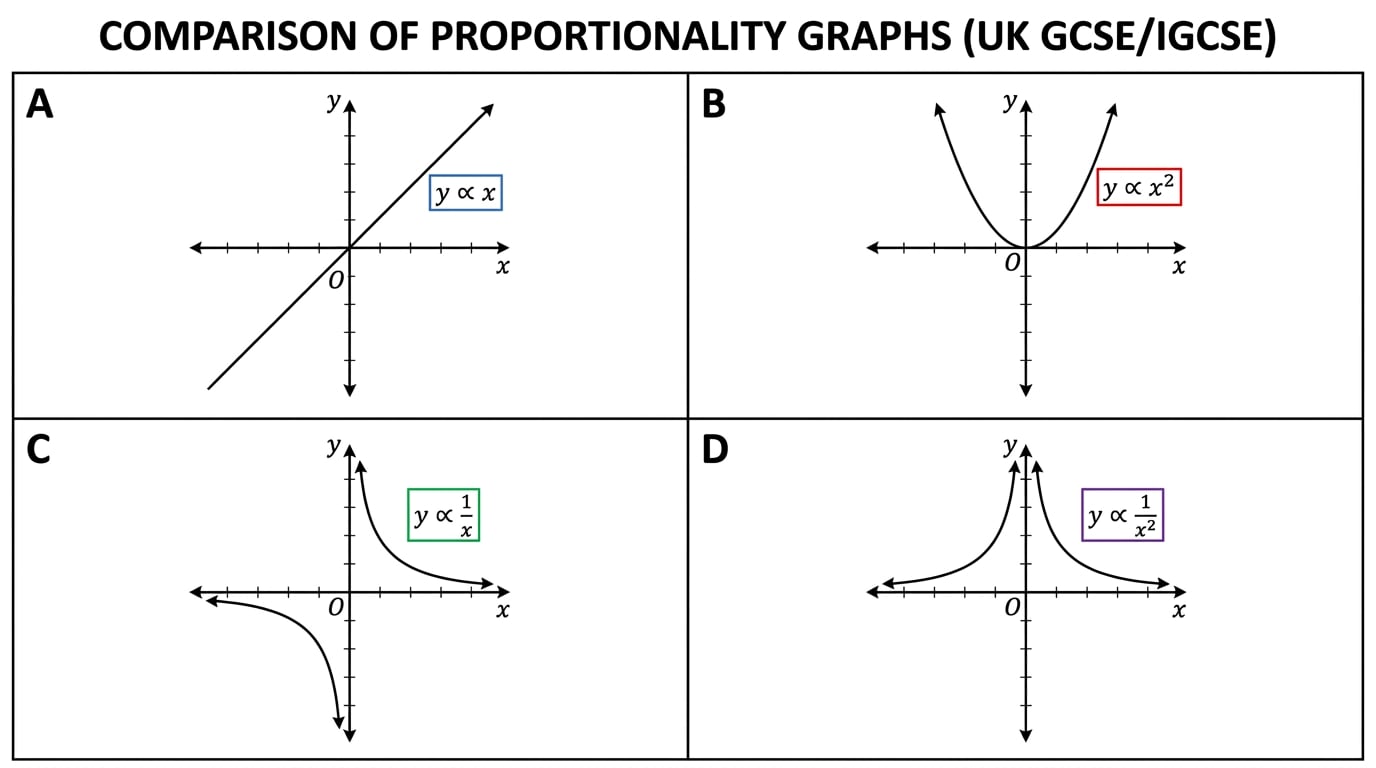
The graph shape can tell you the type of proportion.
- y∝xy \propto xy∝x gives a straight line through the origin.
- y∝x2y \propto x^2y∝x2 gives a U-shaped parabola with its vertex at the origin.
- y∝1xy \propto \frac{1}{x}y∝x1 gives a reciprocal curve in the first and third quadrants.
- y∝1x2y \propto \frac{1}{x^2}y∝x21 gives two positive branches, symmetric about the yyy-axis.
Example
Matching a graph to a proportionality statement
A graph is a straight line passing through the origin with positive gradient. Decide which statement it represents.
-
A straight line suggests a linear relationship.
-
Passing through the origin is the key sign of direct proportion.
-
So the correct statement is:
y∝xy \propto xy∝x
Common Mistake
Not every straight line is direct proportion
A straight line only represents y∝xy \propto xy∝x if it passes through the origin. A line such as y=2x+3y = 2x + 3y=2x+3 is linear, but not directly proportional to xxx.
Using tables to identify the relationship
Sometimes you are given two pairs of values and asked whether yyy is proportional to xxx, x2x^2x2, or x3x^3x3.
The method is to test which ratio stays constant:
- For y∝xy \propto xy∝x, check whether yx\frac{y}{x}xy is constant.
- For y∝x2y \propto x^2y∝x2, check whether yx2\frac{y}{x^2}x2y is constant.
- For y∝x3y \propto x^3y∝x3, check whether yx3\frac{y}{x^3}x3y is constant.
Worked example: choosing the right power
For two values of xxx, the matching values of yyy are:
- When x=2x = 2x=2, y=24y = 24y=24.
- When x=3x = 3x=3, y=81y = 81y=81.
Decide whether y∝xy \propto xy∝x, y∝x2y \propto x^2y∝x2, or y∝x3y \propto x^3y∝x3, then write a formula for yyy.
Example
Testing ratios from a table
-
Test y∝xy \propto xy∝x by comparing yx\frac{y}{x}xy.
242=12,813=27\frac{24}{2} = 12,\qquad \frac{81}{3} = 27224=12,381=27 -
The ratios are not equal, so it is not y∝xy \propto xy∝x.
-
Test y∝x2y \propto x^2y∝x2 by comparing yx2\frac{y}{x^2}x2y.
2422=6,8132=9\frac{24}{2^2} = 6,\qquad \frac{81}{3^2} = 92224=6,3281=9 -
The ratios are not equal, so it is not y∝x2y \propto x^2y∝x2.
-
Test y∝x3y \propto x^3y∝x3 by comparing yx3\frac{y}{x^3}x3y.
2423=3,8133=3\frac{24}{2^3} = 3,\qquad \frac{81}{3^3} = 32324=3,3381=3 -
The constant is 3, so the formula is:
y=3x3y = 3x^3y=3x3
Tip
Table strategy
If the xxx values are small, testing xxx, then x2x^2x2, then x3x^3x3 is usually faster than trying to guess the formula.
Rearranging when the missing value is inside a power
Sometimes the final value you need is the variable being squared, cubed, or square-rooted. Do not panic: solve the equation carefully.
Worked example: direct cube proportion
Suppose aaa is directly proportional to the cube of bbb.
When a=54a = 54a=54, b=3b = 3b=3.
Find bbb when a=16a = 16a=16.
Example
Solving for a variable inside a cube
-
Write the equation.
a=kb3a = kb^3a=kb3 -
Use the first pair of values to find kkk.
54=k×3354 = k \times 3^354=k×33 -
Since 33=273^3 = 2733=27, calculate kkk.
54=27k⇒k=254 = 27k \Rightarrow k = 254=27k⇒k=2 -
Substitute a=16a = 16a=16.
16=2b316 = 2b^316=2b3 -
Divide by 2, then cube-root.
b3=8⇒b=2b^3 = 8 \Rightarrow b = 2b3=8⇒b=2
Exam technique
In the exam
-
Start by writing the correct formula with kkk before substituting any numbers.
-
Use the first pair of values only to find kkk, then use your formula again for the new value.
-
Check the direction: in direct proportion, bigger input usually gives bigger output; in inverse proportion, bigger input usually gives smaller output.
Self review
Check yourself
-
If yyy is inversely proportional to x2x^2x2, what equation should you write first?
-
How can you tell from a graph that yyy is directly proportional to xxx?
-
In a table question, what ratio would you test for y∝x3y \propto x^3y∝x3?

Recap questions
Test yourself with 5 quick questions on this guide. Answer them all correctly to complete it.
You've reached the end
Test yourself on this topic, or move on to the next guide.
How was this guide?