Revision notes for Oxford AQA IGCSE Maths Speed and Density. Open the guide for explanations and worked examples. Written against the Oxford AQA IGCSE Maths (9260) specification, so the content matches what's examinable rather than general Maths background.
Speed and Density
What you'll learn
- How to use the formulas for average speed, density and pressure.
- How to rearrange formulas to find a missing quantity.
- How to convert mixed times like 4 hours 15 minutes correctly.
- How to tackle whole-journey and liquid-mixture questions.
1. Compound measures: “per” means divide
Speed, density and pressure are all examples of compound measures. They compare two different quantities.
For example, miles per hour means “miles in 1 hour”, and grams per cm³ means “grams in 1 cm³”.
Definition
Compound measure
A compound measure is a measurement made from two other measurements, usually involving division. The word per often means “for each” or “divided by”.
The three key formulas are:
average speed=distancetimedensity=massvolumepressure=forcearea\begin{aligned} \text{average speed} &= \frac{\text{distance}}{\text{time}}\\ \text{density} &= \frac{\text{mass}}{\text{volume}}\\ \text{pressure} &= \frac{\text{force}}{\text{area}} \end{aligned}average speeddensitypressure=timedistance=volumemass=areaforceExample
Finding pressure from force and area
A crate pushes down with a force of 96 N. The area touching the floor is 3 m². Find the pressure.
-
Choose the pressure formula.
pressure=forcearea\text{pressure} = \frac{\text{force}}{\text{area}}pressure=areaforce -
Substitute the values.
pressure=963=32\text{pressure} = \frac{96}{3} = 32pressure=396=32 -
The pressure is 32 N/m².
Tip
Units tell you the formula
If the answer unit is something like m/s, g/cm³ or N/m², it is usually a “divide” formula: first quantity divided by second quantity.
2. Average speed
Definition
Average speed
Average speed is the total distance divided by the total time. It does not mean the object travelled at exactly that speed for the whole journey.
The formula is:
average speed=total distancetotal time\text{average speed} = \frac{\text{total distance}}{\text{total time}}average speed=total timetotal distanceYou can also rearrange it:
distance=speed×timetime=distancespeed\begin{aligned} \text{distance} &= \text{speed} \times \text{time}\\ \text{time} &= \frac{\text{distance}}{\text{speed}} \end{aligned}distancetime=speed×time=speeddistanceBasic speed questions
Example
Finding an average speed
A runner completes 160 metres in 20 seconds. Find the runner’s average speed.
-
Use the formula for average speed.
average speed=distancetime\text{average speed} = \frac{\text{distance}}{\text{time}}average speed=timedistance -
Substitute distance 160 metres and time 20 seconds.
average speed=16020=8\text{average speed} = \frac{160}{20} = 8average speed=20160=8 -
The average speed is 8 m/s.
Converting time
This is where many marks are lost. If speed is in mph, the time must be in hours. If speed is in m/s, the time must be in seconds.
For example, 4 hours 15 minutes is not 4.15 hours. Since 15 minutes is a quarter of an hour, it is 4.25 hours.
Common Mistake
Using minutes as decimals
Do not write 3 hours 30 minutes as 3.30 hours. It is 3.5 hours, because 30 minutes is half an hour.
Example
Speed in miles per hour
A car travels 250 miles in 4 hours 30 minutes. Work out its average speed in mph, giving your answer to 1 decimal place.
-
Convert the time into hours.
4 hours 30 minutes=4.5 hours4\text{ hours }30\text{ minutes} = 4.5\text{ hours}4 hours 30 minutes=4.5 hours -
Use average speed equals distance divided by time.
average speed=2504.5=55.555…\text{average speed} = \frac{250}{4.5} = 55.555\ldotsaverage speed=4.5250=55.555… -
Round to 1 decimal place: 55.6 mph.
Finding a time of arrival
When you are given distance and speed, first find the journey time, then add it to the starting time.
Example
Finding an arrival time
Nadia leaves home at 08:10. She drives 63 miles at an average speed of 28 mph. Find her arrival time.
-
Use the time formula.
time=distancespeed\text{time} = \frac{\text{distance}}{\text{speed}}time=speeddistance -
Substitute the values.
time=6328=2.25 hours\text{time} = \frac{63}{28} = 2.25\text{ hours}time=2863=2.25 hours -
Convert 2.25 hours into hours and minutes: 2 hours 15 minutes.
-
Add 2 hours 15 minutes to 08:10.
-
Nadia arrives at 10:25.
3. Average speed over a whole journey
For a whole journey, always use:
average speed for whole journey=total distancetotal time\text{average speed for whole journey} = \frac{\text{total distance}}{\text{total time}}average speed for whole journey=total timetotal distanceDo not just average the separate speeds unless the times are the same and the question genuinely allows it.
Common Mistake
Averaging the speeds
If one part of a journey is at 60 mph and another part is at 40 mph, the whole journey speed is not automatically 50 mph. Use total distance divided by total time.
Example
A journey in two parts
Mina drives 310 miles. She drives the first 150 miles at 60 mph. The rest of the journey takes 3 hours 20 minutes. Find her average speed for the whole journey.
-
Find the time for the first part.
time=15060=2.5 hours\text{time} = \frac{150}{60} = 2.5\text{ hours}time=60150=2.5 hours -
Convert the second time into hours.
3 hours 20 minutes=3+2060=3.333… hours3\text{ hours }20\text{ minutes} = 3 + \frac{20}{60} = 3.333\ldots\text{ hours}3 hours 20 minutes=3+6020=3.333… hours -
Add the times.
total time=2.5+3.333…=5.833… hours\text{total time} = 2.5 + 3.333\ldots = 5.833\ldots\text{ hours}total time=2.5+3.333…=5.833… hours -
Divide total distance by total time.
average speed=3105.833…=53.142…\text{average speed} = \frac{310}{5.833\ldots} = 53.142\ldotsaverage speed=5.833…310=53.142… -
The average speed is about 53.1 mph.
Tip
Same journey means same distance
If you use one person’s speed and time to find a distance, you are assuming another person travelled the same distance. If they took a different route, the distance might be different.
Assuming the same speed
Some questions ask you to assume someone keeps the same speed for a longer distance. This is a proportional reasoning question: if the speed stays constant, time and distance increase in the same ratio.
Example
Running further at the same speed
Elliot runs 3.2 miles in 15 minutes 20 seconds. Assuming he keeps the same speed, estimate how long it would take him to run 8 miles.
-
Convert 15 minutes 20 seconds into seconds.
15×60+20=920 seconds15 \times 60 + 20 = 920\text{ seconds}15×60+20=920 seconds -
Find the time for 1 mile.
9203.2=287.5 seconds per mile\frac{920}{3.2} = 287.5\text{ seconds per mile}3.2920=287.5 seconds per mile -
Multiply by 8 miles.
287.5×8=2300 seconds287.5 \times 8 = 2300\text{ seconds}287.5×8=2300 seconds -
Convert 2300 seconds into minutes and seconds: 38 minutes 20 seconds.
Common Mistake
Real-life speed changes
If a runner slows down as the distance increases, the calculated time using the same speed will be too small. The real time would be longer.
4. Density
Definition
Density
Density is mass per unit volume. It tells you how much mass is packed into each 1 cm³ or each 1 ml.
The main formula is:
density=massvolume\text{density} = \frac{\text{mass}}{\text{volume}}density=volumemassRearranged forms:
mass=density×volumevolume=massdensity\begin{aligned} \text{mass} &= \text{density} \times \text{volume}\\ \text{volume} &= \frac{\text{mass}}{\text{density}} \end{aligned}massvolume=density×volume=densitymassFinding density
Example
Density of a solid
A piece of metal has mass 540 g and volume 30 cm³. Find its density.
-
Use density equals mass divided by volume.
density=massvolume\text{density} = \frac{\text{mass}}{\text{volume}}density=volumemass -
Substitute the values.
density=54030=18\text{density} = \frac{540}{30} = 18density=30540=18 -
The density is 18 g/cm³.
Finding mass or volume
Example
Finding volume from mass and density
A stone has mass 72 g and density 4.5 g/cm³. Find its volume.
-
Use the rearranged formula for volume.
volume=massdensity\text{volume} = \frac{\text{mass}}{\text{density}}volume=densitymass -
Substitute the values.
volume=724.5=16\text{volume} = \frac{72}{4.5} = 16volume=4.572=16 -
The volume is 16 cm³.
Example
Finding mass of a liquid
A liquid has density 1.2 g/ml. Find the mass of 300 ml of the liquid.
-
Use mass equals density multiplied by volume.
mass=density×volume\text{mass} = \text{density} \times \text{volume}mass=density×volume -
Substitute the values.
mass=1.2×300=360\text{mass} = 1.2 \times 300 = 360mass=1.2×300=360 -
The mass is 360 g.
5. Mixtures and density
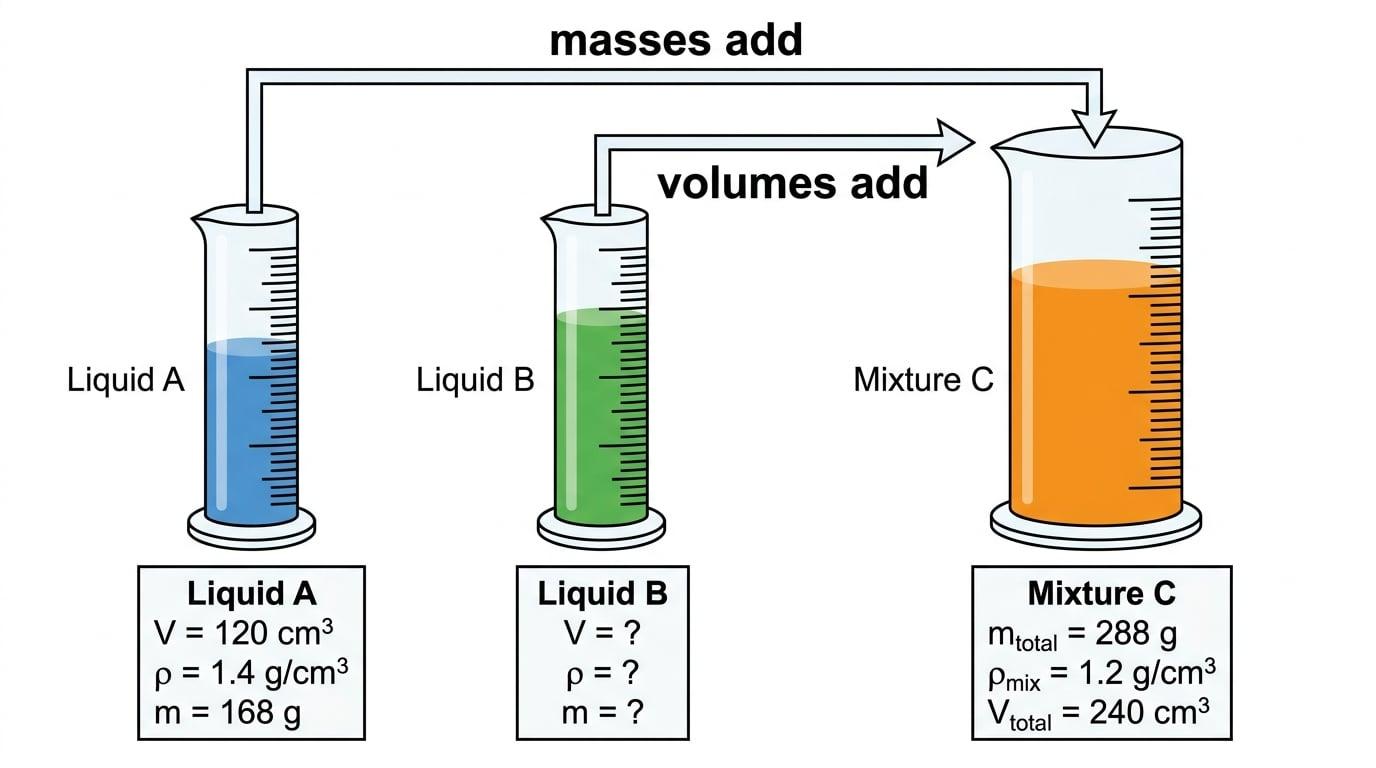
When liquids are mixed, track mass and volume separately. The masses add together, and the volumes add together, then you calculate the final density.
Key Idea
Mixture method
For mixtures, do not combine densities directly. First find total mass and total volume, then use density equals total mass divided by total volume.
Common Mistake
Adding densities
You cannot add densities like 0.8 g/ml plus 1.2 g/ml to get the density of the mixture. Density depends on both mass and volume.
Example
Finding the density of an unknown liquid in a mixture
Liquid A has density 1.4 g/cm³ and volume 120 cm³. It is mixed with some Liquid B. The final mixture has mass 288 g and density 1.2 g/cm³. Find the density of Liquid B.
-
Find the mass of Liquid A.
mass of A=1.4×120=168\text{mass of A} = 1.4 \times 120 = 168mass of A=1.4×120=168 -
Find the total volume of the final mixture.
volume of mixture=2881.2=240\text{volume of mixture} = \frac{288}{1.2} = 240volume of mixture=1.2288=240 -
Liquid B has volume 240 - 120 = 120 cm³.
-
Liquid B has mass 288 - 168 = 120 g.
-
Find the density of Liquid B.
density of B=120120=1\text{density of B} = \frac{120}{120} = 1density of B=120120=1 -
The density of Liquid B is 1 g/cm³.
Example
Finding the density of a final mixture
150 ml of Liquid X has density 0.8 g/ml. 250 ml of Liquid Y has density 1.2 g/ml. They are mixed together. Find the density of the mixture.
-
Find the mass of Liquid X.
0.8×150=1200.8 \times 150 = 1200.8×150=120 -
Find the mass of Liquid Y.
1.2×250=3001.2 \times 250 = 3001.2×250=300 -
Add the masses and volumes.
total mass=120+300=420total volume=150+250=400\begin{aligned} \text{total mass} &= 120 + 300 = 420\\ \text{total volume} &= 150 + 250 = 400 \end{aligned}total masstotal volume=120+300=420=150+250=400 -
Find the density of the mixture.
density=420400=1.05\text{density} = \frac{420}{400} = 1.05density=400420=1.05 -
The density of the mixture is 1.05 g/ml.
Exam technique
In the exam
-
Write the correct formula first, then identify which quantity is missing.
-
Convert time before substituting: use hours for mph and seconds for m/s.
-
For whole journeys and mixtures, use totals: total distance divided by total time, or total mass divided by total volume.
-
Keep units in your final answer, and round only at the end unless the question tells you otherwise.
Self review
Check yourself
-
If a speed is given in mph, what unit should the time be in?
-
How do you find volume when you know mass and density?
-
In a mixture question, why should you calculate total mass and total volume before finding density?

Recap questions
Test yourself with 5 quick questions on this guide. Answer them all correctly to complete it.
You've reached the end
Test yourself on this topic, or move on to the next guide.
How was this guide?