Revision notes for Oxford AQA IGCSE Maths Changing the Subject of a Formula. Open the guide for explanations and worked examples. Written against the Oxford AQA IGCSE Maths (9260) specification, so the content matches what's examinable rather than general Maths background.
Changing the Subject of a Formula
What you'll learn
- What it means to make a letter the subject of a formula.
- How to use inverse operations to rearrange formulae safely.
- How to deal with brackets, fractions, squares, cubes and square roots.
- How to avoid the most common sign and order mistakes in exam questions.
Formulae, variables and subjects
A formula is an equation that connects two or more quantities. A variable is a letter that stands for a number, such as xxx, ttt, aaa or bbb.
Definition
Subject of a formula
The subject of a formula is the variable written on its own, usually on the left-hand side.
For example, in y=3x+4y = 3x + 4y=3x+4, the subject is yyy.
When a question says “make xxx the subject”, your final answer should look like:
x=somethingx = \text{something}x=somethingThe goal is to isolate the required letter.
Example
Making a letter the subject in a simple linear formula
Make rrr the subject of w=7r−9w = 7r - 9w=7r−9.
-
Identify the subject you want: rrr. At the moment, rrr has been multiplied by 7 and then 9 has been subtracted.
-
Undo subtracting 9 by adding 9 to both sides.
w+9=7rw + 9 = 7rw+9=7r -
Undo multiplying by 7 by dividing both sides by 7.
w+97=r\frac{w + 9}{7} = r7w+9=r -
Write the final answer with rrr on the left.
r=w+97r = \frac{w + 9}{7}r=7w+9
Key Idea
Keep the equation balanced
Whatever you do to one side of an equation, you must do to the other side. This keeps the equation true.
Inverse operations: undoing the formula
An inverse operation is an operation that undoes another operation.
Definition
Inverse operations
- Addition and subtraction are inverse operations.
- Multiplication and division are inverse operations.
- Squaring and square rooting are inverse operations.
- Cubing and cube rooting are inverse operations.
When rearranging, think of the formula as a machine. To get back to the original variable, reverse the operations in the opposite order.
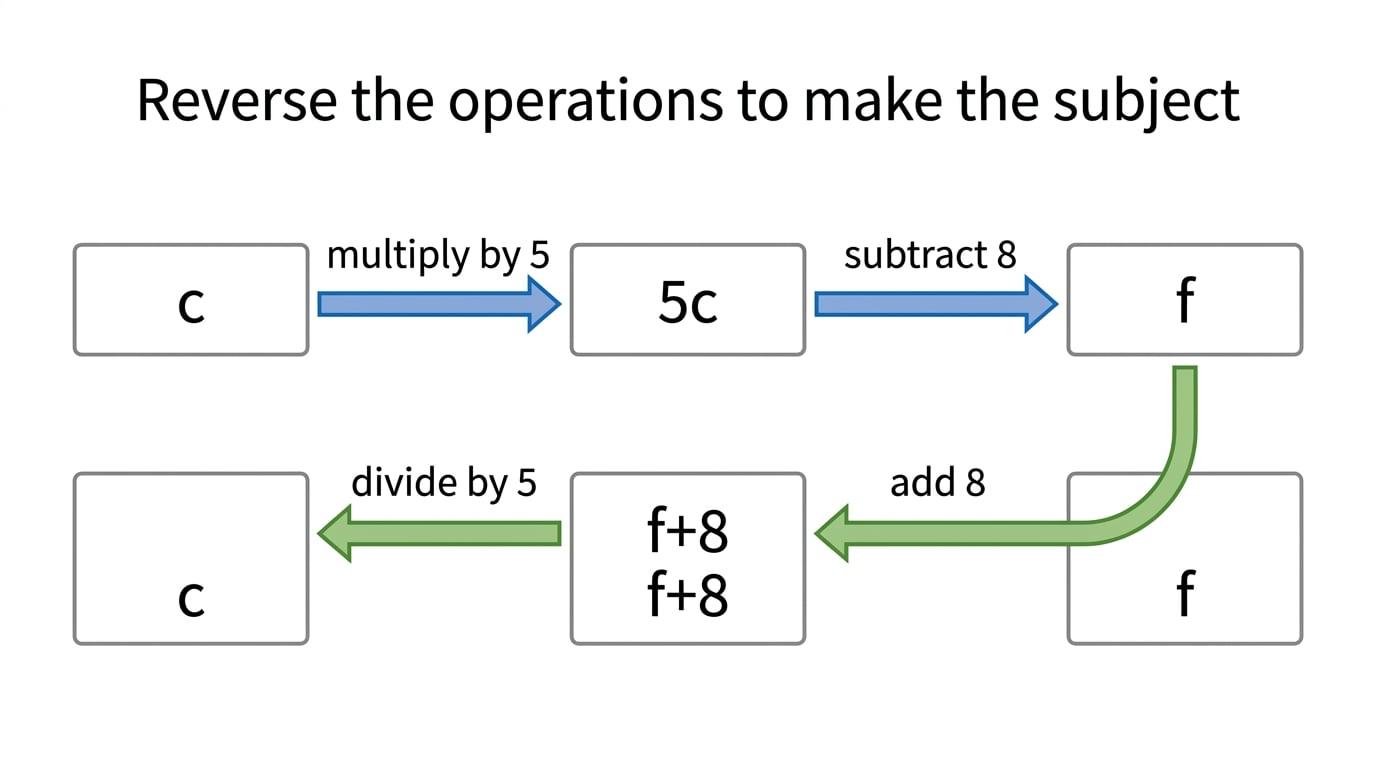
Example
Undoing operations in reverse order
Make ppp the subject of z=4p+13z = 4p + 13z=4p+13.
-
Focus on what has happened to ppp: it was multiplied by 4, then 13 was added.
-
Reverse the last operation first. Subtract 13 from both sides.
z−13=4pz - 13 = 4pz−13=4p -
Now reverse multiplying by 4. Divide both sides by 4.
z−134=p\frac{z - 13}{4} = p4z−13=p -
Write the answer neatly.
p=z−134p = \frac{z - 13}{4}p=4z−13
Common Mistake
Undoing in the wrong order
If z=4p+13z = 4p + 13z=4p+13, do not divide by 4 first. The whole right-hand side is not 4(p+13)4(p + 13)4(p+13); only ppp is multiplied by 4.
Rearranging when there is more than one term
A term is a part of an expression separated by plus or minus signs. For example, in 5a+2b5a + 2b5a+2b, the terms are 5a5a5a and 2b2b2b.
If the variable you want is part of one term, move the other terms away first.
Example
Making one variable the subject when another variable is present
Make aaa the subject of Q=6a+6bQ = 6a + 6bQ=6a+6b.
-
The term containing aaa is 6a6a6a. Move the other term, 6b6b6b, away first.
-
Subtract 6b6b6b from both sides.
Q−6b=6aQ - 6b = 6aQ−6b=6a -
Divide both sides by 6.
Q−6b6=a\frac{Q - 6b}{6} = a6Q−6b=a -
Write the final answer.
a=Q−6b6a = \frac{Q - 6b}{6}a=6Q−6b
Tip
Factor if it makes the answer cleaner
In Q=6a+6bQ = 6a + 6bQ=6a+6b, you could also write Q=6(a+b)Q = 6(a + b)Q=6(a+b). Then divide by 6 first and subtract bbb. Both methods give a=Q6−ba = \frac{Q}{6} - ba=6Q−b.
Brackets: divide first, then remove the bracket
If the variable is inside brackets, first undo anything happening to the whole bracket.
Example
Variable inside brackets
Make hhh the subject of x=5(h−2)x = 5(h - 2)x=5(h−2).
-
The whole bracket h−2h - 2h−2 is multiplied by 5, so undo that first.
x5=h−2\frac{x}{5} = h - 25x=h−2 -
Now undo subtracting 2 by adding 2 to both sides.
x5+2=h\frac{x}{5} + 2 = h5x+2=h -
Write the final answer with hhh on the left.
h=x5+2h = \frac{x}{5} + 2h=5x+2
Common Mistake
Only dividing one term
From x=5(h−2)x = 5(h - 2)x=5(h−2), do not write x=5h−2x = 5h - 2x=5h−2. The 5 multiplies everything inside the bracket, so 5(h−2)=5h−105(h - 2) = 5h - 105(h−2)=5h−10.
Fractions: clear the denominator
The denominator is the bottom number or expression in a fraction. To remove a denominator, multiply both sides by it.
Example
Variable in the numerator of a fraction
Make xxx the subject of y=3x−15y = \frac{3x - 1}{5}y=53x−1.
-
The expression 3x−13x - 13x−1 is divided by 5, so multiply both sides by 5.
5y=3x−15y = 3x - 15y=3x−1 -
Add 1 to both sides.
5y+1=3x5y + 1 = 3x5y+1=3x -
Divide both sides by 3.
5y+13=x\frac{5y + 1}{3} = x35y+1=x -
Write the final answer.
x=5y+13x = \frac{5y + 1}{3}x=35y+1
Example
Variable in the denominator
Make rrr the subject of k=m+4rk = \frac{m + 4}{r}k=rm+4.
-
Multiply both sides by rrr to remove the denominator.
kr=m+4kr = m + 4kr=m+4 -
Divide both sides by kkk.
r=m+4kr = \frac{m + 4}{k}r=km+4
Common Mistake
Dividing by zero
A denominator cannot be zero. For example, in k=m+4rk = \frac{m + 4}{r}k=rm+4, the formula only makes sense when r≠0r \neq 0r=0.
Fractions with coefficients
A coefficient is the number multiplying a variable. In 23x\frac{2}{3}x32x, the coefficient of xxx is 23\frac{2}{3}32.
To undo multiplying by a fraction, multiply by its reciprocal. The reciprocal of 23\frac{2}{3}32 is 32\frac{3}{2}23.
Example
Rearranging when the coefficient is a fraction
Make xxx the subject of y=34x−8y = \frac{3}{4}x - 8y=43x−8.
-
Add 8 to both sides to isolate the term containing xxx.
y+8=34xy + 8 = \frac{3}{4}xy+8=43x -
Multiply both sides by the reciprocal of 34\frac{3}{4}43, which is 43\frac{4}{3}34.
43(y+8)=x\frac{4}{3}(y + 8) = x34(y+8)=x -
Write the answer with xxx on the left.
x=4(y+8)3x = \frac{4(y + 8)}{3}x=34(y+8)
Tip
Keep brackets when multiplying a whole expression
If you multiply y+8y + 8y+8 by 43\frac{4}{3}34, use brackets: 43(y+8)\frac{4}{3}(y + 8)34(y+8). This shows the whole expression is being multiplied.
Squares, cubes and roots
A square root undoes squaring. A cube root undoes cubing.
Example
Making a variable the subject when it is squared
Make nnn the subject of s=n2+10s = n^2 + 10s=n2+10.
-
Subtract 10 from both sides.
s−10=n2s - 10 = n^2s−10=n2 -
Square root both sides. Because both positive and negative numbers can square to the same value, include ±\pm± unless the context says the variable is positive.
n=±s−10n = \pm\sqrt{s - 10}n=±s−10
Example
Making a variable the subject when it is cubed
Make xxx the subject of y=x3−6y = x^3 - 6y=x3−6.
-
Add 6 to both sides.
y+6=x3y + 6 = x^3y+6=x3 -
Cube root both sides.
x=y+63x = \sqrt[3]{y + 6}x=3y+6
Common Mistake
Squares and square roots
If n2=25n^2 = 25n2=25, then n=5n = 5n=5 or n=−5n = -5n=−5. That is why ±\pm± is needed unless the question gives a reason to choose only the positive value.
Square roots with fractions inside
If a formula has a square root, undo the square root first by squaring both sides.
Example
Square root with a fraction inside
Make qqq the subject of g=q+47g = \sqrt{\frac{q + 4}{7}}g=7q+4.
-
Square both sides to remove the square root.
g2=q+47g^2 = \frac{q + 4}{7}g2=7q+4 -
Multiply both sides by 7.
7g2=q+47g^2 = q + 47g2=q+4 -
Subtract 4 from both sides.
7g2−4=q7g^2 - 4 = q7g2−4=q -
Write the final answer.
q=7g2−4q = 7g^2 - 4q=7g2−4
Example
Square root with the required variable inside
Make hhh the subject of D=5h3D = \sqrt{\frac{5h}{3}}D=35h.
-
Square both sides.
D2=5h3D^2 = \frac{5h}{3}D2=35h -
Multiply both sides by 3.
3D2=5h3D^2 = 5h3D2=5h -
Divide both sides by 5.
h=3D25h = \frac{3D^2}{5}h=53D2
Formulae that look more like science
Some rearranging questions use formulae from mechanics or physics. The algebra is exactly the same.
Example
Making the acceleration-style variable the subject
Make aaa the subject of V=U+aTV = U + aTV=U+aT.
-
Subtract UUU from both sides.
V−U=aTV - U = aTV−U=aT -
Divide both sides by TTT.
V−UT=a\frac{V - U}{T} = aTV−U=a -
Write the final answer.
a=V−UTa = \frac{V - U}{T}a=TV−U
Example
Making a variable the subject in a squared formula
Make kkk the subject of A2=B2+6kLA^2 = B^2 + 6kLA2=B2+6kL.
-
Subtract B2B^2B2 from both sides.
A2−B2=6kLA^2 - B^2 = 6kLA2−B2=6kL -
Divide both sides by 6L6L6L.
k=A2−B26Lk = \frac{A^2 - B^2}{6L}k=6LA2−B2
Exam technique
In the exam
-
Circle the variable you are making the subject, then work out what operations are attached to it.
-
Undo operations in reverse order, writing one clear algebra line for each move.
-
Keep brackets around expressions like y+8y + 8y+8 when the whole expression is being multiplied or divided.
-
For squared variables, consider whether you need ±\pm± in your final answer.
Self review
Check yourself
-
If A=4b−7A = 4b - 7A=4b−7, what would you do first to make bbb the subject?
-
Why does x=3(y+5)x = 3(y + 5)x=3(y+5) not mean x=3y+5x = 3y + 5x=3y+5?
-
When you square root both sides of p2=q−1p^2 = q - 1p2=q−1, why might there be two possible answers?

Recap questions
Test yourself with 5 quick questions on this guide. Answer them all correctly to complete it.
You've reached the end
Test yourself on this topic, or move on to the next guide.
How was this guide?