Revision notes for Oxford AQA IGCSE Maths Standard Form. Open the guide for explanations and worked examples. Written against the Oxford AQA IGCSE Maths (9260) specification, so the content matches what's examinable rather than general Maths background.
Standard Form
What you'll learn
- What standard form is and why it is useful.
- How to convert between ordinary numbers and standard form.
- How to multiply, divide, compare, add and subtract numbers in standard form.
- How to use standard form in worded IGCSE-style questions.
1. Powers of 10: the key prerequisite
Standard form is built around powers of 10.
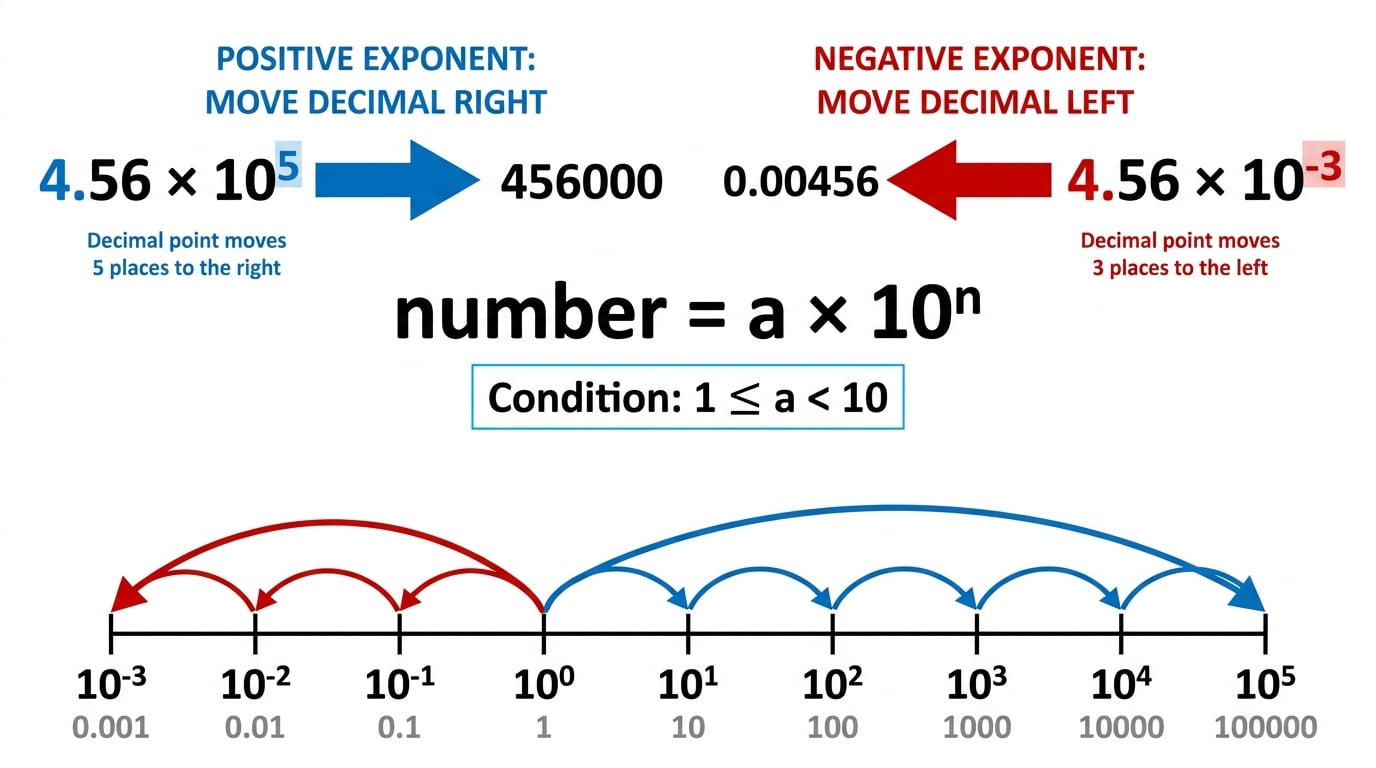
A power of 10 is a number like 10310^3103 or 10−410^{-4}10−4. The small raised number is called the exponent or index. It tells you how many places the decimal point moves when converting.
- Positive powers make numbers bigger: 104=1000010^4 = 10000104=10000.
- Negative powers make numbers smaller: 10−4=110000=0.000110^{-4} = \frac{1}{10000} = 0.000110−4=100001=0.0001.
- 100=110^0 = 1100=1.
When you multiply by a positive power of 10, you move the decimal point to the right. When you multiply by a negative power of 10, you move it to the left.
Example
Using powers of 10
-
Work out 6.38×1036.38 \times 10^36.38×10³ by moving the decimal point 3 places to the right.
-
This gives:
6.38×103=63806.38 \times 10^3 = 63806.38×103=6380 -
Work out 6.38×10−26.38 \times 10^{-2}6.38×10⁻² by moving the decimal point 2 places to the left.
-
This gives:
6.38×10−2=0.06386.38 \times 10^{-2} = 0.06386.38×10−2=0.0638
Tip
Negative exponent check
A negative exponent does not mean the answer is negative. It usually means the number is between 0 and 1.
2. What standard form means
An ordinary number is a number written normally, such as 52000 or 0.00091.
Standard form is a compact way to write very large or very small numbers.
Definition
Standard form
A number is in standard form when it is written as a×10na \times 10^na×10n, where 1≤a<101 \le a < 101≤a<10 and nnn is an integer. An integer is a whole number, including negative whole numbers and zero.
So the front number must be at least 1 but less than 10.
For example:
- 4.8×1064.8 \times 10^64.8×10⁶ is in standard form.
- 12.5×10312.5 \times 10^312.5×10³ is not, because 12.5 is too big.
- 0.72×1050.72 \times 10^50.72×10⁵ is not, because 0.72 is too small.
Example
Deciding whether numbers are in standard form
-
Check 7.41×10−37.41 \times 10^{-3}7.41×10⁻³. The front number 7.41 is between 1 and 10, so it is in standard form.
-
Check 18.2×10418.2 \times 10^418.2×10⁴. The front number 18.2 is bigger than 10, so it is not in standard form.
-
Check 0.56×1080.56 \times 10^80.56×10⁸. The front number 0.56 is smaller than 1, so it is not in standard form.
3. Changing standard form into ordinary numbers
To change from standard form to an ordinary number:
- If the exponent is positive, move the decimal point right.
- If the exponent is negative, move the decimal point left.
- The number of places moved is the size of the exponent.
Example
Writing standard form as ordinary numbers
-
Write 8.52×1058.52 \times 10^58.52×10⁵ as an ordinary number. The exponent is positive, so move the decimal point 5 places to the right.
-
This gives:
8.52×105=8520008.52 \times 10^5 = 8520008.52×105=852000 -
Write 3.07×10−43.07 \times 10^{-4}3.07×10⁻⁴ as an ordinary number. The exponent is negative, so move the decimal point 4 places to the left.
-
This gives:
3.07×10−4=0.0003073.07 \times 10^{-4} = 0.0003073.07×10−4=0.000307
Common Mistake
Missing zero placeholders
When moving the decimal point left or right, you may need to add zeros. For example, 5.1×10−55.1 \times 10^{-5}5.1×10⁻⁵ is 0.000051, not 0.00051.
4. Changing ordinary numbers into standard form
To change an ordinary number into standard form:
- Place the decimal point after the first non-zero digit.
- Count how many places the decimal point has moved.
- Use a positive exponent for large numbers and a negative exponent for small decimals.
Key Idea
The front number rule
Your front number must always be between 1 and 10. This is the quickest way to check whether your answer is truly in standard form.
Example
Writing ordinary numbers in standard form
-
Write 64 200 000 in standard form. Put the decimal point after the first non-zero digit to make 6.42.
-
The decimal point has moved 7 places left, so the exponent is positive 7.
-
Therefore:
64 200 000=6.42×10764\,200\,000 = 6.42 \times 10^764200000=6.42×10⁷ -
Write 0.000 0739 in standard form. Put the decimal point after the first non-zero digit to make 7.39.
-
The decimal point has moved 5 places right, so the exponent is negative 5.
-
Therefore:
0.0000739=7.39×10−50.0000739 = 7.39 \times 10^{-5}0.0000739=7.39×10⁻⁵
Sometimes a number is written using powers of 10 but is not yet in standard form.
Example
Fixing a number that is not in standard form
-
Write 0.47×1060.47 \times 10^60.47×10⁶ in standard form. The front number 0.47 is too small.
-
Rewrite 0.47 as 4.7×10−14.7 \times 10^{-1}4.7×10⁻¹.
-
Substitute this into the expression:
0.47×106=4.7×10−1×1060.47 \times 10^6 = 4.7 \times 10^{-1} \times 10^60.47×106=4.7×10−1×106 -
Add the exponents when multiplying powers of 10:
10−1×106=10510^{-1} \times 10^6 = 10^510−1×106=105 -
The answer is:
4.7×1054.7 \times 10^54.7×10⁵
5. Multiplying and dividing in standard form
For calculations, split the question into two parts:
- Work with the front numbers.
- Work with the powers of 10.
The exponent laws you need are:
10m×10n=10m+n10^m \times 10^n = 10^{m+n}10m×10n=10m+n 10m÷10n=10m−n10^m \div 10^n = 10^{m-n}10m÷10n=10m−nExample
Multiplying standard form numbers
-
Work out (4.2×105)×(3.5×10−2)(4.2 \times 10^5) \times (3.5 \times 10^{-2})(4.2×105)×(3.5×10−2).
-
Multiply the front numbers:
4.2×3.5=14.74.2 \times 3.5 = 14.74.2×3.5=14.7 -
Add the exponents because the powers of 10 are being multiplied:
105×10−2=10310^5 \times 10^{-2} = 10^3105×10−2=103 -
Combine the two parts:
14.7×10314.7 \times 10^314.7×10³ -
This is not in standard form because 14.7 is too big. Rewrite it as:
1.47×1041.47 \times 10^41.47×10⁴
Example
Dividing standard form numbers
-
Work out (9.6×10⁻⁴)÷(3.2×10⁻⁶)(9.6 \times 10^{-4}) \div (3.2 \times 10^{-6})(9.6×10⁻⁴)÷(3.2×10⁻⁶).
-
Divide the front numbers:
9.6÷3.2=39.6 \div 3.2 = 39.6÷3.2=3 -
Subtract the exponents because the powers of 10 are being divided:
10−4÷10−6=10210^{-4} \div 10^{-6} = 10^{2}10−4÷10−6=102 -
The answer is:
3×10²³ \times 10^23×102
Common Mistake
Adding instead of subtracting exponents
For division, subtract the exponent in the denominator. Be especially careful with negatives: −4−(−6)=2-4 - (-6) = 2−4−(−6)=2.
6. Calculations involving ordinary decimals
If a calculation contains small decimals, it can help to convert each number into standard form first.
Example
A fraction involving decimals
-
Work out 0.04×0.030.005\frac{0.04 \times 0.03}{0.005}0.0050.04×0.03 in standard form.
-
Write each decimal in standard form:
0.04=4×10−2,0.03=3×10−2,0.005=5×10−30.04 = 4 \times 10^{-2}, \quad 0.03 = 3 \times 10^{-2}, \quad 0.005 = 5 \times 10^{-3}0.04=4×10−2,0.03=3×10−2,0.005=5×10⁻³ -
Substitute into the fraction:
(4×10⁻²)(3×10⁻²)5×10⁻³\frac{(4 \times 10^{-2})(3 \times 10^{-2})}{5 \times 10^{-3}}5×10⁻³(4×10⁻²)(3×10⁻²) -
Work with the front numbers and powers separately:
4×35=2.4\frac{4 \times 3}{5} = 2.454×3=2.4 -
For the powers of 10:
10−2×10⁻²÷10−3=10−110^{-2} \times 10^{-2} \div 10^{-3} = 10^{-1}10−2×10⁻²÷10−3=10−1 -
The answer is:
2.4×10−12.4 \times 10^{-1}2.4×10⁻¹
7. Ordering, adding and subtracting
For ordering numbers, convert them all to ordinary numbers or all to standard form.
For adding and subtracting, do not add or subtract the exponents. You either convert to ordinary numbers, or write both numbers with the same power of 10.
Example
Putting numbers in order of size
-
Put these in order from smallest to largest: 5.4×1025.4 \times 10^25.4×10², 0.054×1020.054 \times 10^20.054×10², 5400×10−45400 \times 10^{-4}5400×10−4, and 54.
-
Convert each one to an ordinary value:
5.4×102=5400.054×102=5.45400×10−4=0.5454=54\begin{aligned} 5.4 \times 10^2 &= 540 \\ 0.054 \times 10^2 &= 5.4 \\ 5400 \times 10^{-4} &= 0.54 \\ 54 &= 54 \end{aligned}5.4×1020.054×1025400×10−454=540=5.4=0.54=54 -
Order the ordinary values: 0.54, 5.4, 54, 540.
-
Write the original numbers in that order:
5400×10−4,0.054×102,54,5.4×1025400 \times 10^{-4}, \quad 0.054 \times 10^2, \quad 54, \quad 5.4 \times 10^25400×10−4,0.054×102,54,5.4×102
Example
Finding a difference in standard form
-
A planet has diameter 8.4×1058.4 \times 10^58.4×10⁵ km. A moon has diameter 6.7×1046.7 \times 10^46.7×10⁴ km. Find the difference.
-
Write both numbers using the same power of 10:
6.7×104=0.67×1056.7 \times 10^4 = 0.67 \times 10^56.7×104=0.67×10⁵ -
Subtract the front numbers:
8.4×10⁵−0.67×105=7.73×1058.4 \times 10^5 - 0.67 \times 10^5 = 7.73 \times 10^58.4×10⁵−0.67×105=7.73×10⁵ -
The answer is already in standard form:
7.73×10⁵ km7.73 \times 10^5 \text{ km}7.73×10⁵ km
8. Standard form in worded problems
Worded questions often involve very large distances, tiny masses, or formulae. The maths is usually just multiply, divide, add or subtract — the skill is choosing the correct operation.
Example
Using a formula with standard form
-
A sphere has radius 2.0×1032.0 \times 10^32.0×10³ m. Find its volume using V=43πr3V = \frac{4}{3}\pi r^3V=34πr3, giving your answer in standard form to 1 decimal place.
-
Substitute the radius:
V=43π(2.0×10³)3V = \frac{4}{3}\pi (2.0 \times 10^3)^3V=34π(2.0×10³)3 -
Cube the standard form part:
(2.0×10³)3=8.0×10⁹(2.0 \times 10^3)^3 = 8.0 \times 10^9(2.0×10³)3=8.0×10⁹ -
Multiply by 43π\frac{4}{3}\pi34π:
V≈3.351×10¹⁰V \approx 3.351 \times 10^{10}V≈3.351×10¹⁰ -
To 1 decimal place in standard form:
V=3.4×10¹⁰ m3V = 3.4 \times 10^{10} \text{ m}^3V=3.4×10¹⁰ m3
Tip
Calculator display
If your calculator shows something like 3.4E10, that means 3.4×10103.4 \times 10^{10}3.4×10¹⁰. Still check that the front number is between 1 and 10.
Exam technique
In the exam
-
Always check the front number is at least 1 and less than 10.
-
For multiplication, add exponents; for division, subtract exponents.
-
If the question asks for an ordinary number, convert your final standard form answer at the end.
-
In worded problems, convert words like “million” into standard form before calculating.
Self review
Check yourself
-
Can you explain why 0.62×1070.62 \times 10^70.62×10⁷ is not in standard form?
-
Can you convert a small decimal like 0.00048 into standard form without guessing?
-
Do you know what to do to the exponents when dividing standard form numbers?

Recap questions
Test yourself with 5 quick questions on this guide. Answer them all correctly to complete it.
You've reached the end
Test yourself on this topic, or move on to the next guide.
How was this guide?