Revision notes for Oxford AQA IGCSE Maths Pythagoras. Open the guide for explanations and worked examples. Written against the Oxford AQA IGCSE Maths (9260) specification, so the content matches what's examinable rather than general Maths background.
Pythagoras
What you'll learn
- How to recognise the hypotenuse in a right-angled triangle.
- How to use Pythagoras' theorem to find a missing side.
- When to add squares and when to subtract squares.
- How to spot hidden right-angled triangles in rectangles, ladders, isosceles triangles and worded problems.
Before Pythagoras: squares and square roots
Pythagoras uses squares and square roots, so it is worth checking these first.
Definition
Squares and square roots
- To square a number, multiply it by itself. For example, 626^262 means 6 multiplied by 6.
- A square root reverses squaring. For example, 49\sqrt{49}49 is 7 because 72=497^2 = 4972=49.
Example
Using squares and square roots
-
Square 8.5 by multiplying it by itself:
8.52=8.5×8.5=72.258.5^2 = 8.5 \times 8.5 = 72.258.52=8.5×8.5=72.25 -
Find 72.25\sqrt{72.25}72.25 by asking, “What number squared gives 72.25?”
72.25=8.5\sqrt{72.25} = 8.572.25=8.5
Tip
Calculator tip
Use the square button for x2x^2x2 and the square-root button for x\sqrt{x}x. If your calculator gives a long decimal, keep the full answer in the calculator until the final rounding step.
Right-angled triangles and the hypotenuse
Pythagoras only works in a right-angled triangle.
Definition
Right-angled triangle
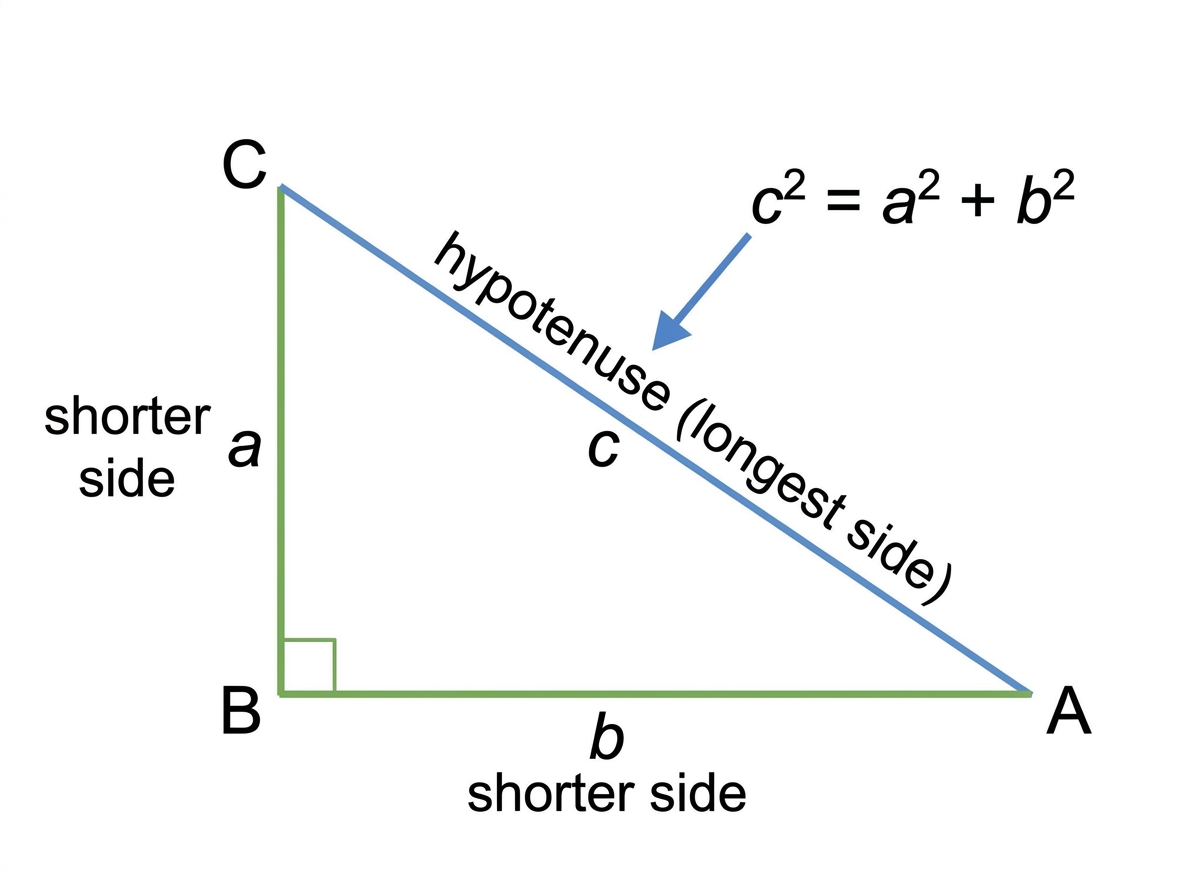
A right-angled triangle is a triangle with one angle of 90°. The hypotenuse is the side opposite the right angle. It is always the longest side.
Here is the key labelling you need to recognise before using the formula.
Key Idea
Pythagoras' theorem
In any right-angled triangle, the square of the hypotenuse equals the sum of the squares of the other two sides.
c2=a2+b2c^2 = a^2 + b^2c2=a2+b2In this formula, ccc is the hypotenuse. The letters aaa and bbb are the two shorter sides.
Common Mistake
Using the wrong side as the hypotenuse
Do not choose the side that “looks” longest unless you are sure. The hypotenuse is always directly opposite the right angle.
Finding the hypotenuse
If the missing side is opposite the right angle, you are finding the hypotenuse. This is the most straightforward case: square the two shorter sides, add them, then square-root.
Example
Finding the hypotenuse
A right-angled triangle has shorter sides of 7.2 cm and 9.6 cm. Find the hypotenuse.
-
Let the hypotenuse be xxx.
-
Use Pythagoras, adding the squares of the shorter sides:
x2=7.22+9.62x^2 = 7.2^2 + 9.6^2x2=7.22+9.62 -
Square and add:
x2=51.84+92.16=144x^2 = 51.84 + 92.16 = 144x2=51.84+92.16=144 -
Square-root to find xxx:
x=144=12x = \sqrt{144} = 12x=144=12 -
The hypotenuse is 12 cm.
Tip
Quick sense check
The hypotenuse must be longer than both shorter sides. In the example, 12 cm is longer than 7.2 cm and 9.6 cm, so the answer is sensible.
Finding a shorter side
Sometimes you are given the hypotenuse and one shorter side. Then you need to find the other shorter side.
Because the hypotenuse square is the biggest square, you subtract:
missing side2=hypotenuse2−known side2\text{missing side}^2 = \text{hypotenuse}^2 - \text{known side}^2missing side2=hypotenuse2−known side2Example
Finding a shorter side
A right-angled triangle has hypotenuse 15 cm and one shorter side 8 cm. Find the other shorter side correct to 1 decimal place.
-
Let the missing shorter side be xxx.
-
Start with Pythagoras:
152=82+x215^2 = 8^2 + x^2152=82+x2 -
Rearrange by subtracting 828^282:
x2=152−82x^2 = 15^2 - 8^2x2=152−82 -
Square and subtract:
x2=225−64=161x^2 = 225 - 64 = 161x2=225−64=161 -
Square-root to find xxx:
x=161=12.688…x = \sqrt{161} = 12.688\ldotsx=161=12.688… -
Rounded to 1 decimal place, the missing side is 12.7 cm.
Common Mistake
Subtracting before squaring
Do not do 15 minus 8 and then square the answer. Pythagoras uses the squares of the sides, so calculate 152−8215^2 - 8^2152−82, not (15−8)2(15 - 8)^2(15−8)2.
Rounding your answer
Exam questions often ask for a certain level of accuracy, such as 1 decimal place or 3 significant figures.
Definition
Decimal places and significant figures
- 1 decimal place means one digit after the decimal point.
- 3 significant figures means the first three important digits, starting from the first non-zero digit.
Example
Rounding a Pythagoras answer
A calculation gives a length of 18.3579…18.3579\ldots18.3579… metres. Round it to 3 significant figures.
-
The first three significant figures are 1, 8 and 3.
-
Look at the next digit, which is 5, so round the 3 up to 4.
-
The rounded answer is 18.4 m.
Tip
Do not round too early
If a question has two stages, keep the unrounded value in your calculator until the final answer. Rounding halfway through can make your final answer slightly inaccurate.
Spotting hidden right-angled triangles
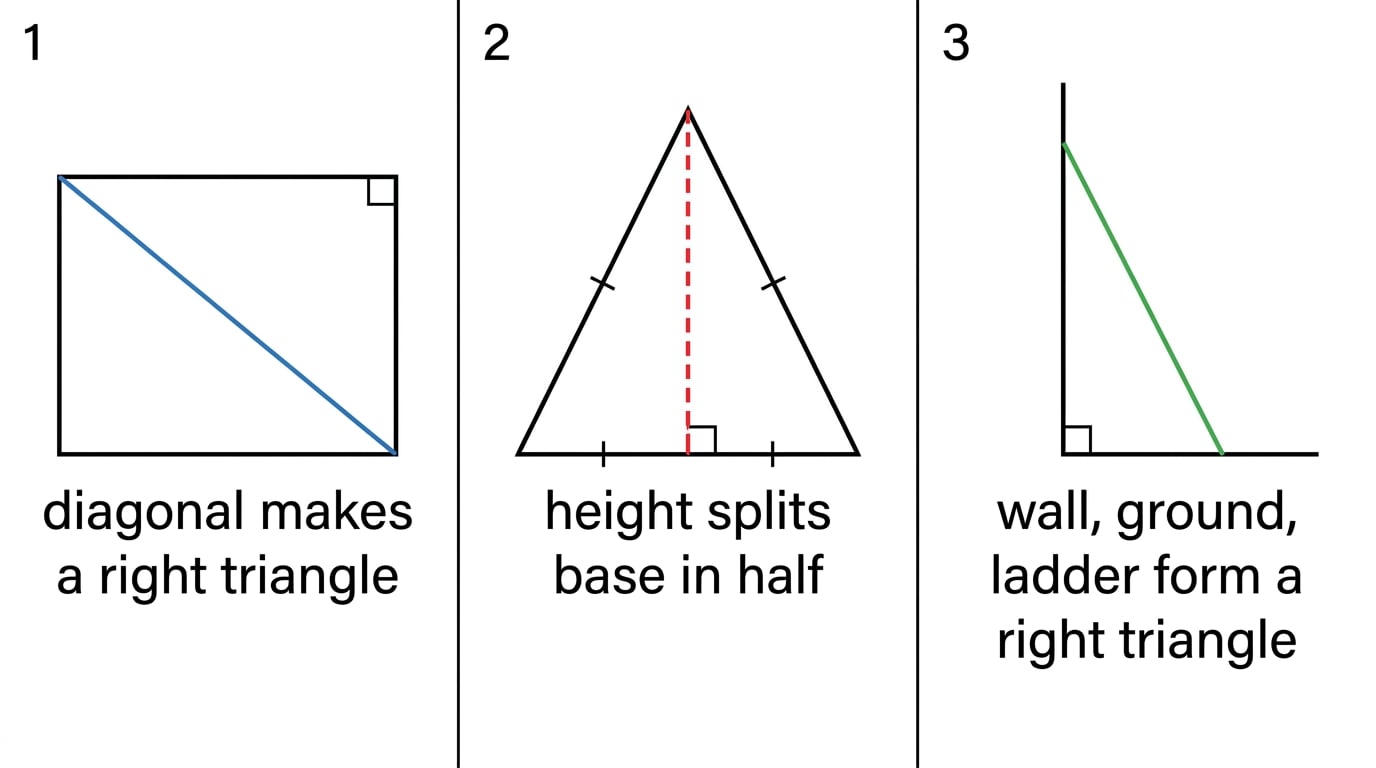
Pythagoras questions are not always drawn as a single triangle. You may need to find the right-angled triangle inside another shape.
Common examples include:
- a diagonal in a rectangle,
- a height in an isosceles triangle,
- a ladder against a wall,
- a journey north/east or south/west,
- two right-angled triangles joined together.
Rectangles and diagonals
A rectangle has four right angles. A diagonal splits it into two right-angled triangles.
Example
Finding the diagonal of a rectangle
A rectangle is 16 cm long and 9 cm wide. Find the length of its diagonal correct to 1 decimal place.
-
The length, width and diagonal form a right-angled triangle.
-
The diagonal is the hypotenuse, so add the squares:
d2=162+92d^2 = 16^2 + 9^2d2=162+92 -
Square and add:
d2=256+81=337d^2 = 256 + 81 = 337d2=256+81=337 -
Square-root:
d=337=18.357…d = \sqrt{337} = 18.357\ldotsd=337=18.357… -
Rounded to 1 decimal place, the diagonal is 18.4 cm.
Isosceles triangles
An isosceles triangle has two equal sides. If you draw the perpendicular height from the top vertex to the base, it splits the base into two equal halves.
Example
Finding the height of an isosceles triangle
An isosceles triangle has equal sides of 13 cm and a base of 10 cm. Find its perpendicular height.
-
The height splits the base into two equal parts, so each half is 5 cm.
-
Use one half of the triangle. The 13 cm side is the hypotenuse.
-
Let the height be hhh:
h2=132−52h^2 = 13^2 - 5^2h2=132−52 -
Square and subtract:
h2=169−25=144h^2 = 169 - 25 = 144h2=169−25=144 -
Square-root:
h=144=12h = \sqrt{144} = 12h=144=12 -
The perpendicular height is 12 cm.
Common Mistake
Forgetting to halve the base
In an isosceles triangle, the right-angled triangle uses half the base, not the whole base.
Multi-step Pythagoras questions
Some questions need Pythagoras twice. Usually, you find a shared side first, then use it in another triangle.
Example
Two joined right-angled triangles
Two right-angled triangles share a side. In the first triangle, the hypotenuse is 20 m and one shorter side is 12 m. In the second triangle, the shared side and a side of 9 m form the shorter sides. Find the final hypotenuse correct to 3 significant figures.
-
First find the shared side. Let it be sss.
-
In the first triangle, subtract because 20 m is the hypotenuse:
s2=202−122s^2 = 20^2 - 12^2s2=202−122 -
Calculate sss:
s2=400−144=256s^2 = 400 - 144 = 256s2=400−144=256 -
Square-root:
s=256=16s = \sqrt{256} = 16s=256=16 -
Now use the second triangle. Let the final hypotenuse be xxx:
x2=162+92x^2 = 16^2 + 9^2x2=162+92 -
Calculate and square-root:
x=337=18.357…x = \sqrt{337} = 18.357\ldotsx=337=18.357… -
Correct to 3 significant figures, the final length is 18.4 m.
Worded problems and units
In real-life problems, you may need to draw the right-angled triangle yourself. Look for horizontal and vertical directions, such as a wall and floor, or north and east.
Example
A ladder against a wall
A ladder reaches 2.4 m up a wall. The base of the ladder is 80 cm from the wall. Find the length of the ladder.
-
Convert 80 cm to metres so the units match:
80 cm=0.8 m80\text{ cm} = 0.8\text{ m}80 cm=0.8 m -
The wall and ground make a right angle. The ladder is the hypotenuse.
-
Let the ladder length be LLL:
L2=2.42+0.82L^2 = 2.4^2 + 0.8^2L2=2.42+0.82 -
Square and add:
L2=5.76+0.64=6.4L^2 = 5.76 + 0.64 = 6.4L2=5.76+0.64=6.4 -
Square-root:
L=6.4=2.529…L = \sqrt{6.4} = 2.529\ldotsL=6.4=2.529… -
The ladder is about 2.53 m long.
Common Mistake
Check the units
Do not mix centimetres and metres in the same Pythagoras calculation. Convert everything to one unit before you square the lengths.
Ratio with Pythagoras
Sometimes a rectangle or screen has a diagonal and a length-to-width ratio. Use the ratio to write the sides in algebraic form.
Example
Screen size from a ratio
A screen has diagonal 65 inches. Its length and width are in the ratio 16:9. Find the length and width correct to 1 decimal place.
-
Write the length as 16k16k16k and the width as 9k9k9k.
-
Use Pythagoras with the diagonal as the hypotenuse:
652=(16k)2+(9k)265^2 = (16k)^2 + (9k)^2652=(16k)2+(9k)2 -
Square the ratio parts:
4225=256k2+81k24225 = 256k^2 + 81k^24225=256k2+81k2 -
Combine like terms:
4225=337k24225 = 337k^24225=337k2 -
Solve for kkk:
k=4225337=3.542…k = \sqrt{\frac{4225}{337}} = 3.542\ldotsk=3374225=3.542… -
Find the two dimensions:
16k=56.7…,9k=31.8…16k = 56.7\ldots,\quad 9k = 31.8\ldots16k=56.7…,9k=31.8… -
The length is 56.7 inches and the width is 31.9 inches, correct to 1 decimal place.
Exam technique
In the exam
- Mark the right angle and identify the hypotenuse before writing the formula.
- If finding the hypotenuse, add the squares; if finding a shorter side, subtract the squares.
- Check units, keep full calculator values until the end, and round exactly as the question asks.
Self review
Check yourself
- Can you explain why the hypotenuse is always opposite the right angle?
- In a triangle with hypotenuse 10 cm and one side 6 cm, would you add or subtract squares?
- If an isosceles triangle has base 14 cm, what length goes into one right-angled half-triangle?

Recap questions
Test yourself with 5 quick questions on this guide. Answer them all correctly to complete it.
You've reached the end
Test yourself on this topic, or move on to the next guide.
How was this guide?