Revision notes for Oxford AQA IGCSE Maths Angles in Parallel Lines. Open the guide for explanations and worked examples. Written against the Oxford AQA IGCSE Maths (9260) specification, so the content matches what's examinable rather than general Maths background.
Angles in Parallel Lines
What you'll learn
- How to spot parallel lines and a transversal in a diagram.
- The three key angle facts: corresponding, alternate, and co-interior angles.
- How to combine parallel-line facts with straight lines, triangles, isosceles triangles, and parallelograms.
- How to write clear reasons for each stage of your working.
The angle facts you need first
Before parallel lines, make sure these basic angle facts feel secure:
- Angles on a straight line add to 180°.
- Angles around a point add to 360°.
- Vertically opposite angles are equal.
- Angles in a triangle add to 180°.
Definition
Basic line and angle terms
- Parallel lines are lines that stay the same distance apart and never meet. They are often marked with matching arrow symbols.
- A transversal is a line that crosses two or more other lines.
- Vertically opposite angles are the opposite angles made when two straight lines cross.
Example
Warm-up: straight-line and vertically opposite angles
Two straight lines cross. One angle is 68°. The opposite angle is ppp, and an angle next to it on the straight line is qqq.
-
The angle opposite 68° is ppp, so p=68∘p = 68^\circp=68∘ because vertically opposite angles are equal.
-
The angle qqq is next to 68° on a straight line, so q+68∘=180∘q + 68^\circ = 180^\circq+68∘=180∘.
-
Subtract 68° from 180° to get q=112∘q = 112^\circq=112∘.
Tip
Reason first, calculation second
In exam answers, try to say the reason as you calculate: “angles on a straight line add to 180°”, “alternate angles are equal”, or “angles in a triangle add to 180°”.
The three parallel-line angle facts
When a transversal crosses two parallel lines, special angle pairs appear. These are the main patterns you need to recognise.
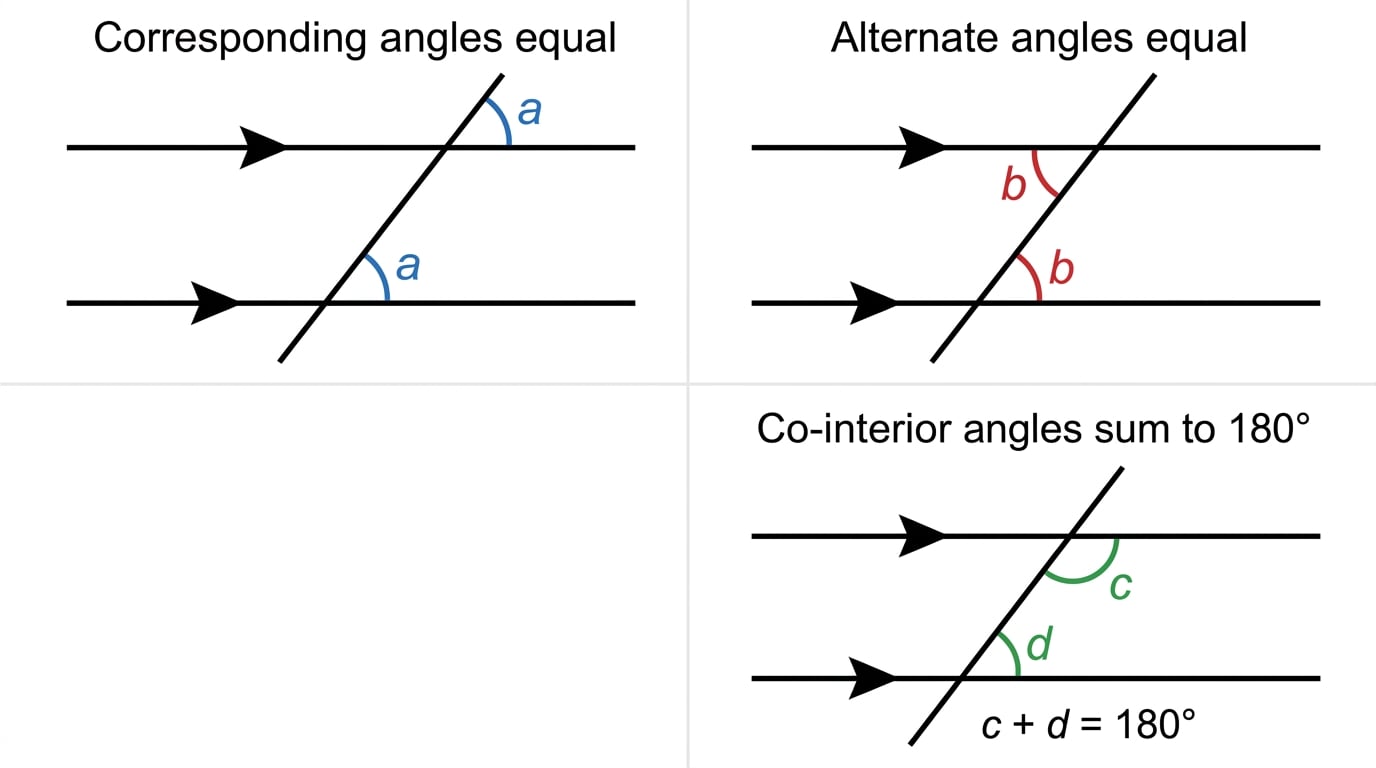
The diagram below shows the three most important patterns: corresponding angles, alternate angles, and co-interior angles.
Corresponding angles
Definition
Corresponding angles
Corresponding angles are in the same relative position at each crossing of the transversal. For example, both might be “top-right” angles.
Key Idea
Corresponding angles
When two parallel lines are cut by a transversal, corresponding angles are equal.
Example
Finding a corresponding angle
Two parallel lines are cut by a sloping transversal. At the top crossing, the top-right angle is 74°. At the lower crossing, the top-right angle is xxx.
-
The two angles are in the same position at different crossings, so they are corresponding angles.
-
The lines are parallel, so corresponding angles are equal.
-
Therefore x=74∘x = 74^\circx=74∘.
Alternate angles
Definition
Alternate angles
Alternate angles lie between the parallel lines and on opposite sides of the transversal. They often make a “Z” shape.
Key Idea
Alternate angles
When two parallel lines are cut by a transversal, alternate angles are equal.
Example
Using alternate angles
Two parallel lines are crossed by a transversal. One interior angle is 49°. The angle on the opposite side of the transversal, inside the parallel lines, is yyy.
-
The two angles are inside the parallel lines and on opposite sides of the transversal.
-
That means they are alternate angles.
-
Since the lines are parallel, alternate angles are equal, so y=49∘y = 49^\circy=49∘.
Co-interior angles
Definition
Co-interior angles
Co-interior angles are inside the parallel lines and on the same side of the transversal. They are also called same-side interior angles.
Key Idea
Co-interior angles
Co-interior angles add to 180°.
Example
Using co-interior angles
Two parallel lines are crossed by a transversal. One co-interior angle is 118°. The other is zzz.
-
The angles are inside the parallel lines and on the same side of the transversal.
-
Co-interior angles add to 180°, so z+118∘=180∘z + 118^\circ = 180^\circz+118∘=180∘.
-
Subtract 118° from 180° to get z=62∘z = 62^\circz=62∘.
Common Mistake
Co-interior angles are not equal
Students often treat co-interior angles like alternate angles. Remember: corresponding and alternate angles are equal, but co-interior angles add to 180°.
Example: two answers from one diagram
A very common question gives you two parallel lines and one transversal, then asks for more than one angle and a reason for each.
Example
One transversal crossing two parallel lines
Lines AB∥CDAB \parallel CDAB∥CD. At the top crossing, an angle of 68° is next to angle xxx on a straight line. At the lower crossing, angle yyy is in the same matching position as xxx.
-
Angle xxx and 68° are on a straight line, so x+68∘=180∘x + 68^\circ = 180^\circx+68∘=180∘.
-
Subtract 68° from 180° to get x=112∘x = 112^\circx=112∘.
-
Angle yyy is in the corresponding position to angle xxx.
-
Since the lines are parallel, corresponding angles are equal, so y=112∘y = 112^\circy=112∘.
Combining parallel lines with triangles
Some questions include two transversals that meet, making a triangle shape. You may need to use straight-line angles, triangle angles, and vertically opposite angles together.
Example
Two sloping lines meet between parallel lines
Two sloping lines meet below a parallel line. At the top, the left angle inside the small triangle is 38°. On the right, the outside angle is 118°. The angle vertically opposite the bottom angle of the triangle is xxx.
-
First find the inside right angle of the triangle. It is on a straight line with 118°, so it is 180∘−118∘=62∘180^\circ - 118^\circ = 62^\circ180∘−118∘=62∘.
-
The angles in the triangle add to 180°, so the angle at the crossing is 180∘−38∘−62∘=80∘180^\circ - 38^\circ - 62^\circ = 80^\circ180∘−38∘−62∘=80∘.
-
Angle xxx is vertically opposite this angle, so x=80∘x = 80^\circx=80∘.
Tip
Look for the hidden triangle
If two transversals meet, lightly trace the triangle they form. Then ask: “Do I know two angles of this triangle yet?”
Parallel lines in parallelograms
Definition
Parallelogram
A parallelogram is a quadrilateral with both pairs of opposite sides parallel.
This means if ABCD is a parallelogram, then AB is parallel to DC, and AD is parallel to BC. You can use the same parallel-line angle facts on its sides.
Example
Parallelogram with an extended side
ABCD is a parallelogram. The line CB is extended through B to a point E. Angle BAD is 124°, and angle AEB is 37°. Find angle BAE.
-
In a parallelogram, opposite sides are parallel, so AD is parallel to BC. Since E lies on the extension of CB, BE is also parallel to AD.
-
AB is a transversal crossing the parallel lines AD and BE. Angles BAD and ABE are co-interior angles, so they add to 180°. Therefore ∠ABE=180∘−124∘=56∘\angle ABE = 180^\circ - 124^\circ = 56^\circ∠ABE=180∘−124∘=56∘.
-
In triangle ABE, the angles add to 180°, so ∠BAE=180∘−56∘−37∘=87∘\angle BAE = 180^\circ - 56^\circ - 37^\circ = 87^\circ∠BAE=180∘−56∘−37∘=87∘.
Parallel lines with an isosceles triangle
Definition
Isosceles triangle
An isosceles triangle has two equal sides. The angles opposite those equal sides are equal; these are called the base angles.
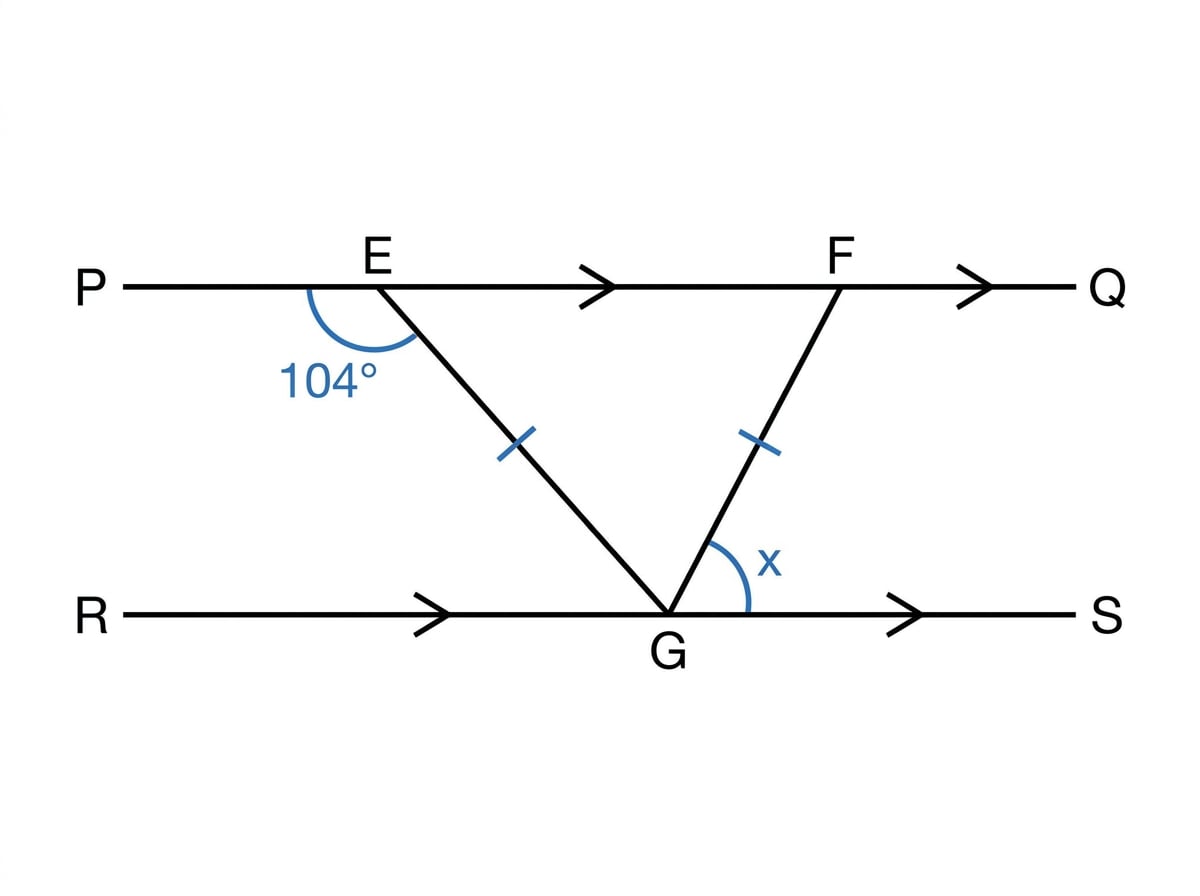
Here is a common style of diagram: an isosceles triangle sits between two parallel lines, and you need to connect the triangle fact with a parallel-line fact.
Example
Isosceles triangle between parallel lines
In the diagram, the two horizontal lines are parallel and EG = FG. The exterior angle at E is 104°. Find xxx.
-
The exterior angle 104° and the interior angle at E lie on a straight line, so the interior angle at E is 180∘−104∘=76∘180^\circ - 104^\circ = 76^\circ180∘−104∘=76∘.
-
Since EG = FG, triangle EFG is isosceles. The base angles at E and F are equal, so the angle at F is also 76°.
-
The angle at F and angle xxx are alternate angles because the horizontal lines are parallel and FG is a transversal.
-
Therefore x=76∘x = 76^\circx=76∘.
Common Mistake
Using the wrong equal angles in an isosceles triangle
Equal sides face equal angles. If EG = FG, then the equal angles are at F and E, not at G.
Reason bank
These are the reasons you should be ready to write:
- Angles on a straight line add to 180°.
- Vertically opposite angles are equal.
- Corresponding angles are equal because the lines are parallel.
- Alternate angles are equal because the lines are parallel.
- Co-interior angles add to 180° because the lines are parallel.
- Angles in a triangle add to 180°.
- Base angles in an isosceles triangle are equal.
- Opposite sides of a parallelogram are parallel.
Exam technique
In the exam
-
Mark parallel lines with arrows and trace the transversal with your pencil or finger.
-
Decide the angle relationship before calculating: corresponding, alternate, co-interior, straight line, triangle, or vertically opposite.
-
Give a reason for every new angle you find, especially in questions worth 2 or 3 marks.
Self review
Check yourself
-
Can you explain the difference between alternate angles and corresponding angles?
-
If two co-interior angles are 113° and xxx, what equation would you write?
-
In an isosceles triangle, how do you decide which two angles are equal?

Recap questions
Test yourself with 5 quick questions on this guide. Answer them all correctly to complete it.
You've reached the end
Test yourself on this topic, or move on to the next guide.
How was this guide?