Revision notes for Oxford AQA IGCSE Maths Prime Factors, HCF and LCM. Open the guide for explanations and worked examples. Written against the Oxford AQA IGCSE Maths (9260) specification, so the content matches what's examinable rather than general Maths background.
Prime Factors, HCF and LCM
What you'll learn
- How to write a number as a product of its prime factors.
- How to find the HCF and LCM using prime factorisations.
- How to use LCM for “when will they happen together again?” questions.
- How to tackle reverse questions where you are given the HCF and LCM.
1. Factors, multiples and prime numbers
Before HCF and LCM, you need three key ideas.
Definition
Factors, multiples and primes
- A factor of a number divides into it exactly, with no remainder.
- A multiple is a number in another number’s times table.
- A prime number has exactly two factors: 1 and itself.
So 6 is a factor of 42 because 42 divided by 6 is exactly 7.
42 is a multiple of 6 because it is in the 6 times table.
Common Mistake
1 is not prime
The number 1 has only one factor, so it is not prime. The first few prime numbers are 2, 3, 5, 7, 11 and 13.
Example
Checking factors and multiples
-
Decide whether 8 is a factor of 56 by dividing 56 by 8:
56÷8=756 \div 8 = 756÷8=7 -
Since the answer is a whole number, 8 is a factor of 56.
-
Decide whether 56 is a multiple of 8 by writing it as a multiplication:
8×7=568 \times 7 = 568×7=56 -
So 56 is a multiple of 8.
2. Writing a number as a product of prime factors
A product is the answer to a multiplication. A prime factorisation means writing a number as a multiplication using only prime numbers.
A factor tree helps you keep splitting a number until every branch ends in a prime number.
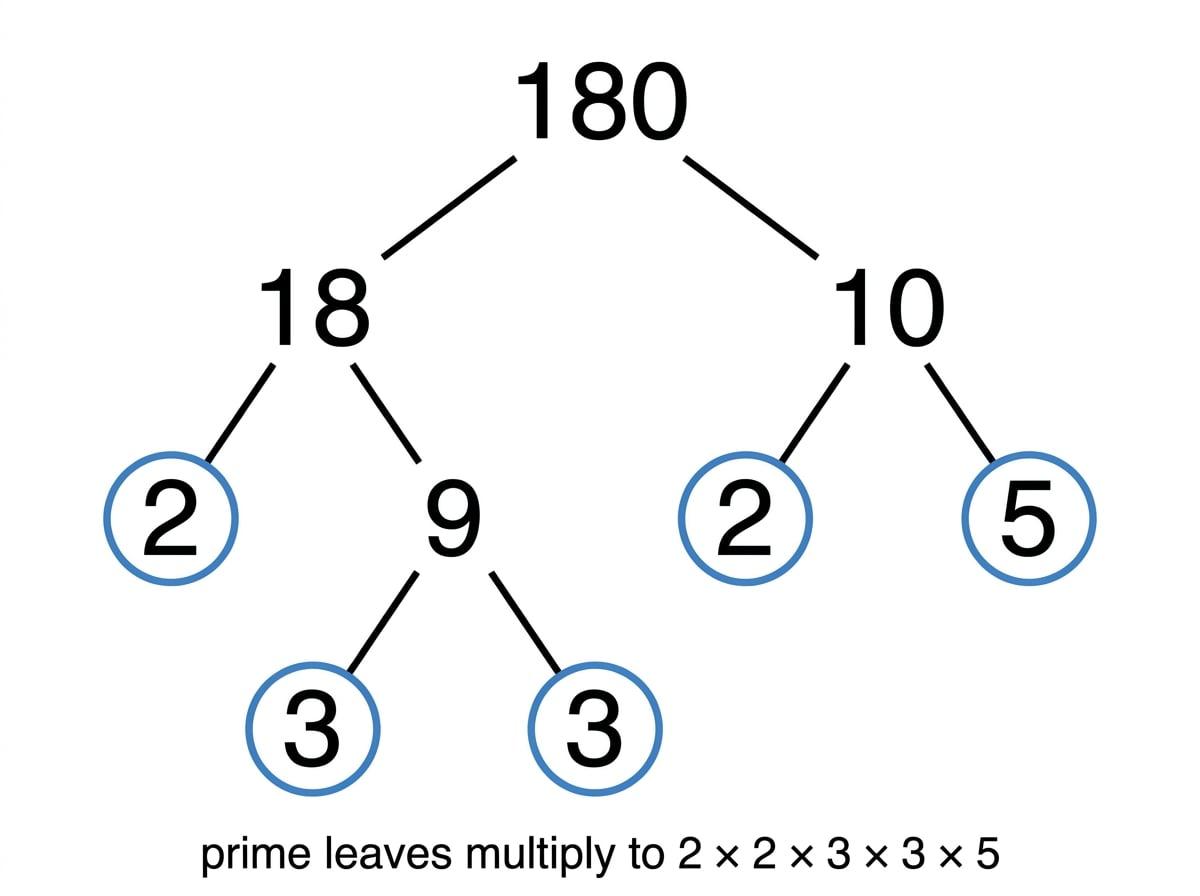
A power is a compact way of writing repeated multiplication. For example, 232^323 means 2×2×22 \times 2 \times 22×2×2. The small raised number is called the exponent.
Example
Write 84 as a product of its prime factors
-
Start by splitting 84 into two factors:
84=12×784 = 12 \times 784=12×7 -
The number 7 is prime, but 12 is not, so split 12 again:
12=3×412 = 3 \times 412=3×4 -
The number 3 is prime, but 4 is not, so split 4:
4=2×24 = 2 \times 24=2×2 -
Collect the prime factors: 2, 2, 3 and 7.
-
Write the answer using powers where possible:
84=22×3×784 = 2^2 \times 3 \times 784=22×3×7
Common Mistake
Stopping too early
Writing 84=12×784 = 12 \times 784=12×7 is not a prime factorisation because 12 is not prime. Keep splitting until every factor is prime.
3. Highest common factor, HCF
The word common means shared by all the numbers you are looking at.
Definition
Highest common factor
The highest common factor, or HCF, is the biggest number that divides exactly into all the given numbers.
You can find an HCF by listing factors, but prime factors are more efficient when the numbers are larger.
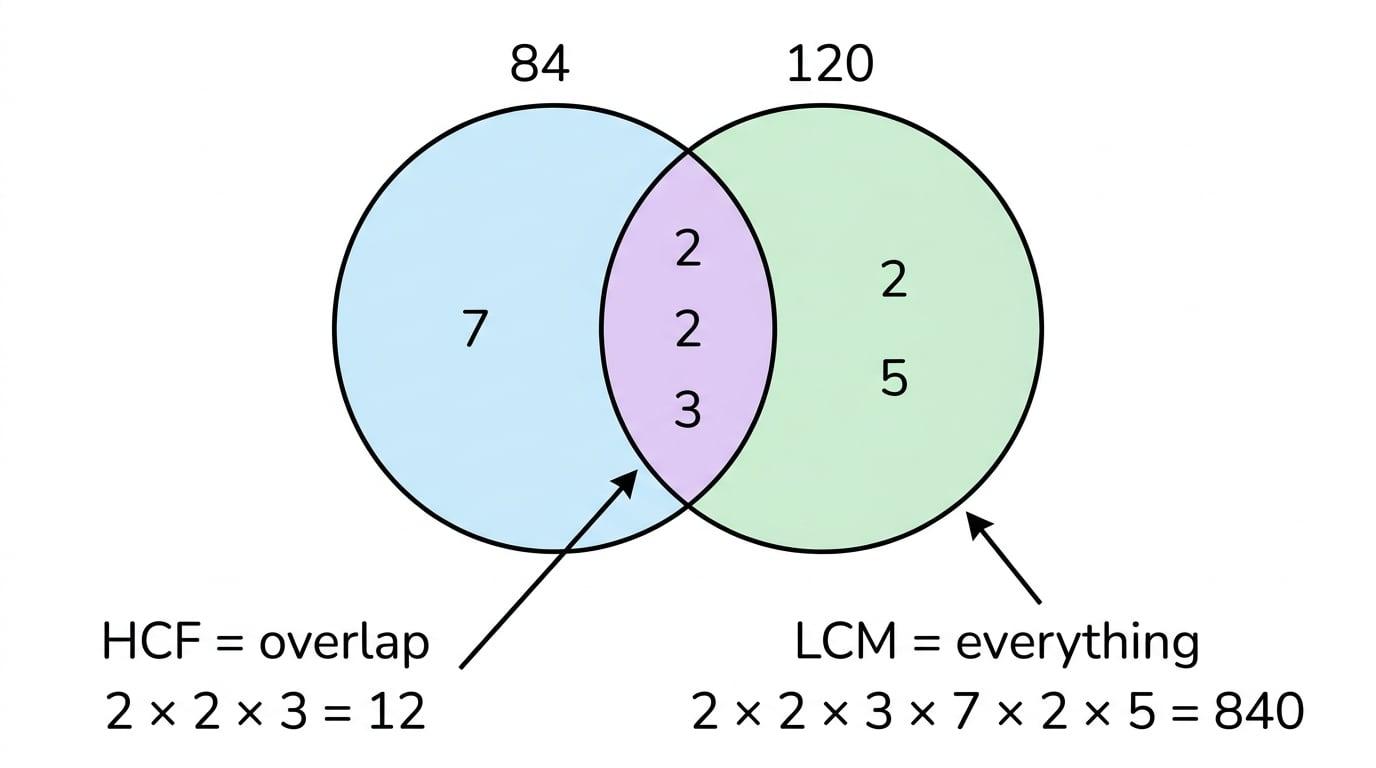
A Venn-style picture can show the idea: the HCF comes from the shared prime factors, while the LCM uses all the prime factors.
Key Idea
HCF rule
For the HCF, use only the prime factors that appear in every number, with the smallest power of each.
Example
Find the HCF of 72 and 108
-
Write each number as a product of prime factors:
72=23×3272 = 2^3 \times 3^272=23×32 108=22×33108 = 2^2 \times 3^3108=22×33 -
Compare the powers of the primes that appear in both numbers. For 2, the smaller power is 222^222. For 3, the smaller power is 323^232.
-
Multiply these smaller powers:
HCF=22×32=4×9=36\text{HCF} = 2^2 \times 3^2 = 4 \times 9 = 36HCF=22×32=4×9=36
Tip
HCF sanity check
The HCF can never be bigger than the smallest number in the question. If your HCF is larger than one of the original numbers, something has gone wrong.
4. Lowest common multiple, LCM
Definition
Lowest common multiple
The lowest common multiple, or LCM, is the smallest positive number that is a multiple of all the given numbers.
The LCM is about finding the first number that appears in all the relevant times tables.
Key Idea
LCM rule
For the LCM, use every prime factor that appears in any number, with the largest power of each.
Example
Find the LCM of 90 and 126
-
Write each number as a product of prime factors:
90=2×32×590 = 2 \times 3^2 \times 590=2×32×5 126=2×32×7126 = 2 \times 3^2 \times 7126=2×32×7 -
List every prime that appears: 2, 3, 5 and 7.
-
Choose the largest power of each prime. That gives 222, 323^232, 5 and 7.
-
Multiply them together:
LCM=2×32×5×7=630\text{LCM} = 2 \times 3^2 \times 5 \times 7 = 630LCM=2×32×5×7=630
Common Mistake
Multiplying the original numbers every time
The LCM of 90 and 126 is not automatically 90 multiplied by 126. That often gives a common multiple, but not the lowest one, especially when the numbers share factors.
5. Repeated events: buses, lights and alarms
If two or more things repeat regularly and start together, the time until they next happen together is the LCM of their time intervals.
For example, if one light flashes every 6 seconds and another flashes every 10 seconds, you need the first time that is in both the 6 times table and the 10 times table.
Example
Two buses leave together
Two buses leave the same stop at 8:15 am. One bus leaves every 12 minutes and the other leaves every 18 minutes. Find the next time they leave together.
-
Find the LCM of 12 and 18.
-
Prime factorise both numbers:
12=22×312 = 2^2 \times 312=22×3 18=2×3218 = 2 \times 3^218=2×32 -
Use the largest powers of each prime:
LCM=22×32=36\text{LCM} = 2^2 \times 3^2 = 36LCM=22×32=36 -
The buses next leave together 36 minutes after 8:15 am.
-
Add 36 minutes to 8:15 am to get 8:51 am.
Common Mistake
Adding the intervals
For repeated-event questions, do not add the gaps. A 12-minute event and an 18-minute event do not meet again after 30 minutes, because 30 is not a multiple of 12 and 18.
6. When the prime factors are already given
Sometimes the question gives you the prime factorisations straight away. This is a gift: do not multiply everything out first unless you really need to.
Key Idea
Smallest powers for HCF, largest powers for LCM
- HCF: choose the smallest powers of the primes shared by all the numbers.
- LCM: choose the largest powers of all primes that appear.
Example
Find the HCF and LCM from prime factor form
Given
A=23×32×5A = 2^3 \times 3^2 \times 5A=23×32×5and
B=22×34×7B = 2^2 \times 3^4 \times 7B=22×34×7find the HCF and LCM of AAA and BBB.
-
For the HCF, use only primes that appear in both AAA and BBB: 2 and 3.
-
Choose the smaller powers: 222^222 and 323^232.
-
Multiply to find the HCF:
HCF=22×32=36\text{HCF} = 2^2 \times 3^2 = 36HCF=22×32=36 -
For the LCM, use every prime that appears: 2, 3, 5 and 7.
-
Choose the larger powers: 232^323, 343^434, 5 and 7.
-
Multiply to find the LCM:
LCM=23×34×5×7=22680\text{LCM} = 2^3 \times 3^4 \times 5 \times 7 = 22680LCM=23×34×5×7=22680
Tip
Missing primes
If a prime appears in one number but not the other, it cannot be part of the HCF, but it must be included in the LCM.
7. HCF and LCM with three numbers
The same rules work for three numbers.
For the HCF, a prime must appear in all three numbers.
For the LCM, a prime only needs to appear in at least one number.
Example
Three-number HCF and LCM
-
Find the HCF of 48, 72 and 108. First write the prime factorisations:
48=24×348 = 2^4 \times 348=24×3 72=23×3272 = 2^3 \times 3^272=23×32 108=22×33108 = 2^2 \times 3^3108=22×33 -
The shared primes are 2 and 3. Choose the smallest powers: 222^222 and 3.
-
Multiply to find the HCF:
HCF=22×3=12\text{HCF} = 2^2 \times 3 = 12HCF=22×3=12 -
Now find the LCM of 8, 12 and 30. First write the prime factorisations:
8=238 = 2^38=23 12=22×312 = 2^2 \times 312=22×3 30=2×3×530 = 2 \times 3 \times 530=2×3×5 -
Use the largest powers of every prime: 232^323, 3 and 5.
-
Multiply to find the LCM:
LCM=23×3×5=120\text{LCM} = 2^3 \times 3 \times 5 = 120LCM=23×3×5=120
8. Working backwards from HCF and LCM
A reverse question gives you the HCF and LCM and asks for the original numbers.
Two numbers are coprime if their HCF is 1. After you divide both original numbers by their HCF, the remaining parts must be coprime.
Example
Find two numbers from their HCF and LCM
Two numbers are greater than 20. Their HCF is 6 and their LCM is 180. Find the two numbers.
-
Since the HCF is 6, both numbers must be multiples of 6.
-
Divide the LCM by the HCF:
180÷6=30180 \div 6 = 30180÷6=30 -
Find coprime factor pairs of 30. The pair 5 and 6 works because the HCF of 5 and 6 is 1.
-
Multiply each part by the HCF, 6:
5×6=305 \times 6 = 305×6=30 6×6=366 \times 6 = 366×6=36 -
The two numbers are 30 and 36.
Tip
Check reverse answers
Always check both facts: the HCF of your two numbers and the LCM of your two numbers. Reverse questions are easy to get partly right.
Exam technique
In the exam
-
For prime factor questions, keep splitting until every factor is prime, then write the answer neatly using powers.
-
For HCF, think “shared factors only” and choose the smallest powers.
-
For LCM, think “all factors needed” and choose the largest powers, especially in buses, lights and alarms questions.
Self review
Check yourself
- Can you write 150 as a product of its prime factors?
- What is the difference between a factor and a multiple?
- If three lights flash every 4, 6 and 9 seconds, why would you use the LCM?

Recap questions
Test yourself with 5 quick questions on this guide. Answer them all correctly to complete it.
You've reached the end
Test yourself on this topic, or move on to the next guide.
How was this guide?