Revision notes for Oxford AQA IGCSE Maths Inequalities. Open the guide for explanations and worked examples. Written against the Oxford AQA IGCSE Maths (9260) specification, so the content matches what's examinable rather than general Maths background.
Inequalities
What you'll learn
- What the inequality symbols mean, including strict and inclusive inequalities.
- How to show inequalities on a number line using open and filled circles.
- How to list integer solutions from an inequality.
- How to solve linear inequalities, including double inequalities and brackets.
Inequalities are like equations with a range of answers
An equation usually has an equals sign and often one exact answer, like x=4x=4x=4.
An inequality compares values using signs such as <<<, >>>, ≤\le≤ and ≥\ge≥. Instead of one answer, an inequality usually describes a range of possible answers.
Definition
Inequality symbols
- x<3x<3x<3 means xxx is less than 3.
- x>3x>3x>3 means xxx is greater than 3.
- x≤3x\le 3x≤3 means xxx is less than or equal to 3.
- x≥3x\ge 3x≥3 means xxx is greater than or equal to 3.
A solution to an inequality is any value that makes the inequality true.
Example
Checking whether values satisfy an inequality
For the inequality x<4x<4x<4, decide whether 2, 4 and 6 are solutions.
-
Substitute 2 into the inequality.
Since 2 is less than 4, 2 is a solution.
-
Substitute 4 into the inequality.
Since x<4x<4x<4 does not include 4 itself, 4 is not a solution.
-
Substitute 6 into the inequality.
Since 6 is greater than 4, 6 is not a solution.
Key Idea
Strict or inclusive?
The symbols <<< and >>> are strict, so the endpoint is not included. The symbols ≤\le≤ and ≥\ge≥ are inclusive, so the endpoint is included.
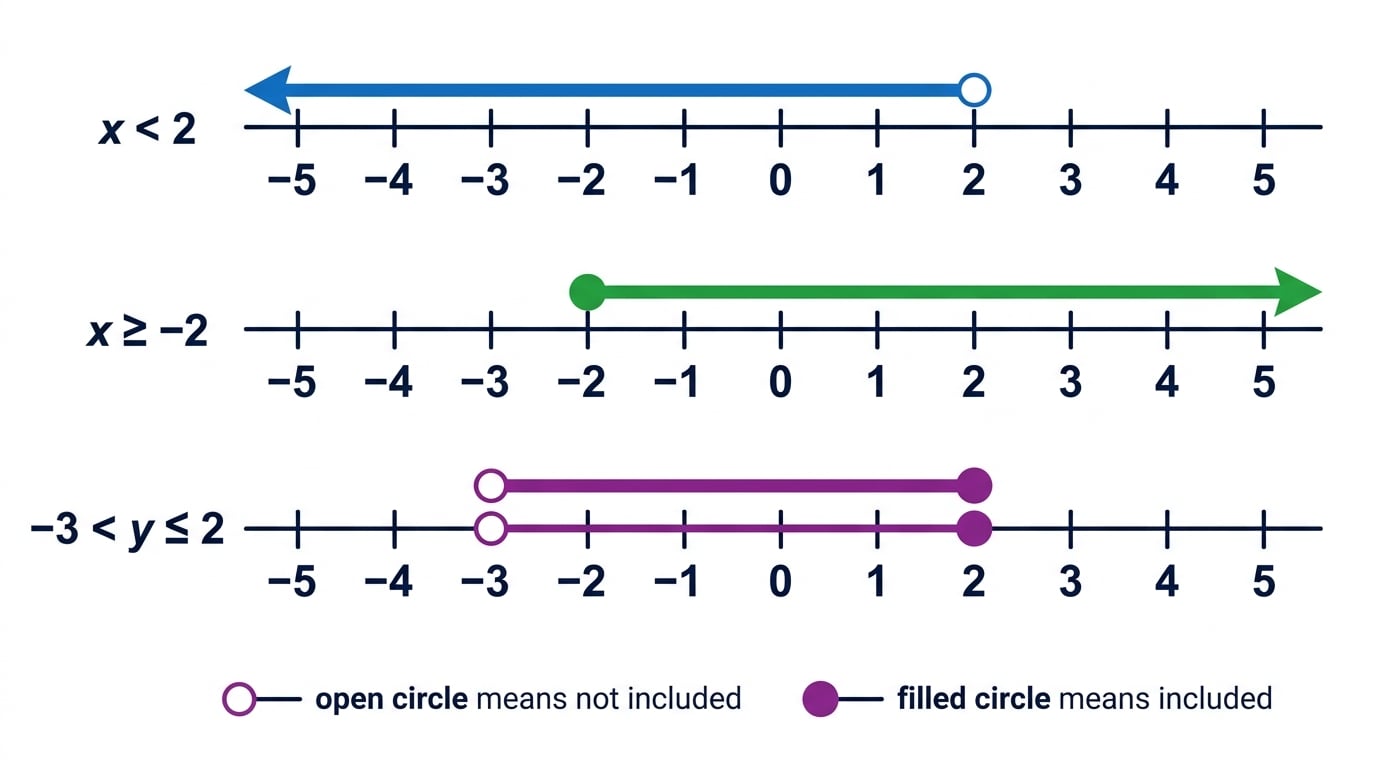
Showing inequalities on a number line
A number line is a line marked with numbers in order. It helps you show all the values that satisfy an inequality.
Use:
- an open circle for <<< or >>>, because the endpoint is not included
- a filled circle for ≤\le≤ or ≥\ge≥, because the endpoint is included
- an arrow when the values continue forever in one direction
- a thick line segment when the values are between two endpoints
Example
Drawing on a number line
-
Find -1 on the number line.
-
Because the sign is >>>, draw an open circle at -1.
-
Since xxx is greater than -1, shade to the right.
-
Add an arrow to show the values continue to the right forever.
Example
Writing an inequality from a number line
A number line has a filled circle at -4 and an arrow going to the right.
-
The filled circle means -4 is included, so use ≥\ge≥ rather than >>>.
-
The arrow goes to the right, so the values are greater than or equal to -4.
-
Write the inequality as:
x≥−4x\ge -4x≥−4
Common Mistake
Open circle vs filled circle
Do not use a filled circle for x<2x<2x<2 or x>2x>2x>2. A filled circle would include 2, but strict inequalities do not include the endpoint.
Listing integer values
An integer is a whole number, including negative whole numbers and zero. Examples include -3, -2, -1, 0, 1, 2 and 3.
When a question says the variable is an integer, you only list whole-number values that fit the inequality.
Example
Listing possible integer values
nnn is an integer and −3≤n<2-3\le n<2−3≤n<2. List all possible values of nnn.
-
Look at the left side: −3≤n-3\le n−3≤n means nnn can be -3 or anything bigger.
-
Look at the right side: n<2n<2n<2 means nnn must be less than 2, so 2 is not included.
-
List the integers from -3 up to, but not including, 2.
-
The possible values are n=−3,−2,−1,0,1n=-3,-2,-1,0,1n=−3,−2,−1,0,1.
Tip
Check the endpoints first
Before listing integers, ask: “Is the left endpoint included?” and “Is the right endpoint included?” That usually prevents losing a mark.
Solving one-step and two-step inequalities
You solve many inequalities almost like equations: use inverse operations, which are operations that undo each other.
For example:
- adding 7 is undone by subtracting 7
- multiplying by 4 is undone by dividing by 4
Key Idea
Keep the inequality balanced
Whatever you do to one side of the inequality, do the same to the other side.
Example
Solving a two-step inequality
Solve 3t+5≤203t+5\le 203t+5≤20.
-
Subtract 5 from both sides.
3t≤153t\le 153t≤15 -
Divide both sides by 3.
t≤5t\le 5t≤5 -
The solution is all values of ttt that are less than or equal to 5.
Example
Solving and showing on a number line
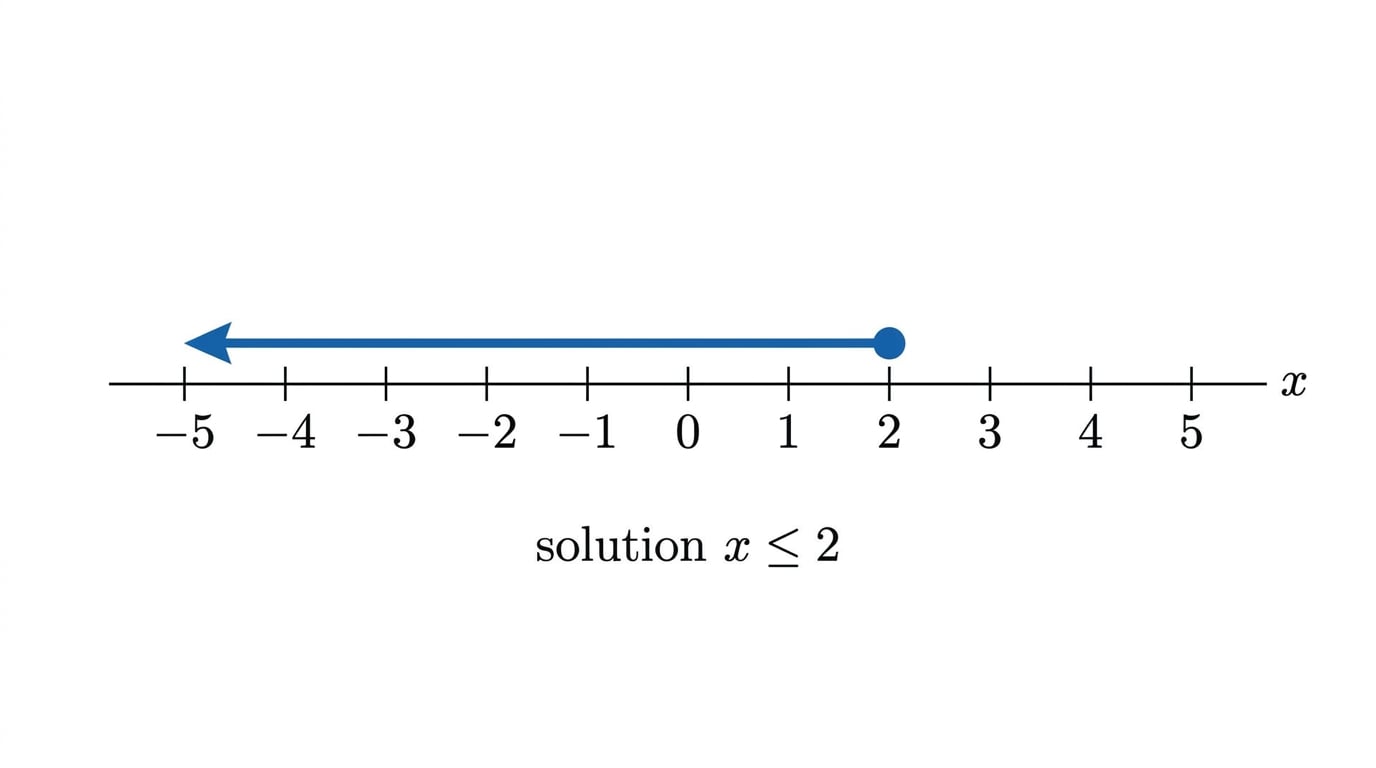
Solve 4x≤x+64x\le x+64x≤x+6 and show the solution on a number line.
-
Subtract xxx from both sides.
3x≤63x\le 63x≤6 -
Divide both sides by 3.
x≤2x\le 2x≤2 -
To show this on a number line, draw a filled circle at 2 and shade to the left.
The sign changes when you divide by a negative
There is one very important difference between equations and inequalities.
Common Mistake
Dividing or multiplying by a negative
If you multiply or divide both sides of an inequality by a negative number, reverse the inequality sign.
For example, if you get −3x<12-3x<12−3x<12, dividing by -3 gives x>−4x>-4x>−4, not x<−4x<-4x<−4.
Example
Solving when the coefficient is negative
Solve 5>17−3x5>17-3x5>17−3x.
-
Subtract 17 from both sides.
−12>−3x-12>-3x−12>−3x -
Divide both sides by -3, remembering to reverse the inequality sign.
4<x4<x4<x -
Rewrite it in the more familiar order.
x>4x>4x>4
Common Mistake
Forgetting to reverse the sign
The most common error is going from −12>−3x-12>-3x−12>−3x to 4>x4>x4>x. Because you divided by -3, the sign must reverse.
Double inequalities
A double inequality puts the variable between two bounds, such as −2<x≤5-2<x\le 5−2<x≤5.
This means both conditions must be true:
- xxx is greater than -2
- xxx is less than or equal to 5
Example
Drawing a double inequality
Show −4<n≤3-4<n\le 3−4<n≤3 on a number line.
-
Mark -4 with an open circle because nnn is greater than -4, not equal to -4.
-
Mark 3 with a filled circle because nnn can equal 3.
-
Draw a thick line between -4 and 3.
Example
Listing integer values from a double inequality
yyy is an integer and 2≤y<72\le y<72≤y<7. List the possible values of yyy.
-
The inequality starts at 2, and 2 is included.
-
The inequality ends before 7, so 7 is not included.
-
List the integers from 2 to 6.
-
The possible values are y=2,3,4,5,6y=2,3,4,5,6y=2,3,4,5,6.
Solving double inequalities
To solve a double inequality, do the same operation to all three parts: the left side, the middle, and the right side.
Example
Solving a double inequality for integers
yyy is an integer and 3≤2y−1<113\le 2y-1<113≤2y−1<11. List all possible values of yyy.
-
Add 1 to all three parts.
4≤2y<124\le 2y<124≤2y<12 -
Divide all three parts by 2.
2≤y<62\le y<62≤y<6 -
Since yyy is an integer, list the whole numbers from 2 up to, but not including, 6.
-
The possible values are y=2,3,4,5y=2,3,4,5y=2,3,4,5.
Tip
Work on all three parts
For a double inequality, avoid only changing the middle expression. If you add 1 to the middle, you must add 1 to the left and the right as well.
Inequalities with brackets
Sometimes you must expand brackets before solving. Expanding means multiplying the term outside the bracket by every term inside the bracket.
Example
Solving an inequality with brackets
Solve 2(3n−4)>102(3n-4)>102(3n−4)>10.
-
Expand the bracket.
6n−8>106n-8>106n−8>10 -
Add 8 to both sides.
6n>186n>186n>18 -
Divide both sides by 6.
n>3n>3n>3
Example
Solving when the variable is on both sides
Solve 5x−6≤2x+95x-6\le 2x+95x−6≤2x+9.
-
Subtract 2x2x2x from both sides.
3x−6≤93x-6\le 93x−6≤9 -
Add 6 to both sides.
3x≤153x\le 153x≤15 -
Divide both sides by 3.
x≤5x\le 5x≤5
Exam technique
In the exam
-
Decide whether each endpoint is included: open circle for <<< or >>>, filled circle for ≤\le≤ or ≥\ge≥.
-
When solving, show each inverse operation clearly so the examiner can award method marks.
-
If you multiply or divide by a negative number, reverse the inequality sign immediately.
Self review
Check yourself
- Can you explain the difference between x<3x<3x<3 and x≤3x\le 3x≤3 on a number line?
- If nnn is an integer and −2<n≤4-2<n\le 4−2<n≤4, which values of nnn are possible?
- When solving 10−2x<410-2x<410−2x<4, why does the inequality sign change?

Recap questions
Test yourself with 5 quick questions on this guide. Answer them all correctly to complete it.
You've reached the end
Test yourself on this topic, or move on to the next guide.
How was this guide?