Revision notes for Oxford AQA IGCSE Maths Multiplication and Division. Open the guide for explanations and worked examples. Written against the Oxford AQA IGCSE Maths (9260) specification, so the content matches what's examinable rather than general Maths background.
Multiplication and Division
What you'll learn
- How to multiply whole numbers using column methods and carrying.
- How to divide whole numbers using short division.
- How to multiply and divide decimals without losing the decimal point.
- How to handle divisions such as
71.2 ÷ 0.4by changing them into easier equivalent calculations.
The key language
Multiplication and division are linked. If you know that 6 groups of 7 make 42, then you also know that 42 shared into 6 equal groups gives 7.
Definition
Important words
- A factor is a number being multiplied.
- A product is the answer to a multiplication.
- A dividend is the number being divided.
- A divisor is the number you divide by.
- A quotient is the answer to a division.
Key Idea
Inverse operations
Multiplication and division are inverse operations, which means they undo each other. This is useful for checking answers.
Example
Checking with the inverse
Work out 8 groups of 9, then check using division.
-
Multiply 8 by 9.
8×9=728 \times 9 = 728×9=72 -
Use the inverse operation to check. Divide the product by one of the factors.
72÷8=972 \div 8 = 972÷8=9 -
Since the division gives the other factor, the multiplication is consistent.
Place value and carrying
A digit’s value depends on its place value. For example, in 347:
- 3 means 3 hundreds
- 4 means 4 tens
- 7 means 7 ones
When multiplying, you work from right to left. If a column total is 10 or more, you carry into the next column.
Definition
Carrying
Carrying means moving extra tens, hundreds, thousands, and so on into the next place-value column.
Multiplying by a single digit
For calculations like 386 × 7, use short multiplication.
Example
Short multiplication
Work out 386 × 7.
-
Start with the ones column: 6 times 7 gives 42. Write 2 in the ones column and carry 4 tens.
-
Move to the tens column: 8 times 7 gives 56. Add the carried 4 to get 60. Write 0 in the tens column and carry 6 hundreds.
-
Move to the hundreds column: 3 times 7 gives 21. Add the carried 6 to get 27.
-
Put the parts together.
386×7=2702386 \times 7 = 2702386×7=2702
Common Mistake
Forgetting the carry
A common error is to multiply the next digit but forget to add the carried number. Always say the carried number to yourself before moving on.
Tip
Estimate first
Before calculating, round to check the size of your answer. For example, 386 × 7 is close to 400 × 7, so the answer should be near 2800.
Dividing by a single digit
For calculations like 756 ÷ 6, use short division, often called the “bus stop” method.
A remainder is what is left over when a number does not divide exactly. In short division, a remainder is carried into the next place-value column.
Example
Short division
Work out 756 ÷ 6.
-
Start from the left. 6 goes into 7 once, with 1 left over.
-
Carry the remaining 1 hundred into the tens column. The 5 tens become 15 tens.
-
6 goes into 15 twice, with 3 left over.
-
Carry the remaining 3 tens into the ones column. The 6 ones become 36 ones.
-
6 goes into 36 exactly 6 times.
-
Write the answer.
756÷6=126756 \div 6 = 126756÷6=126
Tip
Use multiplication facts
Division is easier if you think, “What do I multiply the divisor by?” For example, 6 into 36 means “6 times what gives 36?”
Common Mistake
Never divide by zero
You can divide zero by a number, but you cannot divide by zero. For example, 0 ÷ 5 is 0, but 5 ÷ 0 is not defined.
Multiplying by a two-digit number
For a two-digit multiplier, split it into tens and ones.
For example, multiplying by 38 means multiplying by 30 and by 8, then adding the results.
Key Idea
Split the multiplier
To multiply by a two-digit number, multiply by the ones digit, multiply by the tens digit, then add.
Example
Long multiplication
Work out 64 × 38.
-
Split 38 into 30 and 8.
-
Multiply by the ones part.
64×8=51264 \times 8 = 51264×8=512 -
Multiply by the tens part.
64×30=192064 \times 30 = 192064×30=1920 -
Add the two partial products.
512+1920=2432\begin{aligned} 512 + 1920 &= 2432 \end{aligned}512+1920=2432 -
State the answer.
64×38=243264 \times 38 = 243264×38=2432
Common Mistake
Missing the zero
When multiplying by 30, 40, 50, and so on, remember you are multiplying by a tens number, not just by 3, 4, or 5. That extra zero matters.
Multiplying decimals by a whole number
A decimal point separates whole-number place values from smaller place values such as tenths and hundredths.
For example, in 48.26:
- 48 is the whole-number part
- 2 is in the tenths column
- 6 is in the hundredths column
When multiplying a decimal by a whole number, you can use the same carrying method. Keep the decimal point in the correct place.
Example
Decimal multiplied by a whole number
Work out 48.26 × 3.
-
Multiply as if you are doing short multiplication, starting from the right.
-
Ones of hundredths: 6 times 3 gives 18. Write 8 and carry 1.
-
Tenths: 2 times 3 gives 6, plus the carried 1 gives 7.
-
Ones: 8 times 3 gives 24. Write 4 and carry 2.
-
Tens: 4 times 3 gives 12, plus the carried 2 gives 14.
-
Place the decimal point directly in line with the original decimal point.
48.26×3=144.7848.26 \times 3 = 144.7848.26×3=144.78
Tip
Check the size
Since 48.26 is close to 50, 48.26 × 3 should be close to 150. So 144.78 is sensible, but 14.478 would be far too small.
Multiplying decimals by decimals
When both numbers have decimal points, a reliable method is:
- Ignore the decimal points.
- Multiply as whole numbers.
- Count the total number of decimal places in the original factors.
- Put that many decimal places in the answer.
Definition
Decimal places
Decimal places are the digits after the decimal point. For example, 9.04 has 2 decimal places and 7.6 has 1 decimal place.
Example
Multiplying two decimals
Work out 9.04 × 7.6.
-
Ignore the decimal points first. Think of the calculation as
904 × 76. -
Multiply 904 by 6.
904×6=5424904 \times 6 = 5424904×6=5424 -
Multiply 904 by 70.
904×70=63280904 \times 70 = 63280904×70=63280 -
Add the partial products.
5424+63280=68704\begin{aligned} 5424 + 63280 &= 68704 \end{aligned}5424+63280=68704 -
Count the decimal places in the original question: 9.04 has 2 decimal places and 7.6 has 1 decimal place, so the answer needs 3 decimal places.
-
Place the decimal point.
9.04×7.6=68.7049.04 \times 7.6 = 68.7049.04×7.6=68.704
Common Mistake
Counting decimal places wrongly
Do not just copy the decimal point position from one number. Count all the decimal places in both factors.
Dividing decimals by a whole number
When dividing a decimal by a whole number, place the decimal point in the answer directly above the decimal point in the dividend.
Example
Decimal divided by a whole number
Work out 42.84 ÷ 6.
-
Divide the whole-number part first: 6 goes into 42 exactly 7 times.
-
Put the decimal point in the answer directly above the decimal point in 42.84.
-
Divide the tenths: 6 goes into 8 tenths once, with 2 tenths left over.
-
Carry the 2 tenths into the hundredths column. The 4 hundredths become 24 hundredths.
-
Divide the hundredths: 6 goes into 24 exactly 4 times.
-
Write the answer.
42.84÷6=7.1442.84 \div 6 = 7.1442.84÷6=7.14
Sometimes you run out of digits but still have a remainder. You may add a zero after the decimal point because it does not change the value. For example, 18.2 is the same as 18.20.
Example
Adding a zero when dividing
Work out 18.2 ÷ 4.
-
4 goes into 18 four times, with 2 left over.
-
Put the decimal point in the answer.
-
Carry the remainder into the tenths column. The 2 tenths make 22 tenths, so 4 goes into 22 five times, with 2 left over.
-
Add a zero after the decimal point so 18.2 becomes 18.20.
-
Carry the remainder into the hundredths column. 4 goes into 20 exactly 5 times.
-
Write the answer.
18.2÷4=4.5518.2 \div 4 = 4.5518.2÷4=4.55
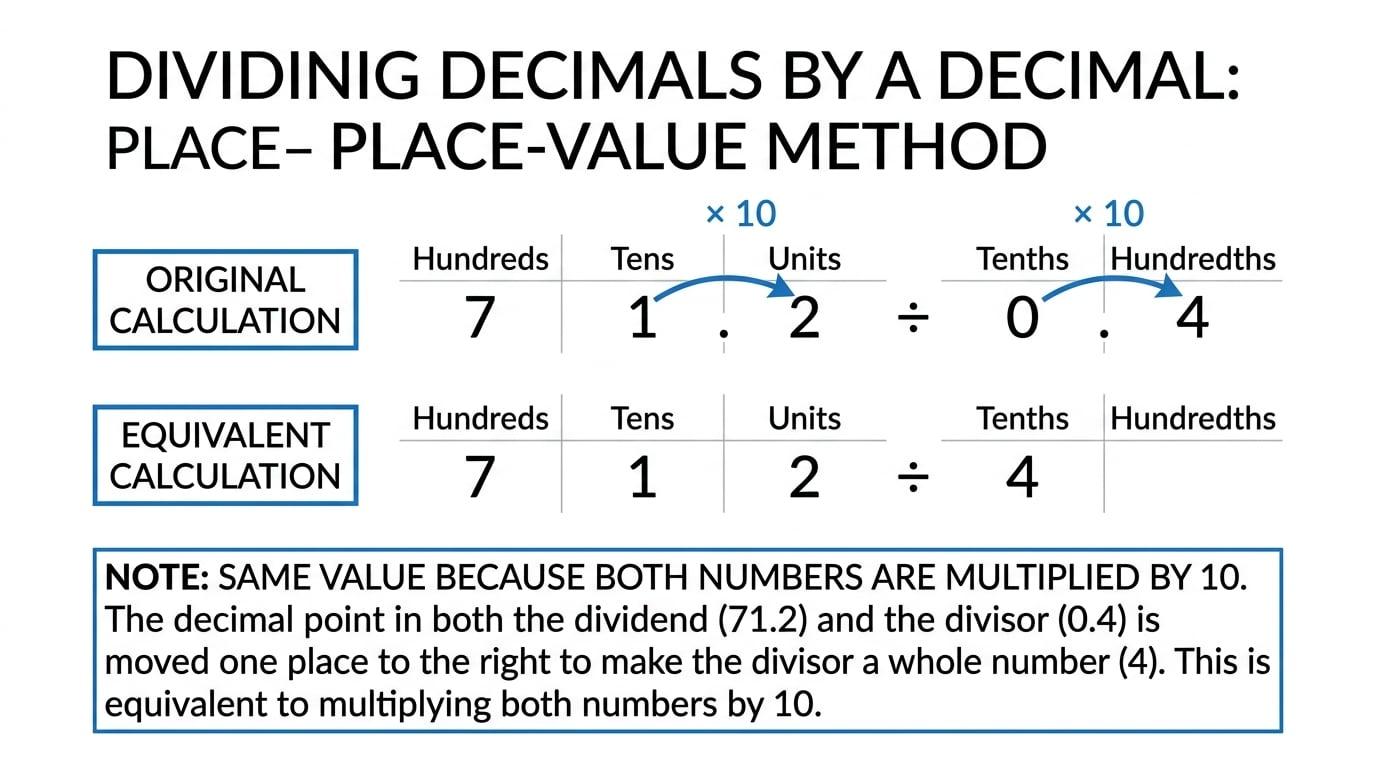
Dividing by a decimal
If the divisor is a decimal, change the calculation into an equivalent one where the divisor is a whole number.
You do this by multiplying both numbers by the same power of 10, such as 10 or 100. The answer stays the same because the ratio between the numbers has not changed.
Example
Dividing by a decimal
Work out 54.4 ÷ 0.8.
-
The divisor is 0.8, which is not a whole number.
-
Multiply both numbers by 10 to make the divisor whole.
54.4÷0.8=544÷854.4 \div 0.8 = 544 \div 854.4÷0.8=544÷8 -
Now divide 544 by 8.
-
8 goes into 54 six times, with 6 left over.
-
Carry the 6 into the ones column. 8 goes into 64 exactly 8 times.
-
Write the answer.
54.4÷0.8=6854.4 \div 0.8 = 6854.4÷0.8=68
Common Mistake
Only moving one decimal point
If you multiply the divisor by 10, you must also multiply the dividend by 10. Changing only one number changes the answer.
Quick reasonableness checks
Before you finish, ask: “Does my answer make sense?”
- Multiplying by a number bigger than 1 usually makes the answer bigger.
- Dividing by a whole number bigger than 1 usually makes the answer smaller.
- Dividing by a decimal less than 1 can make the answer bigger. For example, dividing by 0.5 is the same as finding how many halves fit in the number.
Exam technique
In the exam
- Estimate first so you know roughly how big the answer should be.
- Keep digits lined up carefully, especially decimal points in division.
- For decimal division, make the divisor a whole number by doing the same change to both numbers.
- Check your answer using the inverse operation if you have time.
Self review
Check yourself
- Can you explain why
63 ÷ 7checks7 × 9? - When multiplying 3.08 by 4.6, how many decimal places should the answer have?
- In
45.6 ÷ 0.3, what equivalent division would you do first?

Recap questions
Test yourself with 5 quick questions on this guide. Answer them all correctly to complete it.
You've reached the end
Test yourself on this topic, or move on to the next guide.
How was this guide?