Revision notes for Oxford AQA IGCSE Maths Time. Open the guide for explanations and worked examples. Written against the Oxford AQA IGCSE Maths (9260) specification, so the content matches what's examinable rather than general Maths background.
Time
What you'll learn
- Convert between hours and minutes.
- Find the difference between two lengths of time.
- Add several time intervals to find an arrival or finish time.
- Read train and bus timetables, including planning backwards from a deadline.
The basic units of time
A minute is a small unit of time. An hour is a larger unit of time.
Definition
Hours and minutes
There are 60 minutes in 1 hour.
This is the key fact for almost every time question at this level.
Key Idea
The conversion fact
- To change hours to minutes, multiply by 60.
- To change minutes to hours, divide by 60.
Changing minutes to hours
If you have 120 minutes, think: “How many groups of 60 minutes are there?”
Example
Changing minutes to hours
Change 180 minutes to hours.
-
Remember that 60 minutes = 1 hour.
-
Divide the number of minutes by 60:
180÷60=3180 \div 60 = 3180÷60=3 -
So 180 minutes is 3 hours.
Changing hours to minutes
If you have hours and want minutes, multiply by 60.
Example
Changing hours to minutes
Change 5 hours to minutes.
-
Remember that 1 hour = 60 minutes.
-
Multiply by 60:
5×60=3005 \times 60 = 3005×60=300 -
So 5 hours is 300 minutes.
Tip
Quick mental check
Half an hour is 30 minutes, so 2 hours is 120 minutes, 3 hours is 180 minutes, and 4 hours is 240 minutes.
Mixed times: hours and minutes together
Sometimes a time is written using both hours and minutes, such as 2 hours 20 minutes.
To work with these, it is usually easiest to change everything into minutes first.
Definition
Duration
A duration is a length of time, such as 45 minutes, 2 hours, or 1 hour 30 minutes.
Converting mixed hours and minutes
To convert 2 hours 25 minutes into minutes:
- 2 hours = 120 minutes
- 25 minutes stays as 25 minutes
- Total = 145 minutes
Example
Changing a mixed time to minutes
Change 3 hours 15 minutes to minutes.
-
Convert the hours into minutes:
3×60=1803 \times 60 = 1803×60=180 -
Add the extra 15 minutes:
180+15=195180 + 15 = 195180+15=195 -
So 3 hours 15 minutes is 195 minutes.
Fractions of an hour
You may see fractions such as 12\frac{1}{2}21 hour, 14\frac{1}{4}41 hour, or 34\frac{3}{4}43 hour.
Because 1 hour is 60 minutes:
- 12\frac{1}{2}21 hour = 30 minutes
- 14\frac{1}{4}41 hour = 15 minutes
- 34\frac{3}{4}43 hour = 45 minutes
Example
Converting a fraction of an hour
Change 1341\frac{3}{4}143 hours into minutes.
-
Split the mixed number into 1 hour and 34\frac{3}{4}43 hour.
-
Convert 1 hour to minutes:
1×60=601 \times 60 = 601×60=60 -
Convert 34\frac{3}{4}43 hour to minutes:
34×60=45\frac{3}{4} \times 60 = 4543×60=45 -
Add the two parts:
60+45=10560 + 45 = 10560+45=105 -
So 1341\frac{3}{4}143 hours is 105 minutes.
Common Mistake
Forgetting the fraction part
Do not change 1121\frac{1}{2}121 hours to just 60 minutes. The 12\frac{1}{2}21 hour is another 30 minutes, so 1121\frac{1}{2}121 hours is 90 minutes.
Finding the difference between two times
The difference means how far apart two amounts are. In time questions, this is often asking: “How many minutes longer is one duration than the other?”
A safe method is:
- Convert both durations into minutes.
- Subtract the smaller number from the larger number.
- Write the answer in minutes if the question asks for minutes.
Example
Finding a difference in minutes
Work out the difference, in minutes, between 50 minutes and 1121\frac{1}{2}121 hours.
-
Convert 1121\frac{1}{2}121 hours into minutes. One hour is 60 minutes and half an hour is 30 minutes.
-
Add them:
60+30=9060 + 30 = 9060+30=90 -
Now compare 90 minutes and 50 minutes.
-
Subtract:
90−50=4090 - 50 = 4090−50=40 -
The difference is 40 minutes.
Example
Comparing a mixed time with a fraction of an hour
Find the difference, in minutes, between 2 hours 10 minutes and 1341\frac{3}{4}143 hours.
-
Convert 2 hours 10 minutes into minutes:
2×60+10=1302 \times 60 + 10 = 1302×60+10=130 -
Convert 1341\frac{3}{4}143 hours into minutes:
60+45=10560 + 45 = 10560+45=105 -
Subtract the smaller duration from the larger duration:
130−105=25130 - 105 = 25130−105=25 -
The difference is 25 minutes.
Adding time to a starting time
Many questions tell you when someone starts, then give several durations. You need to find the final time.
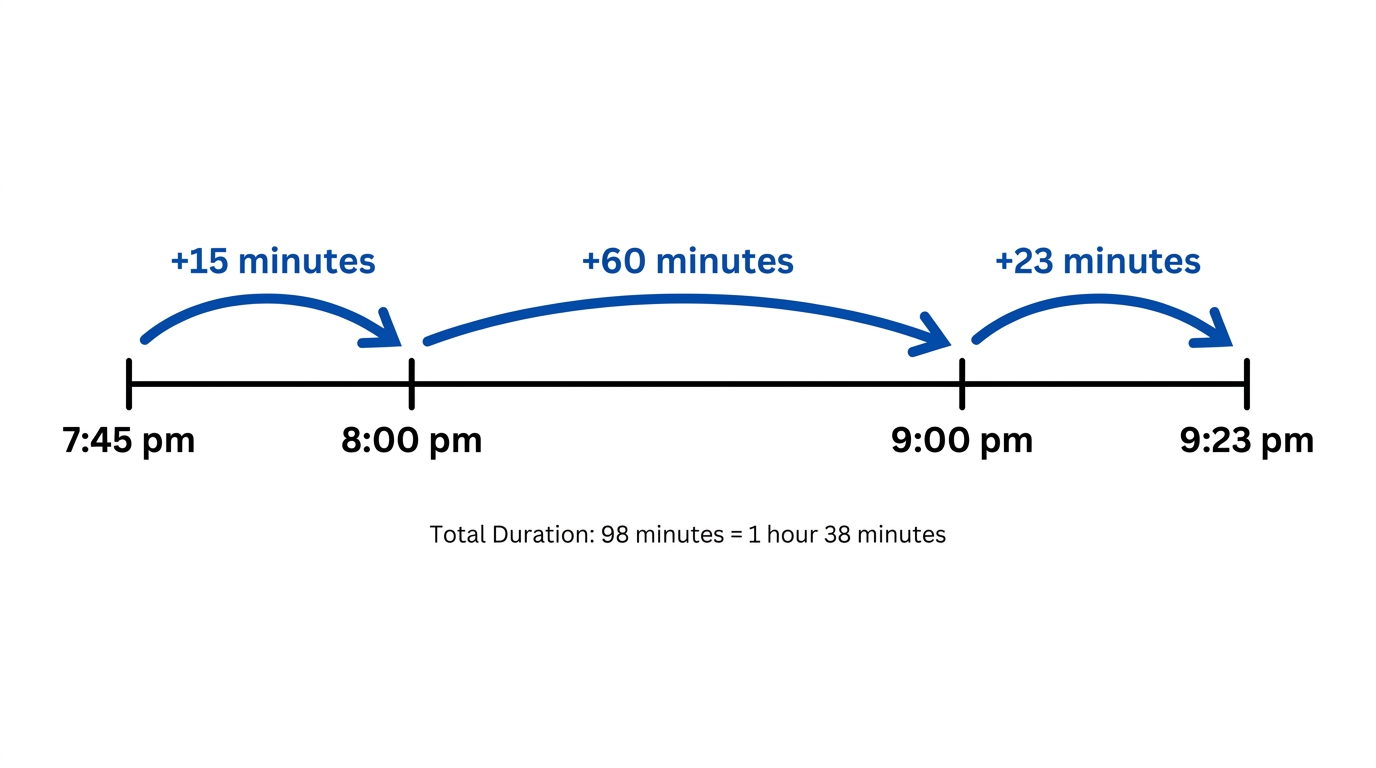
A good method is to add the minutes in stages. If you cross an hour, use the next o’clock time as a helpful checkpoint.
Here is a visual way to split a duration when it crosses an hour.
Definition
am and pm
am means after midnight and before midday. pm means after midday and before midnight.
Adding several parts of a journey
Example
Finding an arrival time
Aisha leaves home at 11.35 am. She walks for 18 minutes to a café, stays there for 12 minutes, then walks for 25 minutes to a friend’s house. What time does she arrive?
-
Start with the leaving time: 11.35 am.
-
Add the first walk of 18 minutes:
11:35+18 minutes=11:5311{:}35 + 18\text{ minutes} = 11{:}5311:35+18 minutes=11:53 -
Add the café stop of 12 minutes:
11:53+12 minutes=12:0511{:}53 + 12\text{ minutes} = 12{:}0511:53+12 minutes=12:05 -
Add the second walk of 25 minutes:
12:05+25 minutes=12:3012{:}05 + 25\text{ minutes} = 12{:}3012:05+25 minutes=12:30 -
Aisha arrives at 12.30 pm.
Tip
Crossing midday
After 11.59 am comes 12.00 pm, not 12.00 am. Midday is 12 pm.
Adding a duration longer than an hour
If a film lasts 98 minutes, you can split it into 1 hour and 38 minutes because 98 minutes = 60 minutes + 38 minutes.
Example
Finding a finish time
A film starts at 6.50 pm and lasts 95 minutes. What time does it finish?
-
Split 95 minutes into 1 hour and 35 minutes.
-
Add 1 hour to 6.50 pm:
6:50 pm+1 hour=7:50 pm6{:}50\text{ pm} + 1\text{ hour} = 7{:}50\text{ pm}6:50 pm+1 hour=7:50 pm -
Add the remaining 35 minutes:
7:50 pm+35 minutes=8:25 pm7{:}50\text{ pm} + 35\text{ minutes} = 8{:}25\text{ pm}7:50 pm+35 minutes=8:25 pm -
The film finishes at 8.25 pm.
Common Mistake
Adding minutes like ordinary decimals
Do not treat 7.50 plus 35 minutes as 7.85. There are only 60 minutes in an hour, so 7.85 is not a real clock time.
Reading 24-hour times
Timetables often use the 24-hour clock. This means the day runs from 0000 to 2359.
Definition
24-hour clock
The 24-hour clock writes times using four digits. For example, 0715 means 7.15 am, and 1540 means 3.40 pm.
For Grade 1 time questions, you usually only need to read the times and find differences in minutes.
Examples:
- 0540 means 5.40 am.
- 0917 means 9.17 am.
- 1632 means 4.32 pm.
Common Mistake
Four-digit times
In a timetable, 0701 means 7.01 am. The zero is important because it keeps the time in four-digit form.
Reading timetables
A timetable is a table showing when buses, trains, or events happen.
Usually:
- Each column is one bus or train journey.
- Each row is one place.
- A dash means that service does not stop there.
Definition
Timetable column
In a travel timetable, one vertical column usually follows one vehicle from stop to stop.
Finding a journey time from a timetable
To find how long a journey takes:
- Choose the correct column.
- Read the departure time from the starting place.
- Read the arrival time at the destination.
- Find the difference.
Example
Finding a train journey time
A train leaves City Station at 06:20 and arrives at Airport Station at 09:05. How many minutes does the journey take?
-
From 06:20 to 09:20 is 3 hours.
-
But the train arrives at 09:05, which is 15 minutes earlier than 09:20.
-
So the journey is 2 hours 45 minutes.
-
Convert 2 hours 45 minutes to minutes:
2×60+45=1652 \times 60 + 45 = 1652×60+45=165 -
The journey takes 165 minutes.
Tip
Counting up is often easier
Instead of subtracting clock times, count up to the next hour and then to the arrival time. For example, from 07:24 to 08:37: 36 minutes to 08:00, then 37 more minutes, giving 73 minutes.
Choosing the latest possible train or bus
Sometimes you are given a deadline, such as a meeting at 10.30 am. You need the latest service that arrives before or at that time.
Example
Choosing the latest train before a deadline
A traveller must arrive by 10.30 am. The possible arrival times are 09:50, 10:18, 10:34, and 11:05. Which is the latest one they can use?
-
The deadline is 10.30 am.
-
Any arrival after 10.30 am is too late, so 10:34 and 11:05 cannot be used.
-
The remaining arrivals are 09:50 and 10:18.
-
The latest of these is 10:18.
-
So the traveller should choose the service arriving at 10.18 am.
Common Mistake
Picking the latest time overall
If the deadline is 10.30 am, an arrival at 10.34 am is not okay, even though it is only 4 minutes late. The latest possible time must still be on time.
Planning backwards from a deadline
Some timetable questions include walking time before or after a journey.
If someone must be at work by 9.00 am and it takes 8 minutes to walk from the station to work, they need to arrive at the station by 8.52 am.
This is called working backwards.
Example
Working backwards with a bus timetable
Ben needs to be at work by 9.00 am. It takes him 10 minutes to walk from the bus stop to work. The bus arrival times at his destination are 08:35, 08:47, 08:56, and 09:04. It also takes him 12 minutes to walk from home to the bus stop. What is the latest time he can leave home?
-
Work backwards from 9.00 am by subtracting the 10-minute walk to work:
9:00−10 minutes=8:509{:}00 - 10\text{ minutes} = 8{:}509:00−10 minutes=8:50 -
Ben needs a bus that arrives at the destination by 8.50 am.
-
The latest suitable bus arrival is 08:47.
-
If that bus leaves his starting bus stop at 08:12, he must be at the bus stop by 08:12.
-
Subtract the 12-minute walk from home:
8:12−12 minutes=8:008{:}12 - 12\text{ minutes} = 8{:}008:12−12 minutes=8:00 -
The latest time Ben can leave home is 8.00 am.
Tip
Show the whole chain
For timetable word problems, write the chain of times: leave home, reach stop, bus leaves, bus arrives, reach final place. This helps you spot missing walking times.
Deciding whether someone is on time
You may be asked whether someone reaches a meeting by a certain time. You must show your working, not just write yes or no.
Example
Checking if someone arrives on time
Maya leaves home at 3.10 pm. It takes 15 minutes to get to the station. Her train leaves at 3.34 pm and arrives at 4.48 pm. It then takes her 18 minutes to walk to a meeting. The meeting starts at 5.00 pm. Is she on time?
-
Add the journey from home to the station:
3:10 pm+15 minutes=3:25 pm3{:}10\text{ pm} + 15\text{ minutes} = 3{:}25\text{ pm}3:10 pm+15 minutes=3:25 pm -
Maya reaches the station at 3.25 pm, so she is in time for the 3.34 pm train.
-
The train arrives at 4.48 pm.
-
Add the final walk:
4:48 pm+18 minutes=5:06 pm4{:}48\text{ pm} + 18\text{ minutes} = 5{:}06\text{ pm}4:48 pm+18 minutes=5:06 pm -
Maya arrives at 5.06 pm, so she is not on time for a 5.00 pm meeting.
Exam technique
In the exam
-
Convert hours, fractions of hours, and mixed times into minutes before comparing durations.
-
For arrival-time questions, add each part in order and watch carefully when you pass an hour.
-
In timetable questions, follow one column at a time and remember to include any walking or waiting times given in the question.
Self review
Check yourself
-
Can you explain why 1141\frac{1}{4}141 hours is 75 minutes?
-
If a journey starts at 8.45 am and lasts 50 minutes, can you find the finish time?
-
In a timetable, can you identify which times are too late for a 10.30 am deadline?

Recap questions
Test yourself with 5 quick questions on this guide. Answer them all correctly to complete it.
You've reached the end
Test yourself on this topic, or move on to the next guide.
How was this guide?