Revision notes for Oxford AQA IGCSE Maths Addition and Subtraction. Open the guide for explanations and worked examples. Written against the Oxford AQA IGCSE Maths (9260) specification, so the content matches what's examinable rather than general Maths background.
Addition and Subtraction
What you'll learn
- How to add and subtract whole numbers using column methods.
- How to line up decimals correctly before calculating.
- How to handle money questions with pounds and pence.
- How to deal with longer calculations containing both addition and subtraction.
The big idea: place value
Before you add or subtract, you need to know what each digit is worth.
For example, in 4,372:
- 4 means 4 thousands
- 3 means 3 hundreds
- 7 means 7 tens
- 2 means 2 ones
Definition
Place value
Place value means the value of a digit because of its position in a number. In 58.26, the 5 is worth 50, the 8 is worth 8, the 2 is worth two tenths, and the 6 is worth six hundredths.
When you use a column method, digits with the same place value must be lined up underneath each other.
Key Idea
Line up matching columns
Ones go under ones, tens go under tens, tenths go under tenths, and hundredths go under hundredths. This is the main rule for both addition and subtraction.
Adding whole numbers
To add means to combine amounts. The answer to an addition is called the sum or total.
When a column makes 10 or more, you need to carry into the next column.
Definition
Carrying
Carrying means regrouping 10 of one place value into 1 of the next place value. For example, 12 ones is the same as 1 ten and 2 ones.
Worked example: adding a 3-digit number and a 2-digit number
Example
Adding whole numbers
Work out 368 + 74.
-
Line up the numbers by place value. The 74 has no hundreds digit, so it sits under the tens and ones columns.
-
Add the ones column first: 8 + 4 = 12. Write 2 in the ones column and carry 1 ten.
-
Add the tens column, including the carried 1:
6+7+1=146 + 7 + 1 = 146+7+1=14 -
Write 4 in the tens column and carry 1 hundred.
-
Add the hundreds column: 3 + 1 = 4.
-
The total is:
368+74=442368 + 74 = 442368+74=442
Tip
Quick check
For 368 + 74, you can estimate first: 370 + 70 is about 440, so 442 is sensible.
Adding more than two numbers
Sometimes you may need to add three numbers. The method is the same: line up the place values and add from right to left.
Worked example: adding three numbers
Example
Adding three whole numbers
Work out 1475 + 206 + 93.
-
Line up the ones, tens, hundreds and thousands.
-
Add the ones column: 5 + 6 + 3 = 14. Write 4 and carry 1 ten.
-
Add the tens column:
7+0+9+1=177 + 0 + 9 + 1 = 177+0+9+1=17 -
Write 7 and carry 1 hundred.
-
Add the hundreds column:
4+2+0+1=74 + 2 + 0 + 1 = 74+2+0+1=7 -
Add the thousands column: 1.
-
The answer is:
1475+206+93=17741475 + 206 + 93 = 17741475+206+93=1774
Subtracting whole numbers
To subtract means to take one amount away from another. The answer to a subtraction is called the difference.
If the top digit is too small, you need to exchange from the next column.
Definition
Exchanging
Exchanging means taking 1 from the next place value and turning it into 10 of the place value you need. For example, 1 ten can be exchanged for 10 ones.
Worked example: subtracting with exchanging
Example
Subtracting whole numbers
Work out 3740 - 526.
-
Line up the numbers by place value. Think of 526 as 0526 so the columns match.
-
Start with the ones: 0 - 6 cannot be done using whole-number column subtraction, so exchange 1 ten from the 4 tens.
-
The 4 tens becomes 3 tens, and the 0 ones becomes 10 ones. Now subtract the ones:
10−6=410 - 6 = 410−6=4 -
Subtract the tens:
3−2=13 - 2 = 13−2=1 -
Subtract the hundreds:
7−5=27 - 5 = 27−5=2 -
Subtract the thousands:
3−0=33 - 0 = 33−0=3 -
The answer is:
3740−526=32143740 - 526 = 32143740−526=3214
Common Mistake
Forgetting the exchanged digit
If you exchange from a column, remember to reduce that column by 1 before you use it. For example, if 4 tens gives 1 ten away, it becomes 3 tens.
Adding and subtracting decimals
A decimal is a number with a decimal point, such as 21.4 or 58.26. Digits after the decimal point are parts of a whole.
- The first digit after the decimal point is tenths.
- The second digit after the decimal point is hundredths.
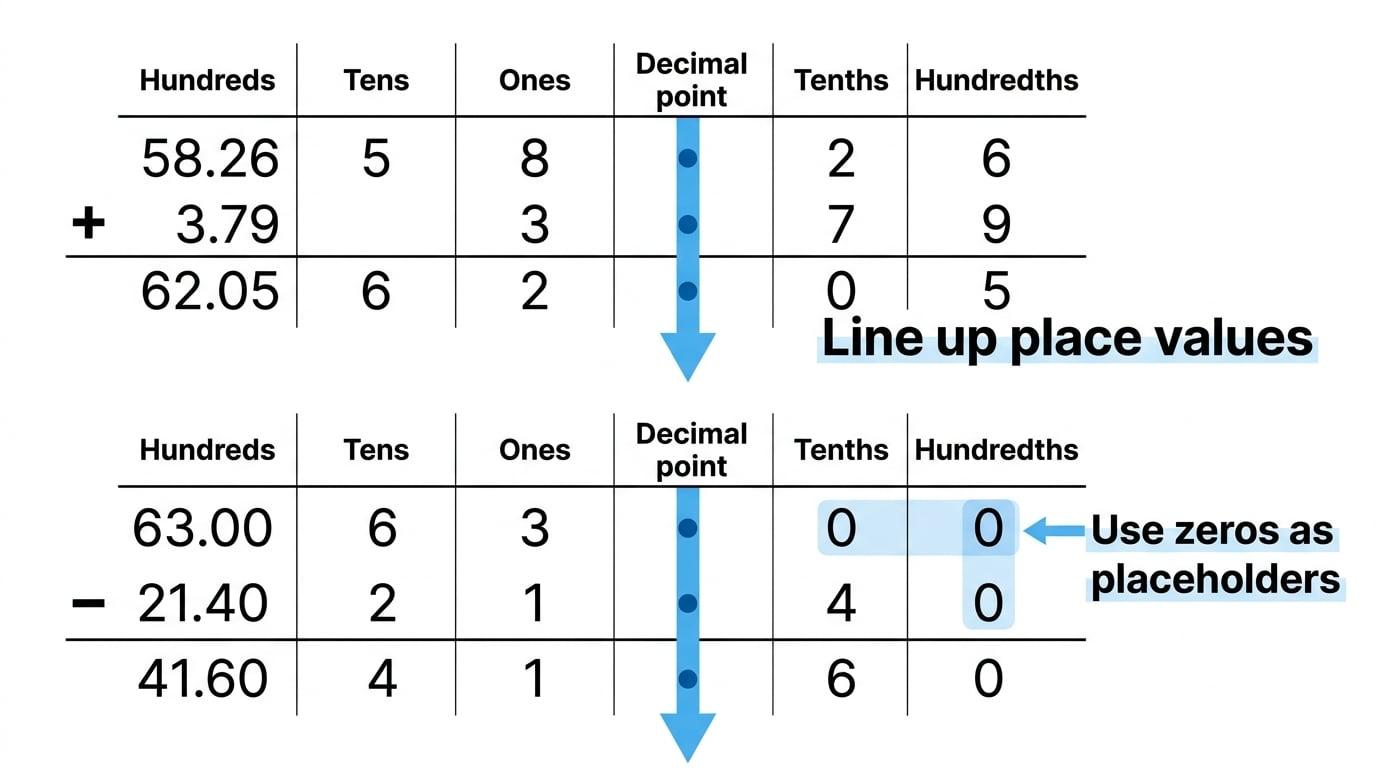
When adding or subtracting decimals, the decimal points must be lined up vertically. You can add zeros as placeholders to make the columns clearer.
Definition
Placeholder zero
A placeholder zero is a zero added to show an empty place value. It does not change the value of the number. For example, 62 is the same value as 62.0 or 62.00.
Worked example: adding decimals
Example
Adding decimals
Work out 58.26 + 4.87.
-
Line up the decimal points. This puts ones under ones, tenths under tenths, and hundredths under hundredths.
-
Add the hundredths: 6 + 7 = 13. Write 3 and carry 1 tenth.
-
Add the tenths:
2+8+1=112 + 8 + 1 = 112+8+1=11 -
Write 1 in the tenths column and carry 1 one.
-
Add the ones:
8+4+1=138 + 4 + 1 = 138+4+1=13 -
Write 3 in the ones column and carry 1 ten.
-
Add the tens: 5 + 1 = 6.
-
The answer is:
58.26+4.87=63.1358.26 + 4.87 = 63.1358.26+4.87=63.13
Worked example: subtracting a decimal from a whole number
Example
Subtracting decimals
Work out 72 - 18.6.
-
Write 72 as 72.0 so it has a tenths column.
-
Line up the decimal points:
72.0−18.672.0 - 18.672.0−18.6 -
Start with the tenths. You cannot do 0 - 6, so exchange 1 one from the 2 ones.
-
The 2 ones becomes 1 one, and the 0 tenths becomes 10 tenths.
-
Subtract the tenths:
10−6=410 - 6 = 410−6=4 -
Now subtract the ones. You cannot do 1 - 8, so exchange 1 ten from the 7 tens.
-
The 7 tens becomes 6 tens, and the 1 one becomes 11 ones.
-
Finish the subtraction:
11−8=36−1=5\begin{aligned} 11 - 8 &= 3 \\ 6 - 1 &= 5 \end{aligned}11−86−1=3=5 -
The answer is:
72−18.6=53.472 - 18.6 = 53.472−18.6=53.4
Common Mistake
Lining up the right-hand ends
Do not line decimals up by the last digit. Line up the decimal points. For example, 4.87 must go under 58.26 with the decimal points in the same vertical line.
Adding and subtracting money
Money questions work like decimal questions, but money is normally written to two decimal places because there are 100 pence in £1.
For example:
- £6.50 means 6 pounds and 50 pence.
- £6.05 means 6 pounds and 5 pence.
- £6.5 should usually be written as £6.50 in a final money answer.
Worked example: finding change
Example
Subtracting money
A book costs £18.76. You pay with £40. Work out the change.
-
Write £40 as £40.00 so there are two decimal places.
-
Ignore the pound sign while doing the column subtraction, but remember the answer is still money.
-
Subtract 18.76 from 40.00. You will need to exchange because there are zeros after the decimal point.
-
The numerical calculation is:
40.00−18.76=21.2440.00 - 18.76 = 21.2440.00−18.76=21.24 -
Put the pound sign back on the answer: £21.24.
Tip
Money answers
Always give money answers with two digits after the decimal point, such as £3.40 rather than £3.4.
Longer calculations with addition and subtraction
For a calculation containing only addition and subtraction, a safe method is to work from left to right.
You can also group the numbers you are adding and the numbers you are subtracting, but you must keep the operation with each number.
Worked example: mixed decimals
Example
Adding and subtracting decimals together
Work out 18.7 + 24 - 6.58.
-
Write the numbers with the same number of decimal places:
18.70+24.00−6.5818.70 + 24.00 - 6.5818.70+24.00−6.58 -
Add the first two numbers:
18.70+24.00=42.7018.70 + 24.00 = 42.7018.70+24.00=42.70 -
Now subtract 6.58 from 42.70.
-
Exchange in the hundredths column because 0 - 8 cannot be done directly.
-
Finish the subtraction:
42.70−6.58=36.1242.70 - 6.58 = 36.1242.70−6.58=36.12 -
So the final answer is 36.12.
Worked example: a longer mixed calculation
Example
Grouping added and subtracted amounts
Work out 64.5 - 18.23 - 7.4 + 25.
-
Write each number to two decimal places:
64.50−18.23−7.40+25.0064.50 - 18.23 - 7.40 + 25.0064.50−18.23−7.40+25.00 -
Add the amounts that are being added:
64.50+25.00=89.5064.50 + 25.00 = 89.5064.50+25.00=89.50 -
Add the amounts that are being subtracted:
18.23+7.40=25.6318.23 + 7.40 = 25.6318.23+7.40=25.63 -
Subtract the total taken away from the total added:
89.50−25.63=63.8789.50 - 25.63 = 63.8789.50−25.63=63.87 -
The answer is 63.87.
Common Mistake
Dropping the minus sign
In a longer calculation, the sign before a number belongs with that number. In 64.5 - 18.23 - 7.4 + 25, both 18.23 and 7.4 are amounts being subtracted.
Final accuracy checks
Before you move on, ask yourself:
- Are the columns lined up correctly?
- Have you included placeholder zeros where needed?
- Did you carry or exchange carefully?
- Does your answer make sense compared with an estimate?
Exam technique
In the exam
-
Write the calculation clearly in columns, especially when decimals or money are involved.
-
Estimate before or after calculating so you can spot answers that are much too big or too small.
-
For money, always finish with a pound sign and two decimal places.
Self review
Check yourself
-
If you calculate 63 - 21.4, why is it helpful to write 63 as 63.0?
-
In a column addition, what should you do if a column adds to 10 or more?
-
Why is lining up decimal points more important than lining up the final digits?

Recap questions
Test yourself with 5 quick questions on this guide. Answer them all correctly to complete it.
You've reached the end
Test yourself on this topic, or move on to the next guide.
How was this guide?