Revision notes for Edexcel IGCSE Maths Solving Simultaneous Equations Graphically. Open the guide for explanations and worked examples. Written against the Edexcel IGCSE Maths (4MA1) specification, so the content matches what's examinable rather than general Maths background.
Solving Simultaneous Equations Graphically
What you'll learn
- How to read coordinates accurately from a graph.
- Why the intersection of two straight lines solves two equations at once.
- How to draw straight-line graphs from equations such as 3y−x=63y - x = 63y−x=6.
- How to write your final answer as coordinates, usually in the form (x,y)(x, y)(x,y).
1. The basics: points, axes and straight lines
A graph uses two number lines crossing at right angles:
- the horizontal axis is the x-axis
- the vertical axis is the y-axis
- a point is written as an ordered pair, such as (2,5)(2, 5)(2,5)
The first number tells you how far to move across. The second number tells you how far to move up or down.
Definition
Ordered pair
An ordered pair is a coordinate written as (x,y)(x, y)(x,y), where xxx is the horizontal value and yyy is the vertical value.
A straight-line equation, such as y=2x+1y = 2x + 1y=2x+1, has lots of possible coordinate pairs that make it true. When all those points are joined, they form a straight line.
Example
Checking whether a point lies on a line
Does the point (3,7)(3, 7)(3,7) lie on the line y=2x+1y = 2x + 1y=2x+1?
-
Identify the coordinate values:
- x=3x = 3x=3
- y=7y = 7y=7
-
Substitute x=3x = 3x=3 into the right-hand side of the equation:
2x+1=2(3)+1=72x + 1 = 2(3) + 1 = 72x+1=2(3)+1=7 -
Compare this with the y-coordinate of the point. The point has y=7y = 7y=7, so it matches.
-
Therefore, (3,7)(3, 7)(3,7) lies on the line y=2x+1y = 2x + 1y=2x+1.
Tip
Reading coordinates
Always read coordinates in the order across, then up/down. So (4,−2)(4, -2)(4,−2) means move 4 right, then 2 down.
2. What are simultaneous equations?
Definition
Simultaneous equations
Simultaneous equations are two or more equations that are true at the same time. A solution must satisfy every equation in the set.
For two straight-line equations, each equation makes a line. The solution is the point that lies on both lines.
That means the solution is the point of intersection.
Definition
Point of intersection
The point of intersection is the point where two graphs cross. Its coordinates give the values of xxx and yyy that satisfy both equations.
Key Idea
The big idea
To solve simultaneous equations graphically, find where the two lines cross. The x-coordinate and y-coordinate of that crossing point are the solution.
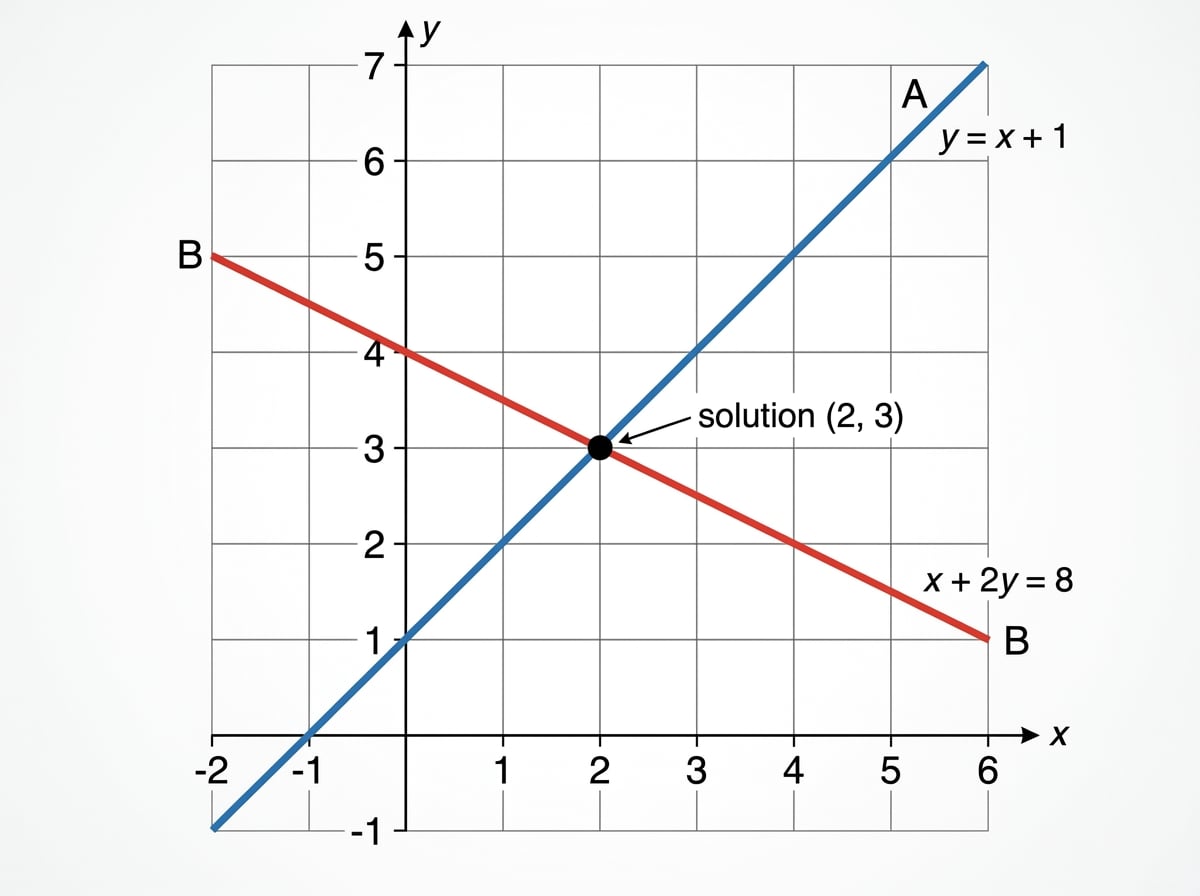
The graph below shows the two lines y=x+1y = x + 1y=x+1 and x+2y=8x + 2y = 8x+2y=8. They cross at (2,3)(2, 3)(2,3), so the solution is x=2x = 2x=2, y=3y = 3y=3.
Example
Using a graph to solve simultaneous equations
The lines y=x+1y = x + 1y=x+1 and x+2y=8x + 2y = 8x+2y=8 have already been drawn. Use the graph to solve the simultaneous equations.
-
Look for the point where the two lines cross.
-
Read the x-coordinate of the crossing point. The crossing is above x=2x = 2x=2.
-
Read the y-coordinate of the crossing point. The crossing is level with y=3y = 3y=3.
-
Write the solution as coordinates:
(2,3)(2, 3)(2,3) -
You can also write it as:
x=2,y=3x = 2,\quad y = 3x=2,y=3
Common Mistake
Swapping the coordinates
If the intersection is at (2,3)(2, 3)(2,3), the answer is x=2x = 2x=2, y=3y = 3y=3. Do not write x=3x = 3x=3, y=2y = 2y=2 by accident.
3. Drawing a straight-line graph from an equation
Sometimes the graph is not already drawn. You may have to draw both lines first, then use the intersection.
A good method is:
- Rearrange the equation into the form y=mx+cy = mx + cy=mx+c, if possible.
- Choose two or three easy x-values.
- Calculate the matching y-values.
- Plot the points.
- Join them with a straight line using a ruler.
Definition
The form
The form y=mx+cy = mx + cy=mx+c is a useful way to write a straight-line equation. The number mmm is the gradient, and ccc is the y-intercept where the line crosses the y-axis.
You do not always have to use y=mx+cy = mx + cy=mx+c, but it often makes plotting easier.
Example
Drawing one line from an equation
Draw the graph of 3y−x=63y - x = 63y−x=6.
-
Rearrange the equation so that yyy is the subject:
3y−x=63y=x+6y=x3+2\begin{aligned} 3y - x &= 6 \\ 3y &= x + 6 \\ y &= \frac{x}{3} + 2 \end{aligned}3y−x3yy=6=x+6=3x+2 -
Choose x-values that are easy to divide by 3, such as -3, 0, 3 and 6.
-
Substitute each x-value into y=x3+2y = \frac{x}{3} + 2y=3x+2:
- when x=−3x = -3x=−3, y=1y = 1y=1
- when x=0x = 0x=0, y=2y = 2y=2
- when x=3x = 3x=3, y=3y = 3y=3
- when x=6x = 6x=6, y=4y = 4y=4
-
Plot the points (−3,1)(-3, 1)(−3,1), (0,2)(0, 2)(0,2), (3,3)(3, 3)(3,3) and (6,4)(6, 4)(6,4).
-
Join the points with a straight line and label it 3y−x=63y - x = 63y−x=6.
Tip
Pick friendly x-values
If the equation contains fractions, choose x-values that make the arithmetic easy. For y=x3+2y = \frac{x}{3} + 2y=3x+2, multiples of 3 are helpful.
4. Solving by drawing both graphs
Once both lines are drawn, the solving part is simply reading the intersection.
Let’s go through a full example, like the kind where you are asked to draw the graphs and then use them to solve the simultaneous equations.
Example
Draw two lines, then solve
Solve the simultaneous equations graphically:
3y−x=63y - x = 63y−x=6 y=−x+4y = -x + 4y=−x+4-
Rearrange the first equation:
3y−x=63y=x+6y=x3+2\begin{aligned} 3y - x &= 6 \\ 3y &= x + 6 \\ y &= \frac{x}{3} + 2 \end{aligned}3y−x3yy=6=x+6=3x+2 -
Choose points for the first line, y=x3+2y = \frac{x}{3} + 2y=3x+2:
- (−3,1)(-3, 1)(−3,1)
- (0,2)(0, 2)(0,2)
- (3,3)(3, 3)(3,3)
- (6,4)(6, 4)(6,4)
-
Choose points for the second line, y=−x+4y = -x + 4y=−x+4:
- (0,4)(0, 4)(0,4)
- (2,2)(2, 2)(2,2)
- (4,0)(4, 0)(4,0)
-
Plot the points for both equations on the same grid.
-
Join each set of points with a straight line and label each line clearly.
-
Read the intersection. The lines cross halfway between 1 and 2 on the x-axis, and halfway between 2 and 3 on the y-axis.
-
Write the solution:
x=1.5,y=2.5x = 1.5,\quad y = 2.5x=1.5,y=2.5 -
As a coordinate, the solution is:
(1.5,2.5)(1.5, 2.5)(1.5,2.5)
Common Mistake
Drawing on separate grids
Both lines must be drawn on the same grid. If you draw them on separate grids, there is no intersection to read.
5. When the question gives you the graph already
In some questions, the lines are already drawn and labelled with their equations. You may only need to find the coordinates of the point where they intersect.
Be careful: the answer is not the equation of either line. The answer is the coordinate where the two lines meet.
Example
Finding the intersection from a given diagram
Two straight lines are labelled y=3x−2y = 3x - 2y=3x−2 and y=x+4y = x + 4y=x+4. They intersect on the grid. Work out the coordinates of their intersection.
-
Find the point where the two lines cross.
-
From that point, move vertically down to the x-axis to read the x-coordinate. The crossing is at x=3x = 3x=3.
-
From the crossing point, move horizontally across to the y-axis to read the y-coordinate. The crossing is at y=7y = 7y=7.
-
Write the coordinates of the intersection:
(3,7)(3, 7)(3,7) -
Check quickly by substituting x=3x = 3x=3 into both equations:
y=3(3)−2=7y=3+4=7\begin{aligned} y &= 3(3) - 2 = 7 \\ y &= 3 + 4 = 7 \end{aligned}yy=3(3)−2=7=3+4=7
Tip
Use the equations as a check
If the intersection looks like an exact coordinate, substitute the x-value into both equations. If both give the same y-value, your reading is probably correct.
6. Accuracy and awkward intersections
Graphical solutions are sometimes exact, such as (3,7)(3, 7)(3,7), but sometimes the intersection is between grid lines, such as (1.5,2.5)(1.5, 2.5)(1.5,2.5).
In an exam, you are usually allowed a small tolerance when reading from a graph, but your graph must be neat enough to support your answer.
Common Mistake
Parallel lines
If two straight lines are parallel, they never meet. That means there is no solution to the simultaneous equations. This is less common in basic graphical questions, but it is important to know.
Example
Reading a fractional coordinate
A graph shows two lines crossing halfway between x=−2x = -2x=−2 and x=−1x = -1x=−1, and exactly on y=4y = 4y=4.
-
Halfway between -2 and -1 is -1.5.
-
The y-coordinate is exactly 4.
-
So the intersection is:
(−1.5,4)(-1.5, 4)(−1.5,4) -
The solution is:
x=−1.5,y=4x = -1.5,\quad y = 4x=−1.5,y=4
7. How marks are usually awarded
For this topic, marks often come from:
- drawing accurate lines
- using the same grid for both equations
- reading the point of intersection correctly
- giving the answer as coordinates or as x=...x = \text{...}x=..., y=...y = \text{...}y=...
If a question says “use the graphs”, you should normally show or read from the graph, not only solve algebraically.
Exam technique
In the exam
-
If you are drawing the graphs, plot at least two accurate points for each line and use a ruler.
-
Label each line with its equation so you do not confuse them.
-
Read the intersection carefully: x-coordinate first, y-coordinate second.
-
If the crossing is between grid lines, give a sensible decimal estimate, such as 1.5 or 2.25.
-
Check your answer by substituting the coordinates into both equations if you have time.
Self review
Check yourself
-
Can you explain why the intersection of two lines solves both equations?
-
If a crossing point is at (−3,2)(-3, 2)(−3,2), what are the values of xxx and yyy?
-
What steps would you take to draw the graph of 2y+x=82y + x = 82y+x=8?

Recap questions
Test yourself with 5 quick questions on this guide. Answer them all correctly to complete it.
You've reached the end
Test yourself on this topic, or move on to the next guide.
How was this guide?