Revision notes for Edexcel IGCSE Maths Gradient of a Line. Open the guide for explanations and worked examples. Written against the Edexcel IGCSE Maths (4MA1) specification, so the content matches what's examinable rather than general Maths background.
Gradient of a Line
What you'll learn
- What the gradient of a straight line means.
- How to find gradient from a graph using rise and run.
- How to calculate gradient from two coordinate points.
- How to use a given gradient to find a missing value such as kkk.
Coordinates: the starting point
A point on a graph is written as an ordered pair, like (3,5)(3, 5)(3,5).
- The first number is the xxx-coordinate: how far left or right.
- The second number is the yyy-coordinate: how far up or down.
So (3,5)(3, 5)(3,5) means 3 across and 5 up.
A straight line has many points on it, but you only need two points to find its gradient.
Example
Choosing two points from a line
A straight line passes through the clear grid points (−1,−4)(-1, -4)(−1,−4), (0,−1)(0, -1)(0,−1) and (1,2)(1, 2)(1,2). Find two points you could use to find its gradient.
-
Look for points where the line crosses exact grid intersections.
-
Choose any two clear points on the line, for example (−1,−4)(-1, -4)(−1,−4) and (1,2)(1, 2)(1,2).
-
It is usually best to choose points that are not too close together, because the change is easier to see.
Tip
Use clear grid points
When finding gradient from a graph, do not guess points between squares. Pick two points where the line passes exactly through grid intersections.
What gradient means
Definition
Gradient
The gradient of a line is a measure of how steep it is. It tells you how much the yyy-value changes for each increase of 1 in the xxx-value.
You may hear gradient described as:
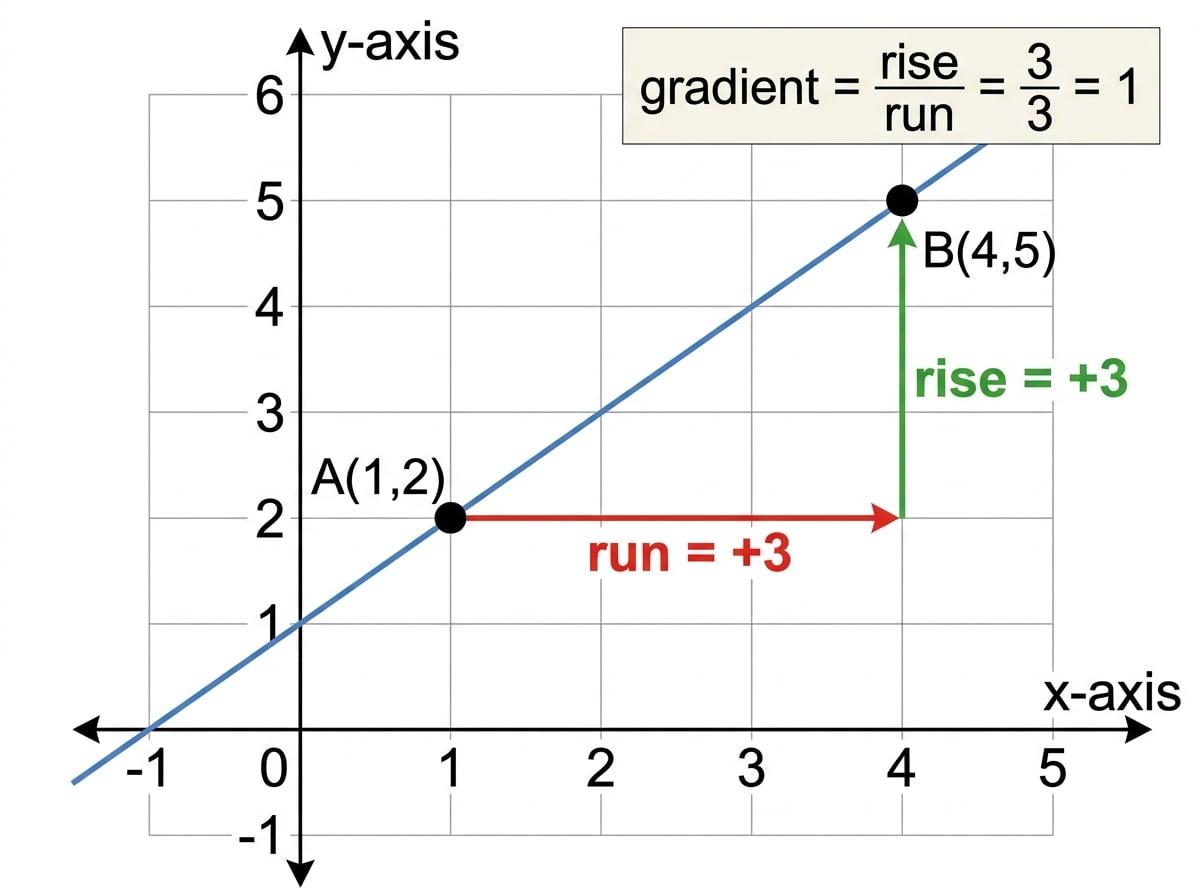
gradient=riserun\text{gradient}=\frac{\text{rise}}{\text{run}}gradient=runriseThe rise is the vertical change.
The run is the horizontal change.
The diagram shows a line where the run is +3 and the rise is +3, so the gradient is 1.
Key Idea
Rise over run
To find the gradient, move from one point on the line to another: count the vertical change, then divide by the horizontal change.
Example
Finding gradient from a graph
A line passes through the points (−2,−3)(-2, -3)(−2,−3) and (0,5)(0, 5)(0,5). Find its gradient.
-
Choose two clear points on the line: (−2,−3)(-2, -3)(−2,−3) and (0,5)(0, 5)(0,5).
-
Find the change in yyy: from -3 to 5 is an increase of 8, so the rise is 8.
-
Find the change in xxx: from -2 to 0 is an increase of 2, so the run is 2.
-
Divide rise by run: gradient=82=4\text{gradient}=\frac{8}{2}=4gradient=28=4.
Positive, negative and fractional gradients
A line with a positive gradient slopes upwards from left to right.
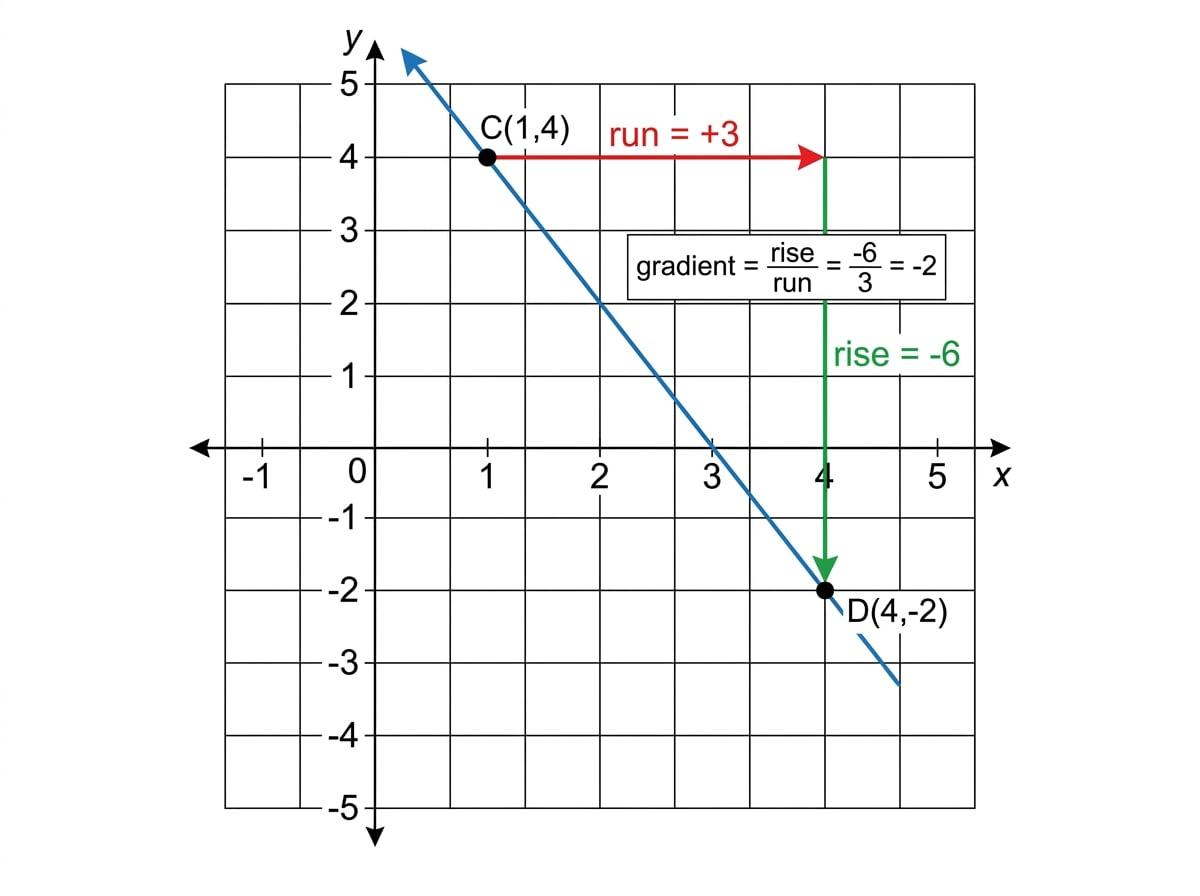
A line with a negative gradient slopes downwards from left to right.
A gradient can also be a fraction. For example, if the line goes up 1 square for every 3 squares across, the gradient is 13\frac{1}{3}31.
The diagram shows a negative gradient: as you move right, the line goes down.
Example
A negative gradient from a graph
A line passes through the points (−3,4)(-3, 4)(−3,4) and (3,2)(3, 2)(3,2). Find its gradient.
-
Choose the two points (−3,4)(-3, 4)(−3,4) and (3,2)(3, 2)(3,2).
-
Find the change in yyy: from 4 to 2 is a decrease of 2, so the rise is -2.
-
Find the change in xxx: from -3 to 3 is an increase of 6, so the run is 6.
-
Divide rise by run: gradient=−26=−13\text{gradient}=\frac{-2}{6}=-\frac{1}{3}gradient=6−2=−31.
Common Mistake
Forgetting the negative sign
If the line slopes down from left to right, the gradient must be negative. A common error is to count the vertical change as positive even though the line goes down.
Calculating gradient from two coordinates
When you are not given a graph, use the coordinate formula.
If the two points are (x1,y1)(x_1, y_1)(x1,y1) and (x2,y2)(x_2, y_2)(x2,y2), then:
gradient=y2−y1x2−x1\text{gradient}=\frac{y_2-y_1}{x_2-x_1}gradient=x2−x1y2−y1This means:
- subtract the yyy-coordinates to find the vertical change;
- subtract the xxx-coordinates to find the horizontal change;
- divide the vertical change by the horizontal change.
Example
Gradient from two points
Find the gradient of the line passing through (2,3)(2, 3)(2,3) and (6,15)(6, 15)(6,15).
-
Label the coordinates: x1=2x_1=2x1=2, y1=3y_1=3y1=3, x2=6x_2=6x2=6, y2=15y_2=15y2=15.
-
Subtract the yyy-coordinates: 15−3=1215-3=1215−3=12.
-
Subtract the xxx-coordinates: 6−2=46-2=46−2=4.
-
Divide: gradient=124=3\text{gradient}=\frac{12}{4}=3gradient=412=3.
Example
Gradient with negative coordinates
Find the gradient of the line passing through (−4,7)(-4, 7)(−4,7) and (2,−5)(2, -5)(2,−5).
-
Label the coordinates carefully: x1=−4x_1=-4x1=−4, y1=7y_1=7y1=7, x2=2x_2=2x2=2, y2=−5y_2=-5y2=−5.
-
Find the change in yyy: −5−7=−12-5-7=-12−5−7=−12.
-
Find the change in xxx: 2−(−4)=62-(-4)=62−(−4)=6.
-
Divide: gradient=−126=−2\text{gradient}=\frac{-12}{6}=-2gradient=6−12=−2.
Common Mistake
Mixing up the order
If you start with the second point on the top, you must also start with the second point on the bottom. For example, y2−y1x2−x1\frac{y_2-y_1}{x_2-x_1}x2−x1y2−y1 is fine, and y1−y2x1−x2\frac{y_1-y_2}{x_1-x_2}x1−x2y1−y2 is also fine, but do not mix them.
Horizontal and vertical lines
A horizontal line is flat. Its yyy-value does not change, so its gradient is 0.
A vertical line goes straight up and down. Its xxx-value does not change, so the formula would involve dividing by 0, which is not allowed.
Example
A horizontal line
Find the gradient of the line passing through (−2,4)(-2, 4)(−2,4) and (5,4)(5, 4)(5,4).
-
Notice that both points have the same yyy-coordinate, 4.
-
Find the change in yyy: 4−4=04-4=04−4=0.
-
Find the change in xxx: 5−(−2)=75-(-2)=75−(−2)=7.
-
Divide: gradient=07=0\text{gradient}=\frac{0}{7}=0gradient=70=0.
Common Mistake
Vertical lines
A vertical line has no gradient because the change in xxx is 0, and you cannot divide by 0. Do not write its gradient as 0; only horizontal lines have gradient 0.
Finding a missing value using gradient
Sometimes you are given the gradient and one coordinate contains an unknown, such as kkk.
Use the same formula, substitute what you know, then solve the equation.
Example
Finding a missing y-coordinate
The line through A(3,−2)A(3, -2)A(3,−2) and B(7,k)B(7, k)B(7,k) has gradient 4. Find kkk.
-
Write the gradient formula using the two points: gradient=k−(−2)7−3\text{gradient}=\frac{k-(-2)}{7-3}gradient=7−3k−(−2).
-
Replace the gradient with 4: 4=k+244=\frac{k+2}{4}4=4k+2.
-
Multiply both sides by 4: 16=k+216=k+216=k+2.
-
Subtract 2 from both sides: k=14k=14k=14.
Example
Finding a missing x-coordinate
The line through (−1,6)(-1, 6)(−1,6) and (k,18)(k, 18)(k,18) has gradient 3. Find kkk.
-
Put the known values into the formula: 3=18−6k−(−1)3=\frac{18-6}{k-(-1)}3=k−(−1)18−6.
-
Simplify the top and the bottom: 3=12k+13=\frac{12}{k+1}3=k+112.
-
Multiply both sides by k+1k+1k+1: 3(k+1)=123(k+1)=123(k+1)=12.
-
Divide by 3: k+1=4k+1=4k+1=4.
-
Subtract 1: k=3k=3k=3.
Tip
Check your answer makes sense
After finding kkk, imagine moving from the first point to the second. If the given gradient is positive, the overall movement should be up as you move right. If the given gradient is negative, it should go down as you move right.
Exam technique
In the exam
-
Pick two clear points if you are using a graph; avoid estimating from unclear parts of the line.
-
Use gradient=change in ychange in x\text{gradient}=\frac{\text{change in }y}{\text{change in }x}gradient=change in xchange in y and keep the subtraction order consistent.
-
Check the sign: upward left-to-right means positive, downward left-to-right means negative.
Self review
Check yourself
-
If a line goes up 6 squares while going right 2 squares, what is its gradient?
-
How can you tell from the graph whether a gradient should be negative?
-
What formula would you use to find the gradient between (x1,y1)(x_1, y_1)(x1,y1) and (x2,y2)(x_2, y_2)(x2,y2)?

Recap questions
Test yourself with 5 quick questions on this guide. Answer them all correctly to complete it.
You've reached the end
Test yourself on this topic, or move on to the next guide.
How was this guide?