Revision notes for Edexcel IGCSE Maths Recurring Decimals to Fractions. Open the guide for explanations and worked examples. Written against the Edexcel IGCSE Maths (4MA1) specification, so the content matches what's examinable rather than general Maths background.
Recurring Decimals to Fractions
What you'll learn
- How to read recurring decimal notation, including dots over repeating digits.
- How fractions can become recurring decimals.
- How to prove algebraically that a recurring decimal equals a fraction.
- How to handle whole numbers and calculations involving recurring decimals.
1. Fractions and decimals
A fraction is another way of writing a division. For example, 711\frac{7}{11}117 means 7 divided by 11.
The denominator is the bottom number in a fraction. It tells you what you are dividing by.
Some fractions give decimals that stop. Others give decimals that repeat forever.
Definition
Terminating and recurring decimals
- A terminating decimal stops after a fixed number of decimal places, such as 0.25.
- A recurring decimal has a digit or block of digits that repeats forever, such as 0.7˙0.\dot{7}0.7˙.
Recurring notation
A dot above one digit means that digit repeats forever:
0.7˙=0.777…0.\dot{7}=0.777\ldots0.7˙=0.777…Two dots show the first and last digit in the repeating block:
0.3˙6˙=0.363636…0.\dot{3}\dot{6}=0.363636\ldots0.3˙6˙=0.363636…and
0.24˙9˙=0.2494949…0.2\dot{4}\dot{9}=0.2494949\ldots0.24˙9˙=0.2494949…Here, the 2 does not repeat; only the block 49 repeats.
Example
Convert to a decimal
-
Think of the fraction as a division: 7 divided by 11.
-
11 does not go into 7, so start with 0 point and divide 70 by 11. This gives 6 with remainder 4.
-
Now divide 40 by 11. This gives 3 with remainder 7.
-
The remainder 7 has appeared again, so the same digits will repeat. The answer is:
711=0.636363…=0.6˙3˙\frac{7}{11}=0.636363\ldots=0.\dot{6}\dot{3}117=0.636363…=0.6˙3˙
Tip
Spot the repeat
In long division, when the same remainder appears again, the decimal digits from that point will repeat forever.
2. The algebra trick
To turn a recurring decimal into a fraction, we usually use algebra.
The main idea is to call the decimal xxx, multiply by a power of 10, then subtract so the repeating part cancels.
A power of 10 means numbers such as 10, 100, 1000, and so on. Multiplying by 10 moves every digit one place to the left; multiplying by 100 moves every digit two places to the left.
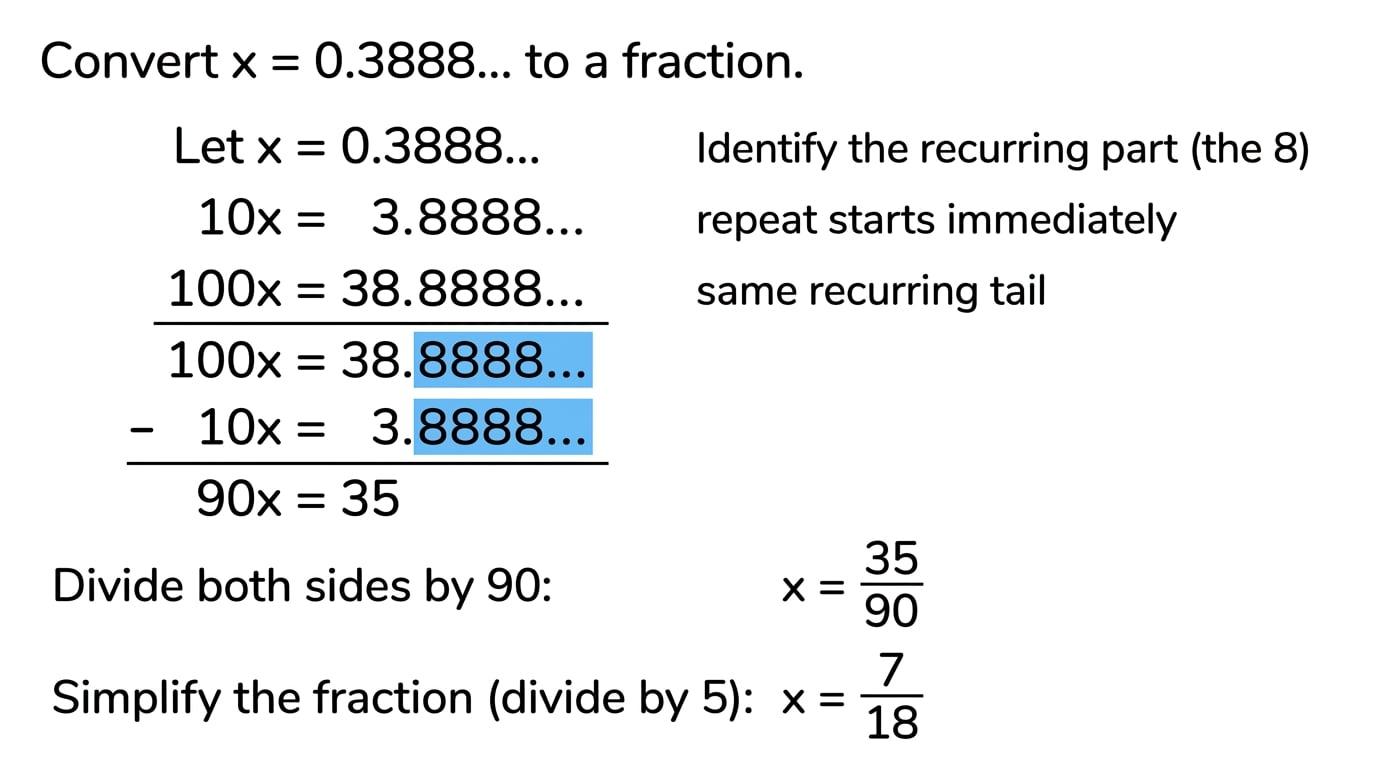
The picture below shows why subtracting works: once the recurring tails match, the infinite repeating part disappears.
Key Idea
The cancellation trick
Choose two multiples of your decimal so that their recurring tails are identical. When you subtract, the repeating digits cancel, leaving a normal equation to solve.
3. One repeating digit straight after the decimal point
A pure recurring decimal starts repeating immediately after the decimal point.
For example, 0.6˙0.\dot{6}0.6˙ means 0.666...
Example
Prove algebraically that
-
Let xxx be the recurring decimal.
x=0.666…x=0.666\ldotsx=0.666… -
Multiply by 10 so the repeating digits line up.
10x=6.666…10x=6.666\ldots10x=6.666… -
Subtract the original equation from the new equation.
10x−x=6.666…−0.666…9x=6\begin{aligned} 10x-x&=6.666\ldots-0.666\ldots\\ 9x&=6 \end{aligned}10x−x9x=6.666…−0.666…=6 -
Divide by 9 and simplify.
x=69=23x=\frac{6}{9}=\frac{2}{3}x=96=32
A fraction is in simplest form when the top and bottom numbers have no common factor other than 1. A common factor is a number that divides both exactly.
4. A non-repeating digit before the repeat
Some decimals have a digit after the decimal point that does not repeat, followed by a digit that does repeat.
For example, 0.38˙=0.3888…0.3\dot{8}=0.3888\ldots0.38˙=0.3888…
Here, the 3 is non-recurring, and the 8 recurs.
Tip
Which powers of 10?
If there are nnn non-recurring decimal digits and the recurring block has length rrr, compare 10n+rx10^{n+r}x10n+rx with 10nx10^n x10nx. This lines up the recurring tails.
Example
Write as a fraction in its simplest form
-
Let xxx be the decimal.
x=0.3888…x=0.3888\ldotsx=0.3888… -
The recurring part starts after one decimal digit, so first multiply by 10.
10x=3.888…10x=3.888\ldots10x=3.888… -
One full recurring digit later, multiply by 100.
100x=38.888…100x=38.888\ldots100x=38.888… -
Subtract the two equations so the recurring 8s cancel.
100x−10x=38.888…−3.888…90x=35\begin{aligned} 100x-10x&=38.888\ldots-3.888\ldots\\ 90x&=35 \end{aligned}100x−10x90x=38.888…−3.888…=35 -
Solve for xxx and simplify.
x=3590=718x=\frac{35}{90}=\frac{7}{18}x=9035=187
Common Mistake
Multiplying by the wrong amount
For a decimal like 0.38˙0.3\dot{8}0.38˙, do not just multiply by 10 and stop. The clean exam method is to compare 100x100x100x with 10x10x10x, because both have the same recurring tail.
5. Repeating blocks with more than one digit
If the repeating block has 2 digits, multiply by 100. If it has 3 digits, multiply by 1000.
Example
Write as a fraction
-
Let xxx be the decimal.
x=0.474747…x=0.474747\ldotsx=0.474747… -
The repeating block has 2 digits, so multiply by 100.
100x=47.474747…100x=47.474747\ldots100x=47.474747… -
Subtract the original equation.
100x−x=47.474747…−0.474747…99x=47\begin{aligned} 100x-x&=47.474747\ldots-0.474747\ldots\\ 99x&=47 \end{aligned}100x−x99x=47.474747…−0.474747…=47 -
Divide by 99.
x=4799x=\frac{47}{99}x=9947
6. Whole numbers before the decimal point
The same method works when there is a whole number before the decimal point. Your final answer may be an improper fraction, where the top number is larger than the bottom number. That is completely fine.
Example
Write as a fraction in its simplest form
-
Write the decimal out so the pattern is clear.
3.26˙3˙=3.263636…3.2\dot{6}\dot{3}=3.263636\ldots3.26˙3˙=3.263636… -
Let xxx equal the decimal.
x=3.263636…x=3.263636\ldotsx=3.263636… -
The non-recurring digit is 2, and the recurring block is 63. So compare 1000x1000x1000x with 10x10x10x.
1000x=3263.636363…10x=32.636363…\begin{aligned} 1000x&=3263.636363\ldots\\ 10x&=32.636363\ldots \end{aligned}1000x10x=3263.636363…=32.636363… -
Subtract.
1000x−10x=3263.636363…−32.636363…990x=3231\begin{aligned} 1000x-10x&=3263.636363\ldots-32.636363\ldots\\ 990x&=3231 \end{aligned}1000x−10x990x=3263.636363…−32.636363…=3231 -
Divide by 990 and simplify.
x=3231990=359110x=\frac{3231}{990}=\frac{359}{110}x=9903231=110359
Tip
Keep the whole number inside
You do not need to split off the whole number first. Let xxx equal the entire decimal and use the same subtraction method.
7. Using a letter for a digit
Sometimes a question uses a letter to represent a digit.
An integer is a whole number, such as 0, 1, 2, or 9. If a digit aaa is between 1 and 9, then it can stand for any one of those whole-number digits.
Example
Prove that for a digit
-
The dots show that the block 0a repeats forever.
x=0.0a0a0a…x=0.0a0a0a\ldotsx=0.0a0a0a… -
The repeating block has 2 digits, so multiply by 100.
100x=a.0a0a…100x=a.0a0a\ldots100x=a.0a0a… -
Subtract the original decimal.
100x−x=a.0a0a…−0.0a0a…99x=a\begin{aligned} 100x-x&=a.0a0a\ldots-0.0a0a\ldots\\ 99x&=a \end{aligned}100x−x99x=a.0a0a…−0.0a0a…=a -
Divide by 99.
x=a99x=\frac{a}{99}x=99a
8. Calculations with recurring decimals
For multiplication or division questions, do not try to multiply the recurring decimals directly. Convert each recurring decimal into a fraction first.
Example
Work out
-
First convert 0.42˙0.4\dot{2}0.42˙ into a fraction.
x=0.4222…100x=42.222…10x=4.222…90x=38x=3890=1945\begin{aligned} x&=0.4222\ldots\\ 100x&=42.222\ldots\\ 10x&=4.222\ldots\\ 90x&=38\\ x&=\frac{38}{90}=\frac{19}{45} \end{aligned}x100x10x90xx=0.4222…=42.222…=4.222…=38=9038=4519 -
Convert 0.3˙0.\dot{3}0.3˙ into a fraction.
0.3˙=130.\dot{3}=\frac{1}{3}0.3˙=31 -
Replace the recurring decimals with fractions.
0.42˙÷0.3˙=1945÷130.4\dot{2}\div 0.\dot{3}=\frac{19}{45}\div\frac{1}{3}0.42˙÷0.3˙=4519÷31 -
Dividing by a fraction means multiplying by its reciprocal.
1945÷13=1945×31=1915\frac{19}{45}\div\frac{1}{3}=\frac{19}{45}\times\frac{3}{1}=\frac{19}{15}4519÷31=4519×13=1519
Exam technique
In the exam
-
Write the recurring decimal out with a few extra digits so you can see exactly what repeats.
-
Choose powers of 10 that make the recurring tails match, then subtract the equations.
-
Always simplify your final fraction; for calculations, convert every recurring decimal before multiplying or dividing.
Self review
Check yourself
- Can you explain why 100x100x100x and 10x10x10x are compared for a decimal like 0.74˙0.7\dot{4}0.74˙?
- Can you convert 0.5˙0.\dot{5}0.5˙ into a fraction using algebra?
- Can you work out 0.21˙×0.3˙0.2\dot{1}\times 0.\dot{3}0.21˙×0.3˙ by converting both decimals first?

Recap questions
Test yourself with 5 quick questions on this guide. Answer them all correctly to complete it.
You've reached the end
Test yourself on this topic, or move on to the next guide.
How was this guide?