Revision notes for Edexcel IGCSE Maths Fractional and Negative Indices. Open the guide for explanations and worked examples. Written against the Edexcel IGCSE Maths (4MA1) specification, so the content matches what's examinable rather than general Maths background.
Fractional and Negative Indices
What you'll learn
- How negative indices turn powers into reciprocals.
- How fractional indices mean roots, such as square roots and cube roots.
- How to evaluate expressions like 34323343^{\frac{2}{3}}34332 and (1625)−32\left(\frac{16}{25}\right)^{-\frac{3}{2}}(2516)−23.
- How to use index laws when everything can be written with the same base.
The basics: powers, roots and reciprocals
An expression like ana^nan is called a power. You read it as “aaa to the power of nnn”.
Definition
Index
In ana^nan, the number or expression being repeatedly multiplied is the base aaa, and the small raised number is the index or exponent nnn.
Before negative indices make sense, you need the idea of a reciprocal.
Definition
Reciprocal
The reciprocal of a non-zero number is one divided by that number. For example, the reciprocal of 8 is 18\frac{1}{8}81, and the reciprocal of 56\frac{5}{6}65 is 65\frac{6}{5}56.
Example
Finding reciprocals
-
To find the reciprocal of 6, write one divided by 6: 16\frac{1}{6}61.
-
To find the reciprocal of 49\frac{4}{9}94, swap the numerator and denominator.
149=94\frac{1}{\frac{4}{9}}=\frac{9}{4}941=49 -
So the reciprocal of 6 is 16\frac{1}{6}61, and the reciprocal of 49\frac{4}{9}94 is 94\frac{9}{4}49.
Negative indices
A negative index does not make the answer negative. It tells you to take a reciprocal.
Key Idea
Negative indices mean reciprocal
For any non-zero base aaa, the rule is a−n=1ana^{-n}=\frac{1}{a^n}a−n=an1. In particular, a−1=1aa^{-1}=\frac{1}{a}a−1=a1.
Common Mistake
Zero cannot have a negative index
Expressions such as 0−10^{-1}0−1 are undefined, because they would require division by zero.
Example
Evaluating negative indices
-
For 5−25^{-2}5−2, the negative index means put the power in the denominator.
5−2=1525^{-2}=\frac{1}{5^2}5−2=521 -
Now square 5: 5−2=1255^{-2}=\frac{1}{25}5−2=251.
-
For (38)−1\left(\frac{3}{8}\right)^{-1}(83)−1, the index -1 means “take the reciprocal”.
(38)−1=83\left(\frac{3}{8}\right)^{-1}=\frac{8}{3}(83)−1=38 -
Notice that neither answer is negative.
Common Mistake
Negative index, not negative number
Writing 4−1=−44^{-1}=-44−1=−4 is wrong. The correct idea is reciprocal: 4−1=144^{-1}=\frac{1}{4}4−1=41.
Fractional indices: roots first
A fractional index is an index written as a fraction. The denominator of the fraction tells you which root to take.
Definition
Fractional index
For positive values of aaa, a12=aa^{\frac{1}{2}}=\sqrt{a}a21=a and a13=a3a^{\frac{1}{3}}=\sqrt[3]{a}a31=3a. More generally, a1n=ana^{\frac{1}{n}}=\sqrt[n]{a}an1=na.
For a fraction like mn\frac{m}{n}nm, the denominator tells you the root, and the numerator tells you the power.
Key Idea
Denominator root, numerator power
For suitable values, amn=(an)ma^{\frac{m}{n}}=\left(\sqrt[n]{a}\right)^manm=(na)m. It is usually easiest to take the root first, then apply the power.
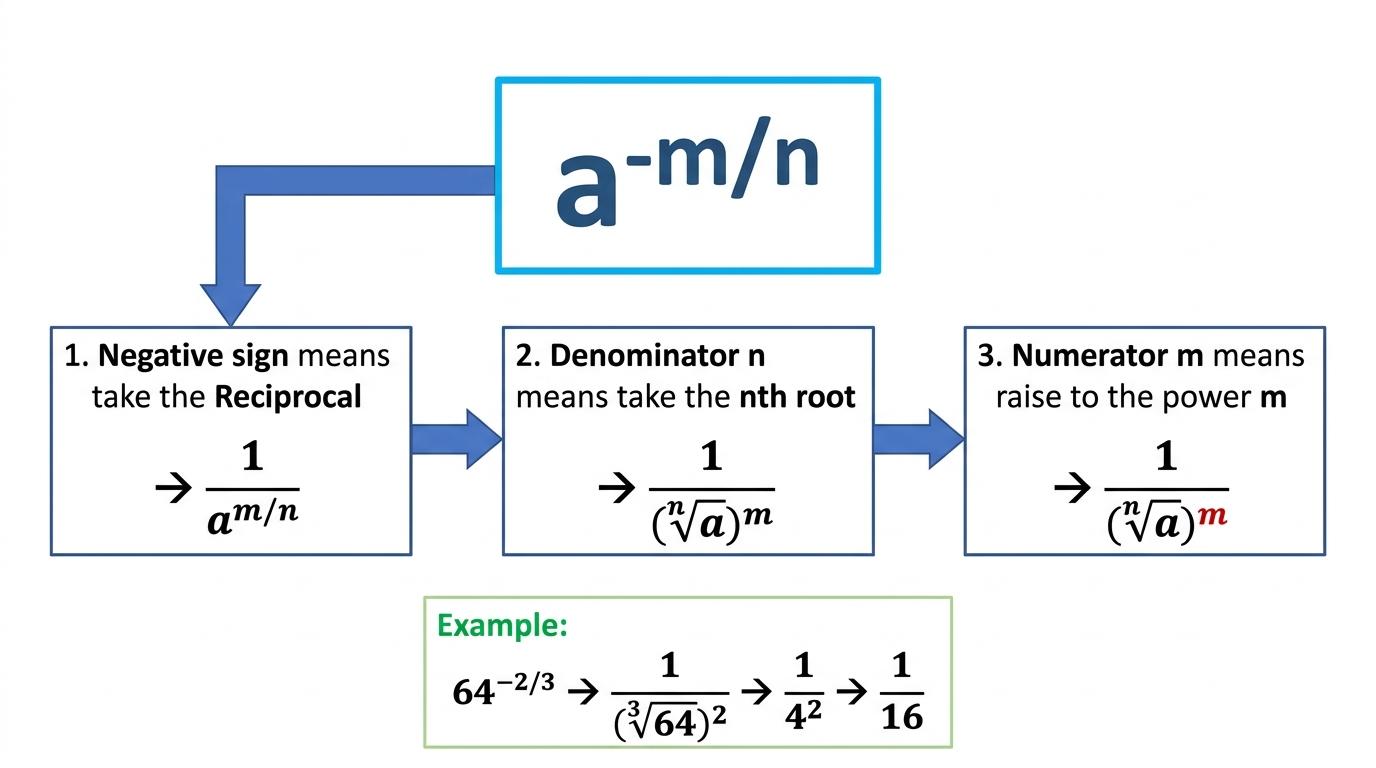
The diagram below is a useful memory aid for combining fractional and negative indices.
Example
Evaluating fractional indices
-
For 14412144^{\frac{1}{2}}14421, the denominator 2 means square root.
14412=144=12144^{\frac{1}{2}}=\sqrt{144}=1214421=144=12 -
For 34323343^{\frac{2}{3}}34332, the denominator 3 means cube root first.
3433=7\sqrt[3]{343}=73343=7 -
The numerator 2 means square the result: 72=497^2=4972=49.
-
So 34323=49343^{\frac{2}{3}}=4934332=49.
Common Mistake
A half power is not halving
14412144^{\frac{1}{2}}14421 means 144\sqrt{144}144, not 144 divided by 2.
Negative fractional indices
Now combine the two ideas:
- the negative sign means reciprocal;
- the denominator means root;
- the numerator means power.
Key Idea
The combined rule
For non-zero aaa, a−mn=1amn=1(an)ma^{-\frac{m}{n}}=\frac{1}{a^{\frac{m}{n}}}=\frac{1}{\left(\sqrt[n]{a}\right)^m}a−nm=anm1=(na)m1.
Example
Evaluating a negative fractional index
-
Start with 32−2532^{-\frac{2}{5}}32−52. The negative sign means take the reciprocal of 322532^{\frac{2}{5}}3252.
32−25=1322532^{-\frac{2}{5}}=\frac{1}{32^{\frac{2}{5}}}32−52=32521 -
The denominator 5 means take the fifth root: 325=2\sqrt[5]{32}=2532=2.
-
The numerator 2 means square the result: 22=42^2=422=4.
-
Therefore 32−25=1432^{-\frac{2}{5}}=\frac{1}{4}32−52=41.
Fraction bases
When the base is a fraction and the index is negative, it is often quickest to invert the fraction first.
Tip
Invert first when helpful
For expressions like (ab)−mn\left(\frac{a}{b}\right)^{-\frac{m}{n}}(ba)−nm, first change the base to (ba)mn\left(\frac{b}{a}\right)^{\frac{m}{n}}(ab)nm, then deal with the root and power.
Example
A fraction with a negative fractional index
-
Deal with the negative sign by taking the reciprocal of the base.
(1625)−32=(2516)32\left(\frac{16}{25}\right)^{-\frac{3}{2}}=\left(\frac{25}{16}\right)^{\frac{3}{2}}(2516)−23=(1625)23 -
The denominator 2 means take the square root of the fraction.
2516=54\sqrt{\frac{25}{16}}=\frac{5}{4}1625=45 -
The numerator 3 means cube the result.
(54)3=12564\left(\frac{5}{4}\right)^3=\frac{125}{64}(45)3=64125 -
So (1625)−32=12564\left(\frac{16}{25}\right)^{-\frac{3}{2}}=\frac{125}{64}(2516)−23=64125.
Algebraic expressions with fractional indices
The same index laws apply to algebraic terms. The most useful one here is the power of a power rule:
(ap)q=apq(a^p)^q=a^{pq}(ap)q=apqYou can also take roots of powers of variables when the exponents divide neatly.
Example
Simplifying an algebraic fractional power
-
Consider (27x6)23(27x^6)^{\frac{2}{3}}(27x6)32. The denominator 3 means take the cube root of each part.
27x63=3x2\sqrt[3]{27x^6}=3x^2327x6=3x2 -
The numerator 2 means square the result.
(3x2)2=9x4(3x^2)^2=9x^4(3x2)2=9x4 -
Therefore (27x6)23=9x4(27x^6)^{\frac{2}{3}}=9x^4(27x6)32=9x4.
Rewriting everything with the same base
You will often be asked to find an unknown index. The strategy is to rewrite both sides using the same base, then compare the indices.
The key laws are:
- ap×aq=ap+qa^p \times a^q=a^{p+q}ap×aq=ap+q
- (ap)q=apq(a^p)^q=a^{pq}(ap)q=apq
- ap÷aq=ap−qa^p \div a^q=a^{p-q}ap÷aq=ap−q
Example
Finding an unknown index
-
Suppose 2×32=2n2 \times \sqrt{32}=2^n2×32=2n. First rewrite 32 as a power of 2: 32=2532=2^532=25.
-
Convert the square root into a half power.
32=(25)12=252\sqrt{32}=(2^5)^{\frac{1}{2}}=2^{\frac{5}{2}}32=(25)21=225 -
Rewrite the full left-hand side using powers of 2.
2×32=21×2522 \times \sqrt{32}=2^1 \times 2^{\frac{5}{2}}2×32=21×225 -
Add the indices because the bases are the same.
21×252=2722^1 \times 2^{\frac{5}{2}}=2^{\frac{7}{2}}21×225=227 -
Since 2×32=2n2 \times \sqrt{32}=2^n2×32=2n, we have n=72n=\frac{7}{2}n=27.
Example
Expressing powers in terms of letters
-
Let r=5pr=5^pr=5p and s=5qs=5^qs=5q. Then 5p+q=5p×5q=rs5^{p+q}=5^p \times 5^q=rs5p+q=5p×5q=rs.
-
For 52p5^{2p}52p, use the power of a power rule: 52p=(5p)2=r25^{2p}=(5^p)^2=r^252p=(5p)2=r2.
-
For 5q−15^{q-1}5q−1, split the index: 5q−1=5q÷5=s55^{q-1}=5^q \div 5=\frac{s}{5}5q−1=5q÷5=5s.
Large roots written as products
Sometimes a root looks awkward, but the product has been chosen to make a perfect power.
Example
Evaluating a fourth root product
-
Consider 5×125×1084\sqrt[4]{5 \times 125 \times 10^8}45×125×108.
-
Multiply the first two factors: 5×125=625=545 \times 125=625=5^45×125=625=54.
-
Rewrite the power of 10 as a fourth power: 108=(102)410^8=(10^2)^4108=(102)4.
-
Combine the factors into one fourth power.
54×(102)4=(5×10²)45^4 \times (10^2)^4=(5 \times 10^2)^454×(102)4=(5×10²)4 -
Taking the fourth root gives 5×102=5005 \times 10^2=5005×102=500.
Exam technique
In the exam
- Check whether the index is negative first; if it is, plan for a reciprocal.
- For fractional indices, read the denominator as the root and the numerator as the power.
- If an equation has powers, try to rewrite everything using the same base before comparing indices.
Self review
Check yourself
- Can you explain why a−1a^{-1}a−1 means 1a\frac{1}{a}a1 rather than −a-a−a?
- What root is shown by the denominator in a23a^{\frac{2}{3}}a32?
- How would you start simplifying (916)−32\left(\frac{9}{16}\right)^{-\frac{3}{2}}(169)−23?

Recap questions
Test yourself with 5 quick questions on this guide. Answer them all correctly to complete it.
You've reached the end
Test yourself on this topic, or move on to the next guide.
How was this guide?