Revision notes for Edexcel IGCSE Maths Cylinders. Open the guide for explanations and worked examples. Written against the Edexcel IGCSE Maths (4MA1) specification, so the content matches what's examinable rather than general Maths background.
Cylinders
What you'll learn
- How to use circle facts to find the volume of a cylinder.
- How to find the total surface area of a closed cylinder.
- How to handle semi-cylinders and simple combined solids.
- How to solve reverse questions and practical unit-conversion problems.
1. The circle facts you need first
A cylinder is built from circles, so the key skills come from circle area and circumference.
Definition
Cylinder
A cylinder is a 3D solid with two equal, parallel circular faces joined by one curved surface. The radius is the distance from the centre of a circle to its edge, and the diameter is the distance all the way across the circle through the centre.
For a circle:
- Diameter is twice the radius, so d=2rd = 2rd=2r.
- Radius is half the diameter, so r=d2r = \frac{d}{2}r=2d.
- Area of a circle is A=πr2A = \pi r^2A=πr2.
- Circumference means the distance around the circle, and C=2πrC = 2\pi rC=2πr or C=πdC = \pi dC=πd.
Common Mistake
Using the diameter as the radius
If a question gives the diameter, halve it before using formulas with rrr. A diameter of 9 cm means the radius is 4.5 cm, not 9 cm.
Example
Finding the radius and circular area
A circular end of a cylinder has diameter 12 cm. Find its radius and the area of the circular end in terms of π\piπ.
-
Halve the diameter to get the radius.
r=122=6r = \frac{12}{2} = 6r=212=6 -
Use the circle area formula.
A=πr2=π×62A = \pi r^2 = \pi \times 6^2A=πr2=π×62 -
Square the radius.
A=36πA = 36\piA=36π -
The area of the circular end is 36π36\pi36π cm².
2. Volume of a cylinder
Volume tells you how much space a 3D solid takes up. For a cylinder, imagine stacking identical circular layers on top of each other.
Key Idea
Cylinder volume
The volume of a cylinder is the area of the circular base multiplied by the height, so V=πr2hV = \pi r^2hV=πr2h.
Here, VVV means volume, rrr means radius, and hhh means height.
Example
Volume in terms of
A cylinder has radius 4 cm and height 10 cm. Work out its volume in terms of π\piπ.
-
Write down the formula.
V=πr2hV = \pi r^2hV=πr2h -
Substitute radius 4 and height 10.
V=π×42×10V = \pi \times 4^2 \times 10V=π×42×10 -
Square the radius, then multiply by the height.
V=π×16×10=160πV = \pi \times 16 \times 10 = 160\piV=π×16×10=160π -
The volume is 160π160\pi160π cm³.
Tip
When the answer says in terms of
Leave π\piπ in your answer. Do not press the calculator’s π\piπ button unless the question asks for a decimal answer.
Example
Volume with a diameter and rounding
A cylinder has diameter 8 cm and height 11.5 cm. Work out its volume correct to 1 decimal place.
-
Find the radius by halving the diameter.
r=82=4r = \frac{8}{2} = 4r=28=4 -
Use the volume formula.
V=π×42×11.5V = \pi \times 4^2 \times 11.5V=π×42×11.5 -
Calculate the value.
V=184π≈578.053V = 184\pi \approx 578.053V=184π≈578.053 -
Round to 1 decimal place: the volume is 578.1 cm³.
3. Total surface area of a cylinder
Surface area is the total area of the outside faces of a 3D shape.
A net is a flat layout of a 3D shape. A closed cylinder’s net has:
- two circles, one for the top and one for the bottom;
- one rectangle, which wraps around to make the curved surface.
The rectangle’s height is the cylinder height. Its width is the circumference of the circular base.
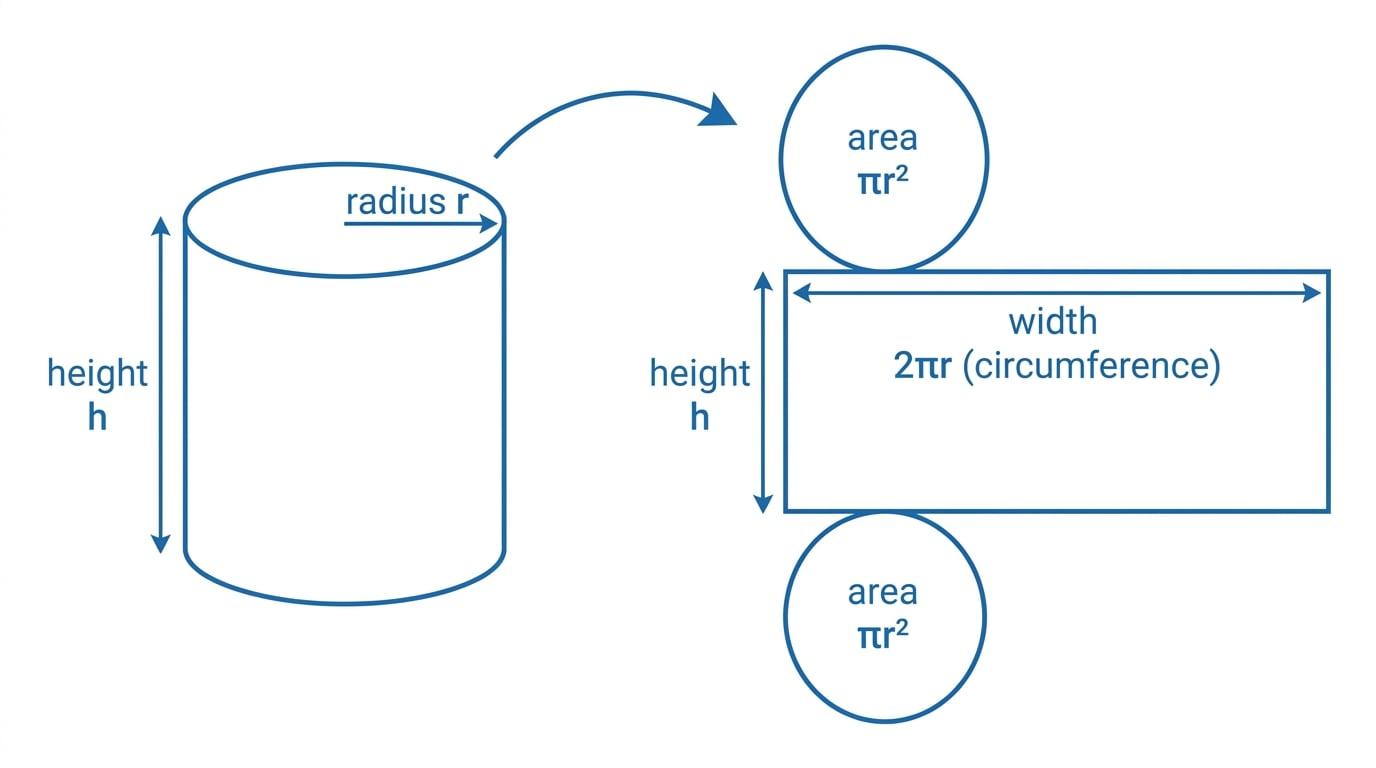
For a closed cylinder:
- area of two circles is 2πr22\pi r^22πr2;
- curved surface area is 2πrh2\pi rh2πrh;
- total surface area is 2πr2+2πrh2\pi r^2 + 2\pi rh2πr2+2πrh.
Common Mistake
Closed or open cylinder?
The formula 2πr2+2πrh2\pi r^2 + 2\pi rh2πr2+2πrh is for a closed cylinder with both a top and a bottom. If a tank is open at the top, you would not include the top circle.
Example
Total surface area from radius and height
A closed cylinder has radius 3 cm and height 9.5 cm. Find its total surface area correct to 1 decimal place.
-
Start with the closed-cylinder surface area formula.
TSA=2πr2+2πrh\text{TSA} = 2\pi r^2 + 2\pi rhTSA=2πr2+2πrh -
Substitute radius 3 and height 9.5.
TSA=2π×32+2π×3×9.5\text{TSA} = 2\pi \times 3^2 + 2\pi \times 3 \times 9.5TSA=2π×32+2π×3×9.5 -
Work out each part.
TSA=18π+57π=75π\text{TSA} = 18\pi + 57\pi = 75\piTSA=18π+57π=75π -
Convert to a decimal.
75π≈235.61975\pi \approx 235.61975π≈235.619 -
The total surface area is 235.6 cm² to 1 decimal place.
Example
Total surface area from diameter
A solid cylinder has diameter 10 cm and height 13 cm. Work out its total surface area correct to 3 significant figures.
-
Halve the diameter to find the radius.
r=102=5r = \frac{10}{2} = 5r=210=5 -
Substitute into the total surface area formula.
TSA=2π×52+2π×5×13\text{TSA} = 2\pi \times 5^2 + 2\pi \times 5 \times 13TSA=2π×52+2π×5×13 -
Simplify.
TSA=50π+130π=180π\text{TSA} = 50\pi + 130\pi = 180\piTSA=50π+130π=180π -
Convert to a decimal and round.
180π≈565.487180\pi \approx 565.487180π≈565.487 -
The total surface area is 565 cm² to 3 significant figures.
4. Semi-cylinders and combined solids
A semi-cylinder is half a cylinder, usually made by cutting a cylinder lengthways.
For volume, a semi-cylinder is simply half the volume of the full cylinder:
V=12πr2LV = \frac{1}{2}\pi r^2LV=21πr2LHere, LLL is the length of the semi-cylinder.
For total surface area, think about each outside face:
- half the curved surface of a full cylinder;
- one flat rectangle made by the cut;
- two semicircular ends, which together make one full circle.
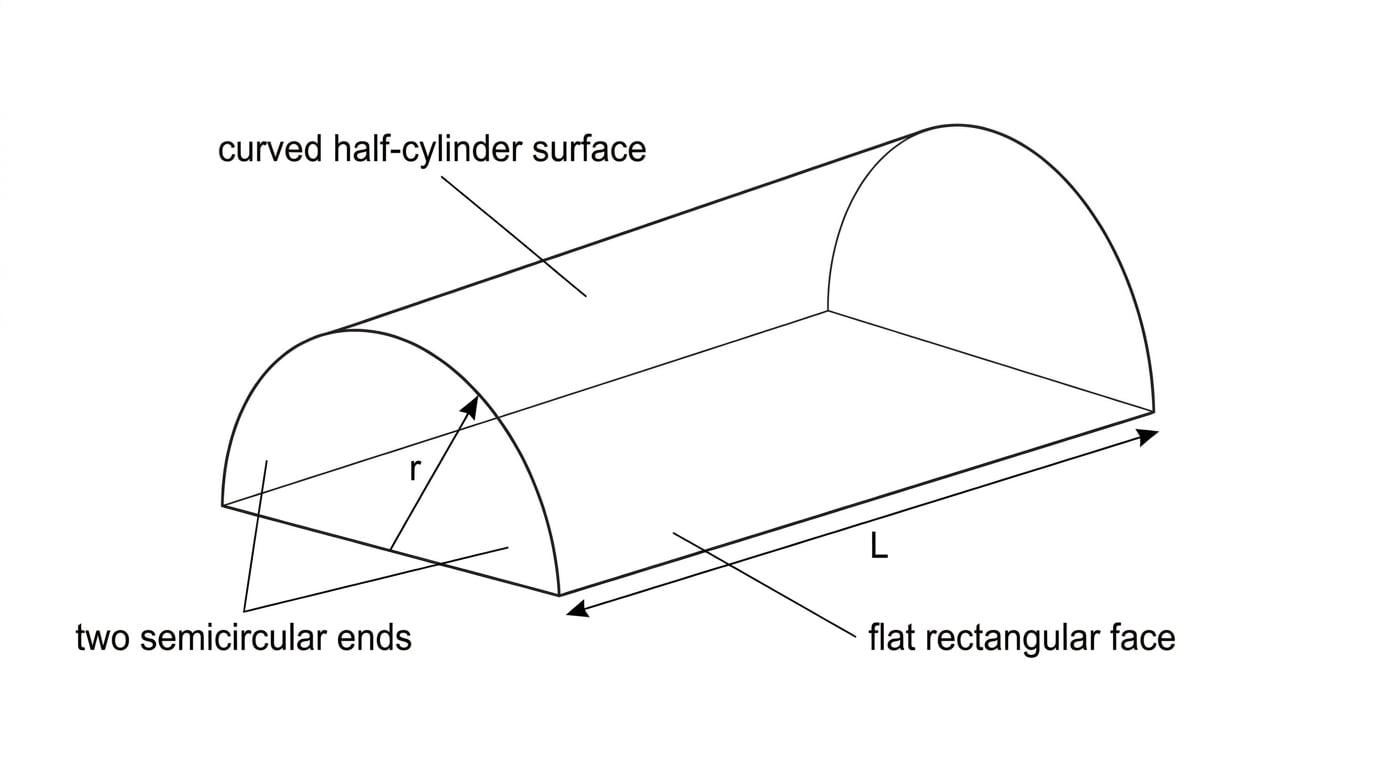
Example
Volume and surface area of a semi-cylinder
A semi-cylinder has radius 10 cm and length 40 cm. Find its volume and total surface area, each correct to 3 significant figures.
-
For volume, use half of the full-cylinder volume.
V=12π×102×40V = \frac{1}{2}\pi \times 10^2 \times 40V=21π×102×40 -
Simplify the volume.
V=2000π≈6283.185V = 2000\pi \approx 6283.185V=2000π≈6283.185 -
The volume is 6.28×1036.28 \times 10^36.28×103 cm³ to 3 significant figures.
-
For surface area, add the curved half, the flat rectangle, and the two semicircular ends.
TSA=πrL+2rL+πr2\text{TSA} = \pi rL + 2rL + \pi r^2TSA=πrL+2rL+πr2 -
Substitute radius 10 and length 40.
TSA=π×10×40+2×10×40+π×102\text{TSA} = \pi \times 10 \times 40 + 2 \times 10 \times 40 + \pi \times 10^2TSA=π×10×40+2×10×40+π×102 -
Simplify and round.
TSA=500π+800≈2370.796\text{TSA} = 500\pi + 800 \approx 2370.796TSA=500π+800≈2370.796 -
The total surface area is 2.37×1032.37 \times 10^32.37×103 cm² to 3 significant figures.
A composite solid is a shape made from two or more simpler 3D solids. For volume, split it into shapes you know.
Example
Half cylinder on a rectangular prism
A solid is made from a rectangular prism with a half-cylinder on top. It has width 4 m, total height 5 m, and length 9 m. Find the volume correct to 3 significant figures.
-
The half-cylinder sits across the width, so its diameter is 4 m and its radius is 2 m.
-
The rectangular prism height is the total height minus the radius of the half-cylinder.
5−2=35 - 2 = 35−2=3 -
Find the prism volume.
4×3×9=1084 \times 3 \times 9 = 1084×3×9=108 -
Find the semi-cylinder volume.
12π×22×9=18π\frac{1}{2}\pi \times 2^2 \times 9 = 18\pi21π×22×9=18π -
Add the two volumes.
108+18π≈164.549108 + 18\pi \approx 164.549108+18π≈164.549 -
The volume is 165 m³ to 3 significant figures.
5. Working backwards
Sometimes you are given the volume or surface area and asked to find a missing radius or height. Use the formula first, then solve the equation.
Example
Finding a missing radius from volume
A cylinder has height 8 m and volume 288π288\pi288π m³. Find its radius.
-
Start with the volume formula.
V=πr2hV = \pi r^2hV=πr2h -
Substitute the known values.
288π=πr2×8288\pi = \pi r^2 \times 8288π=πr2×8 -
Divide both sides by π\piπ, then divide by 8.
288=8r2288 = 8r^2288=8r2 -
Solve for r2r^2r2.
r2=36r^2 = 36r2=36 -
Square root to find the positive radius.
r=6r = 6r=6 -
The radius is 6 m.
Example
Finding a missing height from surface area
A closed cylinder has radius 4 m and total surface area 112π112\pi112π m². Find its height.
-
Use the total surface area formula.
TSA=2πr2+2πrh\text{TSA} = 2\pi r^2 + 2\pi rhTSA=2πr2+2πrh -
Substitute radius 4 and surface area 112π112\pi112π.
112π=2π×42+2π×4×h112\pi = 2\pi \times 4^2 + 2\pi \times 4 \times h112π=2π×42+2π×4×h -
Simplify.
112π=32π+8πh112\pi = 32\pi + 8\pi h112π=32π+8πh -
Subtract 32π32\pi32π from both sides.
80π=8πh80\pi = 8\pi h80π=8πh -
Divide by 8π8\pi8π.
h=10h = 10h=10 -
The height is 10 m.
6. Practical problems: units, paint, and water
Cylinder questions often involve real-life units. Check whether all measurements are in the same unit before substituting into a formula.
Useful conversions:
- 1 m = 100 cm
- 1 m² = 10000 cm²
- 1 m³ = 1000000 cm³
- 1 litre = 1000 cm³
Common Mistake
Confusing square and cubic units
Surface area uses square units such as cm² or m². Volume uses cubic units such as cm³ or m³. Also, 1500 cm² is not 15 m²; since 1 m² is 10000 cm², 1500 cm² is 0.15 m².
Example
Paint needed for closed cylindrical tanks
Four closed cylindrical tanks are to be painted. Each tank has diameter 50 cm and height 1.2 m. One pot of paint covers 3 m². How many pots are needed?
-
Convert the diameter to metres.
50 cm=0.5 m50\text{ cm} = 0.5\text{ m}50 cm=0.5 m -
Find the radius in metres.
r=0.52=0.25r = \frac{0.5}{2} = 0.25r=20.5=0.25 -
Find the surface area of one closed tank.
TSA=2π×0.252+2π×0.25×1.2\text{TSA} = 2\pi \times 0.25^2 + 2\pi \times 0.25 \times 1.2TSA=2π×0.252+2π×0.25×1.2 -
Simplify.
TSA=0.725π≈2.278\text{TSA} = 0.725\pi \approx 2.278TSA=0.725π≈2.278 -
Find the total area for four tanks.
4×2.278≈9.1124 \times 2.278 \approx 9.1124×2.278≈9.112 -
Divide by the coverage per pot.
9.112÷3≈3.0379.112 \div 3 \approx 3.0379.112÷3≈3.037 -
You must buy 4 pots, because 3 pots would not cover enough area.
Tip
Rounding for practical answers
If you are buying pots of paint, packets, tiles, or containers, round up to the next whole number. You cannot buy 3.037 pots of paint.
Example
Filling a cylindrical tank
A cylindrical tank has radius 10 cm and height 60 cm. Water flows in at 1.5 litres per minute. Find the time to fill the tank to the nearest minute.
-
Find the tank volume in cm³.
V=π×102×60=6000πV = \pi \times 10^2 \times 60 = 6000\piV=π×102×60=6000π -
Convert cm³ to litres by dividing by 1000.
6000π÷1000=6π6000\pi \div 1000 = 6\pi6000π÷1000=6π -
Divide by the flow rate.
6π÷1.5≈12.5666\pi \div 1.5 \approx 12.5666π÷1.5≈12.566 -
Round to the nearest minute: it takes 13 minutes.
Exam technique
In the exam
- Write the correct formula first, then substitute the numbers carefully.
- If you are given a diameter, halve it before using any formula with rrr.
- Check units: surface area is squared, volume is cubed, and practical answers may need rounding up.
Self review
Check yourself
- Can you explain why the curved surface area of a cylinder is 2πrh2\pi rh2πrh?
- If a cylinder has diameter 14 cm, what radius should you use in the formula?
- How would you convert 18000 cm³ into litres?

Recap questions
Test yourself with 5 quick questions on this guide. Answer them all correctly to complete it.
You've reached the end
Test yourself on this topic, or move on to the next guide.
How was this guide?