Revision notes for Edexcel IGCSE Maths Bearings. Open the guide for explanations and worked examples. Written against the Edexcel IGCSE Maths (4MA1) specification, so the content matches what's examinable rather than general Maths background.
Bearings
What you'll learn
- How to read and write bearings using the three key rules.
- How to draw a bearing accurately with a protractor.
- How to find reverse bearings, such as from B back to A.
- How bearings connect to angle facts in triangles and straight lines.
The angle facts you need first
Before bearings, make sure these angle facts feel familiar:
- A full turn is 360°.
- A straight line is 180°.
- A right angle is 90°.
- Angles in a triangle add up to 180°.
A bearing is really just an angle, but it is measured in a very particular way.
Example
Using a full turn
A line from P to Q is just to the left of North. The small angle between North and PQ is 34° anticlockwise. Find the clockwise bearing of Q from P.
-
A bearing must be measured clockwise, not anticlockwise.
-
The diagram gives the small anticlockwise angle, so subtract it from a full turn:
360∘−34∘=326∘360^\circ - 34^\circ = 326^\circ360∘−34∘=326∘ -
The bearing of Q from P is 326°.
What is a bearing?
Definition
Bearing
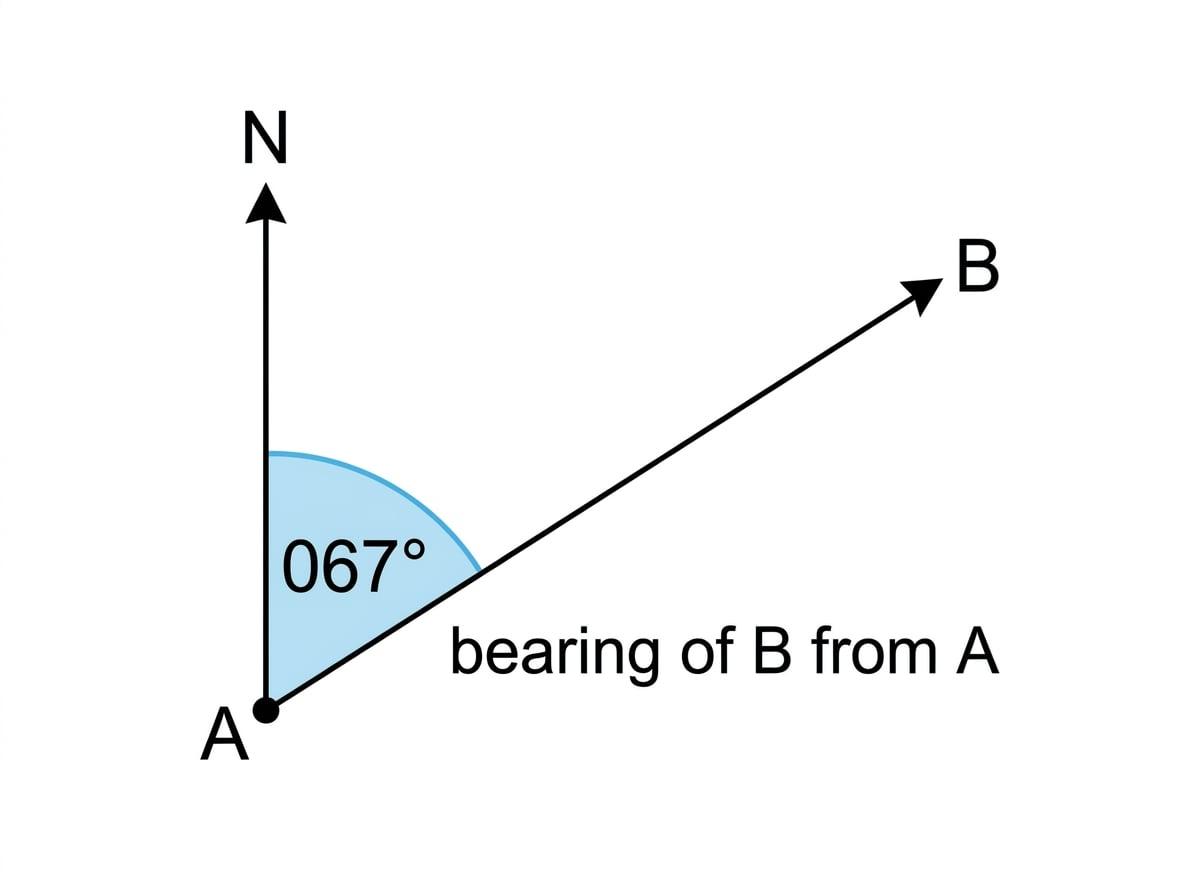
A bearing is an angle used to describe direction. It is always measured clockwise from North at the starting point and written using three figures, such as 067° or 315°.
The diagram below shows the key idea: start at A, face North, then turn clockwise until you are pointing towards B.
Key Idea
The three bearing rules
Every bearing is measured from North, measured clockwise, and written using three figures.
The word “from” matters
In “the bearing of B from A”, the direction comes from A. Imagine standing at A and looking towards B.
Example
Reading a bearing from a diagram
The angle from the North line at A to the line AB is marked 067°. State the bearing of B from A.
-
Find the starting point. The phrase “from A” tells you to stand at A.
-
Use the North line drawn at A.
-
Turn clockwise from North until you reach the line pointing to B.
-
The marked angle is 067°, so the bearing of B from A is 067°.
Common Mistake
Using the wrong North line
A bearing “from A” must use the North line at A, even if another North line is drawn somewhere else.
Writing bearings with three figures
A three-figure bearing has exactly three digits before the degree symbol.
So:
- 7° becomes 007°.
- 45° becomes 045°.
- 90° becomes 090°.
- 180° and 270° already have three figures.
The main compass directions are:
- North: 000°
- East: 090°
- South: 180°
- West: 270°
Example
Converting directions to bearings
Write these directions as three-figure bearings: East, South-West, and an angle of 23° clockwise from North.
-
East is a quarter turn clockwise from North, so it is 090°.
-
South-West is halfway between South and West. South is 180° and West is 270°, so halfway is 225°.
-
An angle of 23° needs leading zeros to make three figures, so it is 023°.
Common Mistake
Forgetting the leading zero
A bearing of 67° must be written as 067°. In bearings, “three figures” means three digits.
Drawing a bearing accurately
To draw a bearing, you usually need a ruler and protractor.
Definition
Protractor
A protractor is the measuring tool used to draw or measure angles, usually marked from 0° to 180°.
When drawing a bearing, the zero line of the protractor should line up with North, and you measure clockwise.
Example
Drawing a bearing
Draw point Q so that Q is 6 cm from P on a bearing of 125°.
-
Mark point P clearly.
-
Draw a vertical North line upwards from P and label it N.
-
Place the centre of the protractor on P.
-
Line up 0° with the North line.
-
Measure 125° clockwise from North and make a small mark.
-
Draw a straight ray from P through your mark.
-
Measure 6 cm along the ray from P and label that point Q.
Tip
Choosing the correct protractor scale
As you move clockwise from North, the numbers should get bigger. If they are getting smaller, you are reading the wrong scale.
Reverse bearings
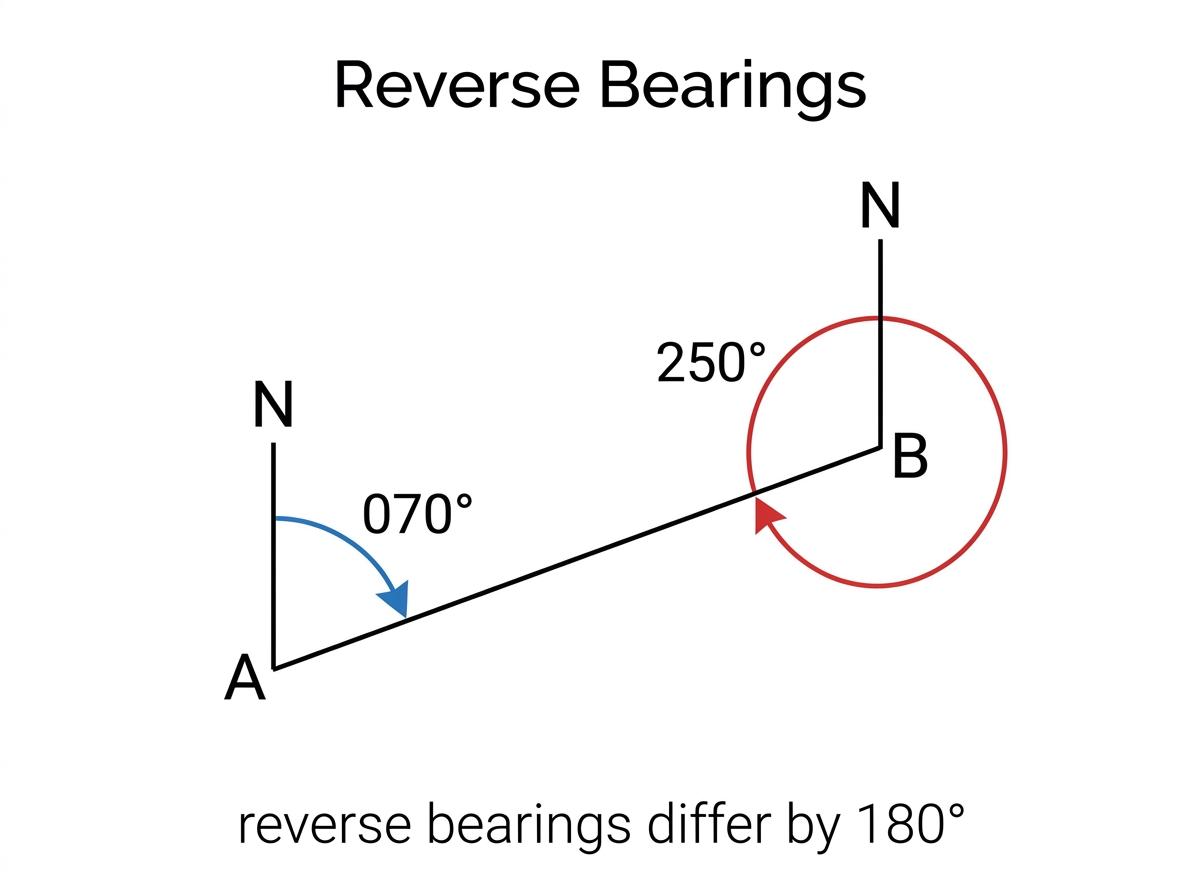
A reverse bearing is the bearing in the opposite direction. For example, if you know the bearing of B from A, the reverse bearing is the bearing of A from B.
The North lines at A and B are parallel, and the direction back is a half-turn away. A half-turn is 180°.
Key Idea
Reverse bearing rule
To find the reverse bearing, add 180° if the bearing is less than 180°. Subtract 180° if the bearing is 180° or more.
Example
Finding the bearing back
The bearing of B from A is 070°. Find the bearing of A from B.
-
You are now travelling in the opposite direction, so you need the reverse bearing.
-
Since 070° is less than 180°, add 180°:
70∘+180∘=250∘70^\circ + 180^\circ = 250^\circ70∘+180∘=250∘ -
The bearing of A from B is 250°.
Example
Reverse bearing with a leading zero
The bearing of D from C is 238°. Find the bearing of C from D.
-
You need the opposite direction, so find the reverse bearing.
-
Since 238° is more than 180°, subtract 180°:
238∘−180∘=58∘238^\circ - 180^\circ = 58^\circ238∘−180∘=58∘ -
The answer must be three figures, so the bearing of C from D is 058°.
Bearings in triangles
Bearings often create triangles. The trick is to turn the bearing information into ordinary angle information.
The most useful steps are:
- Draw North lines at each point.
- Remember that all North lines are parallel.
- Find any reverse bearings you need.
- Use angle facts such as angles on a straight line, angles around a point, or angles in a triangle.
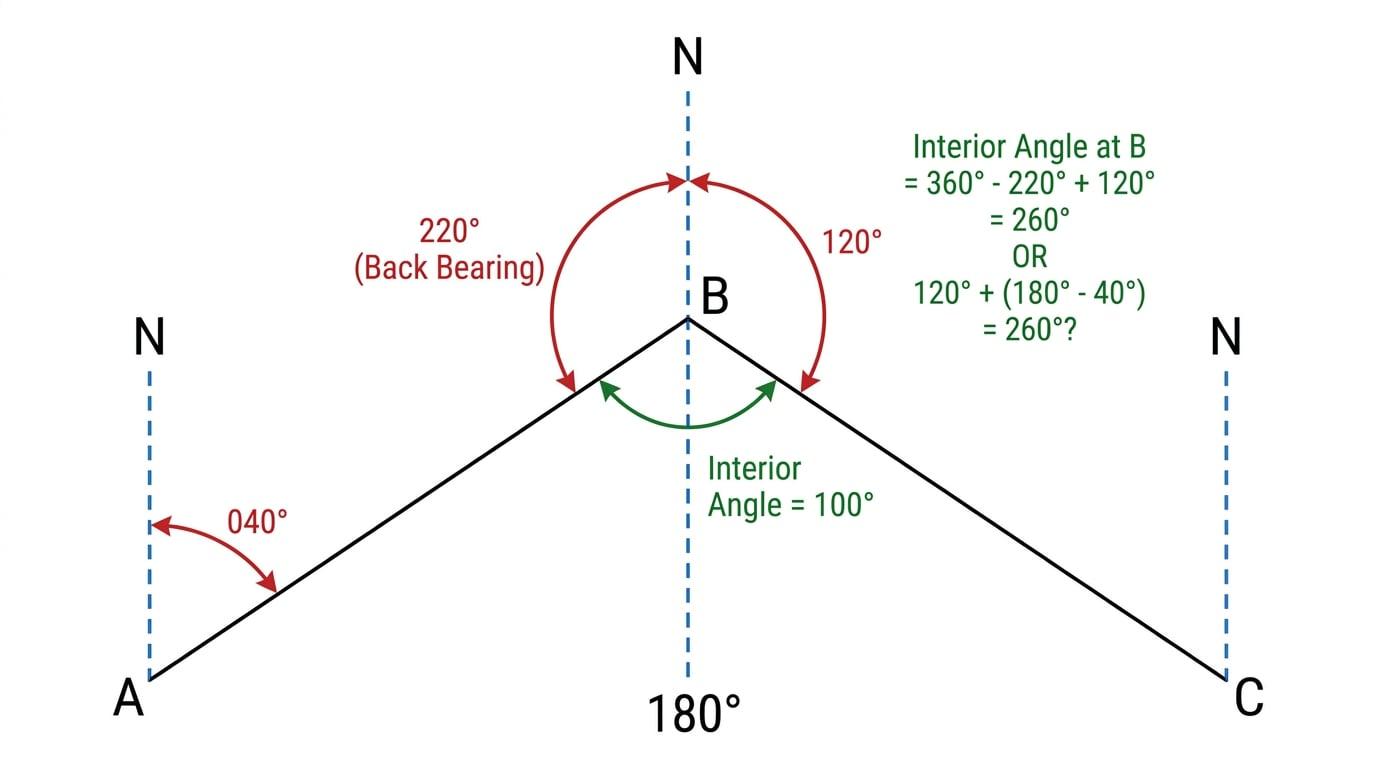
The diagram below shows two journeys using bearings. The angle at B can be found by comparing the direction from B to A with the direction from B to C.
Example
Finding an angle in a bearings diagram
From A, B is on a bearing of 040°. From B, C is on a bearing of 120°. Find angle ABC.
-
Angle ABC is the angle at B between BA and BC.
-
The bearing 040° describes the direction from A to B. At B, we need the direction back from B to A.
-
Find the reverse bearing of 040°:
40∘+180∘=220∘40^\circ + 180^\circ = 220^\circ40∘+180∘=220∘ -
From B, BA has a bearing of 220°, and BC has a bearing of 120°.
-
The angle between those two directions is the difference:
220∘−120∘=100∘220^\circ - 120^\circ = 100^\circ220∘−120∘=100∘ -
Therefore, angle ABC is 100°.
Tip
Compare directions from the same point
If you are finding an angle at B, make sure both directions are measured from B before you subtract.
Measuring bearings from a diagram
If a question asks you to measure a bearing, accuracy matters.
A good method is:
- Put a sharp pencil dot on the starting point.
- Draw or extend the North line if needed.
- Place the protractor centre exactly on the starting point.
- Measure clockwise from North to the line of travel.
- Write your answer as a three-figure bearing.
Example
Measuring a bearing
On a scale diagram, the line from X to Y is to the south-east of X. The clockwise angle from North at X to XY measures 142°. State the bearing of Y from X.
-
The phrase “from X” tells you to measure at X.
-
Start from the North line at X.
-
Measure clockwise until you reach the line XY.
-
The measured angle is 142°, which already has three figures.
-
The bearing of Y from X is 142°.
Exam technique
In the exam
-
Underline the word from and put your pencil on that point first.
-
Draw or extend a North line at the starting point if one is missing.
-
Always measure clockwise and write the answer using three figures.
-
For a reverse bearing, add or subtract 180° and then check the answer is between 000° and 360°.
-
In triangle questions, find reverse bearings first, then use your usual angle facts.
Self review
Check yourself
-
How should a bearing of 8° be written as a three-figure bearing?
-
In “the bearing of C from D”, which point do you stand at?
-
If the bearing of Q from P is 135°, what operation finds the bearing of P from Q?

Recap questions
Test yourself with 5 quick questions on this guide. Answer them all correctly to complete it.
You've reached the end
Test yourself on this topic, or move on to the next guide.
How was this guide?