Revision notes for Edexcel IGCSE Maths Volume of a Prism. Open the guide for explanations and worked examples. Written against the Edexcel IGCSE Maths (4MA1) specification, so the content matches what's examinable rather than general Maths background.
Volume of a Prism
What you'll learn
- What a prism is and how to spot its cross-section.
- How to use the formula: volume = cross-section area times length.
- How to handle triangular, trapezium and composite prisms.
- How to solve practical problems involving boxes, water, litres and missing lengths.
1. The basic idea of volume
Definition
Volume
Volume is the amount of space inside a 3D shape. It is measured in cubic units, such as cm³, m³ or mm³.
For a cuboid, the volume is found by multiplying the three perpendicular dimensions:
V=length×width×heightV = \text{length} \times \text{width} \times \text{height}V=length×width×heightA cube is a special cuboid where all the edges are the same length.
Key Idea
Cuboid volume
For a cuboid, multiply the three side lengths. If one length is missing, use the volume to work backwards.
Example
Finding a missing cuboid width
A cuboid has length 15 cm, height 6 cm and volume 270 cm³. Find its width, xxx.
-
Write the cuboid volume formula.
V=length×width×heightV = \text{length} \times \text{width} \times \text{height}V=length×width×height -
Substitute the known values.
270=15×x×6270 = 15 \times x \times 6270=15×x×6 -
Multiply the known numbers first.
270=90x270 = 90x270=90x -
Divide by 90 to find xxx.
x=270÷90=3x = 270 \div 90 = 3x=270÷90=3 -
The missing width is 3 cm.
Common Mistake
Forgetting all three dimensions
For a volume, you need three dimensions. Area uses two dimensions; volume uses three.
2. What is a prism?
Definition
Prism
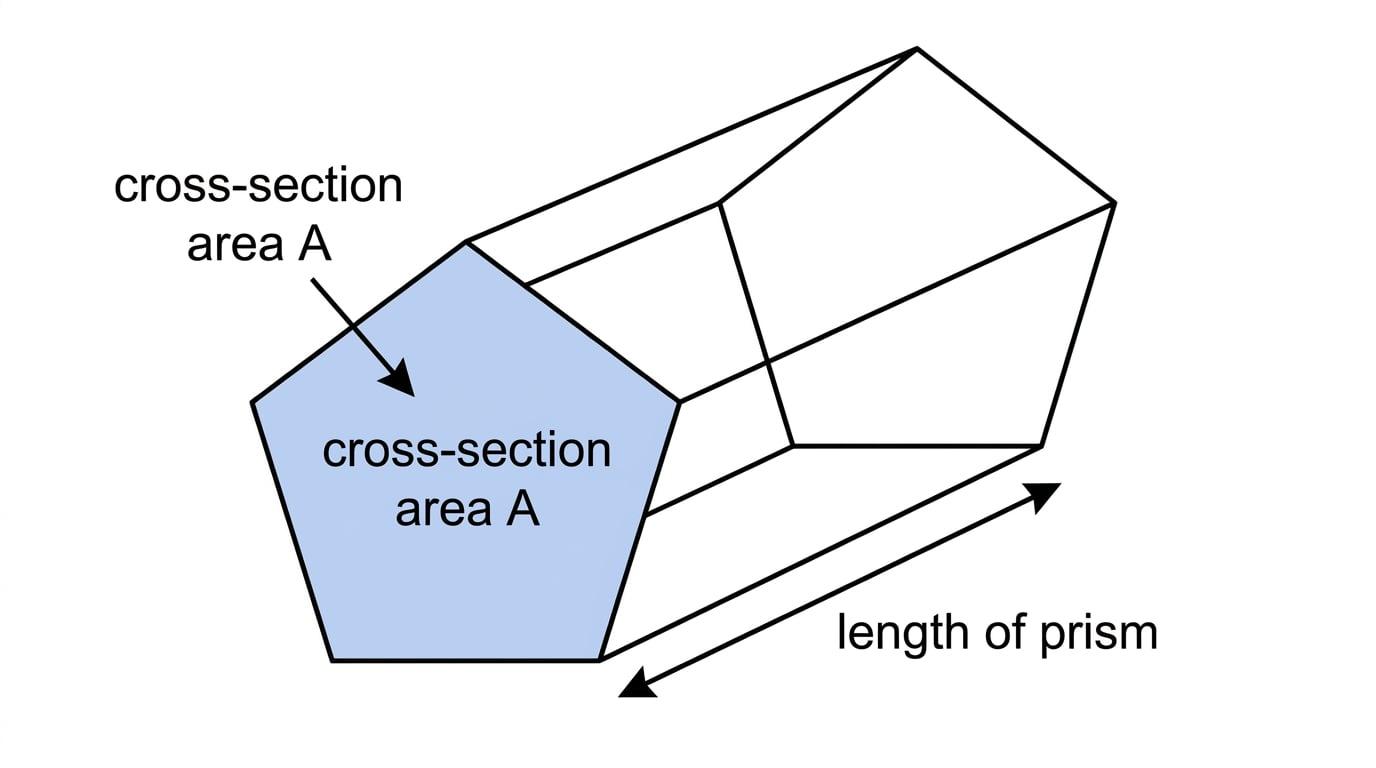
A prism is a 3D shape with the same 2D shape repeated all the way through its length. That repeated 2D shape is called the cross-section.
For example, in a triangular prism, the cross-section is a triangle. In a trapezium prism, the cross-section is a trapezium.
The cross-section is like the “front face” that has been stretched backwards through a length.
Key Idea
Volume of any prism
For any prism:
V=A×lV = A \times lV=A×lwhere AAA is the area of the cross-section and lll is the length of the prism.
Example
Triangular prism volume
A triangular prism has a right-angled triangular cross-section with base 6 cm and height 5 cm. The prism is 9 cm long. Find the volume.
-
Find the area of the triangular cross-section.
A=12×6×5A = \frac{1}{2} \times 6 \times 5A=21×6×5 -
Work out the triangle area.
A=15A = 15A=15 -
Multiply the cross-section area by the length of the prism.
V=15×9V = 15 \times 9V=15×9 -
Calculate the volume.
V=135V = 135V=135 -
The volume is 135 cm³.
Common Mistake
Using the sloping side of a triangle
For a right-angled triangle, the area uses the two perpendicular sides: base and height. The sloping side is not the height unless it is perpendicular to the base.
3. Finding the area of the cross-section
Before you can find the volume of a prism, you must find the area of the cross-section.
Here are the key area facts you need:
- Rectangle area: length times width.
- Triangle area: 12×base×height\frac{1}{2} \times \text{base} \times \text{height}21×base×height.
- Trapezium area: 12(a+b)h\frac{1}{2}(a+b)h21(a+b)h, where aaa and bbb are the parallel sides and hhh is the perpendicular height.
- Composite shape area: split the shape into simpler shapes, then add their areas.
Definition
Trapezium
A trapezium is a quadrilateral with one pair of parallel sides.
Example
Trapezium prism volume
A prism has a trapezium cross-section. The parallel sides are 5 cm and 11 cm. The perpendicular height is 4 cm. The prism is 12 cm long. Find the volume.
-
Use the trapezium area formula.
A=12(a+b)hA = \frac{1}{2}(a+b)hA=21(a+b)h -
Substitute the parallel sides and height.
A=12(5+11)×4A = \frac{1}{2}(5+11) \times 4A=21(5+11)×4 -
Add the parallel sides.
A=12×16×4A = \frac{1}{2} \times 16 \times 4A=21×16×4 -
Work out the cross-section area.
A=32A = 32A=32 -
Multiply by the length of the prism.
V=32×12=384V = 32 \times 12 = 384V=32×12=384 -
The volume is 384 cm³.
Tip
Check the direction
The length of the prism is the direction the cross-section has been stretched. It is not always the longest number in the diagram.
4. Composite prisms
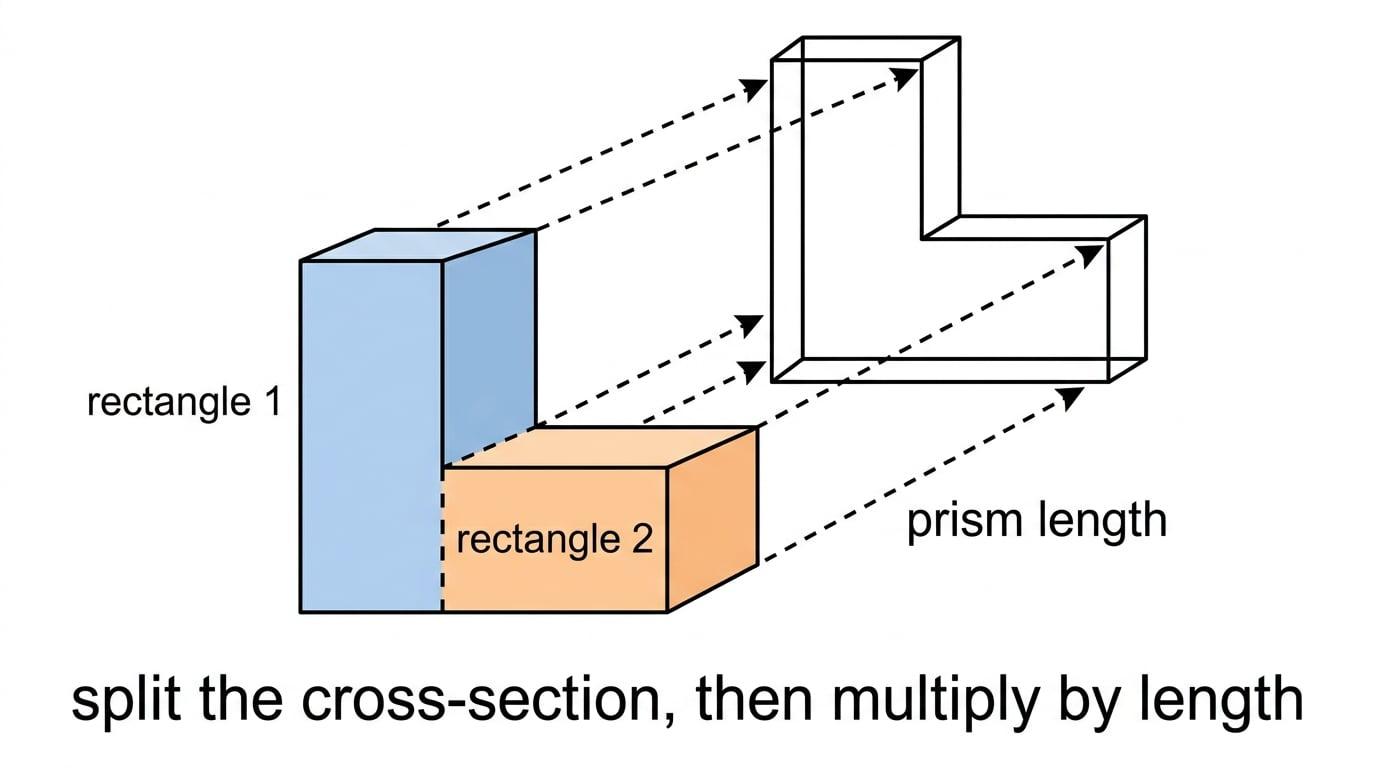
Some prisms have a cross-section made from more than one simple shape. These are often L-shaped or made from rectangles joined together.
The safest method is:
- Split the cross-section into rectangles or triangles.
- Find each area.
- Add the areas.
- Multiply by the prism length.
Example
L-shaped prism volume
An L-shaped cross-section is made from two rectangles. One rectangle is 3 cm by 10 cm. The other rectangle is 2 cm by 10 cm. The prism length is 8 cm. Find the volume.
-
Find the area of the first rectangle.
A1=3×10=30A_1 = 3 \times 10 = 30A1=3×10=30 -
Find the area of the second rectangle.
A2=2×10=20A_2 = 2 \times 10 = 20A2=2×10=20 -
Add the two areas to get the total cross-section area.
A=30+20=50A = 30 + 20 = 50A=30+20=50 -
Multiply by the prism length.
V=50×8=400V = 50 \times 8 = 400V=50×8=400 -
The volume is 400 cm³.
Common Mistake
Adding lengths instead of areas
For a composite cross-section, add the areas of the parts, not just the side lengths.
5. Working backwards from the volume
Sometimes the volume is given and you need to find a missing length.
The method is still based on:
V=A×lV = A \times lV=A×lbut you form an equation and solve it.
Example
Finding a missing triangle height
A triangular prism has a right-angled triangular cross-section. The triangle has base 4 cm and height xxx cm. The prism length is 11 cm. The volume is 220 cm³. Find xxx.
-
Write the area of the triangular cross-section.
A=12×4×xA = \frac{1}{2} \times 4 \times xA=21×4×x -
Simplify the cross-section area.
A=2xA = 2xA=2x -
Use volume = cross-section area times length.
220=2x×11220 = 2x \times 11220=2x×11 -
Simplify the right-hand side.
220=22x220 = 22x220=22x -
Divide by 22.
x=10x = 10x=10 -
The missing height is 10 cm.
Tip
Reverse the operations
If the question gives the volume, do the normal formula first, then use division to undo the multiplication.
6. Cubes, square faces and surface area links
A cube has 6 identical square faces. If you know the area of one square face, you can find the side length.
For example, if a square face has area 25 cm², then its side length is 5 cm because 5 times 5 is 25.
Example
Cube volume from total surface area
The total surface area of a cube is 216 cm². Find the volume of the cube.
-
A cube has 6 equal square faces, so divide by 6 to find the area of one face.
216÷6=36216 \div 6 = 36216÷6=36 -
Find the side length of the square face.
36=6\sqrt{36} = 636=6 -
Use the cube volume formula.
V=63V = 6^3V=63 -
Work out the volume.
V=216V = 216V=216 -
The volume is 216 cm³.
Common Mistake
Using surface area as volume
Surface area is measured in square units, such as cm². Volume is measured in cubic units, such as cm³. They are different things.
7. Units, litres and practical questions
Many IGCSE prism questions involve containers, water or boxes.
You need these conversions:
- 1 m = 100 cm
- 1 litre = 1000 cm³
- 1 ml = 1 cm³
Definition
Capacity
Capacity is the amount of liquid a container can hold. In these questions, you often find the container’s volume first, then convert to litres or millilitres.
Example
Buckets needed to fill a container
A rectangular water tank is 80 cm long, 45 cm wide and 50 cm high. Each bucket holds 9 litres. How many full buckets are needed to fill the tank?
-
Find the volume of the tank in cm³.
V=80×45×50V = 80 \times 45 \times 50V=80×45×50 -
Calculate the volume.
V=180000V = 180000V=180000 -
Convert cm³ to litres by dividing by 1000.
180000÷1000=180180000 \div 1000 = 180180000÷1000=180 -
Divide by the bucket size.
180÷9=20180 \div 9 = 20180÷9=20 -
20 buckets are needed.
Example
Boxes fitting in a van by volume
Each box is a cuboid measuring 50 cm by 30 cm by 40 cm. A van has cuboid storage space measuring 2.5 m by 1.8 m by 1.6 m. Estimate how many boxes fit by comparing volumes.
-
Convert the van dimensions to centimetres.
2.5 m=250 cm,1.8 m=180 cm,1.6 m=160 cm2.5\text{ m} = 250\text{ cm}, \quad 1.8\text{ m} = 180\text{ cm}, \quad 1.6\text{ m} = 160\text{ cm}2.5 m=250 cm,1.8 m=180 cm,1.6 m=160 cm -
Find the volume of one box.
50×30×40=6000050 \times 30 \times 40 = 6000050×30×40=60000 -
Find the volume of the van space.
250×180×160=7200000250 \times 180 \times 160 = 7200000250×180×160=7200000 -
Divide the van volume by the box volume.
7200000÷60000=1207200000 \div 60000 = 1207200000÷60000=120 -
By volume, 120 boxes could fit.
Common Mistake
Packing boxes
Comparing volumes tells you the maximum by volume. In real packing problems, boxes also need to fit along the length, width and height without awkward gaps. If the exam expects a simple volume comparison, it will usually be clear from the numbers and wording.
Tip
Litres shortcut
To convert cm³ to litres, divide by 1000. To convert litres to cm³, multiply by 1000.
Exam technique
In the exam
- Identify the cross-section first, then find its area carefully.
- Multiply the cross-section area by the length of the prism.
- Check the units: cm³ for volume, litres for capacity, and convert before dividing.
- If a value is missing, write an equation using the volume formula and solve it.
- For practical questions, think about whether your final answer must be a whole number.
Self review
Check yourself
- Can you explain the difference between area, volume and capacity?
- If a triangular prism has volume 300 cm³ and length 10 cm, what must you find before solving for a missing triangle side?
- When converting a water container’s volume from cm³ to litres, do you multiply or divide by 1000?

Recap questions
Test yourself with 5 quick questions on this guide. Answer them all correctly to complete it.
You've reached the end
Test yourself on this topic, or move on to the next guide.
How was this guide?