Revision notes for Edexcel IGCSE Maths Ratio. Open the guide for explanations and worked examples. Written against the Edexcel IGCSE Maths (4MA1) specification, so the content matches what's examinable rather than general Maths background.
Ratio
What you'll learn:
- What a ratio is and how to write it.
- How to share a total amount into a given ratio.
- How to find missing amounts when you are given just one part or the difference between parts.
- How to use ratios in geometry and link them to fractions.
1. The Basics of Ratio
A ratio shows how much of one thing there is compared to another thing. It helps us compare the sizes of different parts of a whole.
Definition
Ratio Notation
Ratios are written with a colon : separating the numbers.
For example, if a recipe needs 3 cups of flour and 1 cup of sugar, the ratio of flour to sugar is written as 3:13:13:1. We read this out loud as "three to one".
Just like fractions, ratios should usually be simplified to their lowest terms. You do this by dividing all the parts of the ratio by their highest common factor. For instance, a ratio of 10:510:510:5 simplifies to 2:12:12:1 (by dividing both sides by 5).
2. Sharing a Total Amount
The most common ratio problem asks you to share a total amount of money, objects, or weight between people or categories in a specific ratio.
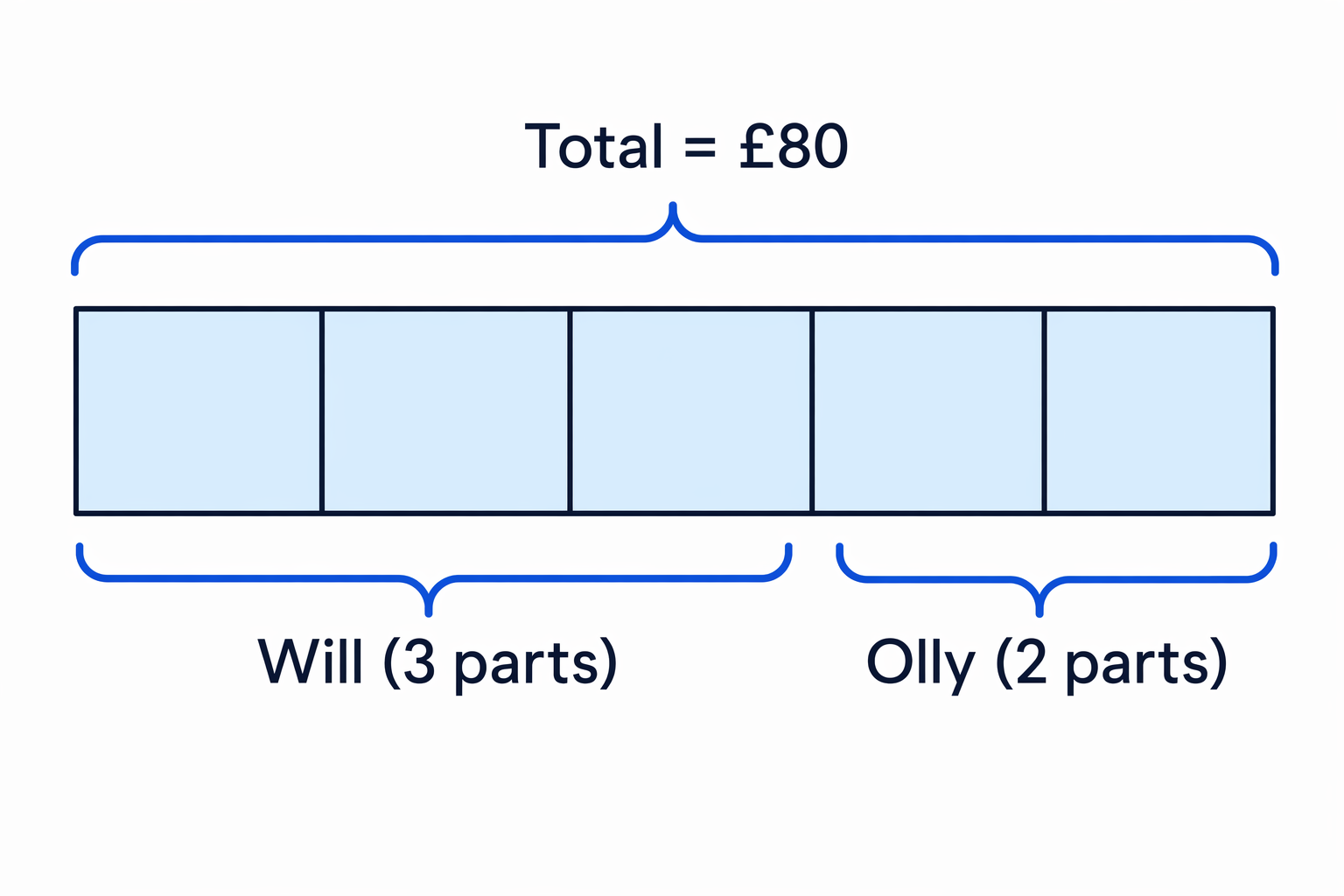
The secret to sharing in a ratio is figuring out what one part is worth. Think of the ratio as a set of identical "boxes" or "parts".
Key Idea
The 3-Step Sharing Method
Whenever you need to share a total amount:
- Add the parts of the ratio to find the total number of parts.
- Divide the total amount by the total number of parts. This tells you the value of 1 part.
- Multiply this value by the number of parts each person has.
Example
Sharing a Total
Alice and Bob share £60 in the ratio 2:32:32:3. Work out how much each person gets.
-
Find the total parts: Add the numbers in the ratio together.
2+3=5 parts2 + 3 = 5 \text{ parts}2+3=5 parts -
Find the value of 1 part: Divide the total amount of money by the total number of parts.
60÷5=1260 \div 5 = 1260÷5=12So, 1 part is worth £12.
-
Multiply to find each share:
- Alice has 2 parts: 2×12=242 \times 12 = 242×12=24
- Bob has 3 parts: 3×12=363 \times 12 = 363×12=36
Alice gets £24 and Bob gets £36.
Tip
Sanity Check
Always add your final answers back together. In the example above, 24+36=6024 + 36 = 6024+36=60, which matches our starting total of £60. If it doesn't add up, you've made a mistake!
3. Working with "One Part" or "The Difference"
Sometimes, an exam question will not give you the total amount. Instead, it will give you the amount for just one person, or it will tell you how much more one person got compared to another.
Common Mistake
Dividing by the Total
The biggest mistake students make is always dividing the number in the question by the total parts (2+3=52+3=52+3=5). You only divide by the total parts if the number is the total amount. If the number belongs to just one person, divide by their parts!
Type A: Given One Person's Amount
Example
Given One Part
Charlie and Dave share some sweets in the ratio 4:74:74:7. Dave gets 35 sweets. Work out how many sweets Charlie gets.
-
Identify what the number represents: The 35 sweets belong to Dave only. Dave has 7 parts.
-
Find the value of 1 part: Since Dave's 7 parts are worth 35 sweets, divide 35 by 7.
35÷7=535 \div 7 = 535÷7=5So, 1 part is worth 5 sweets.
-
Find Charlie's amount: Charlie has 4 parts. Multiply his parts by the value of 1 part.
4×5=204 \times 5 = 204×5=20Charlie gets 20 sweets.
Type B: Given the Difference
Example
Given the Difference
Emma and Fred share some money in the ratio 5:25:25:2. Emma gets £18 more than Fred. Work out how much money Fred gets.
-
Find the difference in parts: Emma has 5 parts and Fred has 2 parts.
5−2=3 parts5 - 2 = 3 \text{ parts}5−2=3 partsEmma has 3 more parts than Fred.
-
Find the value of 1 part: We know these 3 extra parts are worth the extra £18. Divide the difference in money by the difference in parts.
18÷3=618 \div 3 = 618÷3=6So, 1 part is worth £6.
-
Find the requested amount: The question asks for Fred's money. Fred has 2 parts.
2×6=122 \times 6 = 122×6=12Fred gets £12.
4. Ratios in Geometry
Ratios often appear in questions about straight lines or angles in triangles. The logic is exactly the same as sharing money.
Example
Ratios on a straight line
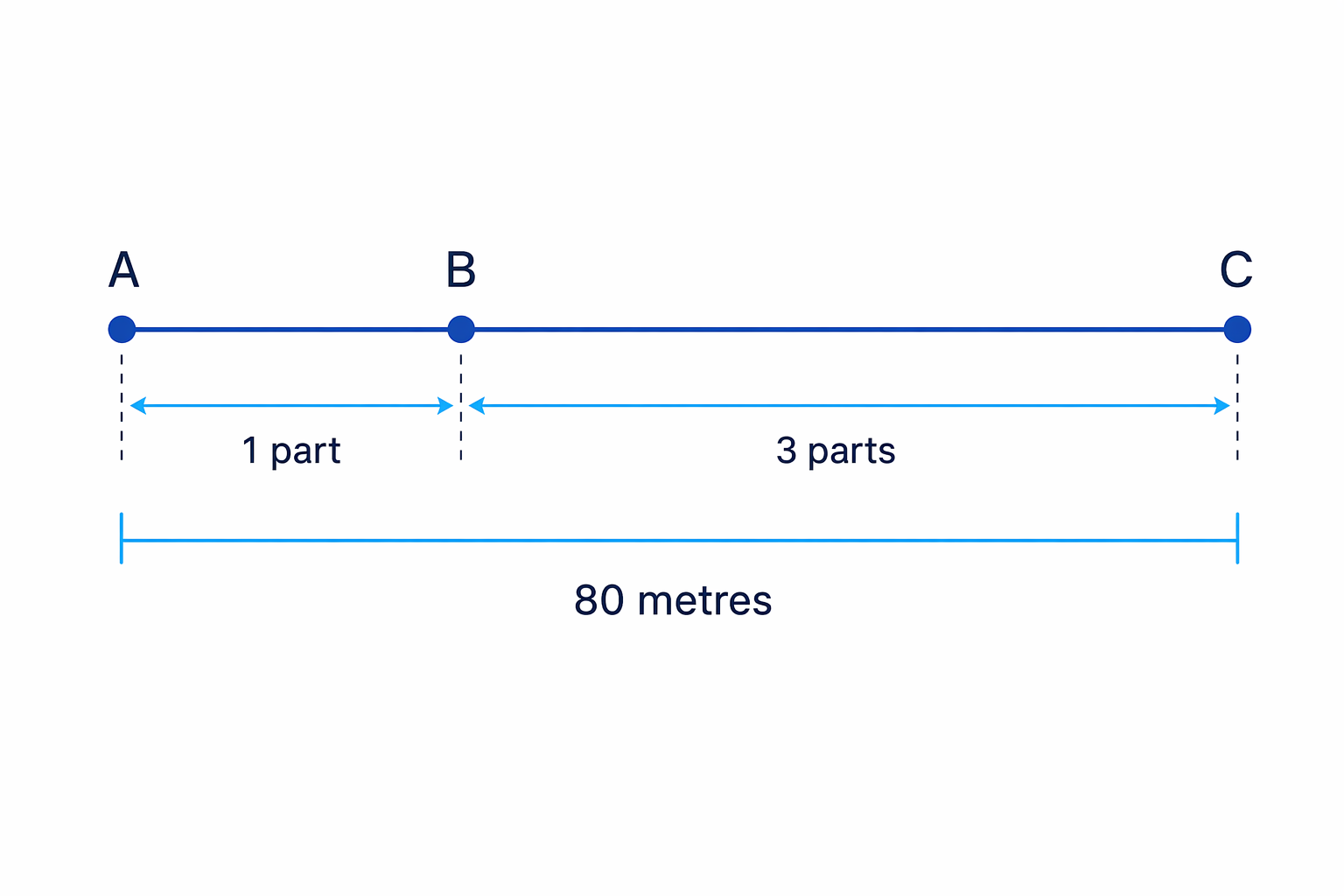
ABC is a straight line. The length of BC is three times the length of AB. The total length AC = 80 metres. Work out the length of AB.
-
Write the relationship as a ratio: If BC is three times AB, then for every 1 part AB has, BC has 3 parts. The ratio of AB to BC is 1:31:31:3.
-
Find the total parts: The total line AC is made up of AB and BC together.
1+3=4 parts total1 + 3 = 4 \text{ parts total}1+3=4 parts total -
Find the value of 1 part: The total length is 80m.
80÷4=2080 \div 4 = 2080÷4=20So, 1 part is worth 20 metres.
-
Find AB: AB is exactly 1 part. Therefore, AB = 20 metres.
5. Ratios and Fractions
You will often need to convert a ratio into a fraction. The key is remembering that the denominator (bottom) of the fraction is the total number of parts.
If red and blue counters are in the ratio 3:43:43:4:
- The total parts are 3+4=73 + 4 = 73+4=7.
- The fraction of red counters is 37\frac{3}{7}73.
- The fraction of blue counters is 47\frac{4}{7}74.
Exam technique
In the exam
- Read the question carefully to decide if the number given is the Total, One Person's Share, or the Difference.
- Find the value of 1 part as your very first calculation.
- Multiply the value of 1 part by the number of parts needed to answer the specific question asked.
- Add your final totals back together to see if they match the starting numbers.
Self review
Check yourself
- If a ratio is 2:52:52:5, what fraction of the total is the smaller part?
- If £40 is shared in the ratio 1:31:31:3, what is the value of 1 part?
- If Ben and Sam share stickers in the ratio 4:14:14:1 and Ben gets 12 stickers, what calculation do you do to find the value of 1 part?

Recap questions
Test yourself with 5 quick questions on this guide. Answer them all correctly to complete it.
You've reached the end
Test yourself on this topic, or move on to the next guide.
How was this guide?