Revision notes for Edexcel IGCSE Maths Percentages. Open the guide for explanations and worked examples. Written against the Edexcel IGCSE Maths (4MA1) specification, so the content matches what's examinable rather than general Maths background.
Percentages
What you'll learn
- What a percentage means and why 100% represents the whole amount.
- How to find easy and harder percentages of quantities, money and measures.
- How to compare percentage amounts and solve worded problems.
- How to handle increases, decreases, deposits, offers and simple interest.
1. What a percentage means
Definition
Percentage
A percentage is a number of parts out of 100. The symbol % means “per hundred”, so 25%=25100=0.2525\% = \frac{25}{100} = 0.2525%=10025=0.25.
A percentage is easiest to picture as a whole split into 100 equal parts. If 25 parts are shaded, that is 25% of the whole.
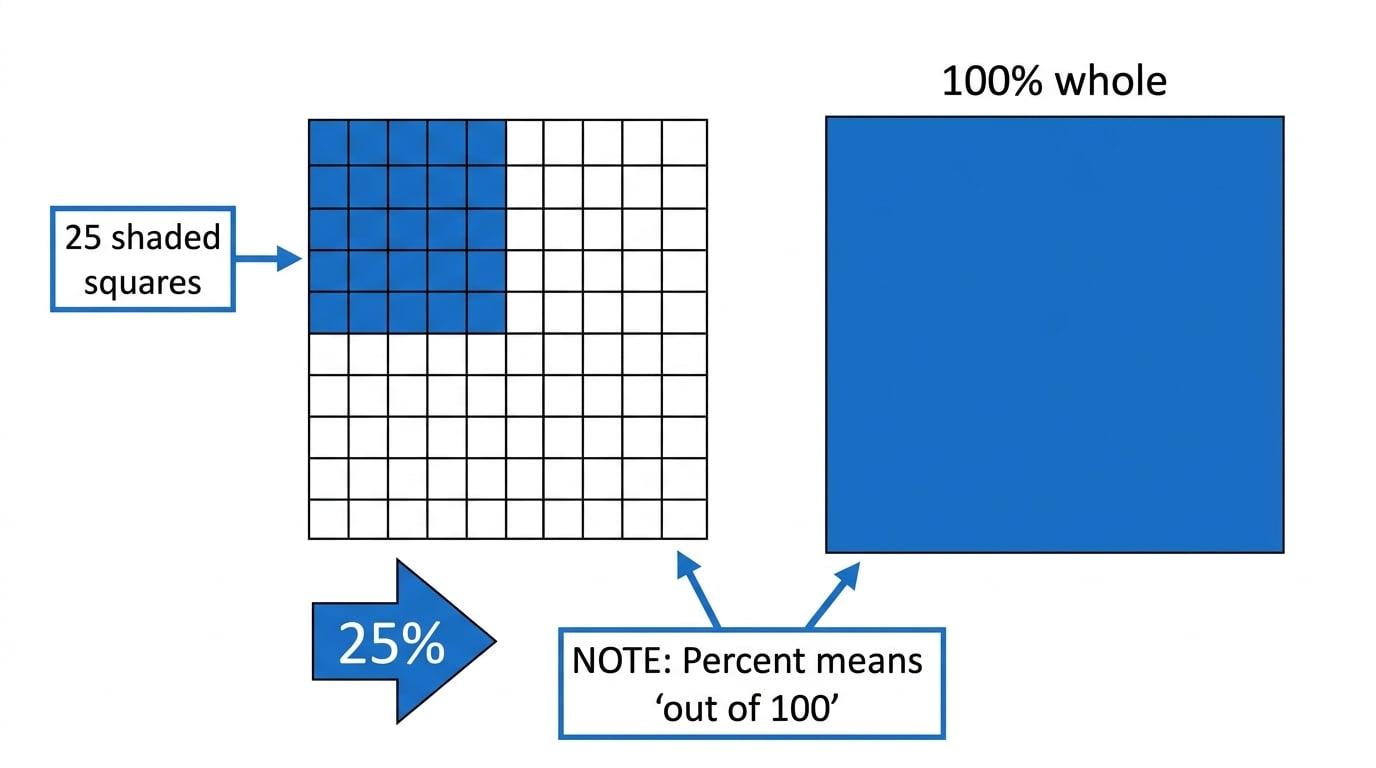
Some percentages are especially useful:
- 50% means half.
- 25% means a quarter.
- 10% means one tenth, so divide by 10.
- 1% means one hundredth, so divide by 100.
Key Idea
The meaning of ‘of’
In percentage questions, “of” means multiply. For example, “20% of 60” means find 20% multiplied by 60.
Example
Finding an easy percentage
Work out 10% of £86.
-
10% means one tenth, so divide the amount by 10.
86÷10=8.686 \div 10 = 8.686÷10=8.6 -
The amount is money, so write the answer with pounds and pence.
-
10% of £86 is £8.60.
Example
Finding 1% of a quantity
Work out 1% of 350 litres.
-
1% means one hundredth, so divide by 100.
350÷100=3.5350 \div 100 = 3.5350÷100=3.5 -
Keep the unit from the question.
-
1% of 350 litres is 3.5 litres.
2. Finding any percentage of an amount
For harder percentages, you have two main methods.
- Build the percentage from easy percentages like 10%, 5% and 1%.
- Convert the percentage to a decimal multiplier and multiply.
Definition
Multiplier
A multiplier is the decimal you multiply by to find a percentage in one step. For example, 36%=36100=0.3636\% = \frac{36}{100} = 0.3636%=10036=0.36, so 36% of an amount means multiply by 0.36.
For Grade 3 questions, the 1% method is often very reliable because it works for any percentage.
Example
Finding 36% using 1%
Find 36% of 2400.
-
Find 1% by dividing the whole amount by 100.
2400÷100=242400 \div 100 = 242400÷100=24 -
36% means 36 lots of 1%, so multiply by 36.
24×36=86424 \times 36 = 86424×36=864 -
So 36% of 2400 is 864.
Tip
Choosing a method
If the percentage is awkward, the 1% method is safe. If you are comfortable with decimals, using a multiplier is quicker.
3. Percentages greater than 100%
A percentage greater than 100% means more than the original whole.
For example:
- 100% is the whole amount.
- 200% is double the amount.
- 250% is two and a half times the amount.
Example
Finding a percentage greater than 100%
Work out 250% of 140.
-
Convert 250% into a decimal multiplier.
250%=250100=2.5250\% = \frac{250}{100} = 2.5250%=100250=2.5 -
Multiply the amount by 2.5.
2.5×140=3502.5 \times 140 = 3502.5×140=350 -
So 250% of 140 is 350.
Common Mistake
Thinking percentages stop at 100%
Percentages can be bigger than 100%. If 100% is one whole, then 250% means 2.5 wholes.
4. Comparing two percentage amounts
When you are asked which is greater, you must work out both values. Do not just choose the bigger percentage or the bigger starting number.
Example
Comparing two percentage calculations
Which is greater: 30% of 110 or 32% of 96?
-
Work out 30% of 110.
0.30×110=330.30 \times 110 = 330.30×110=33 -
Work out 32% of 96.
0.32×96=30.720.32 \times 96 = 30.720.32×96=30.72 -
Compare the two answers.
-
33 is greater than 30.72, so 30% of 110 is greater.
Common Mistake
Comparing only the percentages
32% is bigger than 30%, but it is being taken from a smaller number. Always calculate both percentage amounts before deciding.
5. Finding the whole amount
Sometimes you are not given the total. In these questions, remember that the whole amount is 100%.
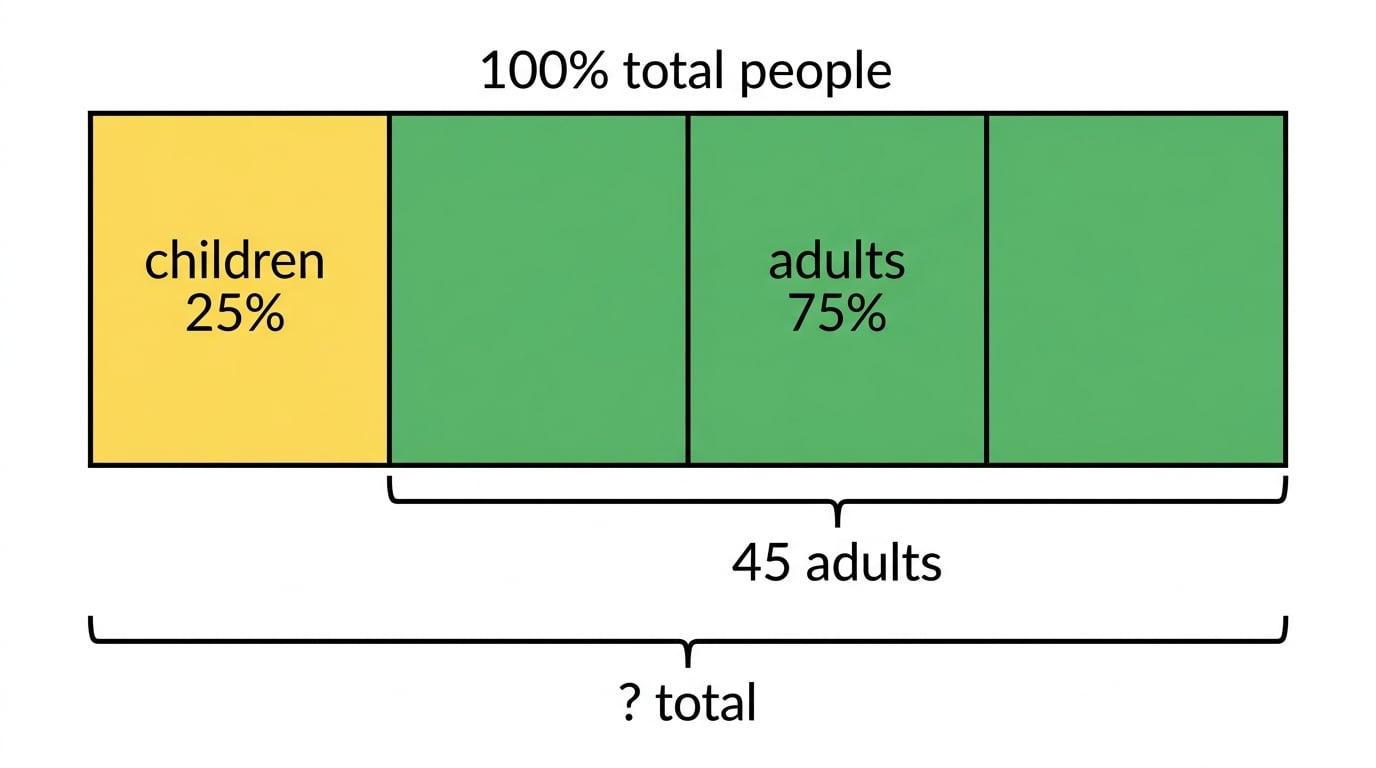
For example, if 25% of people are children, then the remaining 75% are adults.
A bar model can help you see which percentage you know and which percentage you need to find.
Example
Finding the total number of people
At a club, there are 45 adults. 25% of the people are children. Work out the total number of people.
-
If 25% are children, then adults make up the rest.
100%−25%=75%100\% - 25\% = 75\%100%−25%=75% -
So 75% of the total is 45 adults.
-
Find 25% by dividing 45 by 3, because 75% is three lots of 25%.
45÷3=1545 \div 3 = 1545÷3=15 -
The full 100% is four lots of 25%.
15×4=6015 \times 4 = 6015×4=60 -
The total number of people is 60.
6. Percentages in “remaining amount” problems
Many worded questions give you a total, then ask what is left after some parts are taken away.
Common Mistake
Using the wrong whole
In a phrase like “35% of the cakes”, the whole is the total number of cakes, not just one type of cake.
Example
Finding the missing category
A baker makes 360 cakes. 90 are chocolate cakes. 35% are fruit cakes. The rest are plain cakes. Work out the number of plain cakes.
-
Find 35% of 360.
0.35×360=1260.35 \times 360 = 1260.35×360=126 -
So there are 126 fruit cakes.
-
Add the cakes already counted.
90+126=21690 + 126 = 21690+126=216 -
Subtract from the total.
360−216=144360 - 216 = 144360−216=144 -
There are 144 plain cakes.
7. Percentage increases and decreases
Definition
Increase and decrease
An increase means the amount goes up. A decrease means the amount goes down. The percentage is usually taken from the original amount.
For an increase, find the percentage and add it on.
Example
Percentage increase
A salary of £32 000 increases by 4%. Work out the new salary.
-
Find 4% of 32 000.
0.04×32000=12800.04 \times 32000 = 12800.04×32000=1280 -
Add the increase to the original salary.
32000+1280=3328032000 + 1280 = 3328032000+1280=33280 -
The new salary is £33 280.
For a decrease, find the percentage and subtract it.
Example
Sale price after a reduction
A jacket normally costs £48. It is reduced by 20%. Work out the sale price.
-
Find 20% of 48.
0.20×48=9.60.20 \times 48 = 9.60.20×48=9.6 -
Subtract the reduction from the original price.
48−9.6=38.448 - 9.6 = 38.448−9.6=38.4 -
The sale price is £38.40.
8. Deposits and monthly payments
A deposit is an amount paid at the start. If the deposit is a percentage, find that percentage first, then subtract it from the total price.
Example
Deposit then monthly payments
A tablet costs £600. A customer pays a 15% deposit and pays the rest in monthly payments of £30. How many monthly payments are needed?
-
Find the deposit.
0.15×600=900.15 \times 600 = 900.15×600=90 -
Subtract the deposit from the full cost.
600−90=510600 - 90 = 510600−90=510 -
Divide the remaining amount by the monthly payment.
510÷30=17510 \div 30 = 17510÷30=17 -
The customer needs 17 monthly payments.
9. Offers and best buys
For shop offers, compare the total cost for the same number of items. It is often easiest to work in pence.
Example
Comparing two shop offers
You need 6 tins of soup.
Shop A sells tins for 50p each with 10% off.
Shop B sells tins for 70p each with “buy 2 get 1 free”.
Which shop is cheaper?
-
Find the full cost at Shop A before the discount.
6×50=3006 \times 50 = 3006×50=300 -
Find 10% of 300.
0.10×300=300.10 \times 300 = 300.10×300=30 -
Subtract the discount, so Shop A costs 270p.
300−30=270300 - 30 = 270300−30=270 -
For Shop B, “buy 2 get 1 free” means you pay for 2 tins out of every 3 tins.
-
For 6 tins, there are two groups of 3, so you pay for 4 tins.
4×70=2804 \times 70 = 2804×70=280 -
Shop A costs 270p and Shop B costs 280p, so Shop A is cheaper.
Tip
Best-buy questions
Always calculate the actual cost for the exact number of items needed. A deal can look cheaper but still cost more overall.
10. Simple interest
Definition
Simple interest
Simple interest is interest calculated on the original amount each year. The original amount invested is called the principal.
For simple interest, the interest each year stays the same.
Example
Simple interest over several years
Layla invests £600 for 4 years at simple interest of 1.5% per year. Work out the total interest.
-
Find 1.5% of 600 for one year.
0.015×600=90.015 \times 600 = 90.015×600=9 -
The interest is £9 per year.
-
Multiply by 4 years.
9×4=369 \times 4 = 369×4=36 -
The total interest is £36.
Common Mistake
Simple interest is not compound interest
For simple interest, you always use the original amount. You do not add the interest each year before calculating the next year.
Exam technique
In the exam
- Identify the whole amount first: this is 100%.
- Show both calculations when comparing two percentages or two offers.
- For increases add the percentage amount; for decreases subtract it.
- Keep units clear, especially with money, grams, litres and marks.
Self review
Check yourself
- Can you explain why 25% is the same as one quarter?
- If a price is reduced by 15%, do you add or subtract the 15%?
- In a simple interest question, do you calculate interest from the original amount or the new total each year?

Recap questions
Test yourself with 5 quick questions on this guide. Answer them all correctly to complete it.
You've reached the end
Test yourself on this topic, or move on to the next guide.
How was this guide?