Revision notes for CIE IGCSE Maths Vectors Proof Questions. Open the guide for explanations and worked examples. Written against the CIE IGCSE Maths (0580) specification, so the content matches what's examinable rather than general Maths background.
Vectors Proof Questions
What you'll learn
- How to write position vectors using two base vectors such as aaa and bbb.
- How to handle points that divide a line in a given ratio.
- How to prove that three points are on the same straight line.
- How to use collinearity to find an unknown vector on an extended line.
1. Vector basics you need first
In these questions, you usually start from a fixed point called OOO. You then describe every other point by its position from OOO.
Definition
Vector and position vector
- A vector has a size and a direction.
- AB⃗\vec{AB}AB means the movement from point A to point B.
- A position vector gives the position of a point from the origin, for example OA⃗\vec{OA}OA.
The most important rule is:
AB⃗=OB⃗−OA⃗\vec{AB}=\vec{OB}-\vec{OA}AB=OB−OAThink: end minus start.
Example
Finding a midpoint position vector
Suppose OA⃗=4a\vec{OA}=4aOA=4a and OB⃗=7b\vec{OB}=7bOB=7b. Point N is the midpoint of AB. Find AB⃗\vec{AB}AB and ON⃗\vec{ON}ON.
-
Use end minus start to find AB⃗\vec{AB}AB.
AB⃗=7b−4a\vec{AB}=7b-4aAB=7b−4a -
Since N is halfway from A to B, add half of AB⃗\vec{AB}AB to OA⃗\vec{OA}OA.
ON⃗=4a+12(7b−4a)=4a+72b−2a=2a+72b\begin{aligned} \vec{ON}&=4a+\frac{1}{2}(7b-4a)\\ &=4a+\frac{7}{2}b-2a\\ &=2a+\frac{7}{2}b \end{aligned}ON=4a+21(7b−4a)=4a+27b−2a=2a+27b -
So AB⃗=7b−4a\vec{AB}=7b-4aAB=7b−4a and ON⃗=2a+72b\vec{ON}=2a+\frac{7}{2}bON=2a+27b.
2. Points dividing a line in a ratio
If P lies on AB, the ratio tells you how far along the line P is.
For example, if AP:PB=2:3AP:PB=2:3AP:PB=2:3, then the whole line AB has 5 equal parts, and P is 2 of those parts from A.
This is the standard triangle setup for ratio questions.
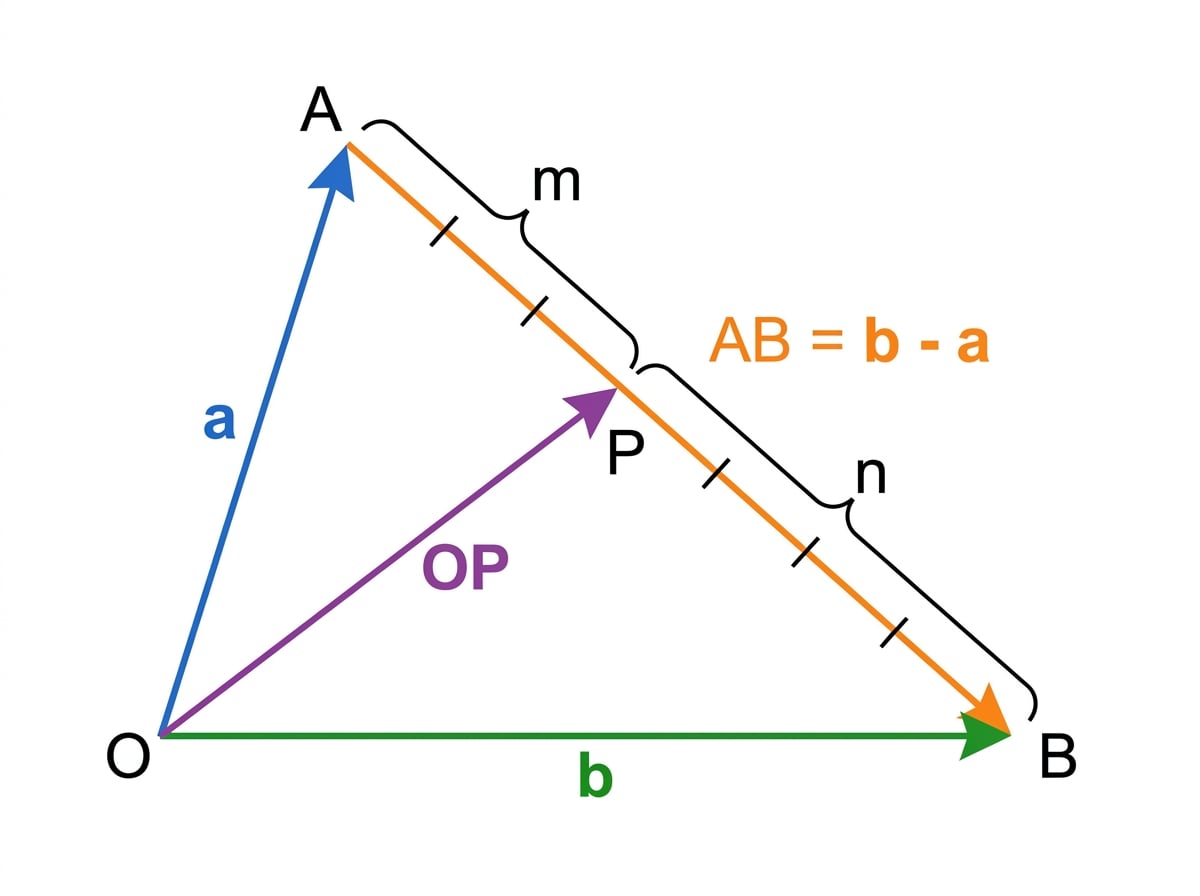
If AP:PB=m:nAP:PB=m:nAP:PB=m:n, then:
AP⃗=mm+nAB⃗\vec{AP}=\frac{m}{m+n}\vec{AB}AP=m+nmABSo:
OP⃗=OA⃗+mm+nAB⃗\vec{OP}=\vec{OA}+\frac{m}{m+n}\vec{AB}OP=OA+m+nmABKey Idea
Use the fraction from the starting end
If P is measured from A, use the AP part of the ratio. In AP:PB=m:nAP:PB=m:nAP:PB=m:n, P is mm+n\frac{m}{m+n}m+nm of the way from A to B.
Example
Finding the value of k
In triangle OAB, OA⃗=2a\vec{OA}=2aOA=2a and OB⃗=5b\vec{OB}=5bOB=5b. Point P lies on AB so that AP:PB=2:3AP:PB=2:3AP:PB=2:3. Given that OP⃗=k(3a+5b)\vec{OP}=k(3a+5b)OP=k(3a+5b), find kkk.
-
First find the vector from A to B.
AB⃗=5b−2a\vec{AB}=5b-2aAB=5b−2a -
Since AP:PB=2:3AP:PB=2:3AP:PB=2:3, P is 25\frac{2}{5}52 of the way from A to B.
OP⃗=OA⃗+25AB⃗=2a+25(5b−2a)=2a+2b−45a=65a+2b\begin{aligned} \vec{OP}&=\vec{OA}+\frac{2}{5}\vec{AB}\\ &=2a+\frac{2}{5}(5b-2a)\\ &=2a+2b-\frac{4}{5}a\\ &=\frac{6}{5}a+2b \end{aligned}OP=OA+52AB=2a+52(5b−2a)=2a+2b−54a=56a+2b -
Factor the answer to match the form in the question.
65a+2b=25(3a+5b)\frac{6}{5}a+2b=\frac{2}{5}(3a+5b)56a+2b=52(3a+5b) -
Therefore k=25k=\frac{2}{5}k=52.
Common Mistake
Using the wrong part of the ratio
If AP:PB=2:3AP:PB=2:3AP:PB=2:3, do not use 35\frac{3}{5}53 from A. The 3 parts are from P to B, not from A to P.
3. Proving three points are on the same straight line
Three points on one straight line are called collinear.
To prove collinearity, you usually show that two vectors are scalar multiples of each other.
Definition
Scalar multiple
A scalar is an ordinary number. If one vector is a scalar multiple of another, such as AD⃗=λAE⃗\vec{AD}=\lambda\vec{AE}AD=λAE, then the two vectors are parallel and lie along the same line.
The target is to compare vectors that start from the same point.
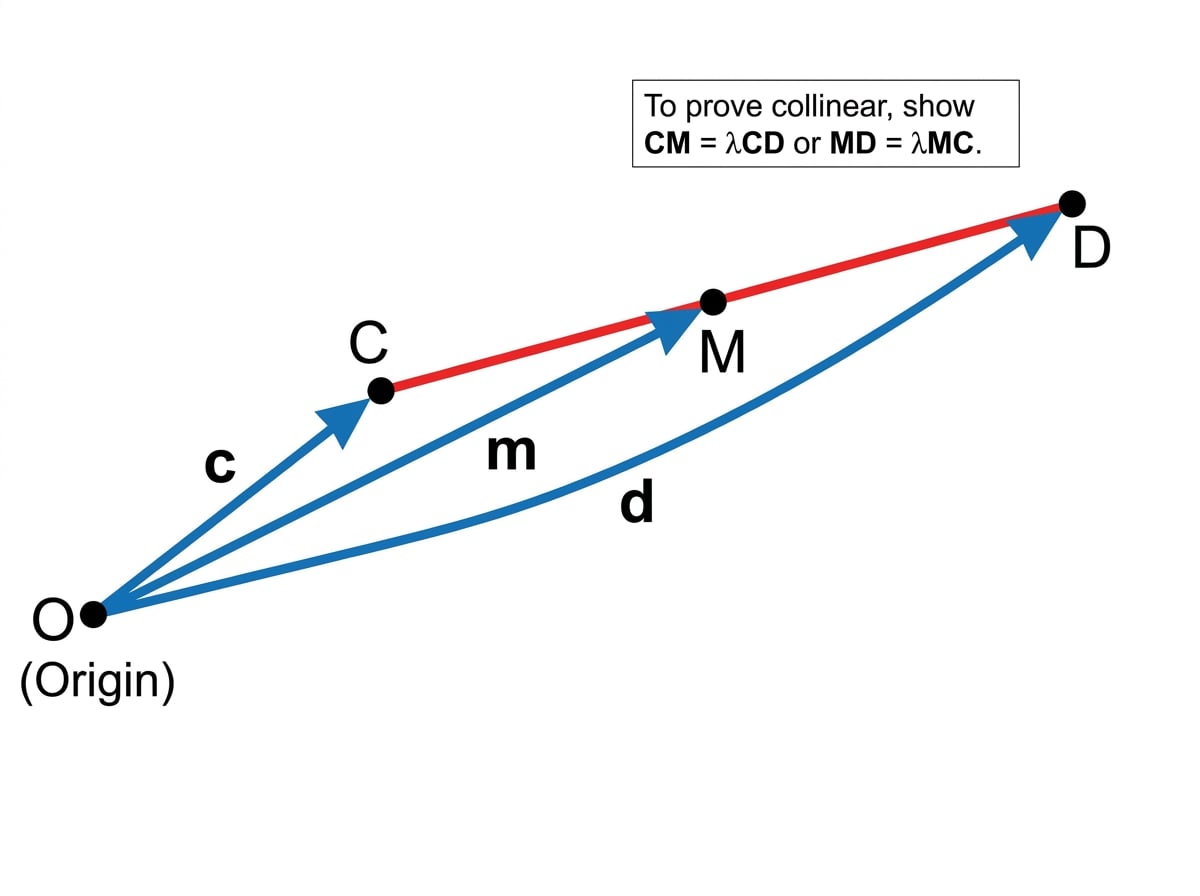
Key Idea
Same start point, same line
To prove A, D and E are collinear, try to show AD⃗=λAE⃗\vec{AD}=\lambda\vec{AE}AD=λAE, or AE⃗=λAD⃗\vec{AE}=\lambda\vec{AD}AE=λAD, for some number λ\lambdaλ.
Example
A parallelogram collinearity proof
OABC is a parallelogram with adjacent sides OA⃗=3a\vec{OA}=3aOA=3a and OB⃗=3b\vec{OB}=3bOB=3b. Point D lies on OC so that OD:DC=2:1OD:DC=2:1OD:DC=2:1. Point E is the midpoint of BC. Show that A, D and E lie on one straight line.
-
In a parallelogram, the diagonal position vector is found by adding the adjacent sides.
OC⃗=3a+3b\vec{OC}=3a+3bOC=3a+3b -
Since OD:DC=2:1OD:DC=2:1OD:DC=2:1, D is 23\frac{2}{3}32 of the way from O to C.
OD⃗=23(3a+3b)=2a+2b\vec{OD}=\frac{2}{3}(3a+3b)=2a+2bOD=32(3a+3b)=2a+2b -
E is the midpoint of B and C.
OE⃗=12(OB⃗+OC⃗)=12(3b+3a+3b)=32a+3b\begin{aligned} \vec{OE}&=\frac{1}{2}(\vec{OB}+\vec{OC})\\ &=\frac{1}{2}(3b+3a+3b)\\ &=\frac{3}{2}a+3b \end{aligned}OE=21(OB+OC)=21(3b+3a+3b)=23a+3b -
Now compare vectors starting from A.
AD⃗=OD⃗−OA⃗=(2a+2b)−3a=−a+2b\begin{aligned} \vec{AD}&=\vec{OD}-\vec{OA}\\ &=(2a+2b)-3a\\ &=-a+2b \end{aligned}AD=OD−OA=(2a+2b)−3a=−a+2b -
Also find AE⃗\vec{AE}AE.
AE⃗=OE⃗−OA⃗=(32a+3b)−3a=−32a+3b=32(−a+2b)\begin{aligned} \vec{AE}&=\vec{OE}-\vec{OA}\\ &=\left(\frac{3}{2}a+3b\right)-3a\\ &=-\frac{3}{2}a+3b\\ &=\frac{3}{2}(-a+2b) \end{aligned}AE=OE−OA=(23a+3b)−3a=−23a+3b=23(−a+2b) -
Since AE⃗=32AD⃗\vec{AE}=\frac{3}{2}\vec{AD}AE=23AD, the vectors are scalar multiples. Therefore A, D and E are collinear.
Common Mistake
Comparing position vectors directly
To prove A, D and E are collinear, do not compare OD⃗\vec{OD}OD and OE⃗\vec{OE}OE. That would only tell you about a line through O. Use vectors such as AD⃗\vec{AD}AD and AE⃗\vec{AE}AE.
4. Regular hexagon vector facts
In a regular hexagon, the centre-to-vertex vectors are very useful. If two adjacent position vectors are ppp and qqq, the next vertex can often be written using q−pq-pq−p.
The diagram shows the common pattern.
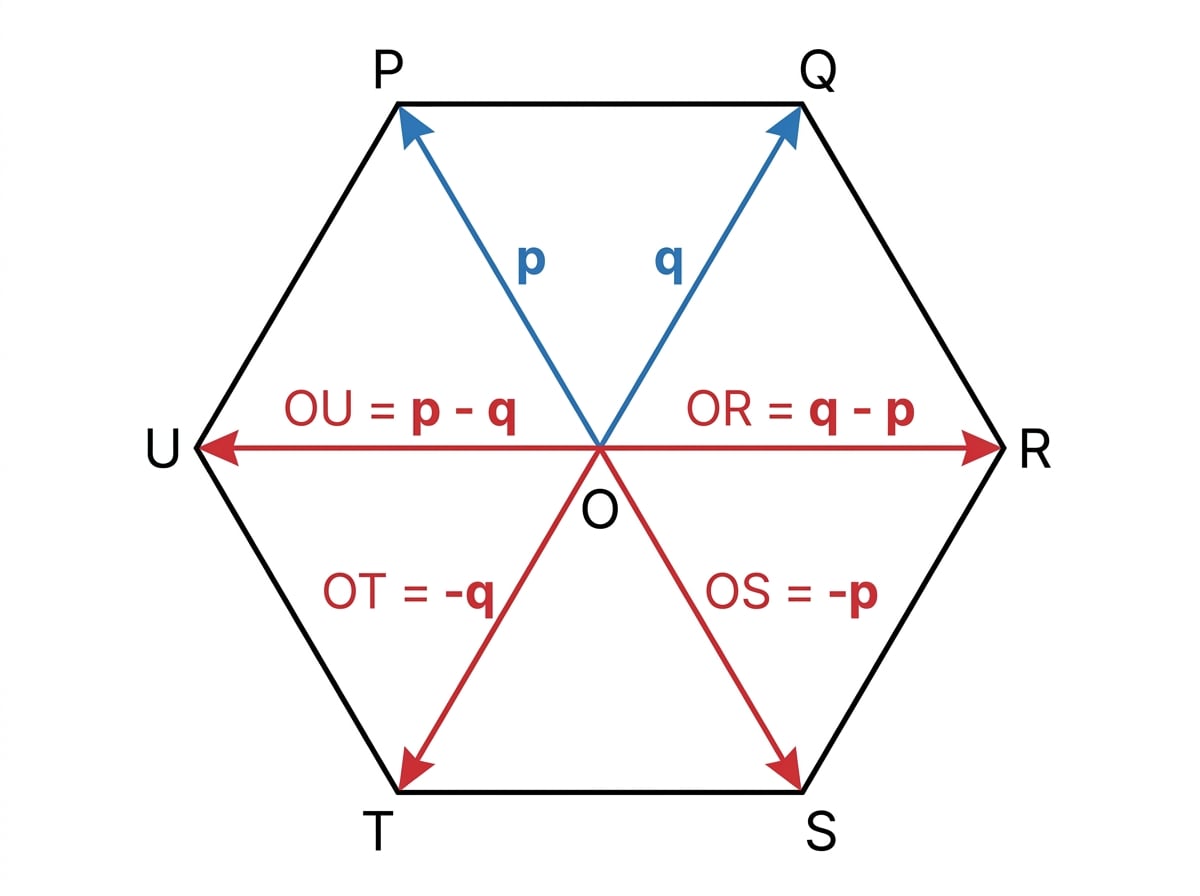
For a regular hexagon PQRSTU with centre O:
- If OP⃗=p\vec{OP}=pOP=p and OQ⃗=q\vec{OQ}=qOQ=q, then OR⃗=q−p\vec{OR}=q-pOR=q−p.
- Opposite vertices have opposite position vectors, so OT⃗=−q\vec{OT}=-qOT=−q and OS⃗=−p\vec{OS}=-pOS=−p.
Example
Proving collinearity in a regular hexagon
PQRSTU is a regular hexagon with centre O. Let OP⃗=p\vec{OP}=pOP=p and OQ⃗=q\vec{OQ}=qOQ=q. Point N is the midpoint of QR. Point Y lies on PQ extended beyond Q, with PQ:QY=3:2PQ:QY=3:2PQ:QY=3:2. Prove that T, N and Y are collinear.
-
Use the regular hexagon fact for the next vertex.
OR⃗=q−p\vec{OR}=q-pOR=q−p -
N is the midpoint of Q and R.
ON⃗=12(OQ⃗+OR⃗)=12(q+q−p)=q−12p\begin{aligned} \vec{ON}&=\frac{1}{2}(\vec{OQ}+\vec{OR})\\ &=\frac{1}{2}(q+q-p)\\ &=q-\frac{1}{2}p \end{aligned}ON=21(OQ+OR)=21(q+q−p)=q−21p -
Since Y is beyond Q and PQ:QY=3:2PQ:QY=3:2PQ:QY=3:2, use QY⃗=23PQ⃗\vec{QY}=\frac{2}{3}\vec{PQ}QY=32PQ.
OY⃗=OQ⃗+QY⃗=q+23(q−p)=53q−23p\begin{aligned} \vec{OY}&=\vec{OQ}+\vec{QY}\\ &=q+\frac{2}{3}(q-p)\\ &=\frac{5}{3}q-\frac{2}{3}p \end{aligned}OY=OQ+QY=q+32(q−p)=35q−32p -
The vertex T is opposite Q, so OT⃗=−q\vec{OT}=-qOT=−q.
-
Compare vectors from T.
TN⃗=ON⃗−OT⃗=(q−12p)−(−q)=2q−12p\begin{aligned} \vec{TN}&=\vec{ON}-\vec{OT}\\ &=\left(q-\frac{1}{2}p\right)-(-q)\\ &=2q-\frac{1}{2}p \end{aligned}TN=ON−OT=(q−21p)−(−q)=2q−21p -
Now find TY⃗\vec{TY}TY.
TY⃗=OY⃗−OT⃗=(53q−23p)−(−q)=83q−23p=43(2q−12p)\begin{aligned} \vec{TY}&=\vec{OY}-\vec{OT}\\ &=\left(\frac{5}{3}q-\frac{2}{3}p\right)-(-q)\\ &=\frac{8}{3}q-\frac{2}{3}p\\ &=\frac{4}{3}\left(2q-\frac{1}{2}p\right) \end{aligned}TY=OY−OT=(35q−32p)−(−q)=38q−32p=34(2q−21p) -
Since TY⃗=43TN⃗\vec{TY}=\frac{4}{3}\vec{TN}TY=34TN, T, N and Y are on the same straight line.
5. Using collinearity to find an unknown vector
Sometimes the question tells you that three points are collinear, and you must find an unknown vector. The method is the same, but you introduce an unknown scalar.
Tip
Let the extension be unknown
If E is on OB extended, write something like BE⃗=xb\vec{BE}=xbBE=xb. Then OE⃗=OB⃗+BE⃗\vec{OE}=\vec{OB}+\vec{BE}OE=OB+BE.
Example
Finding a vector on an extension
In triangle OAB, OA⃗=8a\vec{OA}=8aOA=8a and OB⃗=3b\vec{OB}=3bOB=3b. Point C lies on OA so that OC:CA=3:1OC:CA=3:1OC:CA=3:1. Point D lies on AB so that AD:DB=1:2AD:DB=1:2AD:DB=1:2. The line OB is extended to E. Given that C, D and E are collinear, find BE⃗\vec{BE}BE.
-
Find the position vector of C.
OC⃗=34(8a)=6a\vec{OC}=\frac{3}{4}(8a)=6aOC=43(8a)=6a -
Find the position vector of D. Since AD:DB=1:2AD:DB=1:2AD:DB=1:2, D is 13\frac{1}{3}31 of the way from A to B.
OD⃗=OA⃗+13AB⃗=8a+13(3b−8a)=163a+b\begin{aligned} \vec{OD}&=\vec{OA}+\frac{1}{3}\vec{AB}\\ &=8a+\frac{1}{3}(3b-8a)\\ &=\frac{16}{3}a+b \end{aligned}OD=OA+31AB=8a+31(3b−8a)=316a+b -
Let BE⃗=xb\vec{BE}=xbBE=xb, so OE⃗=(3+x)b\vec{OE}=(3+x)bOE=(3+x)b.
-
Since C, D and E are collinear, write CD⃗=λCE⃗\vec{CD}=\lambda\vec{CE}CD=λCE.
CD⃗=(163a+b)−6a=−23a+b\vec{CD}=\left(\frac{16}{3}a+b\right)-6a=-\frac{2}{3}a+bCD=(316a+b)−6a=−32a+b -
Also write CE⃗\vec{CE}CE in terms of xxx.
CE⃗=(3+x)b−6a=−6a+(3+x)b\vec{CE}=(3+x)b-6a=-6a+(3+x)bCE=(3+x)b−6a=−6a+(3+x)b -
Compare coefficients in CD⃗=λCE⃗\vec{CD}=\lambda\vec{CE}CD=λCE.
−23=−6λ-\frac{2}{3}=-6\lambda−32=−6λ -
So λ=19\lambda=\frac{1}{9}λ=91. Now compare the coefficients of bbb.
1=19(3+x)1=\frac{1}{9}(3+x)1=91(3+x) -
Solve for xxx.
3+x=93+x=93+x=9 -
Therefore x=6x=6x=6, so BE⃗=6b\vec{BE}=6bBE=6b.
Exam technique
In the exam
- Write down the position vector of every important point from O.
- For a ratio, turn it into a fraction of the whole line segment.
- To prove a straight line, compare two vectors with the same starting point.
- If a point is on an extension, introduce an unknown such as BE⃗=xb\vec{BE}=xbBE=xb and compare coefficients.
Self review
Check yourself
- If AP:PB=2:5AP:PB=2:5AP:PB=2:5, what fraction of AB⃗\vec{AB}AB is AP⃗\vec{AP}AP?
- Why is comparing OD⃗\vec{OD}OD and OE⃗\vec{OE}OE not enough to prove A, D and E are collinear?
- In a regular hexagon, if adjacent position vectors are ppp and qqq, what is the position vector of the next vertex?

Recap questions
Test yourself with 5 quick questions on this guide. Answer them all correctly to complete it.
You've reached the end
Test yourself on this topic, or move on to the next guide.
How was this guide?