Revision notes for CIE IGCSE Maths Probability Equation Questions. Open the guide for explanations and worked examples. Written against the CIE IGCSE Maths (0580) specification, so the content matches what's examinable rather than general Maths background.
Probability Equation Questions
What you'll learn
- How to turn “two counters are chosen” information into probability equations.
- How to handle with replacement and without replacement questions.
- How to use ratios like 3:1 to write algebraic numbers of counters.
- How to solve the quadratic equations that often appear in grade 8/9 probability.
The big idea
In these questions, you are not just calculating a probability. You are usually given a probability and asked to work backwards to find how many counters were in the bag.
Definition
Probability equation
A probability equation is an equation formed by setting an algebraic probability equal to a given probability, then solving for the unknown number of items.
An event is the outcome you care about, such as “both counters are blue” or “the first counter is red and the second is red”.
The key skill is translating the words into fractions carefully.
Multiplying probabilities along a path
When two things happen in order, multiply the probabilities along the matching path.
For example, if you want “blue then blue”, multiply:
P(blue then blue)=P(first blue)×P(second blue)P(\text{blue then blue}) = P(\text{first blue}) \times P(\text{second blue})P(blue then blue)=P(first blue)×P(second blue)A tree diagram is a useful way to organise the changing probabilities, especially when counters are not replaced.
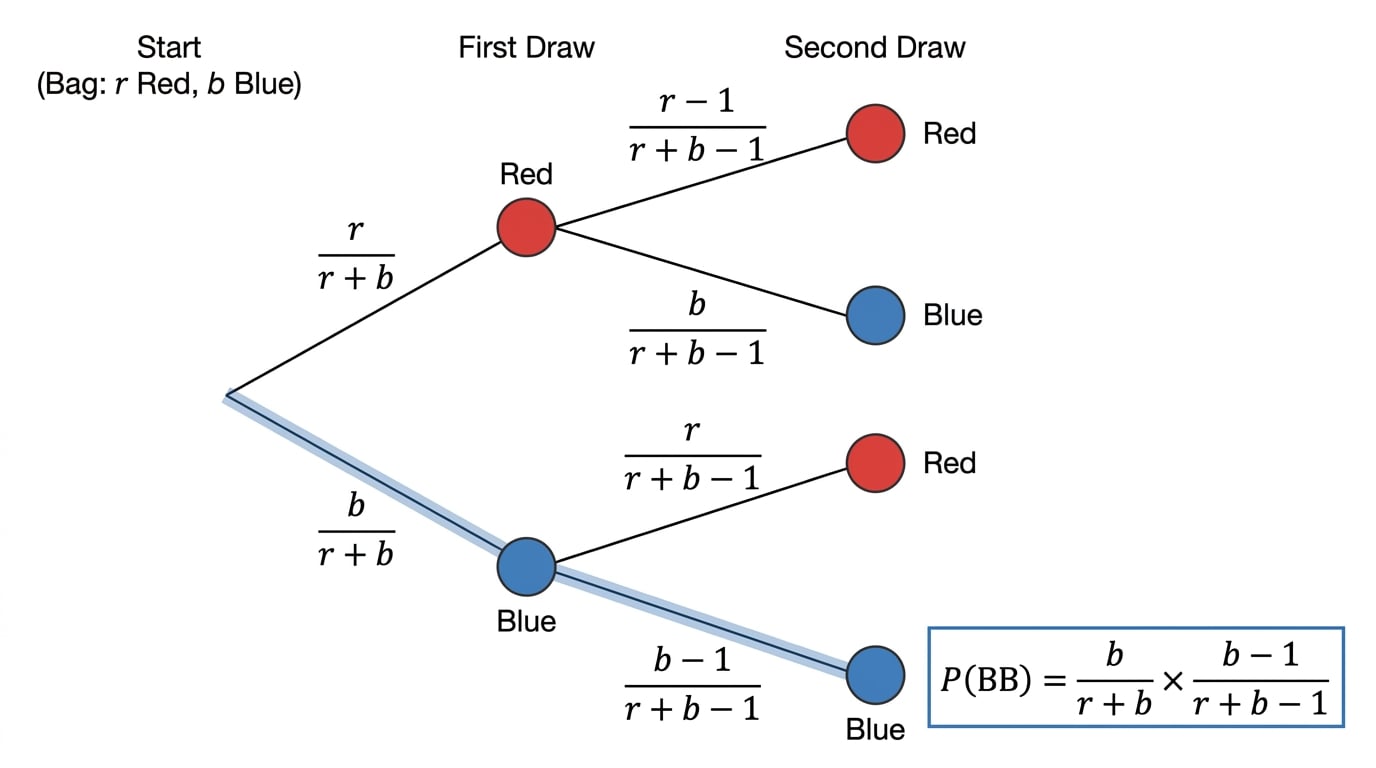
Definition
Without replacement
Without replacement means the first counter is not put back into the bag before the second counter is chosen. So the total number of counters goes down by 1.
Example
Finding a probability without replacement
A bag contains 5 red counters and 3 blue counters. Two counters are chosen at random without replacement. Find the probability that both counters are blue.
-
There are 8 counters altogether, and 3 of them are blue, so the probability of the first blue counter is:
38\frac{3}{8}83 -
If the first counter was blue, there are now 2 blue counters left out of 7 counters altogether. So the probability of the second blue counter is:
27\frac{2}{7}72 -
Multiply the two probabilities:
38×27\frac{3}{8} \times \frac{2}{7}83×72 -
Simplify:
656=328\frac{6}{56} = \frac{3}{28}566=283
Common Mistake
Forgetting the bag has changed
For questions without replacement, the denominator for the second pick is usually one less than before. The chosen colour may also have one fewer counter left.
With replacement: the bag resets
Definition
With replacement
With replacement means the first counter is put back into the bag before the second counter is chosen. The probabilities stay the same on both picks.
This often makes the equation simpler because the same fraction is repeated.
Example
Solving a with-replacement equation
A bag contains 4 red counters and yyy blue counters. A counter is chosen, replaced, then another counter is chosen. The probability of getting two red counters is 425\frac{4}{25}254. Find yyy.
-
The total number of counters is y+4y + 4y+4.
-
The probability of choosing red on one pick is:
4y+4\frac{4}{y + 4}y+44 -
Because the counter is replaced, the probability of red then red is:
4y+4×4y+4\frac{4}{y + 4} \times \frac{4}{y + 4}y+44×y+44 -
Set this equal to the given probability:
(4y+4)2=425\left(\frac{4}{y + 4}\right)^2 = \frac{4}{25}(y+44)2=254 -
Take the positive square root of both sides:
4y+4=25\frac{4}{y + 4} = \frac{2}{5}y+44=52 -
Cross-multiply and solve:
4×5=2(y+4)20=2y+812=2yy=6\begin{aligned} 4 \times 5 &= 2(y + 4) \\ 20 &= 2y + 8 \\ 12 &= 2y \\ y &= 6 \end{aligned}4×52012y=2(y+4)=2y+8=2y=6
Tip
Why the positive square root?
A probability cannot be negative, and the number of counters must be positive, so you only use the positive square root in this type of question.
Using ratios to write the number of counters
A ratio compares quantities. If the ratio of red counters to blue counters is 2:1, then you can write:
- red counters as 2k2k2k
- blue counters as kkk
- total counters as 3k3k3k
The letter kkk represents the multiplier that scales the ratio up to the actual numbers.
Example
Using a ratio to form an equation
The ratio of red counters to blue counters is 2:1. Two counters are chosen at random without replacement. The probability that both counters are red is 37\frac{3}{7}73. Find the number of blue counters.
-
Use the ratio 2:1. Let the number of blue counters be kkk, so the number of red counters is 2k2k2k.
-
The total number of counters is:
3k3k3k -
The probability of the first red counter is:
2k3k\frac{2k}{3k}3k2k -
If one red counter has been removed, there are 2k−12k - 12k−1 red counters left, and 3k−13k - 13k−1 counters altogether. So:
P(red then red)=2k3k×2k−13k−1P(\text{red then red}) = \frac{2k}{3k} \times \frac{2k - 1}{3k - 1}P(red then red)=3k2k×3k−12k−1 -
Set this equal to the given probability:
2k3k×2k−13k−1=37\frac{2k}{3k} \times \frac{2k - 1}{3k - 1} = \frac{3}{7}3k2k×3k−12k−1=73 -
Simplify 2k3k\frac{2k}{3k}3k2k to 23\frac{2}{3}32:
23×2k−13k−1=37\frac{2}{3} \times \frac{2k - 1}{3k - 1} = \frac{3}{7}32×3k−12k−1=73 -
Cross-multiply:
14(2k−1)=9(3k−1)14(2k - 1) = 9(3k - 1)14(2k−1)=9(3k−1) -
Expand and solve:
28k−14=27k−9k=5\begin{aligned} 28k - 14 &= 27k - 9 \\ k &= 5 \end{aligned}28k−14k=27k−9=5 -
Since blue counters were represented by kkk, there are 5 blue counters.
Key Idea
Ratio questions
Do not try to guess the actual numbers straight away. Turn the ratio into algebra first, such as 3k3k3k, kkk, and 4k4k4k.
When the equation becomes quadratic
A quadratic equation is an equation containing a squared term, such as x2x^2x2. These appear because you often multiply two expressions involving the same unknown.
For example:
x(x−1)x(x - 1)x(x−1)gives:
x2−xx^2 - xx2−xIn probability equation questions, you may need to expand brackets, collect terms, factorise, and reject impossible answers.
Example
Unknown number of blue counters
A bag contains 3 red counters and xxx blue counters. Two counters are chosen at random without replacement. The probability that both counters are blue is 514\frac{5}{14}145. Find xxx.
-
The total number of counters is x+3x + 3x+3.
-
The probability of the first blue counter is:
xx+3\frac{x}{x + 3}x+3x -
If the first counter was blue, there are x−1x - 1x−1 blue counters left, and x+2x + 2x+2 counters altogether. So:
P(blue then blue)=xx+3×x−1x+2P(\text{blue then blue}) = \frac{x}{x + 3} \times \frac{x - 1}{x + 2}P(blue then blue)=x+3x×x+2x−1 -
Set up the equation:
xx+3×x−1x+2=514\frac{x}{x + 3} \times \frac{x - 1}{x + 2} = \frac{5}{14}x+3x×x+2x−1=145 -
Multiply the algebraic fractions:
x(x−1)(x+3)(x+2)=514\frac{x(x - 1)}{(x + 3)(x + 2)} = \frac{5}{14}(x+3)(x+2)x(x−1)=145 -
Cross-multiply:
14x(x−1)=5(x+3)(x+2)14x(x - 1) = 5(x + 3)(x + 2)14x(x−1)=5(x+3)(x+2) -
Expand both sides:
14x2−14x=5(x2+5x+6)14x2−14x=5x2+25x+30\begin{aligned} 14x^2 - 14x &= 5(x^2 + 5x + 6) \\ 14x^2 - 14x &= 5x^2 + 25x + 30 \end{aligned}14x2−14x14x2−14x=5(x2+5x+6)=5x2+25x+30 -
Bring everything to one side:
9x2−39x−30=09x^2 - 39x - 30 = 09x2−39x−30=0 -
Divide by 3 to make it simpler:
3x2−13x−10=03x^2 - 13x - 10 = 03x2−13x−10=0 -
Factorise:
(3x+2)(x−5)=0(3x + 2)(x - 5) = 0(3x+2)(x−5)=0 -
Solve each factor:
x=−23orx=5x = -\frac{2}{3} \quad \text{or} \quad x = 5x=−32orx=5 -
A number of counters cannot be negative or a fraction, so x=5x = 5x=5.
Common Mistake
Keeping an impossible answer
If a quadratic gives two answers, check them against the context. The number of counters must be a whole number and cannot be negative.
“Show that” probability equations
Sometimes the question asks you to show a particular quadratic first, then solve it. You still begin with the probability statement.
Example
Showing and solving a quadratic
There are nnn counters in a bag. 6 are red and the rest are blue. Two counters are chosen at random without replacement. The probability of getting two blue counters is 12\frac{1}{2}21.
Show that n2−25n+84=0n^2 - 25n + 84 = 0n2−25n+84=0, then find nnn.
-
If there are nnn counters altogether and 6 are red, then the number of blue counters is:
n−6n - 6n−6 -
The probability of the first blue counter is:
n−6n\frac{n - 6}{n}nn−6 -
After one blue counter is removed, there are n−7n - 7n−7 blue counters left, and n−1n - 1n−1 counters altogether. So:
n−6n×n−7n−1=12\frac{n - 6}{n} \times \frac{n - 7}{n - 1} = \frac{1}{2}nn−6×n−1n−7=21 -
Cross-multiply:
2(n−6)(n−7)=n(n−1)2(n - 6)(n - 7) = n(n - 1)2(n−6)(n−7)=n(n−1) -
Expand both sides:
2(n2−13n+42)=n2−n2n2−26n+84=n2−n\begin{aligned} 2(n^2 - 13n + 42) &= n^2 - n \\ 2n^2 - 26n + 84 &= n^2 - n \end{aligned}2(n2−13n+42)2n2−26n+84=n2−n=n2−n -
Bring everything to one side:
n2−25n+84=0n^2 - 25n + 84 = 0n2−25n+84=0 -
Factorise:
(n−21)(n−4)=0(n - 21)(n - 4) = 0(n−21)(n−4)=0 -
Solve:
n=21orn=4n = 21 \quad \text{or} \quad n = 4n=21orn=4 -
Since the bag already contains 6 red counters, the total number of counters cannot be 4. Therefore n=21n = 21n=21.
Exam technique
In the exam
-
Write the number of each colour first, using algebra if needed.
-
Decide whether the question is with replacement or without replacement before writing the second fraction.
-
Multiply along the required path, set it equal to the given probability, then solve and reject impossible values.
Self review
Check yourself
-
If a bag has xxx blue counters and 5 red counters, what is the total number of counters?
-
In a without-replacement question, why does the second denominator decrease by 1?
-
If a quadratic gives two solutions, what checks should you make before choosing your final answer?

Recap questions
Test yourself with 5 quick questions on this guide. Answer them all correctly to complete it.
You've reached the end
Test yourself on this topic, or move on to the next guide.
How was this guide?