Revision notes for CIE IGCSE Maths Differentiation. Open the guide for explanations and worked examples. Written against the CIE IGCSE Maths (0580) specification, so the content matches what's examinable rather than general Maths background.
Differentiation
What you'll learn
- How to differentiate powers of xxx and terms such as 1x\frac{1}{x}x1.
- How to find stationary points by setting dydx=0\frac{dy}{dx}=0dxdy=0.
- How to decide where a curve has a negative gradient.
- How differentiation connects displacement, velocity, and acceleration.
1. The idea of gradient
The gradient of a straight line tells you how steep it is. For a line, you may remember:
gradient=change in ychange in x\text{gradient}=\frac{\text{change in }y}{\text{change in }x}gradient=change in xchange in yFor a curve, the gradient is not constant. It changes from point to point. To find the gradient at one exact point on a curve, we imagine drawing a tangent.
Definition
Tangent
A tangent is a straight line that touches a curve at one point and has the same direction as the curve at that point.
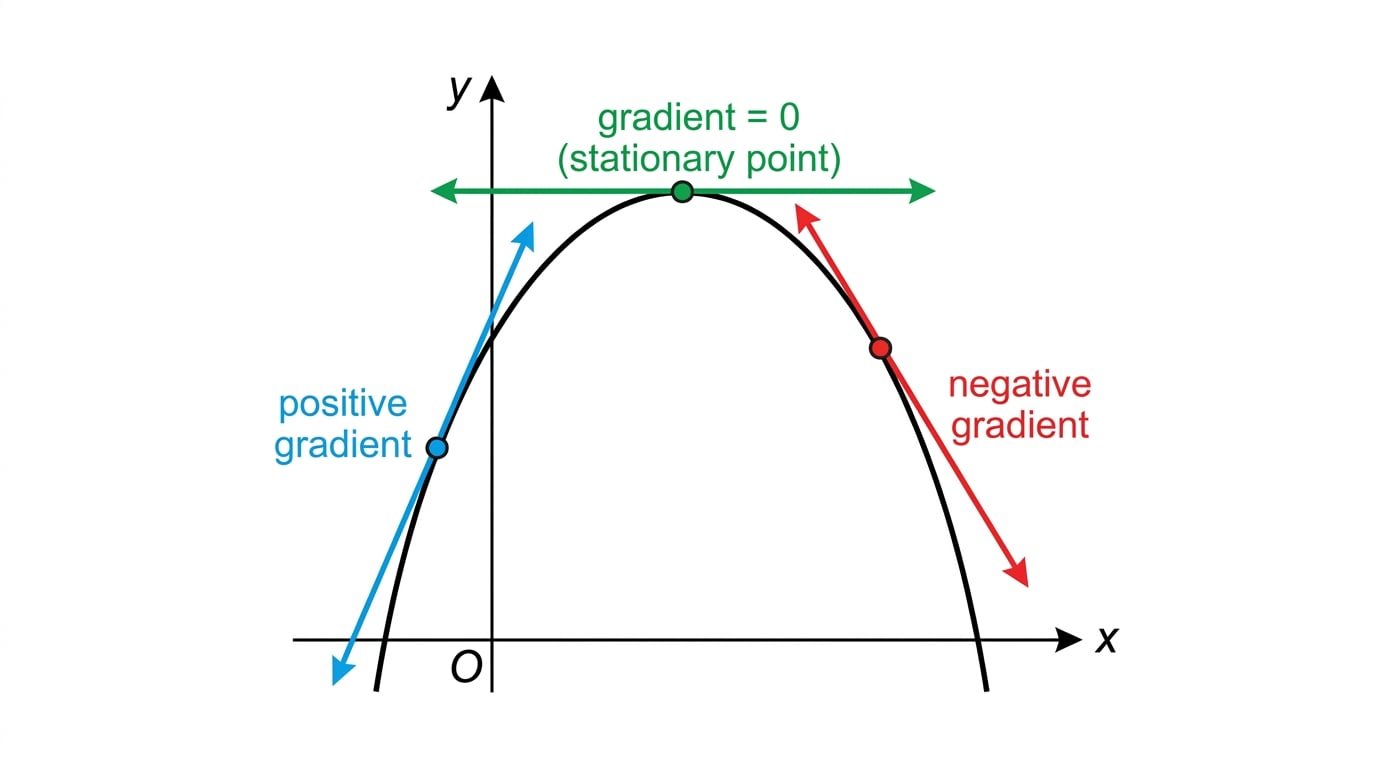
On a curve, a tangent can slope upwards, be horizontal, or slope downwards. This tells you whether the curve has a positive, zero, or negative gradient at that point.
Definition
Derivative
- The derivative of yyy with respect to xxx, written dydx\frac{dy}{dx}dxdy, is the gradient function of a curve.
- To differentiate means to find this derivative.
2. The power rule
At IGCSE, the main differentiation rule you need is the power rule.
Key Idea
Power rule
If y=axny=ax^ny=axn, then dydx=anxn−1\frac{dy}{dx}=anx^{n-1}dxdy=anxn−1. Multiply by the power, then reduce the power by 1.
For example:
- x3x^3x3 differentiates to 3x23x^23x2.
- 5x45x^45x4 differentiates to 20x320x^320x3.
- 7x7x7x differentiates to 7.
- A constant, such as 11, differentiates to zero.
Example
Differentiating a polynomial
Differentiate y=5x4−3x2+7x−11y=5x^4-3x^2+7x-11y=5x4−3x2+7x−11.
-
Identify each term separately:
y=5x4−3x2+7x−11y=5x^4-3x^2+7x-11y=5x4−3x2+7x−11 -
Differentiate 5x45x^45x4 by multiplying by 4 and reducing the power:
5x4→20x35x^4 \to 20x^35x4→20x3 -
Differentiate the remaining terms:
−3x2→−6x,7x→7,−11→0-3x^2 \to -6x,\qquad 7x \to 7,\qquad -11 \to 0−3x2→−6x,7x→7,−11→0 -
Put the differentiated terms together:
dydx=20x3−6x+7\frac{dy}{dx}=20x^3-6x+7dxdy=20x3−6x+7
Common Mistake
Forgetting the constant
A number on its own disappears when you differentiate. For example, the derivative of −11-11−11 is zero, not −11-11−11.
3. Differentiating reciprocal terms
Sometimes you will see a term like 1x\frac{1}{x}x1 or 2x\frac{2}{x}x2. Rewrite it using a negative power first:
1x=x−1\frac{1}{x}=x^{-1}x1=x−1Then use the power rule as normal.
For example:
x−1→−x−2x^{-1} \to -x^{-2}x−1→−x−2You can write −x−2-x^{-2}−x−2 as −1x2-\frac{1}{x^2}−x21 if that is clearer.
Example
Differentiating a curve with a reciprocal term
Differentiate y=4x2+1xy=4x^2+\frac{1}{x}y=4x2+x1.
-
Rewrite the reciprocal term using a negative power:
y=4x2+x−1y=4x^2+x^{-1}y=4x2+x−1 -
Differentiate 4x24x^24x2:
4x2→8x4x^2 \to 8x4x2→8x -
Differentiate x−1x^{-1}x−1:
x−1→−x−2x^{-1} \to -x^{-2}x−1→−x−2 -
Write the derivative:
dydx=8x−x−2\frac{dy}{dx}=8x-x^{-2}dxdy=8x−x−2 -
If preferred, rewrite the negative power as a fraction:
dydx=8x−1x2\frac{dy}{dx}=8x-\frac{1}{x^2}dxdy=8x−x21
Tip
Negative powers
A negative power does not mean the term is negative. It means the term belongs in the denominator. For example, x−2=1x2x^{-2}=\frac{1}{x^2}x−2=x21.
4. Stationary points
A stationary point is a point on a curve where the gradient is zero. The tangent is horizontal there.
Definition
Stationary point
A stationary point occurs when dydx=0\frac{dy}{dx}=0dxdy=0.
Stationary points can be maximum points, minimum points, or sometimes points of inflection. For many IGCSE questions, you are asked only to find the co-ordinates.
Example
Finding the co-ordinates of a stationary point
The curve y=4x2+1xy=4x^2+\frac{1}{x}y=4x2+x1 has one stationary point. Find its co-ordinates.
-
Rewrite the equation using a negative power:
y=4x2+x−1y=4x^2+x^{-1}y=4x2+x−1 -
Differentiate:
dydx=8x−x−2\frac{dy}{dx}=8x-x^{-2}dxdy=8x−x−2 -
Set the derivative equal to zero because the point is stationary:
8x−1x2=08x-\frac{1}{x^2}=08x−x21=0 -
Multiply through by x2x^2x2 to remove the fraction:
8x3−1=08x^3-1=08x3−1=0 -
Solve for xxx:
8x3=1x3=18x=12\begin{aligned} 8x^3&=1\\ x^3&=\frac{1}{8}\\ x&=\frac{1}{2} \end{aligned}8x3x3x=1=81=21 -
Substitute x=12x=\frac{1}{2}x=21 into the original equation:
y=4(12)2+112y=4\left(\frac{1}{2}\right)^2+\frac{1}{\frac{1}{2}}y=4(21)2+211 -
Calculate yyy:
y=1+2=3y=1+2=3y=1+2=3 -
Give the co-ordinates:
(12,3)\left(\frac{1}{2},3\right)(21,3)
Common Mistake
Using the derivative for y
After finding the xxx-coordinate of a stationary point, substitute into the original equation for yyy, not into dydx\frac{dy}{dx}dxdy. The derivative gives the gradient, not the height of the curve.
5. Where a curve has a negative gradient
A curve has a negative gradient when it slopes downwards as xxx increases.
To find where this happens:
- Differentiate to find dydx\frac{dy}{dx}dxdy.
- Make an inequality: dydx<0\frac{dy}{dx}<0dxdy<0.
- Solve the inequality.
Example
Finding the range of values with negative gradient
The curve CCC has equation y=x3−3x2−9x+6y=x^3-3x^2-9x+6y=x3−3x2−9x+6. Find the range of values of xxx for which CCC has a negative gradient.
-
Differentiate the equation:
dydx=3x2−6x−9\frac{dy}{dx}=3x^2-6x-9dxdy=3x2−6x−9 -
A negative gradient means dydx<0\frac{dy}{dx}<0dxdy<0:
3x2−6x−9<03x^2-6x-9<03x2−6x−9<0 -
Factorise the quadratic:
3(x2−2x−3)<03(x^2-2x-3)<03(x2−2x−3)<0 -
Continue factorising:
3(x−3)(x+1)<03(x-3)(x+1)<03(x−3)(x+1)<0 -
Find the critical values by setting each bracket equal to zero:
x=3,x=−1x=3,\qquad x=-1x=3,x=−1 -
Since the quadratic opens upwards, it is negative between its two roots:
−1<x<3-1<x<3−1<x<3
Tip
Solving gradient inequalities
If dydx\frac{dy}{dx}dxdy is an upward-opening quadratic, it is negative between its roots. If it is a downward-opening quadratic, it is negative outside its roots.
Common Mistake
Including the endpoints
For a negative gradient, use strict inequalities. At the endpoints, the gradient is zero, so those values are not included.
6. Differentiation in motion questions
In particle motion questions, displacement is usually written as sss, and time is usually written as ttt.
Definition
Displacement, velocity, and acceleration
- Displacement is the position of the particle from a fixed point.
- Velocity is the rate of change of displacement: v=dsdtv=\frac{ds}{dt}v=dtds.
- Acceleration is the rate of change of velocity: a=dvdta=\frac{dv}{dt}a=dtdv.
So if you are given sss in terms of ttt:
- Differentiate once to get velocity.
- Differentiate twice to get acceleration.
Example
Finding when a particle is instantaneously at rest
A particle moves along a straight line. Its displacement from a fixed point is s=t3−4t2−3t+6s=t^3-4t^2-3t+6s=t3−4t2−3t+6, where t≥0t\geq0t≥0. Find the time when the particle is instantaneously at rest.
-
Instantaneously at rest means the velocity is zero:
v=0v=0v=0 -
Differentiate displacement to find velocity:
v=dsdt=3t2−8t−3v=\frac{ds}{dt}=3t^2-8t-3v=dtds=3t2−8t−3 -
Set the velocity equal to zero:
3t2−8t−3=03t^2-8t-3=03t2−8t−3=0 -
Factorise the quadratic:
(3t+1)(t−3)=0(3t+1)(t-3)=0(3t+1)(t−3)=0 -
Solve for ttt:
t=−13,t=3t=-\frac{1}{3},\qquad t=3t=−31,t=3 -
Use the condition t≥0t\geq0t≥0 to reject the negative time:
t=3t=3t=3
Common Mistake
At rest does not mean s = 0
“At rest” means the velocity is zero. It does not mean the displacement is zero.
Example
Finding when acceleration has a given value
A particle has displacement s=t3−5t2+7t−1s=t^3-5t^2+7t-1s=t3−5t2+7t−1. Find the time when its acceleration is 2 m/s².
-
Differentiate displacement to find velocity:
v=dsdt=3t2−10t+7v=\frac{ds}{dt}=3t^2-10t+7v=dtds=3t2−10t+7 -
Differentiate velocity to find acceleration:
a=dvdt=6t−10a=\frac{dv}{dt}=6t-10a=dtdv=6t−10 -
Set the acceleration equal to 2:
6t−10=26t-10=26t−10=2 -
Solve for ttt:
6t=12t=2\begin{aligned} 6t&=12\\ t&=2 \end{aligned}6tt=12=2
Exam technique
In the exam
-
Rewrite fractions such as 1x\frac{1}{x}x1 as negative powers before differentiating.
-
For stationary points or “instantaneously at rest”, set the derivative equal to zero.
-
For negative gradient questions, solve dydx<0\frac{dy}{dx}<0dxdy<0 and use strict inequalities.
-
In motion questions, remember the chain: displacement →\to→ velocity →\to→ acceleration.
Self review
Check yourself
-
Can you differentiate y=3x4−5x2+7x−9y=3x^4-5x^2+7x-9y=3x4−5x2+7x−9?
-
If dydx=(x−2)(x+4)\frac{dy}{dx}=(x-2)(x+4)dxdy=(x−2)(x+4), for which values of xxx is the gradient negative?
-
In a motion question, which derivative gives velocity, and which gives acceleration?

Recap questions
Test yourself with 5 quick questions on this guide. Answer them all correctly to complete it.
You've reached the end
Test yourself on this topic, or move on to the next guide.
How was this guide?