Revision notes for CIE IGCSE Maths Sequences (Higher). Open the guide for explanations and worked examples. Written against the CIE IGCSE Maths (0580) specification, so the content matches what's examinable rather than general Maths background.
Sequences (Higher)
What you'll learn
- How to describe number patterns with equal gaps.
- How to find a far-away term without writing out the whole list.
- How to add lots of terms quickly using a formula.
- How to solve Grade 8/9 algebra questions involving sequences.
Sequences, terms, and equal gaps
A number pattern is usually written in order, for example:
5, 8, 11, 14, 17, …5,\ 8,\ 11,\ 14,\ 17,\ \ldots5, 8, 11, 14, 17, …The dots mean the pattern continues.
Definition
Sequence and term
A sequence is an ordered list of numbers. Each number in the list is called a term. The first term is the number in position 1, the second term is the number in position 2, and so on.
We write TnT_nTn for the term in position nnn.
An important type of sequence is one where the same amount is added each time.
Definition
Arithmetic sequence
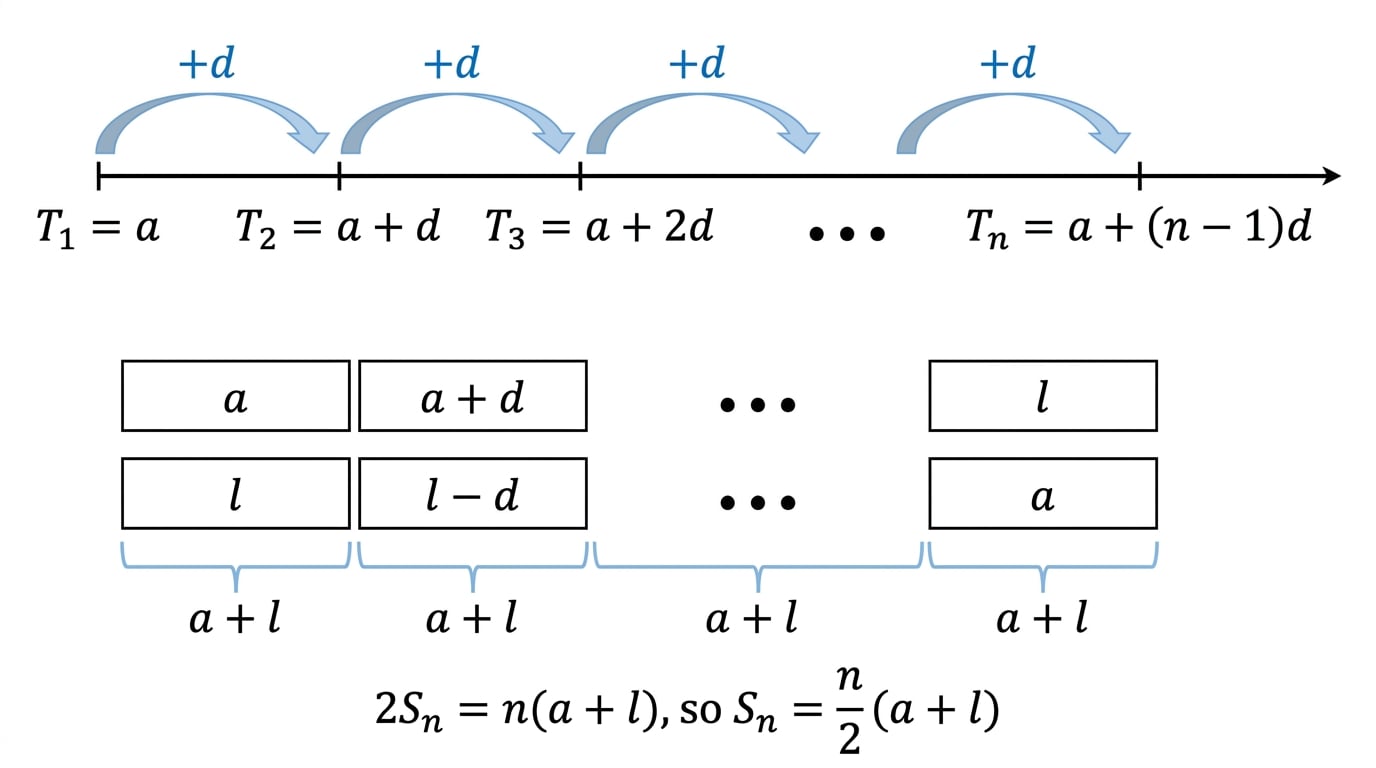
An arithmetic sequence is a sequence where the difference between consecutive terms is constant. This constant difference is called the common difference, written as ddd.
If the first term is aaa, then the nth term is
Tn=a+(n−1)dT_n=a+(n-1)dTn=a+(n−1)dThe reason for the n−1n-1n−1 is important: to get from the first term to the nth term, you make one fewer jump than the term number.
Example
Finding a later term
A sequence begins 6, 10, 14, 18, 22, ... Find the 40th term.
-
Identify the first term and the common difference:
a=6,d=10−6=4a=6,\qquad d=10-6=4a=6,d=10−6=4 -
Use the nth-term formula:
Tn=a+(n−1)dT_n=a+(n-1)dTn=a+(n−1)d -
Substitute n=40n=40n=40:
T40=6+(40−1)×4T_{40}=6+(40-1)\times 4T40=6+(40−1)×4 -
Simplify:
T40=6+39×4=162T_{40}=6+39\times 4=162T40=6+39×4=162 -
The 40th term is 162.
Common Mistake
Using too many jumps
The 40th term is not found by adding 40 lots of the common difference. From the first term to the 40th term there are 39 jumps, so you add 39d39d39d.
Adding an arithmetic sequence: arithmetic series
Sometimes you are asked to add the first 50, 100, or even more terms. Writing them all out would be slow, so we use a formula.
Definition
Arithmetic series
An arithmetic series is the sum of the terms of an arithmetic sequence.
We write SnS_nSn for the sum of the first nnn terms.
There are two main versions of the formula.
If you know the first term aaa, the last term lll, and the number of terms nnn:
Sn=n2(a+l)S_n=\frac{n}{2}(a+l)Sn=2n(a+l)If you know the first term aaa, the common difference ddd, and the number of terms nnn:
Sn=n2(2a+(n−1)d)S_n=\frac{n}{2}\left(2a+(n-1)d\right)Sn=2n(2a+(n−1)d)Key Idea
Why the series formula works
Pair the first and last terms, then the second and second-last terms. Each pair has the same total, so the sum is based on an average term multiplied by the number of terms.
Example
Finding the sum of the first 100 terms
The first five terms of an arithmetic sequence are 4, 7, 10, 13, 16. Find the sum of the first 100 terms.
-
Identify the first term, common difference, and number of terms:
a=4,d=3,n=100a=4,\qquad d=3,\qquad n=100a=4,d=3,n=100 -
Choose the series formula using aaa, ddd, and nnn:
Sn=n2(2a+(n−1)d)S_n=\frac{n}{2}\left(2a+(n-1)d\right)Sn=2n(2a+(n−1)d) -
Substitute the values:
S100=1002(2×4+(100−1)×3)S_{100}=\frac{100}{2}\left(2\times 4+(100-1)\times 3\right)S100=2100(2×4+(100−1)×3) -
Simplify inside the bracket first:
S100=50(8+297)S_{100}=50(8+297)S100=50(8+297) -
Calculate the sum:
S100=50×305=15250S_{100}=50\times 305=15250S100=50×305=15250
Tip
Which sum formula should you use?
Use Sn=n2(a+l)S_n=\frac{n}{2}(a+l)Sn=2n(a+l) when you know the first and last terms. Use Sn=n2(2a+(n−1)d)S_n=\frac{n}{2}\left(2a+(n-1)d\right)Sn=2n(2a+(n−1)d) when you know the first term and common difference.
Working backwards from two given terms
In harder questions, you may not be given the first term or common difference directly. Instead, you might be told two terms from the same arithmetic sequence.
The method is to turn each statement into an equation using
Tn=a+(n−1)dT_n=a+(n-1)dTn=a+(n−1)dThen solve the simultaneous equations. Simultaneous equations are equations that must both be true at the same time.
Example
Using two known terms to find a sum
The 6th term of an arithmetic sequence is 23. The 14th term is 55. Find the sum of the first 50 terms.
-
Write an equation for the 6th term:
a+5d=23a+5d=23a+5d=23 -
Write an equation for the 14th term:
a+13d=55a+13d=55a+13d=55 -
Subtract the first equation from the second equation:
8d=328d=328d=32 -
Find the common difference:
d=4d=4d=4 -
Substitute d=4d=4d=4 into a+5d=23a+5d=23a+5d=23:
a+5×4=23a+5\times 4=23a+5×4=23 -
Find the first term:
a=3a=3a=3 -
Use the arithmetic series formula:
S50=502(2×3+(50−1)×4)S_{50}=\frac{50}{2}\left(2\times 3+(50-1)\times 4\right)S50=250(2×3+(50−1)×4) -
Simplify:
S50=25(6+196)=5050S_{50}=25(6+196)=5050S50=25(6+196)=5050
Common Mistake
Mixing up term position and term value
If the 6th term is 23, the position is 6 and the value is 23. In the formula, the position decides how many lots of ddd you have.
When two sums are compared
A Grade 8/9 question may compare two sums, for example saying that one sum is several times another sum. You may feel there is not enough information, but the algebra often makes the unknowns cancel.
The key is to write both sums using the same aaa and ddd, because they come from the same arithmetic sequence.
Example
Comparing two sums
The sum of the first 56 terms of an arithmetic series is 4 times the sum of the first 42 terms of the same series. Find the sum of the first 35 terms.
-
Write a formula for S56S_{56}S56:
S56=562(2a+55d)=28(2a+55d)S_{56}=\frac{56}{2}\left(2a+55d\right)=28(2a+55d)S56=256(2a+55d)=28(2a+55d) -
Write a formula for S42S_{42}S42:
S42=422(2a+41d)=21(2a+41d)S_{42}=\frac{42}{2}\left(2a+41d\right)=21(2a+41d)S42=242(2a+41d)=21(2a+41d) -
Use the information that S56S_{56}S56 is 4 times S42S_{42}S42:
28(2a+55d)=4×21(2a+41d)28(2a+55d)=4\times 21(2a+41d)28(2a+55d)=4×21(2a+41d) -
Simplify the right-hand side:
28(2a+55d)=84(2a+41d)28(2a+55d)=84(2a+41d)28(2a+55d)=84(2a+41d) -
Divide both sides by 28:
2a+55d=3(2a+41d)2a+55d=3(2a+41d)2a+55d=3(2a+41d) -
Expand and solve for aaa in terms of ddd:
2a+55d=6a+123d−68d=4aa=−17d\begin{aligned} 2a+55d&=6a+123d\\ -68d&=4a\\ a&=-17d \end{aligned}2a+55d−68da=6a+123d=4a=−17d -
Now find S35S_{35}S35:
S35=352(2a+34d)S_{35}=\frac{35}{2}\left(2a+34d\right)S35=235(2a+34d) -
Substitute a=−17da=-17da=−17d:
S35=352(−34d+34d)=0S_{35}=\frac{35}{2}(-34d+34d)=0S35=235(−34d+34d)=0 -
The sum of the first 35 terms is zero.
Common Mistake
A zero sum can be correct
A sum can be zero if negative and positive terms cancel each other out. Do not invent a value for ddd unless the question gives enough information to find it.
Algebraic consecutive terms
Sometimes the terms are given as algebraic expressions. You must use the fact that the gaps are equal.
Definition
Consecutive terms
Consecutive terms are terms next to each other in the sequence, with no missing terms between them.
For three consecutive terms in an arithmetic sequence:
second term−first term=third term−second term\text{second term}-\text{first term}=\text{third term}-\text{second term}second term−first term=third term−second termExample
Proving the common difference
The expressions 2x+72x+72x+7, 6x−46x-46x−4, and 7x7x7x are three consecutive terms of an arithmetic sequence. Prove that the common difference is 9.
-
Set the two consecutive differences equal:
(6x−4)−(2x+7)=7x−(6x−4)(6x-4)-(2x+7)=7x-(6x-4)(6x−4)−(2x+7)=7x−(6x−4) -
Simplify both sides:
4x−11=x+44x-11=x+44x−11=x+4 -
Solve for xxx:
3x=153x=153x=15 -
Therefore:
x=5x=5x=5 -
Substitute x=5x=5x=5 into one of the differences:
(6x−4)−(2x+7)=4x−11(6x-4)-(2x+7)=4x-11(6x−4)−(2x+7)=4x−11 -
Calculate the common difference:
4×5−11=94\times 5-11=94×5−11=9 -
The common difference is 9, as required.
Tip
Proof questions need a conclusion
In a “prove” question, do not stop as soon as you find xxx. You must calculate the common difference and write a clear final statement.
Exam technique
In the exam
-
Define aaa, ddd, and nnn before substituting into formulas.
-
Use Tn=a+(n−1)dT_n=a+(n-1)dTn=a+(n−1)d for an individual term, and Sn=n2(2a+(n−1)d)S_n=\frac{n}{2}\left(2a+(n-1)d\right)Sn=2n(2a+(n−1)d) for a sum.
-
For algebraic proof questions, compare the two consecutive differences, solve for the variable, then calculate the common difference.
Self review
Check yourself
- What is the difference between TnT_nTn and SnS_nSn?
- Why does the nth-term formula use n−1n-1n−1 lots of the common difference?
- If three algebraic expressions are consecutive arithmetic terms, what equation should you write first?

Recap questions
Test yourself with 5 quick questions on this guide. Answer them all correctly to complete it.
You've reached the end
Test yourself on this topic, or move on to the next guide.
How was this guide?