Revision notes for CIE IGCSE Maths Algebraic Fractions. Open the guide for explanations and worked examples. Written against the CIE IGCSE Maths (0580) specification, so the content matches what's examinable rather than general Maths background.
Algebraic Fractions
What you'll learn
- What an algebraic fraction is, and why some values of xxx are not allowed.
- How to simplify algebraic fractions by factorising first.
- How to divide algebraic fractions using a reciprocal.
- How to solve equations and ratio problems involving algebraic fractions.
1. The basic language
An algebraic fraction works like an ordinary fraction, but the top and bottom contain algebra.
Definition
Algebraic fraction
An algebraic fraction is a fraction where the numerator, the denominator, or both contain algebraic expressions. The numerator is the expression on top, and the denominator is the expression on the bottom.
For example, x+5x2−4\frac{x+5}{x^2-4}x2−4x+5 is an algebraic fraction.
A very important rule still applies: the denominator cannot be zero. Any value of xxx that makes the denominator zero is called an excluded value.
Example
Finding excluded values
Find the excluded values for x+3x2−4\frac{x+3}{x^2-4}x2−4x+3.
-
Focus only on the denominator.
x2−4x^2-4x2−4 -
Factorise the denominator using the difference of two squares.
x2−4=(x−2)(x+2)x^2-4=(x-2)(x+2)x2−4=(x−2)(x+2) -
Set each factor equal to zero.
x−2=0orx+2=0x-2=0 \quad \text{or} \quad x+2=0x−2=0orx+2=0 -
Solve these equations.
x=2orx=−2x=2 \quad \text{or} \quad x=-2x=2orx=−2 -
So the excluded values are x=2x=2x=2 and x=−2x=-2x=−2.
Common Mistake
Denominators cannot be zero
Even if a factor cancels later, values that made the original denominator zero are still not allowed. This matters especially when solving equations.
2. Factorising comes before cancelling
To factorise means to rewrite an expression as a product of factors. A factor is something being multiplied.
For example:
x2+5x=x(x+5)x^2+5x=x(x+5)x2+5x=x(x+5)A common factor is a factor that appears in both the numerator and the denominator. You can cancel common factors, just like you can simplify ordinary fractions.
Key Idea
The main rule
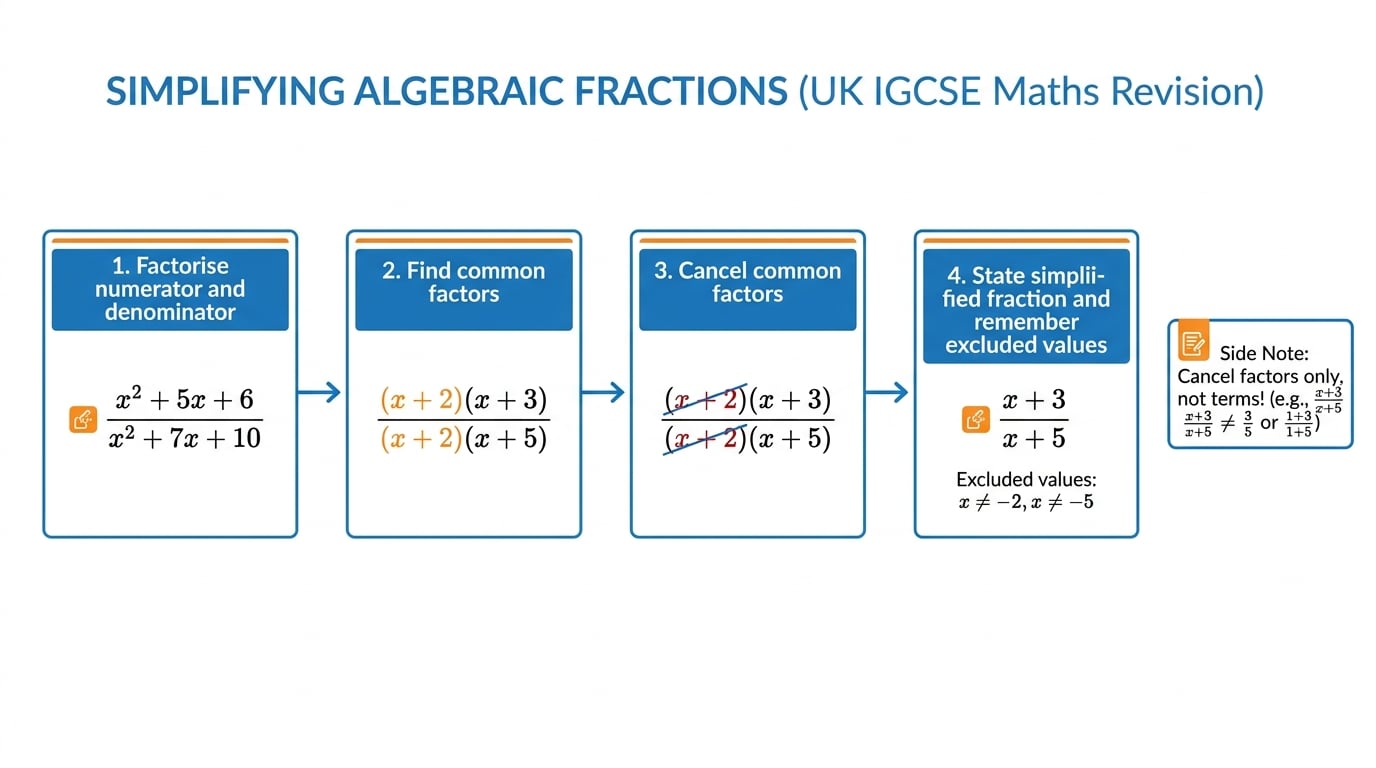
With algebraic fractions, factorise the numerator and denominator fully first. Then cancel common factors, not individual terms.
This flowchart shows the usual simplifying process.
Example
Simplifying by factorising
Simplify fully x2+6xx2+8x+12\frac{x^2+6x}{x^2+8x+12}x2+8x+12x2+6x.
-
Factorise the numerator by taking out the common factor xxx.
x2+6x=x(x+6)x^2+6x=x(x+6)x2+6x=x(x+6) -
Factorise the denominator by finding two numbers that multiply to 12 and add to 8.
x2+8x+12=(x+2)(x+6)x^2+8x+12=(x+2)(x+6)x2+8x+12=(x+2)(x+6) -
Rewrite the whole fraction using factors.
x2+6xx2+8x+12=x(x+6)(x+2)(x+6)\frac{x^2+6x}{x^2+8x+12} = \frac{x(x+6)}{(x+2)(x+6)}x2+8x+12x2+6x=(x+2)(x+6)x(x+6) -
Cancel the common factor (x+6)(x+6)(x+6).
x(x+6)(x+2)(x+6)=xx+2\frac{x(x+6)}{(x+2)(x+6)} = \frac{x}{x+2}(x+2)(x+6)x(x+6)=x+2x -
The simplified fraction is xx+2\frac{x}{x+2}x+2x.
Common Mistake
Cancelling terms instead of factors
You cannot cancel the xxx in x+4x+7\frac{x+4}{x+7}x+7x+4, because xxx is part of an addition. Cancelling only works when the same whole factor is multiplied on the top and bottom.
3. Factor patterns you will use a lot
Many algebraic fraction questions are mostly testing your factorising.
You should be confident with these patterns:
- Common factor: 3x2+9x=3x(x+3)3x^2+9x=3x(x+3)3x2+9x=3x(x+3)
- Difference of two squares: x2−25=(x−5)(x+5)x^2-25=(x-5)(x+5)x2−25=(x−5)(x+5)
- Quadratic factorising: x2+7x+10=(x+5)(x+2)x^2+7x+10=(x+5)(x+2)x2+7x+10=(x+5)(x+2)
- Quadratics with a coefficient of x2x^2x2: 2x2+7x+3=(2x+1)(x+3)2x^2+7x+3=(2x+1)(x+3)2x2+7x+3=(2x+1)(x+3)
Difference of two squares
The expression a2−b2a^2-b^2a2−b2 factorises to (a−b)(a+b)(a-b)(a+b)(a−b)(a+b). For example, x2−49=(x−7)(x+7)x^2-49=(x-7)(x+7)x2−49=(x−7)(x+7).
Example
Using the difference of two squares
Simplify fully x+7x2−49\frac{x+7}{x^2-49}x2−49x+7.
-
Recognise the denominator as a difference of two squares.
x2−49=x2−72x^2-49=x^2-7^2x2−49=x2−72 -
Factorise the denominator.
x2−49=(x−7)(x+7)x^2-49=(x-7)(x+7)x2−49=(x−7)(x+7) -
Rewrite the fraction using factors.
x+7x2−49=x+7(x−7)(x+7)\frac{x+7}{x^2-49} = \frac{x+7}{(x-7)(x+7)}x2−49x+7=(x−7)(x+7)x+7 -
Cancel the common factor (x+7)(x+7)(x+7).
x+7(x−7)(x+7)=1x−7\frac{x+7}{(x-7)(x+7)} = \frac{1}{x-7}(x−7)(x+7)x+7=x−71 -
The simplified fraction is 1x−7\frac{1}{x-7}x−71.
Writing the answer in a given form
Sometimes the question tells you the final form, such as ax+bx+c\frac{ax+b}{x+c}x+cax+b. This is a clue that a bracket factor will cancel, leaving a linear expression on top and bottom.
Example
Writing in a required form
Write 2x2+7x+3x2+4x+3\frac{2x^2+7x+3}{x^2+4x+3}x2+4x+32x2+7x+3 in the form ax+bx+c\frac{ax+b}{x+c}x+cax+b, where aaa, bbb and ccc are integers.
-
Factorise the numerator.
2x2+7x+3=(2x+1)(x+3)2x^2+7x+3=(2x+1)(x+3)2x2+7x+3=(2x+1)(x+3) -
Factorise the denominator.
x2+4x+3=(x+1)(x+3)x^2+4x+3=(x+1)(x+3)x2+4x+3=(x+1)(x+3) -
Rewrite the fraction.
2x2+7x+3x2+4x+3=(2x+1)(x+3)(x+1)(x+3)\frac{2x^2+7x+3}{x^2+4x+3} = \frac{(2x+1)(x+3)}{(x+1)(x+3)}x2+4x+32x2+7x+3=(x+1)(x+3)(2x+1)(x+3) -
Cancel the common factor (x+3)(x+3)(x+3).
(2x+1)(x+3)(x+1)(x+3)=2x+1x+1\frac{(2x+1)(x+3)}{(x+1)(x+3)} = \frac{2x+1}{x+1}(x+1)(x+3)(2x+1)(x+3)=x+12x+1 -
So the form is 2x+1x+1\frac{2x+1}{x+1}x+12x+1, with a=2a=2a=2, b=1b=1b=1 and c=1c=1c=1.
Tip
Factorising check
After factorising a quadratic, expand your brackets mentally to check. For example, (2x+1)(x+3)(2x+1)(x+3)(2x+1)(x+3) gives 2x2+6x+x+32x^2+6x+x+32x2+6x+x+3, which simplifies to 2x2+7x+32x^2+7x+32x2+7x+3.
4. Dividing algebraic fractions
To divide by a fraction, multiply by its reciprocal.
Definition
Reciprocal
The reciprocal of a fraction is found by swapping its numerator and denominator. For example, the reciprocal of x+1x−4\frac{x+1}{x-4}x−4x+1 is x−4x+1\frac{x-4}{x+1}x+1x−4.
The method is:
- Change division into multiplication.
- Flip the second fraction.
- Factorise everything.
- Cancel common factors.
Example
Dividing algebraic fractions
Simplify fully x+3x−5÷x2+5x+6x2−5x\frac{x+3}{x-5} \div \frac{x^2+5x+6}{x^2-5x}x−5x+3÷x2−5xx2+5x+6.
-
Change division into multiplication by the reciprocal.
x+3x−5÷x2+5x+6x2−5x=x+3x−5×x2−5xx2+5x+6\frac{x+3}{x-5} \div \frac{x^2+5x+6}{x^2-5x} = \frac{x+3}{x-5} \times \frac{x^2-5x}{x^2+5x+6}x−5x+3÷x2−5xx2+5x+6=x−5x+3×x2+5x+6x2−5x -
Factorise the expressions that can be factorised.
x2−5x=x(x−5)x^2-5x=x(x-5)x2−5x=x(x−5) x2+5x+6=(x+2)(x+3)x^2+5x+6=(x+2)(x+3)x2+5x+6=(x+2)(x+3) -
Rewrite the multiplication using factors.
x+3x−5×x(x−5)(x+2)(x+3)\frac{x+3}{x-5} \times \frac{x(x-5)}{(x+2)(x+3)}x−5x+3×(x+2)(x+3)x(x−5) -
Cancel the common factors (x+3)(x+3)(x+3) and (x−5)(x-5)(x−5).
x+3x−5×x(x−5)(x+2)(x+3)=xx+2\frac{x+3}{x-5} \times \frac{x(x-5)}{(x+2)(x+3)} = \frac{x}{x+2}x−5x+3×(x+2)(x+3)x(x−5)=x+2x -
The simplified answer is xx+2\frac{x}{x+2}x+2x.
Common Mistake
Dividing by zero
When dividing by an algebraic fraction, the fraction you divide by must not be zero. In harder questions, this can add extra excluded values.
5. Solving equations with algebraic fractions
To solve equations with algebraic fractions, your aim is to remove the denominators.
A common denominator is an expression that all the denominators can divide into. Clearing denominators means multiplying every term in the equation by a common denominator.
Key Idea
Clear the fractions
Multiply every term by the common denominator. This turns the equation into a normal algebraic equation, often a quadratic.
Example
Solving an equation with algebraic fractions
Solve 8x+2+6x+5=1\frac{8}{x+2}+\frac{6}{x+5}=1x+28+x+56=1.
-
Identify the excluded values first. The denominators show that x≠−2x\neq -2x=−2 and x≠−5x\neq -5x=−5.
-
Multiply every term by the common denominator (x+2)(x+5)(x+2)(x+5)(x+2)(x+5).
8(x+5)+6(x+2)=(x+2)(x+5)8(x+5)+6(x+2)=(x+2)(x+5)8(x+5)+6(x+2)=(x+2)(x+5) -
Expand both sides.
8x+40+6x+12=x2+7x+108x+40+6x+12=x^2+7x+108x+40+6x+12=x2+7x+10 -
Simplify and rearrange into a quadratic equal to zero.
14x+52=x2+7x+100=x2−7x−42\begin{aligned} 14x+52&=x^2+7x+10\\ 0&=x^2-7x-42 \end{aligned}14x+520=x2+7x+10=x2−7x−42 -
Factorise the quadratic.
x2−7x−42=(x−14)(x+3)x^2-7x-42=(x-14)(x+3)x2−7x−42=(x−14)(x+3) -
Solve each factor.
x=14orx=−3x=14 \quad \text{or} \quad x=-3x=14orx=−3 -
Check against the excluded values. Both solutions are allowed.
Common Mistake
Forgetting to multiply the 1
In equations like 8x+2+6x+5=1\frac{8}{x+2}+\frac{6}{x+5}=1x+28+x+56=1, the right-hand side also gets multiplied by the common denominator. Do not leave the 1 unchanged.
6. Ratios written with algebra
A ratio statement such as A:B=C:DA:B=C:DA:B=C:D means the same as AB=CD\frac{A}{B}=\frac{C}{D}BA=DC. This is called a proportion.
To solve a proportion, cross multiply:
AB=CD⇒AD=BC\frac{A}{B}=\frac{C}{D} \quad \Rightarrow \quad AD=BCBA=DC⇒AD=BCExample
Solving an algebraic ratio problem
Given that x+2:2x=x+3:3x−1x+2:2x=x+3:3x-1x+2:2x=x+3:3x−1, find the possible values of xxx.
-
Rewrite the ratio statement as a fraction equation.
x+22x=x+33x−1\frac{x+2}{2x}=\frac{x+3}{3x-1}2xx+2=3x−1x+3 -
Cross multiply.
(x+2)(3x−1)=2x(x+3)(x+2)(3x-1)=2x(x+3)(x+2)(3x−1)=2x(x+3) -
Expand both sides.
3x2+5x−2=2x2+6x3x^2+5x-2=2x^2+6x3x2+5x−2=2x2+6x -
Rearrange into a quadratic equal to zero.
x2−x−2=0x^2-x-2=0x2−x−2=0 -
Factorise the quadratic.
(x−2)(x+1)=0(x-2)(x+1)=0(x−2)(x+1)=0 -
Solve each factor.
x=2orx=−1x=2 \quad \text{or} \quad x=-1x=2orx=−1 -
Check the denominators from the fraction equation. Since 2x≠02x\neq 02x=0 and 3x−1≠03x-1\neq 03x−1=0, both values are allowed.
Tip
Ratios become fractions
When you see a colon in an algebra question, think “fraction”. For example, P:Q=R:SP:Q=R:SP:Q=R:S becomes PQ=RS\frac{P}{Q}=\frac{R}{S}QP=SR.
Exam technique
In the exam
-
Factorise before cancelling; never cancel across addition or subtraction.
-
When dividing fractions, change to multiplication and flip the second fraction before factorising and cancelling.
-
When solving, write down excluded values early and check your final answers against them.
Self review
Check yourself
-
Can you spot whether a denominator is a difference of two squares?
-
Can you explain why x+4x+6\frac{x+4}{x+6}x+6x+4 cannot be simplified by cancelling xxx?
-
Can you turn an algebraic ratio like A:B=C:DA:B=C:DA:B=C:D into a fraction equation?

Recap questions
Test yourself with 5 quick questions on this guide. Answer them all correctly to complete it.
You've reached the end
Test yourself on this topic, or move on to the next guide.
How was this guide?