Revision notes for CIE IGCSE Maths Rearranging Harder Formulae. Open the guide for explanations and worked examples. Written against the CIE IGCSE Maths (0580) specification, so the content matches what's examinable rather than general Maths background.
Rearranging Harder Formulae
What you'll learn
- How to make a chosen letter the subject of a formula.
- How to undo brackets, fractions, squares and square roots.
- How to rearrange formulae where the subject appears more than once.
- How to handle reciprocal formulae such as 1a=1b+1c\frac{1}{a}=\frac{1}{b}+\frac{1}{c}a1=b1+c1.
The goal: make one variable the subject
A formula is an equation linking variables. A variable is a letter that represents a quantity, such as time, speed, mass or length.
Definition
Subject of a formula
The subject of a formula is the variable written on its own on one side. For example, in v=u+atv=u+atv=u+at, the subject is vvv.
When you are asked to “make xxx the subject”, your final answer should look like:
x=something not containing xx=\text{something not containing }xx=something not containing xHarder rearranging usually means the target letter is trapped inside brackets, fractions, powers, or appears in more than one place.
The balance method and inverse operations
Every rearrangement uses the same principle: whatever you do to one side, you must do to the other side.
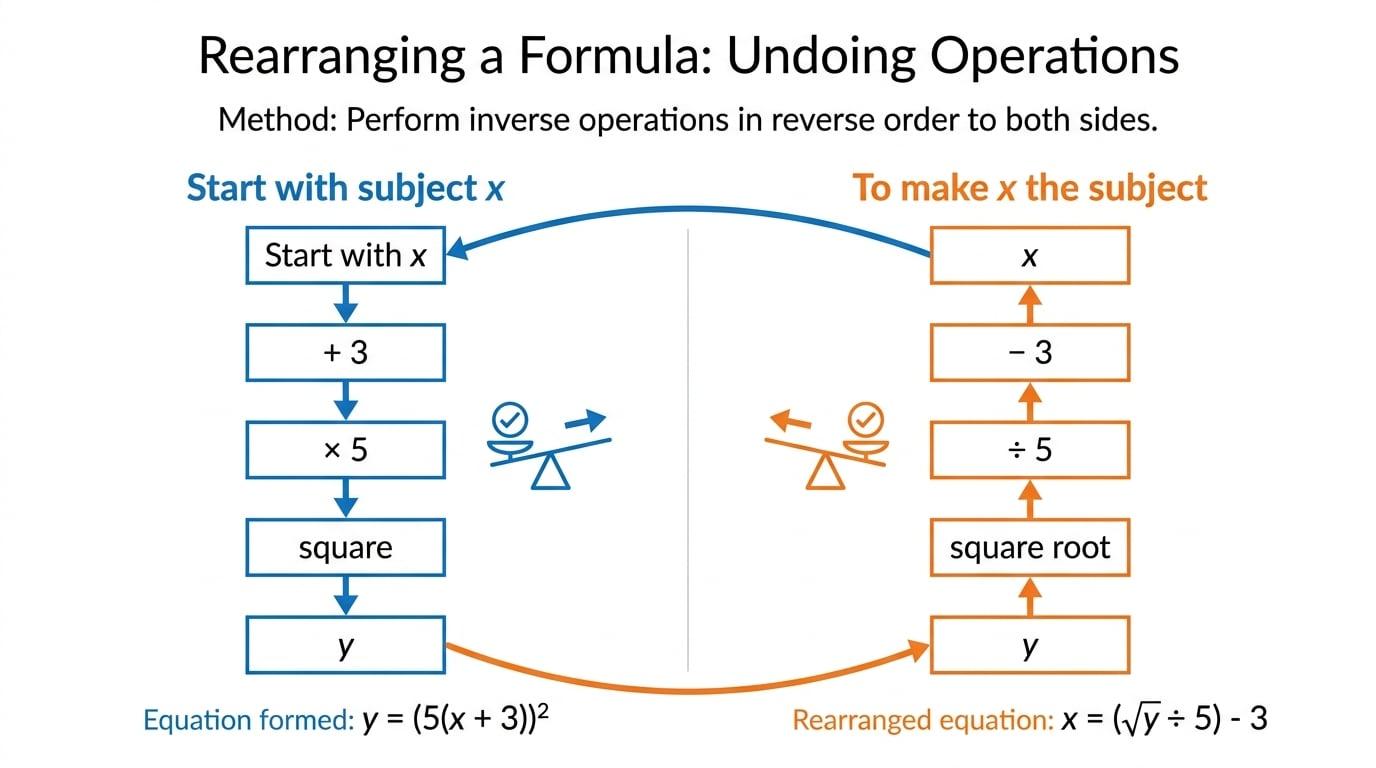
An inverse operation is an operation that undoes another one. Subtracting undoes adding, dividing undoes multiplying, and square-rooting undoes squaring. Rearranging is often about undoing operations in the reverse order.
Key Idea
Main idea
To rearrange a formula, keep the equation balanced and work backwards until the target letter is alone.
Example
Making a letter the subject in a linear formula
Make kkk the subject of m=n+kpm=n+kpm=n+kp.
-
The target is kkk. First remove nnn by subtracting nnn from both sides:
m−n=kpm-n=kpm−n=kp -
Now kkk is multiplied by ppp, so divide both sides by ppp:
k=m−npk=\frac{m-n}{p}k=pm−n
Common Mistake
Do not just 'move' terms
It is safer to think “do the opposite operation to both sides” rather than “move it across”. This helps you avoid sign errors.
Rearranging when there is a square
If the target letter is squared, isolate the squared part first, then take the square root.
The square root is the inverse of squaring. For example, if x2=25x^2=25x2=25, then x=±5x=\pm5x=±5 because both positive and negative values square to 25.
Example
Making a squared letter the subject
Make PPP the subject of R2=P2+5qtR^2=P^2+5qtR2=P2+5qt.
-
The target is PPP, but it is currently inside P2P^2P2. First subtract 5qt5qt5qt from both sides:
R2−5qt=P2R^2-5qt=P^2R2−5qt=P2 -
Take the square root of both sides:
P=±R2−5qtP=\pm\sqrt{R^2-5qt}P=±R2−5qt
Tip
When to use the positive root only
In a real-life context, if the variable represents a length, speed or time, the negative answer may not make sense. In pure algebra, include ±\pm± unless the question gives a reason not to.
Clearing fractions and halves
A denominator is the bottom part of a fraction. To remove a denominator, multiply both sides by that denominator.
This is especially useful when a formula contains 12\frac{1}{2}21.
Example
Removing a half-term
Make nnn the subject of d=wt+12nt2d=wt+\frac{1}{2}nt^2d=wt+21nt2.
-
Remove the term not containing nnn by subtracting wtwtwt from both sides:
d−wt=12nt2d-wt=\frac{1}{2}nt^2d−wt=21nt2 -
Multiply both sides by 2 to remove the half:
2(d−wt)=nt22(d-wt)=nt^22(d−wt)=nt2 -
Divide both sides by t2t^2t2:
n=2(d−wt)t2n=\frac{2(d-wt)}{t^2}n=t22(d−wt)
Common Mistake
Forgetting the whole term
In 12nt2\frac{1}{2}nt^221nt2, the half applies to the whole product nt2nt^2nt2. Remove the half before dividing by t2t^2t2.
When the subject appears more than once
Sometimes the letter you want appears in two places. Your aim is to collect all the target-letter terms on one side, then factorise.
Definition
Factorising
Factorising means taking out a common factor. For example, ax+bx=x(a+b)ax+bx=x(a+b)ax+bx=x(a+b) because both terms contain xxx.
A coefficient is the number or algebraic factor multiplying a variable. In 7x7x7x, the coefficient of xxx is 7. In axaxax, the coefficient of xxx is aaa.
Example
Collecting and factorising the target letter
Make xxx the subject of x(4+a)=b(x+1)x(4+a)=b(x+1)x(4+a)=b(x+1).
-
Expand both brackets:
4x+ax=bx+b4x+ax=bx+b4x+ax=bx+b -
Collect the xxx terms on the left by subtracting bxbxbx from both sides:
4x+ax−bx=b4x+ax-bx=b4x+ax−bx=b -
Factorise the left-hand side by taking out xxx:
x(4+a−b)=bx(4+a-b)=bx(4+a−b)=b -
Divide by the bracket multiplying xxx:
x=b4+a−bx=\frac{b}{4+a-b}x=4+a−bb
Tip
Collect, factorise, divide
If the target appears more than once, use this routine: collect the target terms, factorise the target letter, then divide by what is left.
Algebraic fractions with the subject in the numerator and denominator
An algebraic fraction is a fraction that contains variables. If the subject is in a denominator, clear the fraction first by multiplying both sides by the denominator.
Example
Clearing an algebraic fraction
Make xxx the subject of p=6+2qx2x−5p=\frac{6+2qx}{2x-5}p=2x−56+2qx.
-
Multiply both sides by 2x−52x-52x−5:
p(2x−5)=6+2qxp(2x-5)=6+2qxp(2x−5)=6+2qx -
Expand the left-hand side:
2px−5p=6+2qx2px-5p=6+2qx2px−5p=6+2qx -
Collect the xxx terms on the left and the non-xxx terms on the right:
2px−2qx=6+5p2px-2qx=6+5p2px−2qx=6+5p -
Factorise the left-hand side:
2x(p−q)=6+5p2x(p-q)=6+5p2x(p−q)=6+5p -
Divide by 2(p−q)2(p-q)2(p−q):
x=6+5p2(p−q)x=\frac{6+5p}{2(p-q)}x=2(p−q)6+5p
Common Mistake
Hidden restrictions
You cannot divide by zero. In rearranging questions, assume denominators such as 2x−52x-52x−5 and final divisors such as p−qp-qp−q are non-zero unless a special case is being considered.
Fractions equal to fractions
When you have a fraction equal to a fraction, you can often cross-multiply. This means multiplying both sides by both denominators to remove the fractions.
Example
Using cross-multiplication
Make xxx the subject of ab=3xx+4\frac{a}{b}=\frac{3x}{x+4}ba=x+43x.
-
Multiply both sides by b(x+4)b(x+4)b(x+4):
a(x+4)=3bxa(x+4)=3bxa(x+4)=3bx -
Expand the bracket:
ax+4a=3bxax+4a=3bxax+4a=3bx -
Collect the xxx terms on the right:
4a=3bx−ax4a=3bx-ax4a=3bx−ax -
Factorise the right-hand side:
4a=x(3b−a)4a=x(3b-a)4a=x(3b−a) -
Divide by 3b−a3b-a3b−a:
x=4a3b−ax=\frac{4a}{3b-a}x=3b−a4a
Reciprocal formulae
A reciprocal means “one over” a quantity. For example, the reciprocal of yyy is 1y\frac{1}{y}y1, as long as y≠0y\neq0y=0.
Reciprocal formulae look awkward, but the method is usually:
- isolate the reciprocal containing the target;
- combine the other fractions;
- take the reciprocal of both sides.
Example
Making a variable the subject in a reciprocal formula
Make yyy the subject of 1x=1y+1z\frac{1}{x}=\frac{1}{y}+\frac{1}{z}x1=y1+z1.
-
Isolate 1y\frac{1}{y}y1 by subtracting 1z\frac{1}{z}z1 from both sides:
1y=1x−1z\frac{1}{y}=\frac{1}{x}-\frac{1}{z}y1=x1−z1 -
Combine the fractions on the right using common denominator xzxzxz:
1y=z−xxz\frac{1}{y}=\frac{z-x}{xz}y1=xzz−x -
Take the reciprocal of both sides:
y=xzz−xy=\frac{xz}{z-x}y=z−xxz
Exam technique
In the exam
-
Identify the target letter first, then underline every place it appears.
-
Clear fractions and expand brackets before trying to collect terms.
-
If the target appears more than once, collect, factorise, then divide.
-
Check your final answer: the subject should appear once, on its own, and not on the other side.
Self review
Check yourself
-
If the target letter appears in two separate terms, what is the key step before dividing?
-
When you take the square root of both sides, when might you need a ±\pm± sign?
-
Why is it helpful to clear denominators before expanding brackets?

Recap questions
Test yourself with 5 quick questions on this guide. Answer them all correctly to complete it.
You've reached the end
Test yourself on this topic, or move on to the next guide.
How was this guide?