Revision notes for CIE IGCSE Maths Sector Areas and Arc Lengths. Open the guide for explanations and worked examples. Written against the CIE IGCSE Maths (0580) specification, so the content matches what's examinable rather than general Maths background.
Sector Areas and Arc Lengths
What you'll learn
- What a sector is: a slice of a circle made from two radii and an arc.
- How to find the area of a sector using the angle at the centre.
- How to find an arc length, and then the perimeter of a sector.
- How to handle shaded regions involving sectors, rectangles and semicircles.
The circle facts you need first
A circle is the set of points the same distance from a fixed middle point, called the centre. The distance from the centre to the edge is the radius. The distance all the way across through the centre is the diameter, which is twice the radius.
The circumference is the distance around the outside of a full circle. The area is the space inside the circle.
For a full circle:
- Circumference: C=2πrC = 2\pi rC=2πr
- Area: A=πr2A = \pi r^2A=πr2
where rrr is the radius.
Example
Recapping full circle formulae
-
Suppose a circle has radius 6 cm.
-
The circumference is found using C=2πrC = 2\pi rC=2πr:
C=2π×6=12πC = 2\pi \times 6 = 12\piC=2π×6=12π -
The area is found using A=πr2A = \pi r^2A=πr2:
A=π×62=36πA = \pi \times 6^2 = 36\piA=π×62=36π -
So the circumference is 12π12\pi12π cm and the area is 36π36\pi36π cm².
What is a sector?
A sector is part of a circle enclosed by two radii and an arc. An arc is part of the circumference. The angle between the two radii at the centre is called the central angle.
This diagram shows the key parts you need to recognise.

Definition
Sector vocabulary
- A radius is a straight line from the centre to the circumference.
- An arc is the curved edge of a sector.
- A sector is a fraction of a circle.
- The central angle is the angle at the centre; we often call it θ\thetaθ.
The key idea: use the fraction of the circle
A full circle is 360°. So a sector with angle θ\thetaθ is the fraction θ360\frac{\theta}{360}360θ of the whole circle.
Key Idea
Sector fraction
For any sector:
fraction of circle=θ360\text{fraction of circle} = \frac{\theta}{360}fraction of circle=360θUse this same fraction for both area and arc length.
Example
Finding the fraction of a circle
-
A sector has angle 135°.
-
Write the sector as a fraction of a full circle:
135360\frac{135}{360}360135 -
Simplify the fraction:
135360=38\frac{135}{360} = \frac{3}{8}360135=83 -
So the sector is 38\frac{3}{8}83 of the full circle.
Area of a sector
To find the area of a sector, take the fraction of the circle and multiply it by the area of the full circle.
A=θ360×πr2A = \frac{\theta}{360}\times \pi r^2A=360θ×πr2where AAA is the sector area, rrr is the radius, and θ\thetaθ is the central angle in degrees.
Example
Area of a sector to 3 significant figures
-
A sector has radius 8 cm and angle 150°.
-
Use the sector area formula:
A=150360×π×82A = \frac{150}{360}\times \pi \times 8^2A=360150×π×82 -
Calculate the exact expression first:
A=150360×64π=80π3A = \frac{150}{360}\times 64\pi = \frac{80\pi}{3}A=360150×64π=380π -
Convert to a decimal:
80π3≈83.7758\frac{80\pi}{3} \approx 83.7758380π≈83.7758 -
Round to 3 significant figures: 83.8 cm².
Common Mistake
Rounding too early
Keep the full calculator value until the final answer. If you round halfway through, your 3 significant figure answer may be slightly wrong.
Larger sectors
A major sector is a sector bigger than a semicircle, so its angle is greater than 180°. The same formula still works: just use the angle you are given.
For example, a 200° sector is more than half a circle, because 200° is more than 180°.
Arc length
The arc length is the length of the curved part of the sector. Since an arc is a fraction of the circumference, use the same fraction idea:
L=θ360×2πrL = \frac{\theta}{360}\times 2\pi rL=360θ×2πrwhere LLL is the arc length.
Example
Arc length in terms of pi
-
A sector has radius 12 cm and angle 135°.
-
Use the arc length formula:
L=135360×2π×12L = \frac{135}{360}\times 2\pi \times 12L=360135×2π×12 -
Simplify the fraction:
L=38×24πL = \frac{3}{8}\times 24\piL=83×24π -
Multiply:
L=9πL = 9\piL=9π -
So the arc length is 9π9\pi9π cm.
Tip
When the question says in terms of pi
Do not press the calculator button for π\piπ at the end. Leave your answer with π\piπ in it, such as 9π9\pi9π cm or 25π2\frac{25\pi}{2}225π cm.
Perimeter of a sector
The perimeter of a shape is the total distance around its outside.
For a sector, the outside is made from:
- one arc
- two radii
So:
perimeter of sector=L+2r\text{perimeter of sector} = L + 2rperimeter of sector=L+2rExample
Finding the perimeter of a sector
-
A sector has radius 5.4 cm and angle 80°.
-
First find the arc length:
L=80360×2π×5.4L = \frac{80}{360}\times 2\pi \times 5.4L=36080×2π×5.4 -
Simplify:
L=2.4πL = 2.4\piL=2.4π -
Add the two radii as well as the arc:
P=2.4π+5.4+5.4P = 2.4\pi + 5.4 + 5.4P=2.4π+5.4+5.4 -
Calculate and round to 3 significant figures:
P=10.8+2.4π≈18.3398P = 10.8 + 2.4\pi \approx 18.3398P=10.8+2.4π≈18.3398 -
The perimeter is 18.3 cm.
Common Mistake
Forgetting the two straight sides
For perimeter, do not just find the arc length. A sector has two straight sides as well, so add both radii.
Shaded regions with sectors and semicircles
A semicircle is half a circle. Its area is half of πr2\pi r^2πr2.
Many IGCSE questions ask for a shaded region made from two shapes. The main strategy is:
- Find the area of the larger shape.
- Find the area of the smaller shape.
- Subtract.
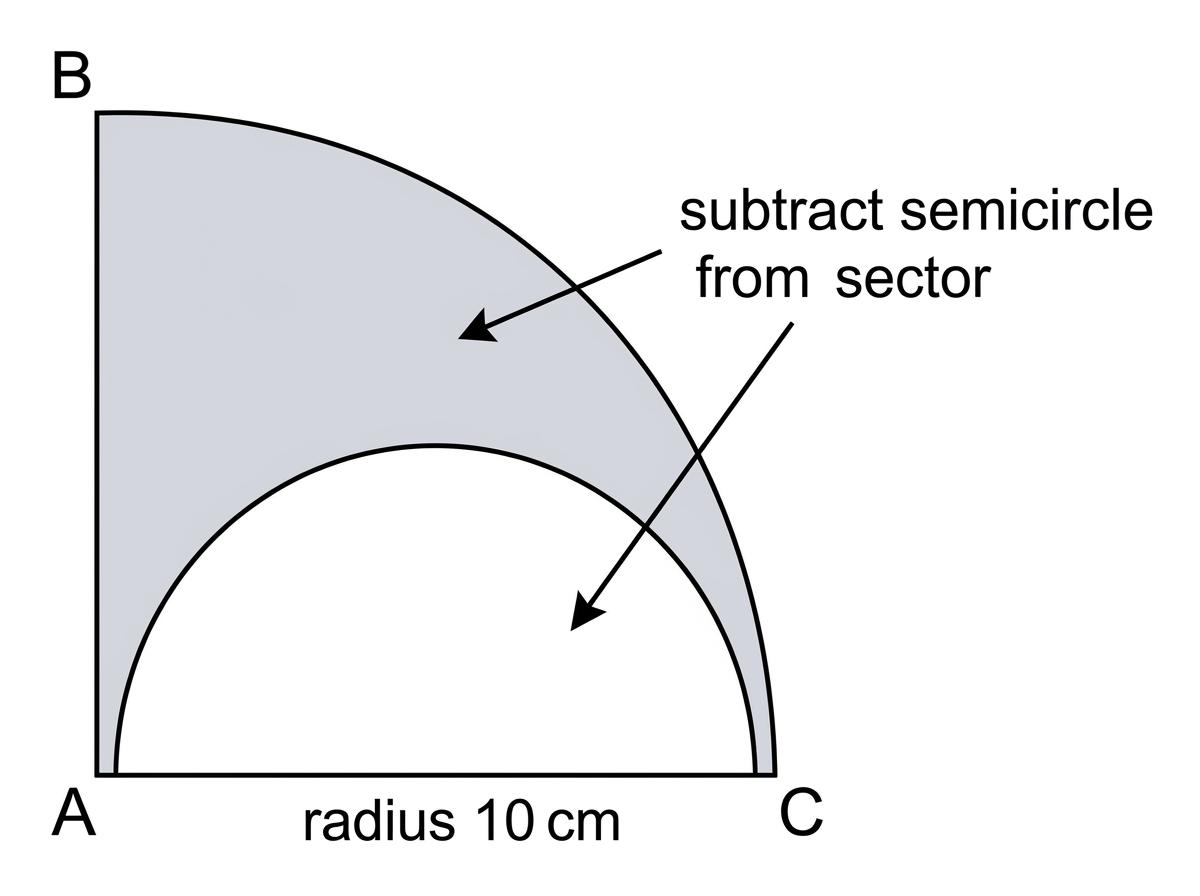
Here is the kind of “sector minus semicircle” structure you may see.
Example
Sector minus semicircle
-
A 90° sector has radius 10 cm. A semicircle is drawn with diameter 10 cm inside it.
-
Find the area of the sector:
Asector=90360×π×102=25πA_{\text{sector}} = \frac{90}{360}\times \pi \times 10^2 = 25\piAsector=36090×π×102=25π -
The semicircle has diameter 10 cm, so its radius is 5 cm.
-
Find the area of the semicircle:
Asemi=12×π×52=25π2A_{\text{semi}} = \frac{1}{2}\times \pi \times 5^2 = \frac{25\pi}{2}Asemi=21×π×52=225π -
Subtract the semicircle from the sector:
Ashaded=25π−25π2=25π2A_{\text{shaded}} = 25\pi - \frac{25\pi}{2} = \frac{25\pi}{2}Ashaded=25π−225π=225π -
The shaded area is 25π2\frac{25\pi}{2}225π cm².
Example
Percentage shaded in a rectangle
-
A rectangle is 16 cm by 10 cm. A semicircle with diameter 10 cm is cut out from it.
-
Find the area of the rectangle:
16×10=16016\times 10 = 16016×10=160 -
The semicircle has radius 5 cm, so its area is:
12×π×52=25π2\frac{1}{2}\times \pi \times 5^2 = \frac{25\pi}{2}21×π×52=225π -
Find the shaded area:
160−25π2160 - \frac{25\pi}{2}160−225π -
Convert to a percentage of the rectangle:
160−25π2160×100≈75.456\frac{160 - \frac{25\pi}{2}}{160}\times 100 \approx 75.456160160−225π×100≈75.456 -
Rounded to 1 decimal place, the shaded percentage is 75.5%.
When you are given arc length instead of angle
Sometimes the angle is not given. If you know the radius and the arc length, you can find the sector area directly.
A=12rLA = \frac{1}{2}rLA=21rLwhere LLL is the arc length.
This works because the arc length and the sector area are both the same fraction of the full circle.
Example
Finding sector area from arc length
-
A sector has radius 8 cm and arc length 5π5\pi5π cm.
-
Use the formula A=12rLA = \frac{1}{2}rLA=21rL.
-
Substitute r=8r = 8r=8 and L=5πL = 5\piL=5π:
A=12×8×5πA = \frac{1}{2}\times 8 \times 5\piA=21×8×5π -
Simplify:
A=20πA = 20\piA=20π -
So the sector area is 20π20\pi20π cm².
Exam technique
In the exam
-
Decide what you are finding first: area, arc length, perimeter, shaded area, or percentage.
-
Write the sector fraction θ360\frac{\theta}{360}360θ before substituting numbers.
-
If the answer says “in terms of π\piπ”, leave π\piπ in your final answer; if it asks for significant figures, round only at the end.
Self review
Check yourself
- Can you explain why a 90° sector is one quarter of a full circle?
- When finding the perimeter of a sector, what three lengths must be included?
- If you are given radius and arc length, which shortcut formula gives the sector area?

Recap questions
Test yourself with 5 quick questions on this guide. Answer them all correctly to complete it.
You've reached the end
Test yourself on this topic, or move on to the next guide.
How was this guide?