Revision notes for CIE IGCSE Maths Spheres and Cones. Open the guide for explanations and worked examples. Written against the CIE IGCSE Maths (0580) specification, so the content matches what's examinable rather than general Maths background.
Spheres and Cones
What you'll learn
- How to identify the radius, diameter, height and slant height in 3D shapes.
- How to calculate volumes and surface areas of cones, spheres and hemispheres.
- How to give answers in terms of π\piπ or rounded to 3 significant figures.
- How to handle compound solids and water displacement questions.
The key measurements
Before using any formula, make sure you know what each measurement means.
Definition
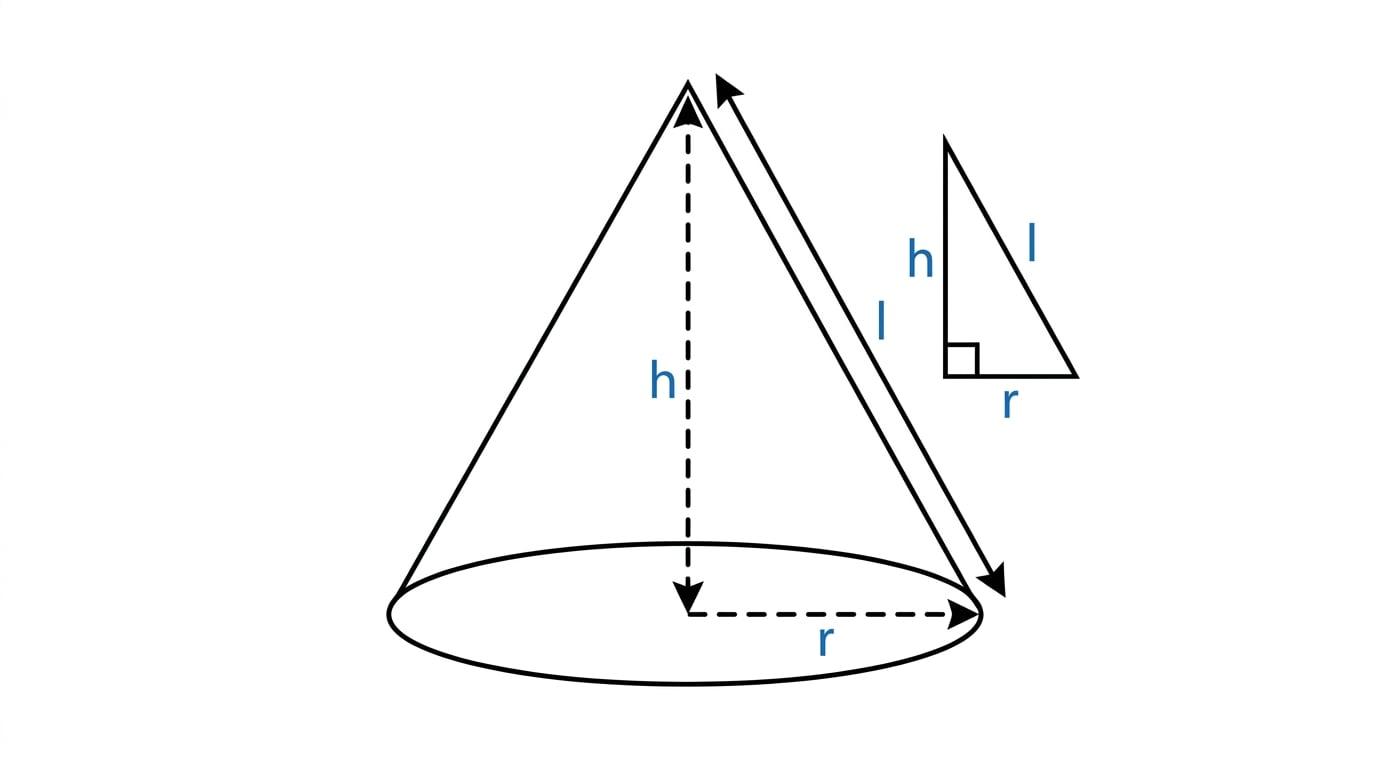
Radius, diameter, height and slant height
- The radius is the distance from the centre of a circle to its edge.
- The diameter is the full width of a circle through its centre.
- The vertical height of a cone is the straight up-and-down distance from the centre of the base to the top.
- The slant height of a cone is the distance along the outside edge from the base to the top.
The most common trap is using the diameter when the formula needs the radius. Always halve the diameter first.
Key Idea
Radius first
Most sphere and cone formulae use the radius, not the diameter. If you are given a diameter, use r=d2r = \frac{d}{2}r=2d before doing anything else.
Cones
A cone has a circular base and a pointed top called the apex.
For a cone:
- Volume: V=13πr2hV = \frac{1}{3}\pi r^2hV=31πr2h
- Curved surface area: A=πrlA = \pi rlA=πrl
- Total surface area of a solid cone: curved surface area + base area
So:
total surface area=πrl+πr2\text{total surface area} = \pi rl + \pi r^2total surface area=πrl+πr2Example: volume of a cone from a diameter
Example
Finding the volume of a cone
A cone has vertical height 15 cm and base diameter 12 cm. Find its volume, correct to 3 significant figures.
-
Convert the diameter to a radius.
r=122=6r = \frac{12}{2} = 6r=212=6 -
Substitute into the cone volume formula.
V=13π×62×15V = \frac{1}{3}\pi \times 6^2 \times 15V=31π×62×15 -
Simplify the exact value first.
V=180πV = 180\piV=180π -
Convert to a decimal and round to 3 significant figures: 565 cm³.
Tip
Rounding
Keep the calculator value until the final line. Rounding too early can make your final answer slightly inaccurate.
Slant height and total surface area of a cone
For cone surface area, you often need the slant height, lll. If you are only given the vertical height and radius, use Pythagoras.
The radius, vertical height and slant height form a right-angled triangle:
l2=r2+h2l^2 = r^2 + h^2l2=r2+h2Example: total surface area using Pythagoras
Example
Total surface area of a cone
A solid cone has vertical height 12 cm and base diameter 18 cm. Work out its total surface area in terms of π\piπ.
-
Convert the diameter to a radius.
r=182=9r = \frac{18}{2} = 9r=218=9 -
Use Pythagoras to find the slant height.
l2=122+92=144+81=225l^2 = 12^2 + 9^2 = 144 + 81 = 225l2=122+92=144+81=225 -
Square root to find lll.
l=225=15l = \sqrt{225} = 15l=225=15 -
Add the curved surface area and the circular base area.
total surface area=πrl+πr2=π×9×15+π×92=135π+81π=216π\begin{aligned} \text{total surface area} &= \pi rl + \pi r^2 \\ &= \pi \times 9 \times 15 + \pi \times 9^2 \\ &= 135\pi + 81\pi \\ &= 216\pi \end{aligned}total surface area=πrl+πr2=π×9×15+π×92=135π+81π=216π -
The total surface area is 216π216\pi216π cm².
Common Mistake
Using the vertical height as the slant height
In πrl\pi rlπrl, the lll means slant height, not vertical height. If the surface area question gives only the vertical height, check whether you need Pythagoras first.
Spheres and hemispheres
Definition
Sphere and hemisphere
A sphere is a perfectly round 3D shape, like a ball. A hemisphere is half of a sphere.
For a sphere:
- Volume: V=43πr3V = \frac{4}{3}\pi r^3V=34πr3
- Surface area: A=4πr2A = 4\pi r^2A=4πr2
For a hemisphere:
- Volume: V=23πr3V = \frac{2}{3}\pi r^3V=32πr3
- Curved surface area: A=2πr2A = 2\pi r^2A=2πr2
- Total surface area of a solid hemisphere: curved surface area + flat circular base
So for a solid hemisphere:
total surface area=2πr2+πr2=3πr2\text{total surface area} = 2\pi r^2 + \pi r^2 = 3\pi r^2total surface area=2πr2+πr2=3πr2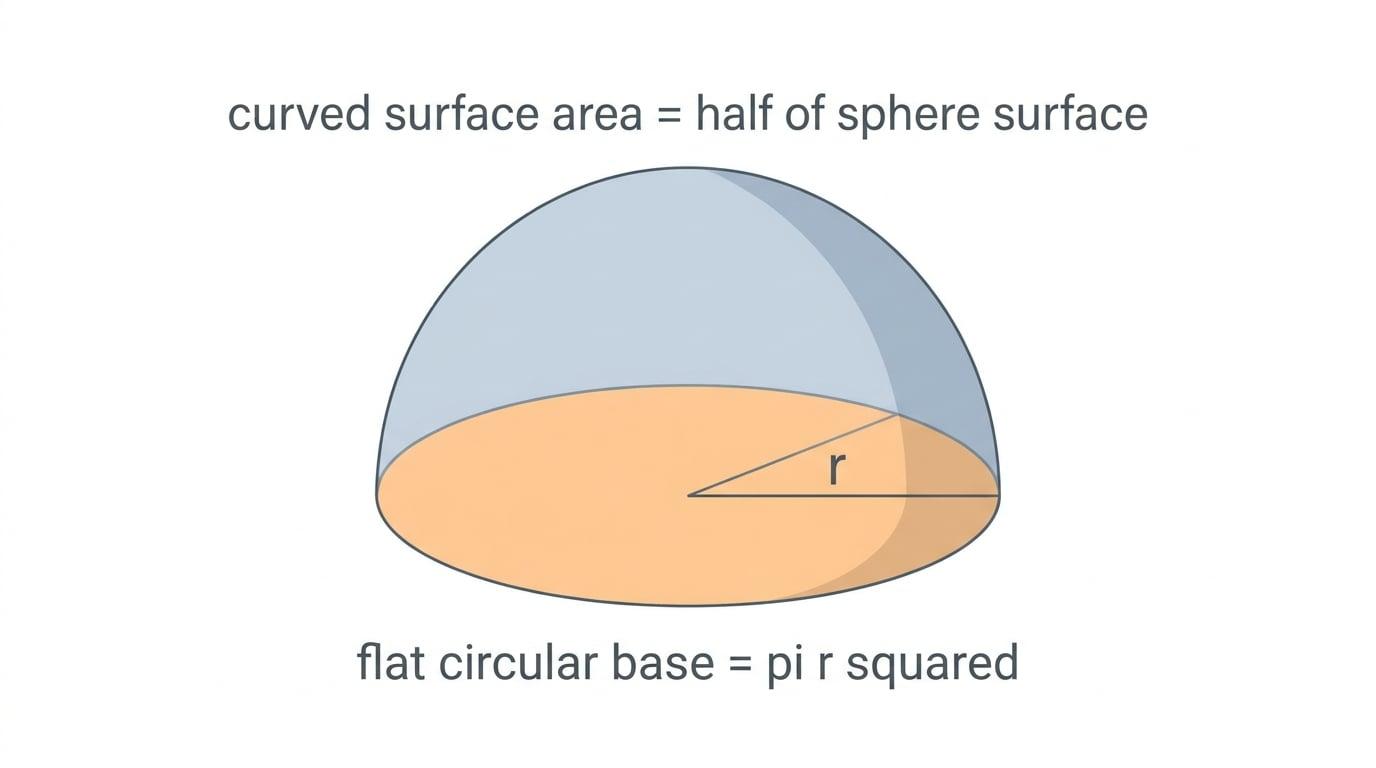
Example: total surface area of a hemisphere
Example
Total surface area of a solid hemisphere
A solid hemisphere has radius 9 cm. Work out its total surface area in terms of π\piπ.
-
A solid hemisphere has a curved surface and a flat circular base.
-
Find the curved surface area.
2πr2=2π×92=162π2\pi r^2 = 2\pi \times 9^2 = 162\pi2πr2=2π×92=162π -
Find the flat circular base area.
πr2=π×92=81π\pi r^2 = \pi \times 9^2 = 81\piπr2=π×92=81π -
Add the two areas.
162π+81π=243π162\pi + 81\pi = 243\pi162π+81π=243π -
The total surface area is 243π243\pi243π cm².
Common Mistake
Forgetting the flat circle
If the question asks for the total surface area of a solid hemisphere, include the flat circular face. If it asks for curved surface area only, do not include it.
Answers in terms of π\piπ
Sometimes the question asks for an answer in terms of π\piπ. This means you should leave π\piπ in your answer instead of converting it to a decimal.
For example, an exact answer might be 216π216\pi216π cm² or 2723π\frac{272}{3}\pi3272π cm³.
Tip
Exact form
If the question says “in terms of π\piπ”, do not round the answer. Collect the number parts together and leave π\piπ at the end.
Compound solids
A compound solid is made by joining two or more 3D shapes together.
For volume, you usually add the volumes of the parts.
For surface area, only count the surfaces on the outside. Any joined faces inside the solid are not visible, so they are not included.
Key Idea
Volume versus surface area
For compound solids, volumes add together. For surface area, only count the outside faces.
Example: cone on top of a hemisphere
Example
Volume of a compound solid
A cone sits on top of a hemisphere. The cone has height 9 cm and base diameter 8 cm. The hemisphere also has diameter 8 cm. Work out the total volume in terms of π\piπ.
-
Find the shared radius.
r=82=4r = \frac{8}{2} = 4r=28=4 -
Find the cone volume.
Vcone=13πr2h=13π×42×9=48π\begin{aligned} V_{\text{cone}} &= \frac{1}{3}\pi r^2h \\ &= \frac{1}{3}\pi \times 4^2 \times 9 \\ &= 48\pi \end{aligned}Vcone=31πr2h=31π×42×9=48π -
Find the hemisphere volume.
Vhemisphere=12×43πr3=23π×43=1283π\begin{aligned} V_{\text{hemisphere}} &= \frac{1}{2}\times \frac{4}{3}\pi r^3 \\ &= \frac{2}{3}\pi \times 4^3 \\ &= \frac{128}{3}\pi \end{aligned}Vhemisphere=21×34πr3=32π×43=3128π -
Add the two volumes.
48π+1283π=2723π48\pi + \frac{128}{3}\pi = \frac{272}{3}\pi48π+3128π=3272π -
The total volume is 2723π\frac{272}{3}\pi3272π cm³.
Reverse problems: finding the radius
Sometimes you are given a volume and asked to find the radius. This means you must rearrange the formula.
For a sphere, the formula is:
V=43πr3V = \frac{4}{3}\pi r^3V=34πr3Because the radius is cubed, you will need a cube root at the end.
Example: sphere with the same volume as a cube
Example
Finding the radius of a sphere
A cube has side length 6 cm. A sphere has the same volume as the cube. Work out the radius of the sphere, correct to 3 significant figures.
-
Find the volume of the cube.
Vcube=63=216V_{\text{cube}} = 6^3 = 216Vcube=63=216 -
Set the sphere volume equal to 216.
43πr3=216\frac{4}{3}\pi r^3 = 21634πr3=216 -
Rearrange to find r3r^3r3.
r3=216×34π=162πr^3 = \frac{216 \times 3}{4\pi} = \frac{162}{\pi}r3=4π216×3=π162 -
Cube root to find rrr.
r=162π3≈3.72r = \sqrt[3]{\frac{162}{\pi}} \approx 3.72r=3π162≈3.72 -
The radius is 3.72 cm to 3 significant figures.
Tip
Cube root, not square root
If the formula contains r3r^3r3, you need a cube root to undo it. A square root only undoes r2r^2r2.
Water displacement
Definition
Displacement
When an object is fully submerged in water, it pushes up a volume of water equal to its own volume.
In a rectangular container:
rise in water level=volume displacedbase area of container\text{rise in water level} = \frac{\text{volume displaced}}{\text{base area of container}}rise in water level=base area of containervolume displacedThe base area of a rectangular container is length times width.
Example: rise in water level
Example
Water level rise
A rectangular container is 12 cm long and 10 cm wide. It contains water to a depth of 7 cm. A metal sphere of radius 3 cm is placed in the water and sinks. Calculate the rise in the water level, correct to 3 significant figures.
-
Find the volume of the sphere.
V=43π×33=36πV = \frac{4}{3}\pi \times 3^3 = 36\piV=34π×33=36π -
Find the base area of the container.
12×10=12012 \times 10 = 12012×10=120 -
Divide the displaced volume by the base area.
rise=36π120≈0.942\text{rise} = \frac{36\pi}{120} \approx 0.942rise=12036π≈0.942 -
The water level rises by 0.942 cm to 3 significant figures.
Common Mistake
Check for overflow
The displacement method assumes the object is fully submerged and the container does not overflow. If water spills out, the question needs different thinking.
Exam technique
In the exam
-
Underline whether the question asks for volume, curved surface area, or total surface area.
-
Convert any diameter to a radius before substituting into a formula.
-
For cones, check whether slant height is given. If only vertical height is given and surface area is needed, use Pythagoras to find lll.
-
If the answer must be in terms of π\piπ, leave π\piπ in the answer. If it asks for significant figures, round only at the end.
Self review
Check yourself
-
What extra circle do you include for the total surface area of a solid hemisphere?
-
How do you find the slant height of a cone when you know its radius and vertical height?
-
In a water displacement question, what volume causes the water level to rise?

Recap questions
Test yourself with 5 quick questions on this guide. Answer them all correctly to complete it.
You've reached the end
Test yourself on this topic, or move on to the next guide.
How was this guide?