Revision notes for CIE IGCSE Maths Forming and Solving Equations. Open the guide for explanations and worked examples. Written against the CIE IGCSE Maths (0580) specification, so the content matches what's examinable rather than general Maths background.
Forming and Solving Equations
What you'll learn
- How to turn information in a question into an algebraic equation.
- How to simplify expressions by collecting like terms.
- How to solve equations from perimeters, angles, areas, and word problems.
- How to check that your answer makes sense in context.
The big idea
Many IGCSE questions do not give you the equation directly. Instead, they describe a situation: a perimeter, a set of angles, an area, or a total number of objects. Your job is to form the equation, then solve it.
Definition
Expression and equation
An expression is a piece of algebra with no equals sign, such as 3x+53x+53x+5. An equation has an equals sign, such as 3x+5=203x+5=203x+5=20, and can be solved to find the unknown value.
Key Idea
Form first, solve second
Do not rush to solve. First write a clear expression or equation that matches the situation, then simplify it carefully.
Prerequisite: collecting like terms
A variable is a letter that represents an unknown number. In this topic, the variable is often xxx.
When you collect like terms, you combine terms with the same variable. For example:
3x+2x+x=6x3x+2x+x=6x3x+2x+x=6xand
7+4−2=97+4-2=97+4−2=9So:
3x+7+2x−2=5x+53x+7+2x-2=5x+53x+7+2x−2=5x+5Example
Writing a perimeter expression
A triangle has side lengths 4x−34x-34x−3, 2x+52x+52x+5, and x+1x+1x+1. Write an expression for its perimeter.
-
Perimeter means the total distance around the outside, so add the three sides:
(4x−3)+(2x+5)+(x+1)(4x-3)+(2x+5)+(x+1)(4x−3)+(2x+5)+(x+1) -
Collect the xxx terms:
4x+2x+x=7x4x+2x+x=7x4x+2x+x=7x -
Collect the number terms:
−3+5+1=3-3+5+1=3−3+5+1=3 -
Write the simplified expression:
7x+37x+37x+3
Common Mistake
Forgetting negative signs
If a side is 3x−53x-53x−5, the minus 5 belongs to that side. When adding expressions, keep the sign with the term.
Solving one-step and two-step equations
Once you have formed an equation, solve it using inverse operations.
Definition
Inverse operation
An inverse operation reverses another operation. Addition and subtraction undo each other. Multiplication and division undo each other.
For example, to solve 5x+6=315x+6=315x+6=31, you undo the plus 6 first, then undo the multiply by 5.
Example
Solving from a perimeter
A triangle has side lengths 2x+42x+42x+4, 3x−13x-13x−1, and x+6x+6x+6. Its perimeter is 45 cm. Find xxx.
-
Add the three side lengths to form the perimeter expression:
(2x+4)+(3x−1)+(x+6)(2x+4)+(3x-1)+(x+6)(2x+4)+(3x−1)+(x+6) -
Simplify the expression:
6x+96x+96x+9 -
Set this equal to the given perimeter:
6x+9=456x+9=456x+9=45 -
Subtract 9 from both sides:
6x=366x=366x=36 -
Divide both sides by 6:
x=6x=6x=6
Tip
Check by substituting
After solving, put your value of xxx back into the lengths. If the total perimeter is the one in the question, your answer is very likely correct.
Geometry facts that help you form equations
Many questions rely on a few basic geometry facts. These facts tell you what the expressions must add up to, or which expressions must be equal.
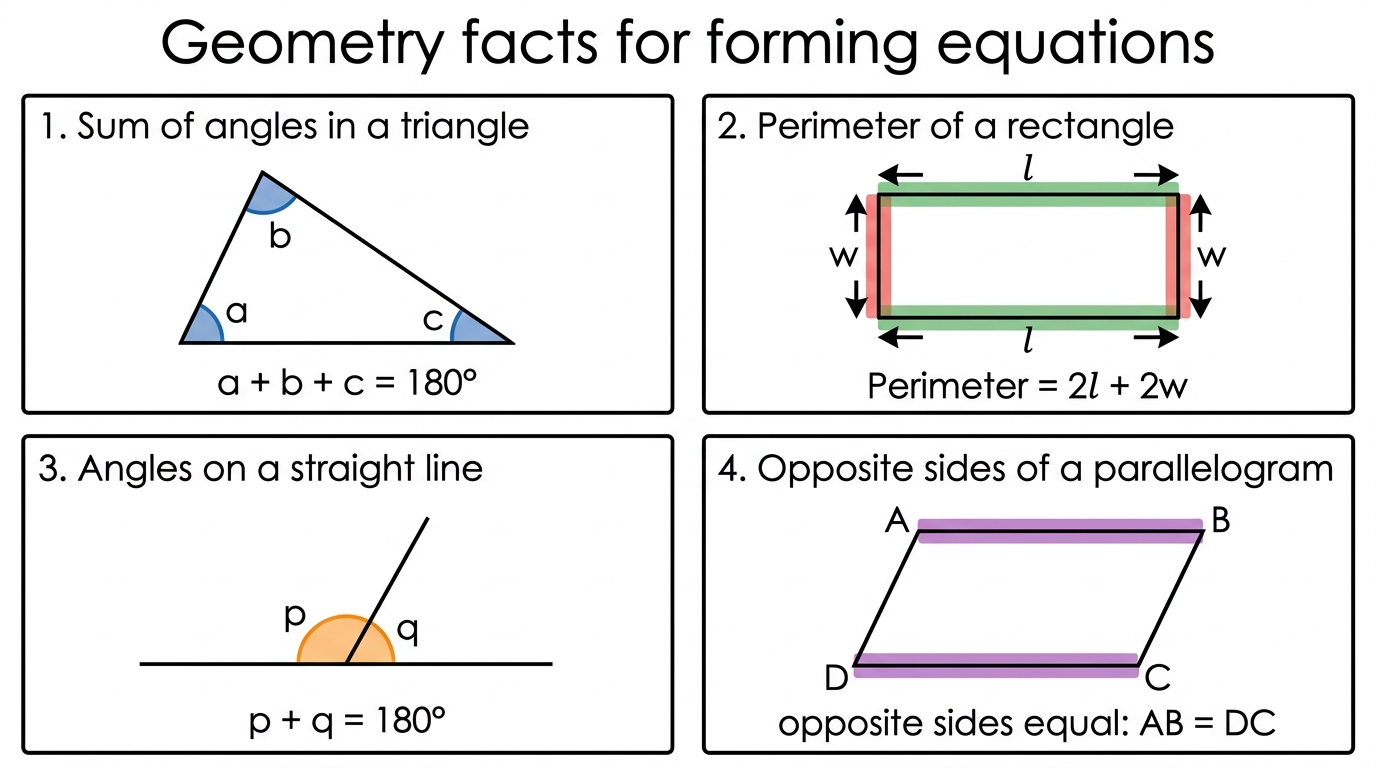
Useful facts include:
- The angles in a triangle add to 180°.
- Angles on a straight line add to 180°.
- A right angle is 90°.
- Opposite sides of a rectangle are equal.
- Opposite sides of a parallelogram are equal.
- Rectangle perimeter is twice the length plus twice the width.
Forming equations from perimeter
For rectangles, remember that there are two lengths and two widths. If the length is 2x+12x+12x+1 and the width is x+4x+4x+4, the perimeter is:
2(2x+1)+2(x+4)2(2x+1)+2(x+4)2(2x+1)+2(x+4)You can also add all four sides one by one.
Example
Rectangle perimeter equation
A rectangle has length 3x+23x+23x+2 cm and width x+6x+6x+6 cm. Its perimeter is 52 cm. Find xxx.
-
Write the perimeter as two lengths plus two widths:
2(3x+2)+2(x+6)2(3x+2)+2(x+6)2(3x+2)+2(x+6) -
Expand the brackets:
6x+4+2x+126x+4+2x+126x+4+2x+12 -
Collect like terms:
8x+168x+168x+16 -
Set the expression equal to 52:
8x+16=528x+16=528x+16=52 -
Subtract 16 from both sides:
8x=368x=368x=36 -
Divide by 8:
x=4.5x=4.5x=4.5
Common Mistake
Only adding length and width once
For a rectangle, length plus width is only halfway around. The perimeter is length + width + length + width.
Using equal sides
Sometimes a diagram gives two expressions for opposite sides of a rectangle or parallelogram. Since opposite sides are equal, you can set the expressions equal to each other.
Example
Opposite sides of a rectangle
A rectangle has top side 4x−74x-74x−7 cm and bottom side 2x+92x+92x+9 cm. Find the perimeter if the height is x+3x+3x+3 cm.
-
Opposite sides of a rectangle are equal, so form an equation:
4x−7=2x+94x-7=2x+94x−7=2x+9 -
Subtract 2x2x2x from both sides:
2x−7=92x-7=92x−7=9 -
Add 7 to both sides:
2x=162x=162x=16 -
Divide by 2:
x=8x=8x=8 -
Find the length using either horizontal side expression:
4(8)−7=254(8)-7=254(8)−7=25 -
Find the height:
8+3=118+3=118+3=11 -
Use rectangle perimeter:
25+11+25+11=7225+11+25+11=7225+11+25+11=72
Forming equations from angles
Angle questions often ask you to use a total:
- Triangle angles add to 180°.
- Angles on a straight line add to 180°.
- Angles around a point add to 360°.
- A right angle is 90°.
Example
Angles in a triangle
The angles of a triangle are 2x+152x+152x+15, x+20x+20x+20, and x−5x-5x−5 degrees. Find xxx.
-
Angles in a triangle add to 180°, so add the three expressions:
(2x+15)+(x+20)+(x−5)=180(2x+15)+(x+20)+(x-5)=180(2x+15)+(x+20)+(x−5)=180 -
Collect like terms:
4x+30=1804x+30=1804x+30=180 -
Subtract 30 from both sides:
4x=1504x=1504x=150 -
Divide by 4:
x=37.5x=37.5x=37.5
Example
Angles in a right-angled triangle
A right-angled triangle has two smaller angles labelled 4x4x4x and 2x+182x+182x+18. Find the smallest angle.
-
A right angle is 90°, so the other two angles must add to 90°:
4x+(2x+18)=904x+(2x+18)=904x+(2x+18)=90 -
Collect like terms:
6x+18=906x+18=906x+18=90 -
Subtract 18 from both sides:
6x=726x=726x=72 -
Divide by 6:
x=12x=12x=12 -
Find the two labelled angles:
4x=484x=484x=48 2x+18=422x+18=422x+18=42 -
The smallest angle is 42°.
Forming equations from area
Area questions use a formula first. For a triangle:
Area=12×base×height\text{Area}=\frac{1}{2}\times \text{base}\times \text{height}Area=21×base×heightIf the base and height both contain xxx, you may get an equation involving x2x^2x2. To undo squaring, use the square root.
Example
Area of a right-angled triangle
A right-angled triangle has perpendicular sides 5x5x5x cm and 6x6x6x cm. Its area is 240 cm². Find xxx.
-
Use the triangle area formula:
Area=12×base×height\text{Area}=\frac{1}{2}\times \text{base}\times \text{height}Area=21×base×height -
Substitute the expressions:
12×5x×6x=240\frac{1}{2}\times 5x\times 6x=24021×5x×6x=240 -
Simplify the left-hand side:
15x2=24015x^2=24015x2=240 -
Divide by 15:
x2=16x^2=16x2=16 -
Take the positive square root because a length cannot be negative:
x=4x=4x=4
Common Mistake
Lengths cannot be negative
If you get a negative value for a length, area, or perimeter, something has gone wrong. Real measurements must be positive.
Equal perimeters
Sometimes two different shapes have the same perimeter. In that case, form an expression for each perimeter, then set them equal.
Example
Rectangle and triangle with equal perimeters
A rectangle has sides 2x+52x+52x+5 cm and x−2x-2x−2 cm. A triangle has sides 3x3x3x, 2x+12x+12x+1, and x+4x+4x+4 cm. The two perimeters are equal. Find xxx.
-
Write the rectangle perimeter:
2(2x+5)+2(x−2)2(2x+5)+2(x-2)2(2x+5)+2(x−2) -
Simplify the rectangle perimeter:
4x+10+2x−4=6x+64x+10+2x-4=6x+64x+10+2x−4=6x+6 -
Write the triangle perimeter:
3x+(2x+1)+(x+4)3x+(2x+1)+(x+4)3x+(2x+1)+(x+4) -
Simplify the triangle perimeter:
6x+56x+56x+5 -
Set the perimeters equal:
6x+6=6x+56x+6=6x+56x+6=6x+5 -
Subtract 6x6x6x from both sides:
6=56=56=5 -
This is impossible, so these expressions cannot represent equal perimeters for any value of xxx.
That example shows why checking matters. In an exam question, the equation will usually have a valid solution, but if your working gives something impossible, recheck the perimeter expressions carefully.
Example
Equal perimeters with a valid solution
A rectangle has sides 2x+32x+32x+3 cm and x+4x+4x+4 cm. A triangle has sides 2x2x2x, x+7x+7x+7, and 2x+82x+82x+8 cm. The perimeters are equal. Find xxx.
-
Form the rectangle perimeter:
2(2x+3)+2(x+4)=6x+142(2x+3)+2(x+4)=6x+142(2x+3)+2(x+4)=6x+14 -
Form the triangle perimeter:
2x+(x+7)+(2x+8)=5x+152x+(x+7)+(2x+8)=5x+152x+(x+7)+(2x+8)=5x+15 -
Set them equal:
6x+14=5x+156x+14=5x+156x+14=5x+15 -
Subtract 5x5x5x from both sides:
x+14=15x+14=15x+14=15 -
Subtract 14 from both sides:
x=1x=1x=1
Word problems: choosing the variable
In word problems, choose one unknown to be xxx. Usually choose the smallest amount, the first person mentioned, or the simplest quantity.
Then translate each sentence into algebra.
Example
Marbles problem
Amir has some marbles. Ben has twice as many as Amir. Cara has 6 more than Ben. Altogether they have 61 marbles. How many marbles does Cara have?
-
Let Amir have xxx marbles.
-
Ben has twice as many, so Ben has 2x2x2x marbles.
-
Cara has 6 more than Ben, so Cara has 2x+62x+62x+6 marbles.
-
Add the three amounts and set the total equal to 61:
x+2x+(2x+6)=61x+2x+(2x+6)=61x+2x+(2x+6)=61 -
Collect like terms:
5x+6=615x+6=615x+6=61 -
Subtract 6 from both sides:
5x=555x=555x=55 -
Divide by 5:
x=11x=11x=11 -
Cara has 2x+62x+62x+6 marbles:
2(11)+6=282(11)+6=282(11)+6=28
Tip
Answer the actual question
If xxx represents Amir’s marbles, but the question asks for Cara’s marbles, do one more substitution step. Do not stop at xxx unless that is what was asked for.
Word problems with angles or ages
Some word problems describe relationships such as “three times as large” or “7 years older”. Translate those phrases carefully.
- “Three times the smallest angle” becomes 3x3x3x.
- “35 more than the smallest angle” becomes x+35x+35x+35.
- “7 years older than Megan” means Lucy’s age is Megan’s age plus 7, or Megan’s age is Lucy’s age minus 7.
Example
Angles described in words
The largest angle in a triangle is twice the smallest angle. The remaining angle is 30° more than the smallest angle. Find all three angles.
-
Let the smallest angle be xxx.
-
The largest angle is twice this, so it is 2x2x2x.
-
The remaining angle is 30° more than the smallest, so it is x+30x+30x+30.
-
Angles in a triangle add to 180°:
x+2x+(x+30)=180x+2x+(x+30)=180x+2x+(x+30)=180 -
Collect like terms:
4x+30=1804x+30=1804x+30=180 -
Subtract 30 from both sides:
4x=1504x=1504x=150 -
Divide by 4:
x=37.5x=37.5x=37.5 -
Find the three angles:
37.5∘,75∘,67.5∘37.5^\circ,\quad 75^\circ,\quad 67.5^\circ37.5∘,75∘,67.5∘
Example
Ages and a ratio
Nina is three times as old as Ali. Nina is 8 years older than Maya. Their total age is 128 years. Find the ratio Ali : Nina : Maya.
-
Let Ali’s age be xxx.
-
Nina is three times Ali’s age, so Nina is 3x3x3x.
-
Nina is 8 years older than Maya, so Maya is 3x−83x-83x−8.
-
Add their ages and set the total equal to 128:
x+3x+(3x−8)=128x+3x+(3x-8)=128x+3x+(3x−8)=128 -
Collect like terms:
7x−8=1287x-8=1287x−8=128 -
Add 8 to both sides:
7x=1367x=1367x=136 -
Divide by 7:
x=1367x=\frac{136}{7}x=7136 -
This gives awkward ages, so check the question numbers. If the total were 125 instead, the equation would give:
7x−8=1257x-8=1257x−8=125 -
Solving this gives:
7x=1337x=1337x=133 -
This is still awkward, so a cleaner exam-style total would be 132:
7x−8=1327x-8=1327x−8=132 -
Then:
7x=1407x=1407x=140 -
So Ali is 20, Nina is 60, and Maya is 52. The ratio is:
20:60:52=5:15:1320:60:52=5:15:1320:60:52=5:15:13
Common Mistake
Mixing up older and younger
If Lucy is 7 years older than Megan, then Megan is 7 years younger than Lucy. So if Lucy is 3x3x3x, Megan is 3x−73x-73x−7, not 3x+73x+73x+7.
Exam technique
In the exam
-
Define the variable clearly, for example: “Let the smallest angle be xxx.”
-
Write the equation before solving it, so the examiner can see where your marks come from.
-
After solving, substitute back and check the total, such as 180° for a triangle or the given perimeter.
Self review
Check yourself
-
Can you form a perimeter expression by adding all the sides and collecting like terms?
-
Do you know which angle fact to use: triangle, straight line, right angle, or around a point?
-
If xxx is not the final answer, can you substitute it back to answer the question asked?

Recap questions
Test yourself with 5 quick questions on this guide. Answer them all correctly to complete it.
You've reached the end
Test yourself on this topic, or move on to the next guide.
How was this guide?