Revision notes for CIE IGCSE Maths Sequences (Nth Term). Open the guide for explanations and worked examples. Written against the CIE IGCSE Maths (0580) specification, so the content matches what's examinable rather than general Maths background.
Sequences (Nth Term)
What you'll learn
- How to continue number sequences using a term-to-term rule.
- How to use an nnnth term formula to find particular terms.
- How to find the nnnth term of an arithmetic sequence.
- How to check whether a number is actually in a sequence.
Sequences, terms and positions
A sequence is a list of numbers or patterns in a particular order. Each number in the sequence is called a term.
For example, in the sequence 4, 7, 10, 13:
- 4 is the first term.
- 7 is the second term.
- 10 is the third term.
- 13 is the fourth term.
The position of a term matters. In sequence questions, position 1 usually means the first term.
Definition
Term
A term is one item in a sequence. The first term is the term in position 1, the second term is in position 2, and so on.
Worked example: continuing a simple sequence
Example
Find the next two terms
The first four terms of a sequence are 6, 10, 14, 18. Find the next two terms.
-
Compare consecutive terms:
10−6=4,14−10=4,18−14=410 - 6 = 4,\quad 14 - 10 = 4,\quad 18 - 14 = 410−6=4,14−10=4,18−14=4 -
The sequence is going up by 4 each time.
-
Add 4 to the last term:
18+4=2218 + 4 = 2218+4=22 -
Add 4 again:
22+4=2622 + 4 = 2622+4=26 -
The next two terms are 22 and 26.
Tip
Quick check
If the gaps between terms are the same, you can keep adding or subtracting that same amount to continue the sequence.
Term-to-term rules
A term-to-term rule tells you how to get from one term to the next term.
For example, the rule could be:
- add 5
- subtract 3
- multiply by 2, then subtract 1
A term-to-term rule is useful for finding the next few terms, but it is not always the quickest way to find a far-away term like the 50th term.
Definition
Term-to-term rule
A term-to-term rule tells you what to do to one term to get the next term.
Worked example: using a term-to-term rule
Example
Is a number in the sequence?
The first term of a sequence is 2. The term-to-term rule is add 7. Decide whether 58 is a term in the sequence.
-
Start with the first term, 2.
-
Since the rule is add 7, every term must be 7 more than the previous term.
-
Work out how far 58 is from the first term:
58−2=5658 - 2 = 5658−2=56 -
Check whether 56 is made from exact jumps of 7:
56÷7=856 \div 7 = 856÷7=8 -
This means 58 is 8 jumps after the first term, so 58 is a term in the sequence.
Common Mistake
Forgetting the first term
If the rule is add 7, the sequence does not automatically start at 7. Always use the given first term.
Worked example: a rule with two operations
Example
Multiply, then subtract
A sequence starts 4, 7, 13. The rule is multiply the previous term by 2, then subtract 1. Find the fourth and fifth terms.
-
Use the third term, 13, to find the fourth term:
13×2−1=2513 \times 2 - 1 = 2513×2−1=25 -
Use the fourth term, 25, to find the fifth term:
25×2−1=4925 \times 2 - 1 = 4925×2−1=49 -
The fourth term is 25 and the fifth term is 49.
Common Mistake
Order matters
For a rule like “multiply by 2, then subtract 1”, do the multiplication first and the subtraction second. Reversing the order gives a different sequence.
The nnnth term
The nnnth term is a formula that gives the term in position nnn.
Here, nnn means the term number:
- for the first term, use n=1n = 1n=1
- for the second term, use n=2n = 2n=2
- for the tenth term, use n=10n = 10n=10
Definition
th term
The nnnth term is a formula for finding any term in a sequence by substituting the term number into the formula.
Worked example: using a given nnnth term
Example
Substitute values of
The nnnth term of a sequence is 3n+43n + 43n+4.
Find the first two terms.
-
For the first term, substitute n=1n = 1n=1:
3(1)+4=73(1) + 4 = 73(1)+4=7 -
For the second term, substitute n=2n = 2n=2:
3(2)+4=103(2) + 4 = 103(2)+4=10 -
The first two terms are 7 and 10.
Worked example: checking whether a number is a term
Example
Is 31 in the sequence?
The nnnth term of a sequence is 3n+43n + 43n+4. Decide whether 31 is a term in the sequence.
-
Set the formula equal to 31:
3n+4=313n + 4 = 313n+4=31 -
Solve the equation:
3n=27n=9\begin{aligned} 3n &= 27 \\ n &= 9 \end{aligned}3nn=27=9 -
Since n=9n = 9n=9, 31 is the ninth term, so it is in the sequence.
Common Mistake
Decimal positions do not count
If solving gives something like n=6.5n = 6.5n=6.5, the number is not a term. Term positions must be positive whole numbers: 1, 2, 3, and so on.
Quadratic-looking nnnth terms
Sometimes the nnnth term includes n2n^2n2. This means you square the term number first.
For example, if the formula is n2+5n^2 + 5n2+5, then the fourth term is found by using n=4n = 4n=4.
Worked example: using n2n^2n2
Example
Finding terms from a square formula
The nnnth term of a sequence is n2+2n^2 + 2n2+2.
Find the first three terms and decide whether 38 is a term.
-
Substitute n=1n = 1n=1:
12+2=31^2 + 2 = 312+2=3 -
Substitute n=2n = 2n=2:
22+2=62^2 + 2 = 622+2=6 -
Substitute n=3n = 3n=3:
32+2=113^2 + 2 = 1132+2=11 -
To check whether 38 is a term, set the formula equal to 38:
n2+2=38n^2 + 2 = 38n2+2=38 -
Solve:
n2=36n=6\begin{aligned} n^2 &= 36 \\ n &= 6 \end{aligned}n2n=36=6 -
Since n=6n = 6n=6, 38 is the sixth term.
Arithmetic sequences
An arithmetic sequence is a sequence where the same amount is added or subtracted each time.
That fixed amount is called the common difference.
Definition
Arithmetic sequence
An arithmetic sequence has a constant difference between consecutive terms. The common difference is the amount added each time.
Key Idea
Main idea
For an arithmetic sequence, the number multiplying nnn in the nnnth term is the common difference.
Finding the nnnth term of an arithmetic sequence
To find the nnnth term:
- Find the common difference.
- Start with that number multiplied by nnn.
- Adjust the formula so it gives the correct first term.
Worked example: increasing arithmetic sequence
Example
Find an expression in terms of
The first four terms of an arithmetic sequence are 8, 13, 18, 23. Find the nnnth term.
-
Find the common difference:
13−8=513 - 8 = 513−8=5 -
So the formula starts with 5n5n5n.
-
List what 5n5n5n gives for the first few positions: 5, 10, 15, 20.
-
Compare the first term you want with the first term from 5n5n5n:
8−5=38 - 5 = 38−5=3 -
Add 3 to the formula:
5n+35n + 35n+3 -
The nnnth term is 5n+35n + 35n+3.
Tip
Test with the first term
After finding an nnnth term, substitute n=1n = 1n=1. If you do not get the first term, your formula needs fixing.
Worked example: decreasing arithmetic sequence
Example
Subtracting each time
The first four terms of an arithmetic sequence are 34, 30, 26, 22. Find the nnnth term.
-
Find the common difference:
30−34=−430 - 34 = -430−34=−4 -
So the formula starts with −4n-4n−4n.
-
Work out what −4n-4n−4n gives for the first term:
−4(1)=−4-4(1) = -4−4(1)=−4 -
To get from -4 to 34, add 38.
-
The nnnth term is:
−4n+38-4n + 38−4n+38 -
Check using n=1n = 1n=1:
−4(1)+38=34-4(1) + 38 = 34−4(1)+38=34
Common Mistake
Losing the negative sign
For a decreasing arithmetic sequence, the common difference is negative. If the sequence goes down by 4 each time, the formula starts with −4n-4n−4n, not 4n4n4n.
Finding later terms and negative terms
Once you have an nnnth term, you can find later terms quickly without writing out the whole sequence.
Worked example: find the eighth term
Example
Use the formula to jump ahead
The first five terms of a sequence are 28, 23, 18, 13, 8. Find the eighth term.
-
The common difference is -5.
-
The formula starts with −5n-5n−5n.
-
When n=1n = 1n=1, −5n-5n−5n gives -5, but the first term should be 28.
-
Add 33 to make the first term correct:
−5n+33-5n + 33−5n+33 -
Substitute n=8n = 8n=8:
−5(8)+33=−7-5(8) + 33 = -7−5(8)+33=−7 -
The eighth term is -7.
Worked example: first negative term
Example
When does the sequence go below zero?
A sequence begins 30, 26, 22, 18, 14. Find the first negative term.
-
The common difference is -4.
-
The nnnth term is 34−4n34 - 4n34−4n.
-
Find when the term becomes negative:
34−4n<034 - 4n < 034−4n<0 -
Solve the inequality:
34<4n8.5<n\begin{aligned} 34 &< 4n \\ 8.5 &< n \end{aligned}348.5<4n<n -
The first whole-number position after 8.5 is 9.
-
Substitute n=9n = 9n=9:
34−4(9)=−234 - 4(9) = -234−4(9)=−2 -
The first negative term is -2.
Pattern sequences
Pattern sequences are just sequences shown with tiles, counters, dots, or shapes. The pattern number works like the value of nnn.
A useful strategy is to separate the pattern into a growing part and a fixed part.
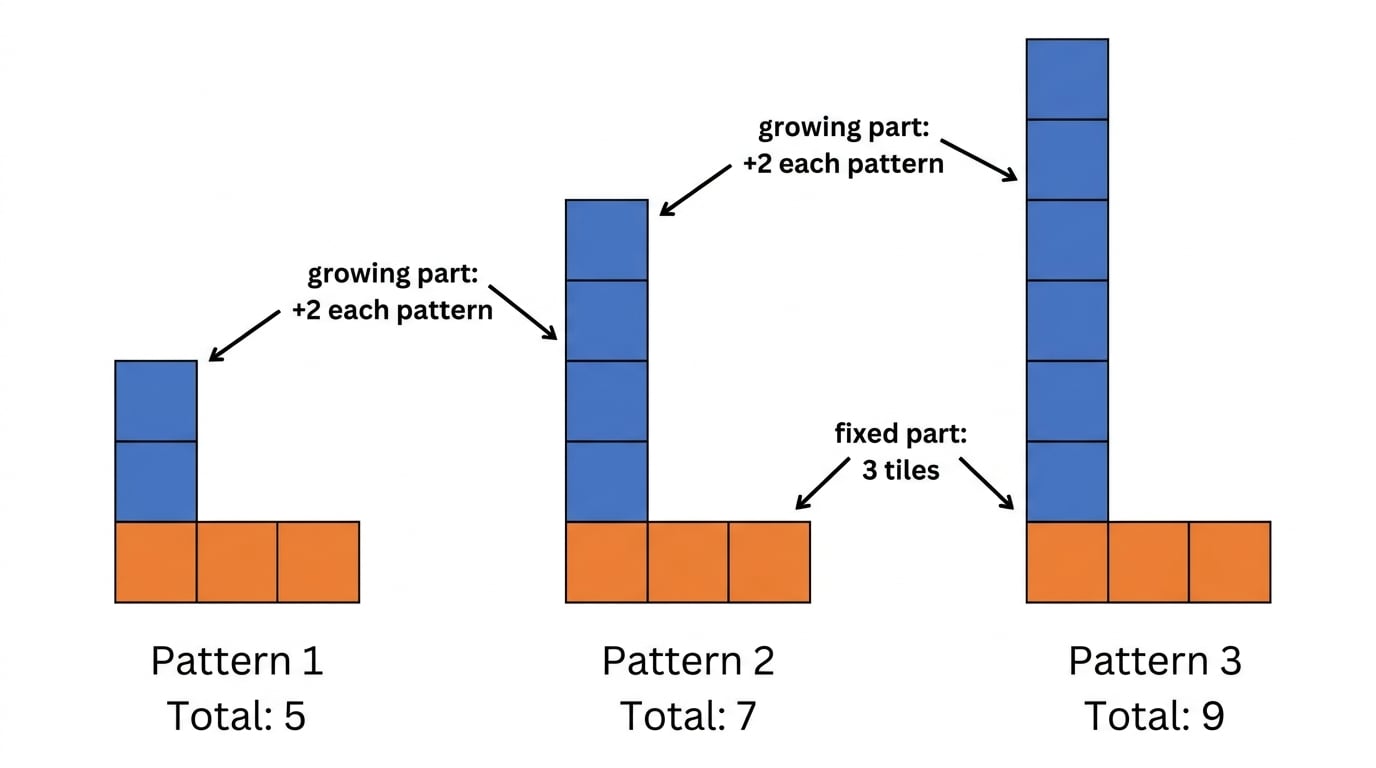
Worked example: counting tiles in a pattern
Example
Use the pattern number
A tile pattern has totals 5, 7, 9 for pattern numbers 1, 2, 3. The pattern grows by 2 tiles each time.
Find the total number of tiles in pattern 6. Then decide whether pattern 6 has double the number of tiles in pattern 3.
-
The totals are increasing by 2, so the nnnth term starts with 2n2n2n.
-
When n=1n = 1n=1, 2n2n2n gives 2, but pattern 1 has 5 tiles.
-
Add 3 to make the first pattern correct:
2n+32n + 32n+3 -
Find pattern 6:
2(6)+3=152(6) + 3 = 152(6)+3=15 -
Pattern 3 has 9 tiles, so double pattern 3 would be 18 tiles.
-
Pattern 6 has 15 tiles, not 18 tiles, so it is not double.
Tip
Drawing pattern 4
If asked to draw the next pattern, copy the same structure and extend only the growing part. Do not change the fixed part unless the pattern clearly shows it changing.
A reliable method for arithmetic nnnth terms
For Grade 4 sequence questions, this method is usually enough:
- Find the common difference.
- Put that number in front of nnn.
- Substitute n=1n = 1n=1.
- Add or subtract to fix the first term.
- Check your formula with another term.
For example, if the sequence is 3, 10, 17, 24:
- the common difference is 7
- start with 7n7n7n
- 7n7n7n gives 7 when n=1n = 1n=1
- you need 3, so subtract 4
- the nnnth term is 7n−47n - 47n−4
Exam technique
In the exam
- Write down the common difference clearly, especially if the sequence is decreasing.
- If checking whether a number is a term, solve for nnn and make sure it is a positive whole number.
- Always test your nnnth term by substituting n=1n = 1n=1 to see whether it gives the first term.
Self review
Check yourself
- Can you find the next two terms of a sequence that goes down by 6 each time?
- If the nnnth term is 4n−14n - 14n−1, how would you check whether 63 is a term?
- Can you find the nnnth term of the arithmetic sequence 11, 16, 21, 26?

Recap questions
Test yourself with 5 quick questions on this guide. Answer them all correctly to complete it.
You've reached the end
Test yourself on this topic, or move on to the next guide.
How was this guide?