Revision notes for CIE IGCSE Maths Probability. Open the guide for explanations and worked examples. Written against the CIE IGCSE Maths (0580) specification, so the content matches what's examinable rather than general Maths background.
Probability
What you'll learn
- How to read probabilities on a scale from impossible to certain.
- How to complete probability tables when the outcomes add to 1.
- How to use probability to estimate how many times something will happen.
- How to work backwards from a probability and an actual number of objects.
1. What probability means
Probability is a way of measuring how likely something is to happen.
An outcome is one possible result, such as landing on red, choosing a blue pen, or rolling a 6. An event is the result we are interested in, such as “the spinner lands on green”.
Definition
Probability
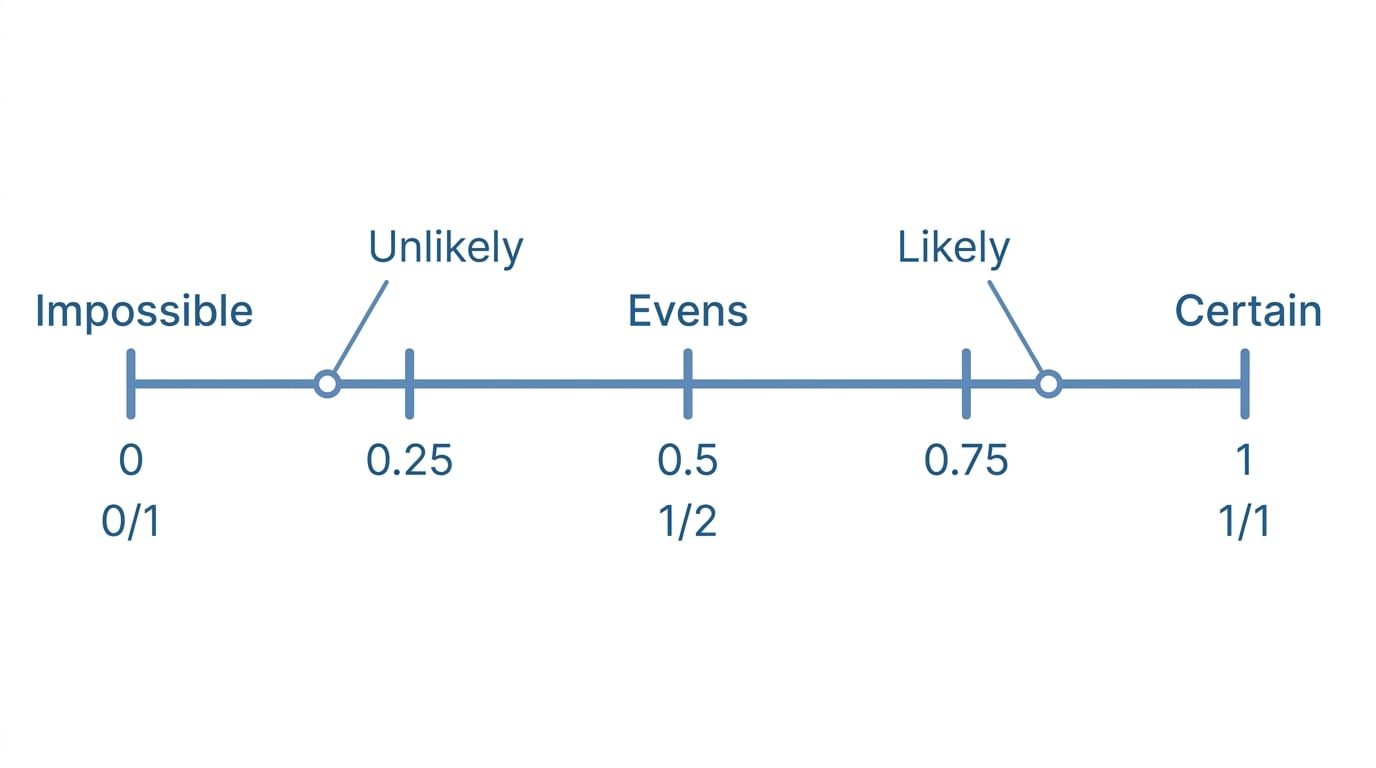
A probability is a number between 0 and 1. A probability of 0 means impossible, and a probability of 1 means certain.
A biased spinner, die, or coin is one where the outcomes are not equally likely. That is fine: you just use the probabilities you are given.
The scale below is a useful mental picture for judging whether an event is unlikely, even chance, likely, impossible, or certain.
Example
Reading a probability
A seed has probability 0.82 of growing. What does this tell you?
-
Check that 0.82 is between 0 and 1, so it is a valid probability.
-
Since 0.82 is greater than 0.5, the seed growing is more likely than not growing.
-
Since 0.82 is not 1, it is not guaranteed. Some seeds may still fail to grow.
2. Complete sets of probabilities add to 1
Often you are told that there are only certain outcomes, such as only red, blue and white counters.
Definition
Exhaustive outcomes
Outcomes are exhaustive when the list includes every possible result. If exactly one of the outcomes happens each time, their probabilities add to 1.
Key Idea
Missing probability
If a table lists all possible outcomes, find a missing probability by subtracting the known probabilities from 1.
Example
Completing a probability table
A bag contains only red, blue and white counters. The probability of red is 0.46 and the probability of blue is 0.27. Find the probability of white.
-
The outcomes are only red, blue and white, so their probabilities must add to 1.
-
Add the known probabilities:
0.46+0.27=0.730.46 + 0.27 = 0.730.46+0.27=0.73 -
Subtract from 1 to find the missing probability:
1−0.73=0.271 - 0.73 = 0.271−0.73=0.27 -
The probability of choosing a white counter is 0.27.
The same idea works with fractions. If one probability is 14\frac{1}{4}41 and another is 25\frac{2}{5}52, use a common denominator before subtracting from 1.
Common Mistake
Forgetting the total
Do not make the missing probability equal to one of the numbers already in the table unless the question tells you they are the same. First find what is left out of 1.
3. Equal missing probabilities
Sometimes two missing probabilities are the same. In that case, first find the total amount left, then split it equally.
Example
Two missing probabilities are equal
A spinner can land on red, blue, yellow or green. The probability of red is 0.18 and the probability of yellow is 0.30. The probabilities of blue and green are equal. Find them.
-
Add the probabilities you already know:
0.18+0.30=0.480.18 + 0.30 = 0.480.18+0.30=0.48 -
Subtract from 1 to find the total probability left for blue and green:
1−0.48=0.521 - 0.48 = 0.521−0.48=0.52 -
Blue and green are equal, so divide the remaining probability by 2:
0.52÷2=0.260.52 \div 2 = 0.260.52÷2=0.26 -
The probability of blue is 0.26 and the probability of green is 0.26.
4. “Twice as likely” and “three times as likely”
Words like twice and three times are really ratio clues.
- “Red is twice as likely as blue” means red : blue = 2 : 1.
- “Black is three times as likely as blue” means black : blue = 3 : 1.
Tip
Use parts
If one probability is twice another, think of 3 equal parts altogether: 2 parts for the bigger probability and 1 part for the smaller probability.
Example
Using a probability relationship
A spinner can land on 1, 2, 3 or 4. The probability of landing on 2 is 0.30 and the probability of landing on 4 is 0.25. Landing on 1 is twice as likely as landing on 3. Find the probabilities of 1 and 3.
-
First find how much probability is already used:
0.30+0.25=0.550.30 + 0.25 = 0.550.30+0.25=0.55 -
Subtract from 1 to find the probability left for 1 and 3:
1−0.55=0.451 - 0.55 = 0.451−0.55=0.45 -
Since 1 is twice as likely as 3, use the ratio 1 : 3 as 2 : 1 in parts. There are 3 parts altogether.
-
Divide the remaining probability by 3:
0.45÷3=0.150.45 \div 3 = 0.150.45÷3=0.15 -
Landing on 3 has probability 0.15, and landing on 1 has probability 0.30.
5. Turning ratios into probabilities
A ratio tells you how many “parts” each outcome has. To turn a ratio into probabilities, divide each part by the total number of parts.
Example
Ratio of counters to probabilities
A bag contains only red, blue and white counters. The ratio red : blue : white is 4 : 3 : 5. Find the probability of each colour.
-
Add the ratio parts:
4+3+5=124 + 3 + 5 = 124+3+5=12 -
Write each colour as its parts out of 12:
P(red)=412=13P(blue)=312=14P(white)=512\begin{aligned} P(\text{red}) &= \frac{4}{12} = \frac{1}{3} \\ P(\text{blue}) &= \frac{3}{12} = \frac{1}{4} \\ P(\text{white}) &= \frac{5}{12} \end{aligned}P(red)P(blue)P(white)=124=31=123=41=125 -
Check the probabilities add to 1:
412+312+512=1212\frac{4}{12} + \frac{3}{12} + \frac{5}{12} = \frac{12}{12}124+123+125=1212
6. Estimating how many times something happens
When an event is repeated many times, you can estimate the number of times it happens.
Definition
Expected frequency
The expected frequency is an estimate of how many times an event will happen. Use probability multiplied by the number of trials.
The key formula is:
expected frequency=probability×number of trials\text{expected frequency} = \text{probability} \times \text{number of trials}expected frequency=probability×number of trialsExample
Estimating from a probability
A biased die has probability 0.31 of landing on 6. The die is rolled 200 times. Estimate the number of times it lands on 6.
-
Identify the probability and the number of trials.
probability=0.31,trials=200\text{probability} = 0.31, \quad \text{trials} = 200probability=0.31,trials=200 -
Multiply:
0.31×200=620.31 \times 200 = 620.31×200=62 -
An estimate for the number of sixes is 62.
Common Mistake
Estimate, not guarantee
An expected frequency is not a promise. If you roll the die 200 times, you might not get exactly 62 sixes, but 62 is the best estimate using the given probability.
7. Working backwards from a probability and a number
Sometimes you know a probability and the actual number of objects in that category. You can use this to find the total number.
The basic idea is:
P(event)=number in eventtotal numberP(\text{event}) = \frac{\text{number in event}}{\text{total number}}P(event)=total numbernumber in eventExample
Finding the total number of counters
A bag contains only red, blue and white counters. The probability of choosing a red counter is 0.2. The probabilities of blue and white are equal. There are 14 red counters. Find the total number of counters.
-
Let the total number of counters be TTT.
-
Use the probability of red:
0.2=14T0.2 = \frac{14}{T}0.2=T14 -
Rearrange by dividing 14 by 0.2:
T=14÷0.2=70T = 14 \div 0.2 = 70T=14÷0.2=70 -
The total number of counters is 70.
-
If needed, you can also find blue and white: 70 - 14 = 56 counters remain, so blue and white would have 28 each.
8. Combining outcomes with “or”
If two outcomes cannot happen at the same time, such as rolling a 2 or rolling a 4 on one die roll, then “or” means add their probabilities.
P(A or B)=P(A)+P(B)P(A \text{ or } B) = P(A) + P(B)P(A or B)=P(A)+P(B)Example
Finding a missing probability, then estimating
A biased die can land on 1, 2, 3, 4, 5 or 6. The probabilities of 1, 2, 3, 5 and 6 are 0.10, 0.24, 0.16, 0.12 and 0.18. The die is rolled 150 times. Estimate the number of times it lands on 2 or 4.
-
First find the probability of rolling a 4 by subtracting the known probabilities from 1:
1−(0.10+0.24+0.16+0.12+0.18)=0.201 - (0.10 + 0.24 + 0.16 + 0.12 + 0.18) = 0.201−(0.10+0.24+0.16+0.12+0.18)=0.20 -
Add the probabilities of rolling 2 or 4:
0.24+0.20=0.440.24 + 0.20 = 0.440.24+0.20=0.44 -
Multiply by the number of rolls:
0.44×150=660.44 \times 150 = 660.44×150=66 -
The estimate is 66 times.
9. A mixed Grade 4 style problem
Harder questions often combine several ideas: completing probabilities, using a relationship like “twice as likely”, and then using a known number of objects.
Example
Finding the number in one category
A bag contains only red, blue, green and yellow counters. The probability of green is 0.20 and the probability of yellow is 0.35. Red is twice as likely as blue. There are 16 green counters. Find the number of red counters.
-
Find the probability left for red and blue:
1−0.20−0.35=0.451 - 0.20 - 0.35 = 0.451−0.20−0.35=0.45 -
Red is twice as likely as blue, so use the ratio red : blue = 2 : 1. There are 3 parts altogether.
-
Find one part:
0.45÷3=0.150.45 \div 3 = 0.150.45÷3=0.15 -
Red is 2 parts, so the probability of red is 0.30.
-
Use the green counters to find the total. If 0.20 of the bag is 16 counters, then:
16÷0.20=8016 \div 0.20 = 8016÷0.20=80 -
Find the number of red counters:
0.30×80=240.30 \times 80 = 240.30×80=24 -
There are 24 red counters.
Exam technique
In the exam
-
Check whether the outcomes are the only possible outcomes. If they are, their probabilities add to 1.
-
For “same probability”, split the remainder equally. For “twice” or “three times”, use ratio parts.
-
For estimates, multiply probability by number of trials. For totals, use probability as a fraction of the whole.
Self review
Check yourself
-
Can you explain why the probabilities in a complete table must add to 1?
-
If two missing probabilities are equal, what do you do after finding the amount left over?
-
How would you estimate the number of successes from 80 trials if the probability of success is 0.35?

Recap questions
Test yourself with 5 quick questions on this guide. Answer them all correctly to complete it.
You've reached the end
Test yourself on this topic, or move on to the next guide.
How was this guide?