Revision notes for CIE IGCSE Maths Reverse Percentages. Open the guide for explanations and worked examples. Written against the CIE IGCSE Maths (0580) specification, so the content matches what's examinable rather than general Maths background.
Reverse Percentages
What you'll learn
- How to recognise when a percentage question is asking you to work backwards.
- How to use percentage multipliers for increases and decreases.
- How to find the original amount when you know the final amount or the amount of change.
- How to avoid the most common exam mistakes with sale prices and increases.
The big idea: percentages are based on 100%
A percentage means “out of 100”. In percentage change questions, the starting amount is always treated as 100%.
If something increases, the final amount is more than 100%.
If something decreases, the final amount is less than 100%.
For example:
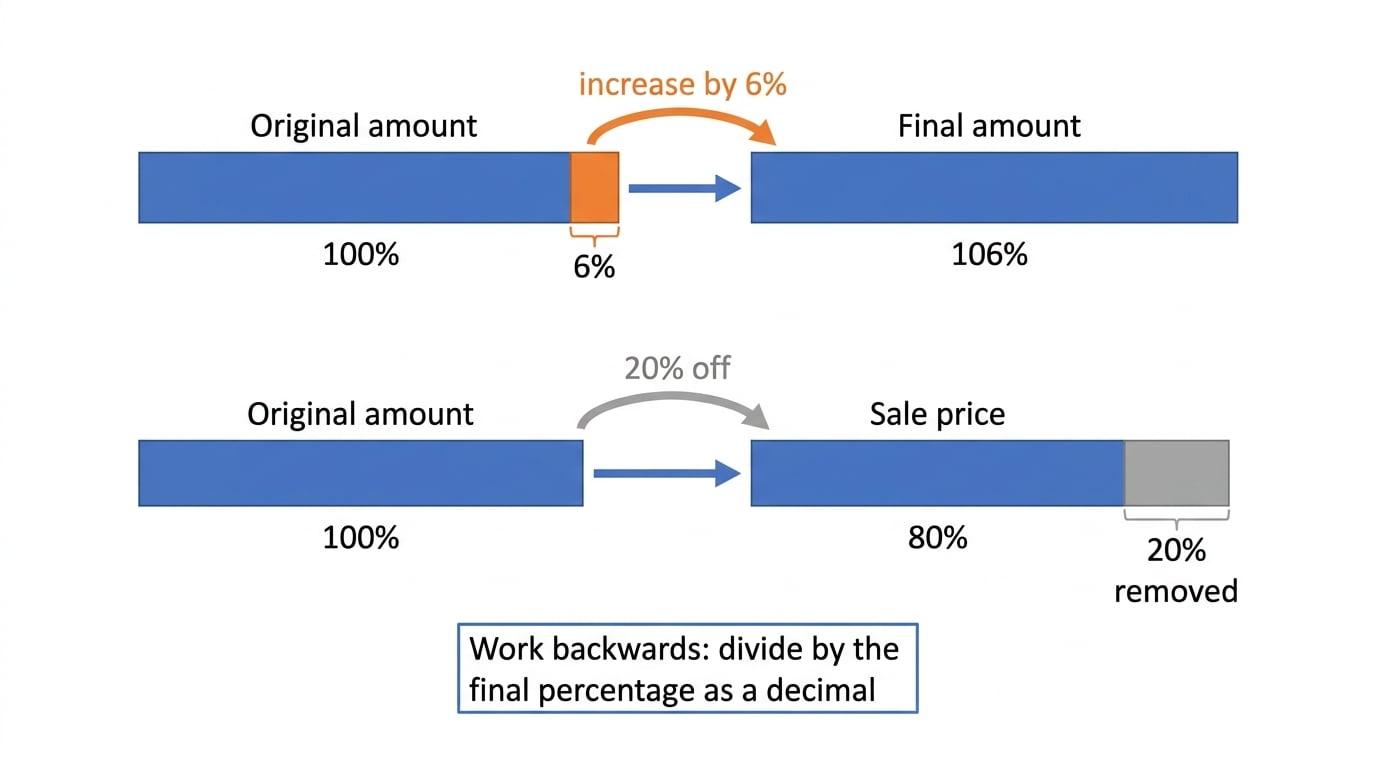
- An increase of 6% means the final amount is 106% of the original.
- A decrease of 20% means the final amount is 80% of the original.
Definition
Reverse percentage
A reverse percentage question asks you to find the original amount, meaning the amount before the percentage change happened. The final amount is the amount after the increase or decrease.
This diagram shows the two main situations: an increase and a sale reduction.
Prerequisite: percentage multipliers
A multiplier is a decimal number that you multiply by to apply a percentage change.
For an increase by p%p\%p%:
1+p1001 + \frac{p}{100}1+100pFor a decrease by p%p\%p%:
1−p1001 - \frac{p}{100}1−100pSo:
- Increase by 8% uses multiplier 1.08.
- Increase by 5% uses multiplier 1.05.
- Decrease by 20% uses multiplier 0.8.
- Decrease by 25% uses multiplier 0.75.
Example
Using a multiplier forwards
A tablet costs £240. Its price increases by 15%. Find the new price.
-
Write the percentage increase as a multiplier.
1+15100=1.151 + \frac{15}{100} = 1.151+10015=1.15 -
Multiply the original price by the multiplier.
240×1.15=276240 \times 1.15 = 276240×1.15=276 -
The new price is £276.
Key Idea
Multiplier memory check
An increase multiplier is bigger than 1. A decrease multiplier is smaller than 1. This is a quick way to spot if your multiplier makes sense.
Reverse percentages when you know the final amount
In a normal percentage question, you do:
original×multiplier=final\text{original} \times \text{multiplier} = \text{final}original×multiplier=finalIn a reverse percentage question, you undo the multiplication:
original=final÷multiplier\text{original} = \text{final} \div \text{multiplier}original=final÷multiplierThis is the main Grade 5 skill: do not subtract the percentage from the final amount. The percentage was based on the original amount, not the final amount.
Example
Finding the value before an increase
A flat increases in value by 6%. It is then worth £318,000. Find its value before the increase.
-
The original value is 100%.
-
After a 6% increase, the final value is 106% of the original.
-
Convert 106% to a multiplier.
106%=1.06106\% = 1.06106%=1.06 -
Divide the final value by the multiplier.
318000÷1.06=300000318000 \div 1.06 = 300000318000÷1.06=300000 -
The value before the increase was £300,000.
Tip
Check by going forwards
After finding the original amount, multiply it by the multiplier to check. For the example above, £300,000 increased by 6% gives £318,000, so the answer is sensible.
Reverse percentages in sales
A discount is a reduction in price. The normal price is the price before the sale.
If an item is reduced by 20%, the sale price is not 20% of the original. The sale price is 80% of the original, because:
100%−20%=80%100\% - 20\% = 80\%100%−20%=80%So if you know the sale price, divide by 0.8.
Example
Finding the normal price after a discount
A book is reduced by 20% in a sale. The sale price is £5.60. Find the normal price.
-
The normal price is 100%.
-
A 20% reduction leaves 80% of the original price.
-
Convert 80% to a multiplier.
80%=0.880\% = 0.880%=0.8 -
Divide the sale price by 0.8.
5.60÷0.8=75.60 \div 0.8 = 75.60÷0.8=7 -
The normal price was £7.
Common Mistake
Using the discount instead of the sale percentage
If a price is reduced by 20%, the final price is 80% of the original, not 20%. Use 0.8 when you know the sale price. Use 0.2 only if you are told the amount of money reduced.
When you are told the amount of increase or reduction
Sometimes you are not given the final price. Instead, you are told how much the amount increased or decreased by.
This changes the thinking:
- If a bill increased by 5% and the increase was £62, then £62 represents 5% of the original.
- If a coat was reduced by 25% and the reduction was £12, then £12 represents 25% of the original.
So you divide the amount of change by the percentage as a decimal.
original=amount of change÷percentage change100\text{original} = \text{amount of change} \div \frac{\text{percentage change}}{100}original=amount of change÷100percentage changeExample
Finding the original bill from the increase amount
A yearly bill increases by 5%. The increase is £74. Find the bill before the increase.
-
The increase is 5% of the original bill.
-
Convert 5% to a decimal.
5%=0.055\% = 0.055%=0.05 -
Divide the increase amount by 0.05.
74÷0.05=148074 \div 0.05 = 148074÷0.05=1480 -
The bill before the increase was £1,480.
Example
Finding the original price from the reduction amount
A jacket is reduced by 25% in a sale. The reduction is £18. Find the normal price.
-
The £18 reduction is 25% of the normal price.
-
Convert 25% to a decimal.
25%=0.2525\% = 0.2525%=0.25 -
Divide the reduction amount by 0.25.
18÷0.25=7218 \div 0.25 = 7218÷0.25=72 -
The normal price was £72.
Choosing the correct method
Before calculating, decide what the number you are given represents.
If you are given the final amount, use the final multiplier:
- Increased by 8%, final multiplier is 1.08.
- Reduced by 30%, final multiplier is 0.7.
If you are given the amount of change, use the change percentage:
- Increased by 4%, the increase is 4% of the original.
- Reduced by 15%, the reduction is 15% of the original.
Example
Deciding which percentage to use
A season ticket increases by 4%. The price increase is £168.40. Find the price before the increase.
-
The question gives the amount of the increase, not the final ticket price.
-
So £168.40 represents 4% of the original price.
-
Convert 4% to a decimal.
4%=0.044\% = 0.044%=0.04 -
Divide the increase amount by 0.04.
168.40÷0.04=4210168.40 \div 0.04 = 4210168.40÷0.04=4210 -
The price before the increase was £4,210.
Exam technique
In the exam
-
Identify whether you have been given the final amount or the amount of change.
-
If you have the final amount, divide by the final multiplier, such as 1.06, 0.8, or 0.75.
-
If you have the amount of change, divide by the change percentage as a decimal, such as 0.05 or 0.15.
-
Always check your answer by going forwards using the percentage change.
Self review
Check yourself
-
If a price is reduced by 30%, what percentage of the original price is the sale price?
-
If an item costs £660 after a 20% reduction, should you divide by 0.2 or 0.8?
-
If a bill increases by 5% and the increase is £62, what does the £62 represent?

Recap questions
Test yourself with 5 quick questions on this guide. Answer them all correctly to complete it.
You've reached the end
Test yourself on this topic, or move on to the next guide.
How was this guide?