Revision notes for CIE IGCSE Maths Area of Compound Shapes. Open the guide for explanations and worked examples. Written against the CIE IGCSE Maths (0580) specification, so the content matches what's examinable rather than general Maths background.
Area of Compound Shapes
What you'll learn
- How to find areas of rectangles, triangles and trapezia.
- How to split a compound shape into simpler shapes.
- How to subtract “holes” or unshaded parts from a larger shape.
- How to use area in a real-life cost question.
1. The area formulae you need first
Definition
Area
Area is the amount of flat space inside a 2D shape. It is measured in square units, such as cm², m² or mm².
For this topic, the most useful formulae are:
- Rectangle: A=bhA = bhA=bh, where bbb is the base and hhh is the height.
- Triangle: A=12bhA = \frac{1}{2}bhA=21bh.
- Trapezium: A=12(a+b)hA = \frac{1}{2}(a+b)hA=21(a+b)h, where aaa and bbb are the two parallel sides.
Definition
Key words
- Parallel lines stay the same distance apart and never meet.
- Perpendicular lines meet at a right angle, 90°.
- The height of a shape means the perpendicular distance from the base to the top.
Key Idea
Area is about the correct height
For triangles and trapezia, the height must be perpendicular to the base. Do not use a sloping side as the height unless it is at 90° to the base.
Worked example: area of a trapezium
Example
Right-angled trapezium
A trapezium has parallel sides 8 cm and 12 cm. Its perpendicular height is 6 cm. Find its area.
-
Identify the two parallel sides: 8 cm and 12 cm.
-
Identify the perpendicular height: 6 cm.
-
Substitute into A=12(a+b)hA = \frac{1}{2}(a+b)hA=21(a+b)h:
A=12(8+12)×6A = \frac{1}{2}(8+12)\times 6A=21(8+12)×6 -
Work out the brackets first, then multiply:
A=12×20×6=60A = \frac{1}{2}\times 20 \times 6 = 60A=21×20×6=60 -
The area is 60 cm².
Common Mistake
Measuring the diagram
If a diagram says it is not accurately drawn, never measure it with a ruler. Use the labelled lengths only.
2. What is a compound shape?
Definition
Compound shape
A compound shape is a shape made by joining two or more simpler shapes together, such as rectangles, triangles or trapezia.
The main strategy is to split the shape into pieces you already know how to find the area of. Then add the areas.
Key Idea
Split, calculate, add
If the shape is made of pieces, find the area of each piece separately, then add them together.
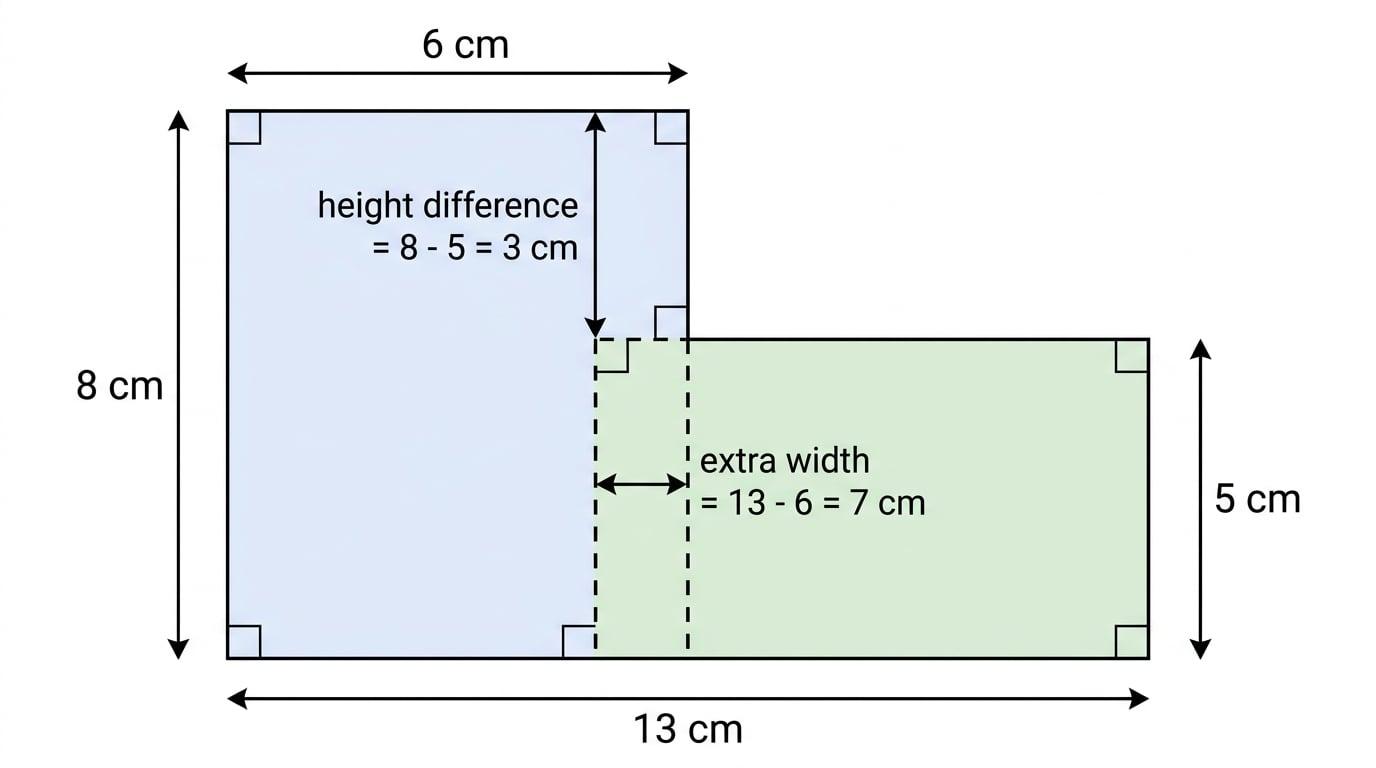
The dashed line below shows one good way to split an L-shaped rectilinear shape into two rectangles.
Worked example: splitting an L-shape
Example
Two rectangles
An L-shaped figure has bottom length 13 cm, left height 8 cm, top length 6 cm and right height 5 cm. Find its area.
-
Split the shape into a left rectangle and a right rectangle.
-
Work out the missing width of the right rectangle: 13 - 6 = 7 cm.
-
The left rectangle is 6 cm by 8 cm:
6×8=486 \times 8 = 486×8=48 -
The right rectangle is 7 cm by 5 cm:
7×5=357 \times 5 = 357×5=35 -
Add the two areas:
48+35=8348 + 35 = 8348+35=83 -
The total area is 83 cm².
Tip
Choose an easy split
For right-angled compound shapes, try splitting along a horizontal or vertical line. This usually creates rectangles.
Common Mistake
Using the outside rectangle
Do not multiply the total width by the total height unless the whole shape is actually a rectangle. That would include space that is not part of the shape.
3. Shapes made from a rectangle and a triangle
Sometimes a compound shape is made from a rectangle joined to a triangle. You still use the same idea: find each area, then add.
For a right-angled triangle, the two sides that meet at the right angle are the base and height.
Worked example: rectangle plus triangle
Example
Six-sided compound shape
A compound shape is made from a rectangle 3 cm wide and 10 cm high, with a right-angled triangle attached. The triangle has base 6 cm and height 4 cm. Find the total area.
-
Find the area of the rectangle:
3×10=303 \times 10 = 303×10=30 -
Find the area of the triangle using A=12bhA = \frac{1}{2}bhA=21bh:
12×6×4=12\frac{1}{2}\times 6 \times 4 = 1221×6×4=12 -
Add the two areas:
30+12=4230 + 12 = 4230+12=42 -
The total area is 42 cm².
4. Shaded areas: subtract what you do not want
Sometimes you are given a large shape with a smaller shape cut out, left blank or unshaded.
Key Idea
Large area minus small area
For a shaded region with a hole, calculate the area of the whole shape first, then subtract the area of the unshaded part.
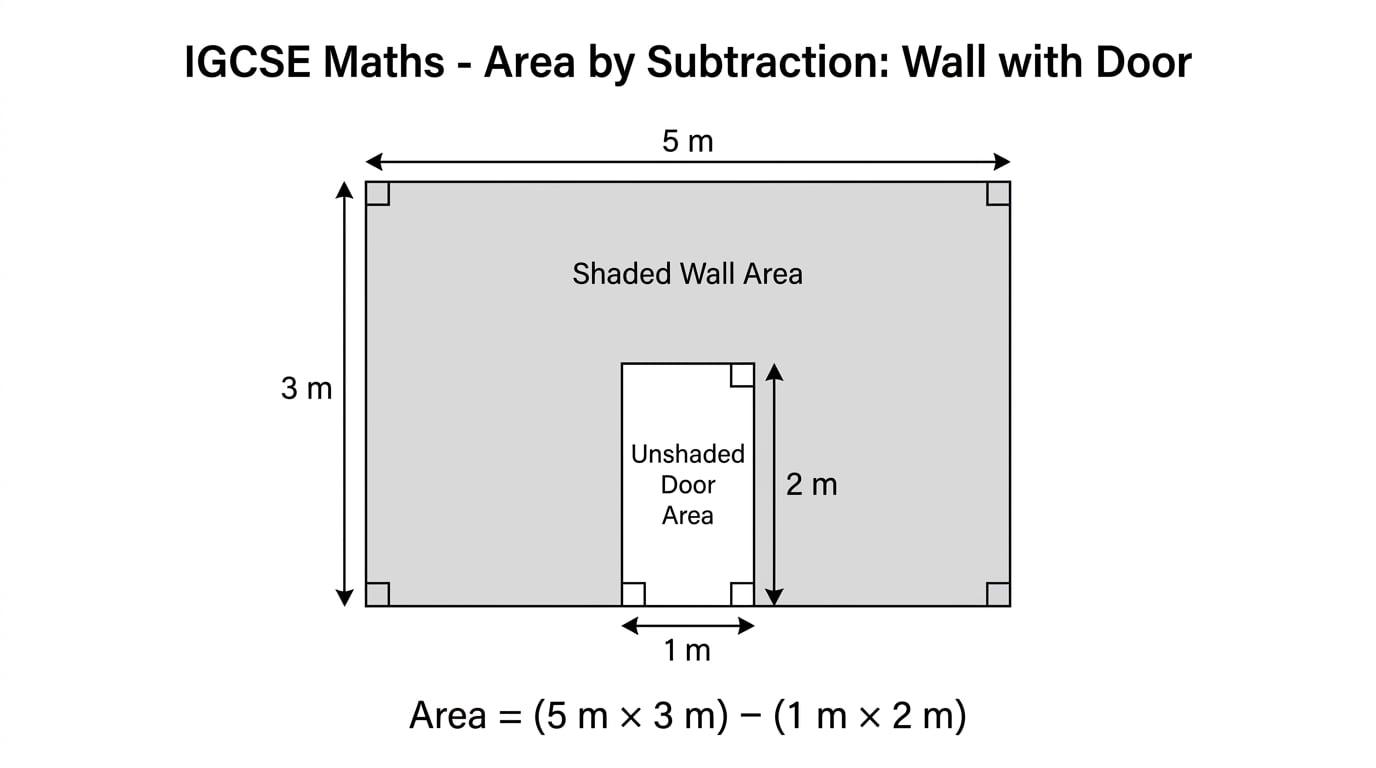
This is common in questions involving walls with doors, rectangles inside rectangles, or rectangles inside triangles.
Worked example: a wall with a door
Example
Subtracting a rectangle
A rectangular wall is 5 m wide and 3 m high. A rectangular door is 1 m wide and 2 m high. Find the painted area of the wall.
-
Find the area of the whole wall:
5×3=155 \times 3 = 155×3=15 -
Find the area of the door:
1×2=21 \times 2 = 21×2=2 -
Subtract the door area from the wall area:
15−2=1315 - 2 = 1315−2=13 -
The painted area is 13 m².
Worked example: several identical cut-outs
Example
Three small rectangles inside a large rectangle
A large rectangle is 11 cm by 8 cm. Inside it are three identical unshaded rectangles, each 3 cm by 2 cm. Find the shaded area.
-
Find the area of the large rectangle:
11×8=8811 \times 8 = 8811×8=88 -
Find the area of one small rectangle:
3×2=63 \times 2 = 63×2=6 -
There are three small rectangles, so find their total area:
3×6=183 \times 6 = 183×6=18 -
Subtract the total unshaded area:
88−18=7088 - 18 = 7088−18=70 -
The shaded area is 70 cm².
Common Mistake
Forgetting all the cut-outs
If there are several identical holes, subtract all of them, not just one.
5. Subtracting from a triangle
You may also see a rectangle inside a triangle. The outer shape is a triangle, so use the triangle formula first.
Worked example: rectangle inside a triangle
Example
Triangle with an unshaded rectangle
A triangle has base 14 cm and perpendicular height 10 cm. Inside it is an unshaded rectangle measuring 4 cm by 3 cm. Find the shaded area.
-
Find the area of the triangle:
12×14×10=70\frac{1}{2}\times 14 \times 10 = 7021×14×10=70 -
Find the area of the rectangle:
4×3=124 \times 3 = 124×3=12 -
Subtract the rectangle from the triangle:
70−12=5870 - 12 = 5870−12=58 -
The shaded area is 58 cm².
6. Compound area in real-life questions
In longer questions, you may need to find an area first, then use it to calculate a cost or selling price.
Tip
Units matter
If the price is given per square metre, your area must be in m² before you multiply by the price.
Worked example: selling a field
Example
Area then money
A field is made from a rectangle and a right-angled triangle. The rectangular part is 70 m by 90 m. The triangular part has base 80 m and height 65 m. The field is sold for £4 per square metre. Find the total amount received.
-
Find the area of the rectangle:
70×90=630070 \times 90 = 630070×90=6300 -
Find the area of the triangle:
12×80×65=2600\frac{1}{2}\times 80 \times 65 = 260021×80×65=2600 -
Add the areas to get the total area:
6300+2600=89006300 + 2600 = 89006300+2600=8900 -
Multiply by £4 per m²:
8900×4=356008900 \times 4 = 356008900×4=35600 -
The farmer receives £35,600.
Exam technique
In the exam
-
Decide whether to add areas or subtract areas before you start calculating.
-
Write down each small area separately, with units, so you can earn method marks.
-
For missing lengths, use opposite sides of rectangles: subtract labelled lengths carefully.
Self review
Check yourself
-
Can you explain when to add areas and when to subtract areas?
-
Can you find a missing width by subtracting two horizontal lengths?
-
Can you spot the perpendicular height in a triangle or trapezium?

Recap questions
Test yourself with 5 quick questions on this guide. Answer them all correctly to complete it.
You've reached the end
Test yourself on this topic, or move on to the next guide.
How was this guide?