Revision notes for CIE IGCSE Maths Frequency Trees. Open the guide for explanations and worked examples. Written against the CIE IGCSE Maths (0580) specification, so the content matches what's examinable rather than general Maths background.
Frequency Trees
When dealing with a large group of people or items that can be split into different categories, it is easy to lose track of the numbers. Frequency trees give us a neat, visual way to break a total population down into smaller sub-groups.
In this topic, you will learn:
- What a frequency tree is and how it works.
- How to complete a blank frequency tree from a word problem.
- How to use a completed frequency tree to find probabilities.
What is a Frequency Tree?
Definition
Frequency
In mathematics, "frequency" simply means "how many". It is the number of times an event occurs or the number of items in a particular group.
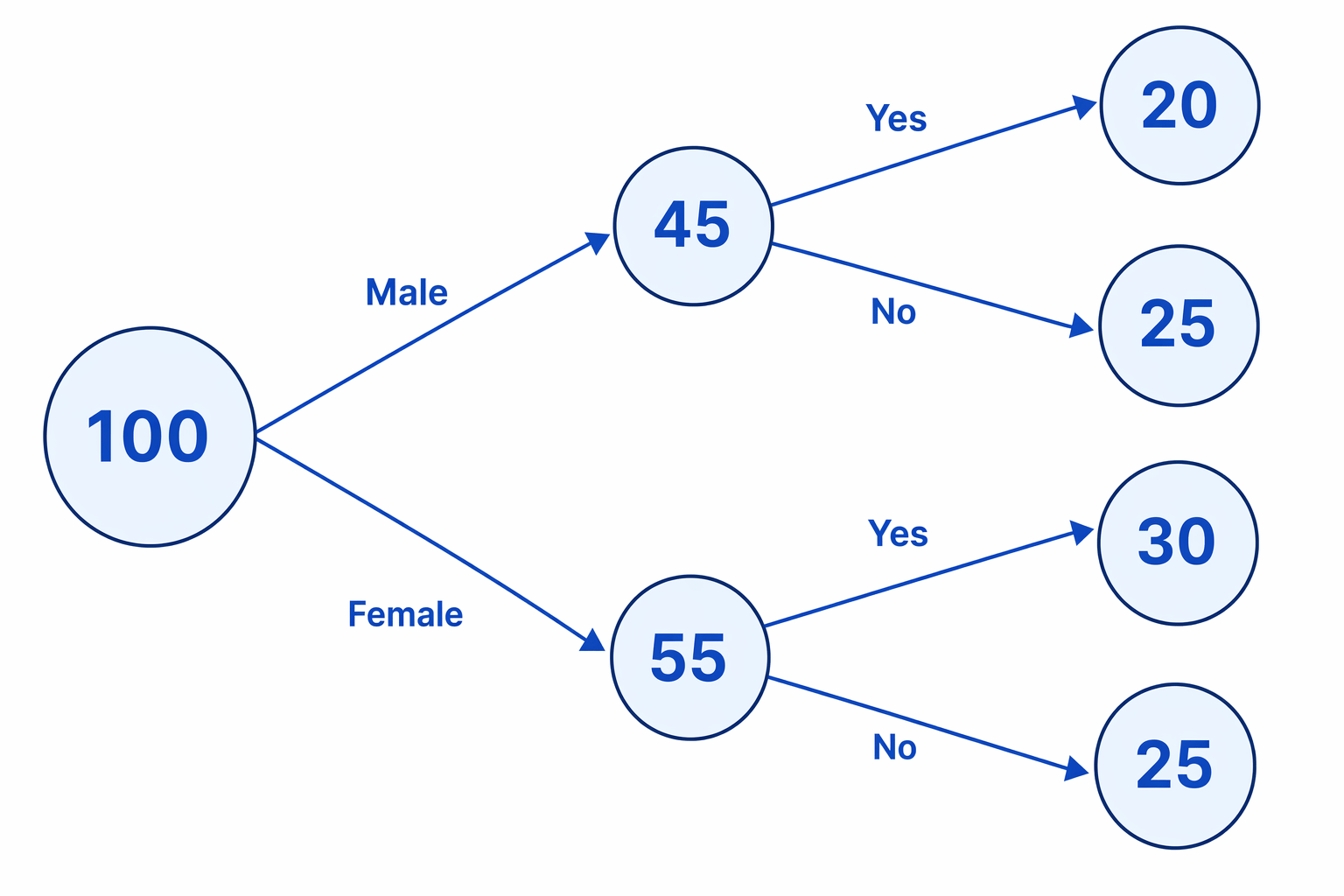
A frequency tree organises these numbers into a series of connected circles. You start with the total number of items in one large circle on the left. This then splits into branches, just like a family tree, sorting that total into smaller groups.
Key Idea
The Golden Rule of Frequency Trees
The numbers in the circles at the ends of the branches must always add up to the number in the circle they came from.
In the diagram above, you can see that the 100 people split into 45 males and 55 females (45+55=10045 + 55 = 10045+55=100). The 45 males then split further into 20 who said "Yes" and 25 who said "No" (20+25=4520 + 25 = 4520+25=45).
Completing a Frequency Tree
In your exam, you will usually be given a blank or partially filled frequency tree and a paragraph of text containing numbers. Your job is to fill in all the missing circles.
To do this:
- Read carefully: Extract the total number and put it in the first circle (if it isn't there already).
- Follow the branches: Look at the labels on the branches to see how the group is being divided.
- Subtract to find missing values: If you know the total for a split and one of the branches, subtract to find the other branch.
Let's walk through a typical exam-style problem.
Example
Filling in the gaps
150 students were asked if they prefer playing tennis or basketball. 80 of the students are boys. 45 of the girls prefer tennis. 60 of all the students prefer basketball.
Complete the frequency tree to show this information.
-
First, place the overall total in the starting circle. The question tells us there are 150 students in total.
-
Next, look at the first split: Boys and Girls. We are told there are 80 boys. Because the branches must add up to the total, we can find the number of girls by subtracting:
150−80=70 girls150 - 80 = 70 \text{ girls}150−80=70 girls -
Now look at the second split for the girls. The text says 45 of the girls prefer tennis. We know there are 70 girls in total, so the girls who prefer basketball must be:
70−45=2570 - 45 = 2570−45=25 -
We still need to fill in the boys' preferences. The text tells us that 60 of all the students prefer basketball. We just worked out that 25 girls prefer basketball. Therefore, the number of boys who prefer basketball is:
60−25=3560 - 25 = 3560−25=35 -
Finally, we know there are 80 boys in total, and 35 of them prefer basketball. The number of boys who prefer tennis is:
80−35=4580 - 35 = 4580−35=45
Tip
Check your final answers
Once your tree is full, do a quick sanity check. Add up all four circles at the very end of the tree (on the far right). They must equal your starting total on the far left. If they don't, you have made a subtraction error somewhere!
Finding Probabilities from Frequency Trees
Once the tree is complete, the hard work is done. The exam will often follow up with a short probability question.
To write a probability as a fraction, you need two numbers:
- The denominator (bottom number): The total number of people you are choosing from.
- The numerator (top number): The number of people who fit the specific description.
Common Mistake
Using the wrong total
When a question says "One of the girls is chosen at random...", the denominator is just the total number of girls, NOT the overall total number of people. Always read the first sentence of the probability question carefully to establish your starting group!
Example
Calculating a probability
Using the completed tennis and basketball tree from the previous example, answer this question:
"One of the 150 students is chosen at random. Write down the probability that this student is a boy who prefers tennis."
-
Identify the total group we are choosing from. The question says "One of the 150 students", so our denominator is 150.
-
Identify the target group. We want a "boy who prefers tennis". Looking back at our calculations, there were 45 boys who preferred tennis. This is our numerator.
-
Write the probability as a fraction:
P(boy and tennis)=45150P(\text{boy and tennis}) = \frac{45}{150}P(boy and tennis)=15045
Hint
Do I need to simplify?
In IGCSE Maths probability questions, you usually do not need to simplify your fractions unless the question explicitly tells you to "give your answer in its simplest form". Writing 45150\frac{45}{150}15045 will get you full marks!
Exam technique
In the exam
- Tick off the data: As you put each number from the word problem into your tree, cross it out in the text. This stops you from getting overwhelmed by the paragraph.
- Don't leave blanks: Even if you get stuck on one tricky clue, guess a number so you can carry on completing the rest of the tree. You will pick up follow-through marks for correct subtraction based on your guess.
- Read the probability condition: Pay close attention to whether a person is chosen from the whole group or just from a sub-group (like "chosen from the people who said yes").
Self review
Check yourself
- Can you explain the rule connecting a circle to the branches that come out of it?
- If 200 people are split into Left-handed and Right-handed, and 30 are Left-handed, how many are Right-handed?
- If a question asks for a probability but says "A Right-handed person is chosen at random...", what number goes on the bottom of your fraction?

Recap questions
Test yourself with 5 quick questions on this guide. Answer them all correctly to complete it.
You've reached the end
Test yourself on this topic, or move on to the next guide.
How was this guide?