Revision notes for CIE IGCSE Maths Calculation Problems. Open the guide for explanations and worked examples. Written against the CIE IGCSE Maths (0580) specification, so the content matches what's examinable rather than general Maths background.
Calculation Problems
What you'll learn
- How to turn worded questions into the right calculation.
- How to work with pounds, pence, packs, measurements and change.
- When to round down and when to round up in practical questions.
- How to show your working clearly for “does she have enough?” and “show that” questions.
The big idea: read, plan, calculate, answer
A calculation problem is a worded question where you need to decide which operations to use: add, subtract, multiply or divide.
Start by identifying:
- how many items, hours, packs or lengths there are
- the cost or amount for one item or one group
- whether the question asks for a total, change, a missing amount, or a yes/no decision
Definition
Unit price and rate
A unit price is the cost of one item. A rate is an amount for one unit, such as pay per hour or grams per wash.
Key Idea
Most calculation problems have a simple structure
Find the cost or amount needed first, then compare it with the money, length, mass or total you have.
Money, pence and change
When prices are in pence, it is often easiest to convert everything into pence first.
Remember:
- £1 = 100p
- £5 = 500p
- £10 = 1000p
- £20 = 2000p
To find change, subtract the total cost from the amount paid.
Example
Finding change from a note
-
Aisha buys 7 rolls at 68p each and pays with a £10 note. Convert £10 into pence: £10 = 1000p.
-
Find the total cost in pence:
7×68=4767 \times 68 = 4767×68=476 -
Convert 476p into pounds and pence: 476p = £4.76.
-
Subtract the cost from the amount paid: 1000p - 476p = 524p.
-
Convert 524p into pounds and pence, so the change is £5.24.
Common Mistake
Mixing pounds and pence
Do not subtract 476 from £10 as if they are in the same units. Either work all in pence or all in pounds.
Price increases and reductions
If a price increases, each item costs more, so the total cost goes up and the change goes down.
If a price is reduced, each item costs less, so the total cost goes down and the change goes up.
Example
Explaining a price change
-
Leo planned to buy 5 pencils, but the shop reduces the price of each pencil.
-
Since each pencil is now cheaper, Leo spends less altogether.
-
If he pays with the same note, he will get more change.
Multiplying items and adding totals
Many questions give several items with different prices. Work out each part separately, then add the totals.
Example
Adding a café bill
-
Nina buys 4 coffees at £1.75 each, so the coffees cost £7.00.
-
She buys 3 teas at £1.20 each, so the teas cost £3.60.
-
She buys 2 slices of cake at £2.40 each, so the cakes cost £4.80.
-
Add the three totals: £7.00 + £3.60 + £4.80 = £15.40.
-
Nina spends £15.40 altogether.
Tip
Keep money aligned
When adding money, line up the decimal points and use two decimal places, for example £4.80 rather than £4.8.
Price lists and packs
Some items are sold in groups, such as “5 for 90p” or “10 for £2.50”. First find how many groups you need.
Example
Using a price list
-
A teacher buys 30 markers sold as 5 for 80p. Since 30 divided by 5 is 6, she needs 6 packs. The markers cost 6 × 80p = 480p = £4.80.
-
She buys 30 rulers sold as 10 for £2.40. Since 30 divided by 10 is 3, she needs 3 packs. The rulers cost 3 × £2.40 = £7.20.
-
She buys 30 pencils sold as 6 for 54p. Since 30 divided by 6 is 5, she needs 5 packs. The pencils cost 5 × 54p = 270p = £2.70.
-
She buys 30 calculators at £6.10 each. The calculators cost 30 × £6.10 = £183.00.
-
Add the costs: £4.80 + £7.20 + £2.70 + £183.00 = £197.70.
Dividing: “as many as possible”
Some questions ask for the greatest number of whole items that can be bought, made or cut.
Definition
Remainder
A remainder is the amount left over after making as many equal whole groups as possible.
If the question asks for “as many as possible”, you usually round down because you cannot buy part of a chocolate bar or make part of a full cup.
Example
Buying as many bars as possible
-
Sam has £6 and each chocolate bar costs 45p. Convert £6 into pence: £6 = 600p.
-
Divide 600 by 45. Since 13 × 45p = 585p and 14 × 45p = 630p, Sam can afford 13 bars.
-
Find the change: 600p - 585p = 15p.
-
Sam buys 13 chocolate bars and gets 15p change.
Measurements: units must match
Before you divide, check the units. Litres and millilitres are not the same unit.
Useful conversions:
- 1 litre = 1000 ml
- 1 kg = 1000 g
- 1 m = 100 cm
Example
Making as many cups as possible
-
Priya has 1.8 litres of water. Convert this into millilitres: 1.8 litres = 1800 ml.
-
Each cup needs 220 ml. Divide the total water by the water per cup:
1800÷220=8 remainder 401800 \div 220 = 8 \text{ remainder } 401800÷220=8 remainder 40 -
The remainder is only 40 ml, which is not enough for another full cup.
-
Priya can make 8 cups.
When to round up
If the question asks how many packs you need to buy to have enough, round up whenever there is a remainder.
Example
Buying enough packs
-
A family does 2 washes each week for 13 weeks, using 40 g each wash.
-
Find the total washing powder needed: 2 × 13 × 40 g = 1040 g.
-
Each pack contains 650 g. One pack is not enough because 650 g is less than 1040 g.
-
Two packs give 1300 g, which is enough.
-
The family needs to buy 2 packs.
Tip
Round the right way
“As many as possible” usually means round down. “Enough for everyone” or “enough for the whole time” usually means round up.
Deposits and equal payments
A deposit is money paid at the start. The rest is often paid in equal monthly payments.
Example
Finding a monthly payment
-
A laptop costs £840. Malik pays a £180 deposit.
-
Subtract the deposit from the total cost: £840 - £180 = £660.
-
The remaining £660 is paid over 12 equal months.
-
Divide £660 by 12 to get £55.
-
Each monthly payment is £55.
Hidden unit prices
Sometimes you are told the cost of several items, not one item. Divide first to find the unit price.
Example
Finding the cost of a pen and pencils
-
Four pens cost £1.40, so one pen costs 35p.
-
Three pens cost 3 × 35p = 105p.
-
Three pens and 5 pencils cost £1.80, which is 180p.
-
The 5 pencils cost 180p - 105p = 75p.
-
One pencil costs 75p divided by 5, which is 15p.
-
One pen and 2 pencils cost 35p + 2 × 15p = 65p.
Budgets and “does she have enough?”
For budget questions, calculate the total cost first. Then compare it with the money available.
Example
Checking a budget
-
Two calculators cost £10.20, so one calculator costs £5.10.
-
Three pens cost £3.60, so one pen costs £1.20.
-
Thirty calculators cost 30 × £5.10 = £153.00.
-
Thirty pens cost 30 × £1.20 = £36.00.
-
The total cost is £153.00 + £36.00 = £189.00.
-
Since £189.00 is less than £200, there is enough money.
Pay rates and “show that” questions
A “show that” question wants a clear calculation ending with the comparison asked for.
Example
Showing pay is more than a target amount
-
Zara earns £9.50 per hour on weekdays and works 12 weekday hours.
-
Her weekday pay is 12 × £9.50 = £114.00.
-
She earns £11.80 per hour on Saturday and works 4 Saturday hours.
-
Her Saturday pay is 4 × £11.80 = £47.20.
-
Her total pay is £114.00 + £47.20 = £161.20.
-
Since £161.20 is more than £150, Zara was paid more than £150.
Total-and-difference sharing problems
Sometimes two people have a total amount, and one person has more than the other. A bar model can help you see the equal parts and the extra amount.
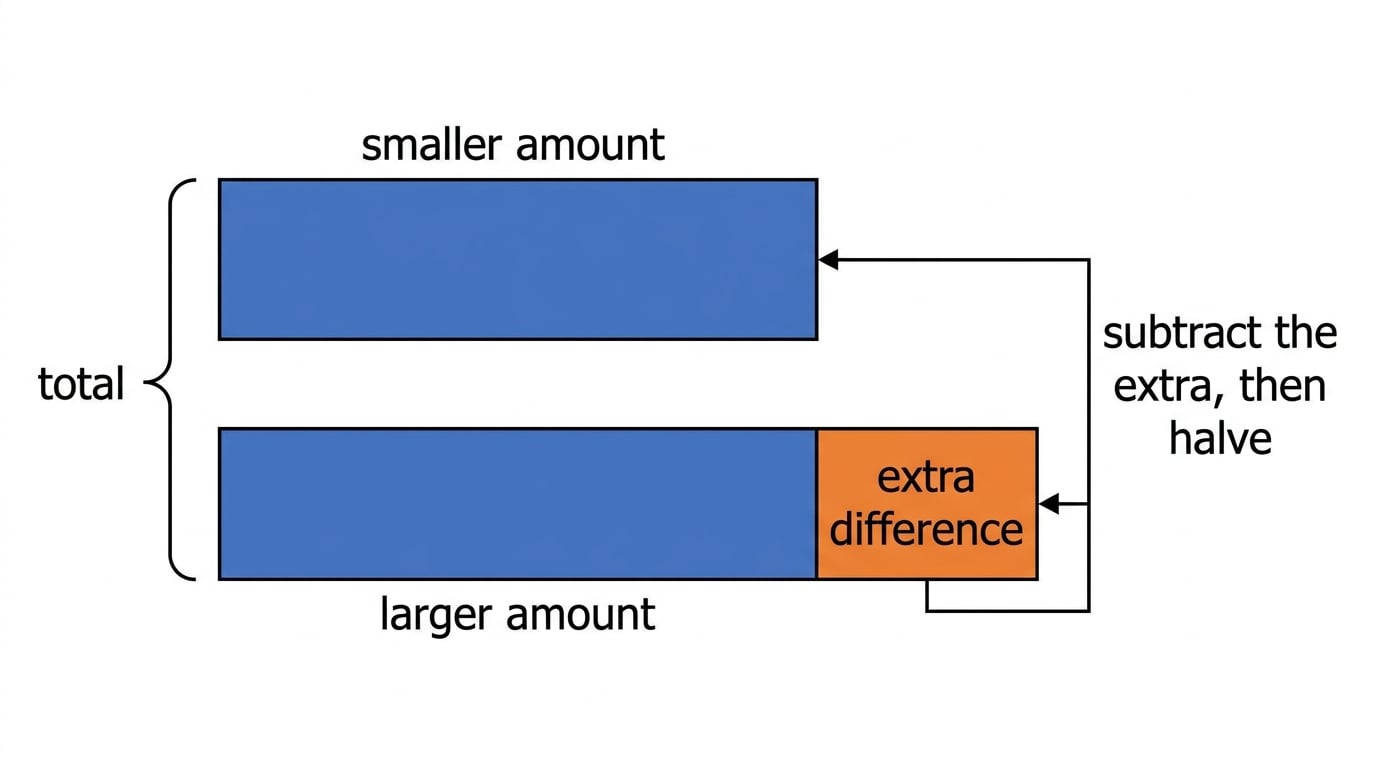
To find the smaller amount:
- Subtract the extra difference from the total.
- Divide what is left by 2.
Example
Sharing a total when one person has more
-
Ben and Sara save £376 altogether. Sara saves £28 more than Ben.
-
Remove Sara’s extra £28 from the total: £376 - £28 = £348.
-
The £348 is now two equal amounts.
-
Divide £348 by 2 to get £174.
-
Ben saved £174.
-
Check: Sara saved £202, and £174 + £202 = £376.
Exam technique
In the exam
-
Read the question twice and underline the numbers, units and what the question is asking for.
-
Convert units before calculating, especially pounds to pence or litres to millilitres.
-
For practical division questions, decide whether to round down or round up before writing your final answer.
Self review
Check yourself
-
If 9 items cost 72p each and you pay with £10, what calculation gives the change?
-
When a pack contains 6 items but you need 110 items, why can’t you just divide and use the decimal answer?
-
In a total-and-difference problem, why do you subtract the extra amount before halving?

Recap questions
Test yourself with 5 quick questions on this guide. Answer them all correctly to complete it.
You've reached the end
Test yourself on this topic, or move on to the next guide.
How was this guide?