Revision notes for CIE IGCSE Maths Negative Numbers. Open the guide for explanations and worked examples. Written against the CIE IGCSE Maths (0580) specification, so the content matches what's examinable rather than general Maths background.
Negative Numbers
What you'll learn
- What negative numbers mean and how to compare them.
- How to add and subtract numbers below zero.
- How to multiply and divide with negative numbers.
- How to solve missing-number, sequence and temperature questions.
1. What are negative numbers?
Negative numbers are used whenever a value goes below zero: temperatures below freezing, money owed, or floors below ground level.
Definition
Negative numbers
A negative number is a number less than zero. It has a minus sign in front, such as -3. A positive number is a number greater than zero, such as 3.
A number line shows numbers in order from left to right. Numbers get smaller as you move left and bigger as you move right. Zero is the boundary between negative and positive numbers.
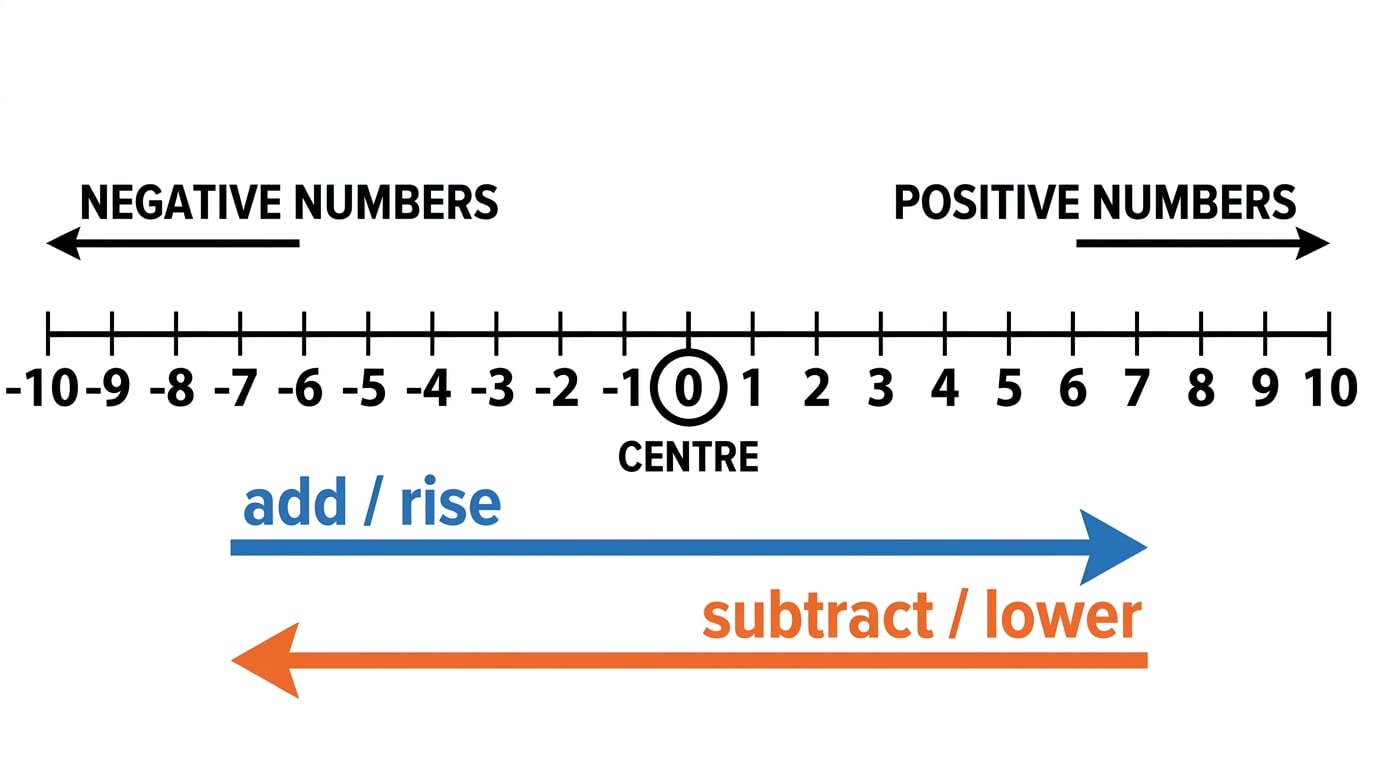
Key Idea
Left means smaller, right means bigger
On a number line, -8 is smaller than -3 because -8 is further left. For negative numbers, the larger-looking digit does not mean the larger value.
Example
Counting backwards past zero
-
Work out 4−74 - 74−7.
-
Start at 4 on the number line.
-
Subtracting 7 means move 7 places left: 3, 2, 1, 0, -1, -2, -3.
-
So 4−7=−34 - 7 = -34−7=−3.
Common Mistake
Comparing negative numbers
Do not say -9 is bigger than -2 just because 9 is bigger than 2. The number -9 is further left on the number line, so it is smaller.
2. Adding negative numbers
Adding usually means moving to the right, but adding a negative number means adding something below zero, so it moves you left.
A useful way to think is:
- add a positive number → move right
- add a negative number → move left
Example
Adding a positive number to a negative number
-
Work out −6+8-6 + 8−6+8.
-
Start at -6.
-
Adding 8 means move 8 places right: -5, -4, -3, -2, -1, 0, 1, 2.
-
So −6+8=2-6 + 8 = 2−6+8=2.
Example
Adding two negative numbers
-
Work out −5+(−7)-5 + (-7)−5+(−7).
-
Start at -5.
-
Adding -7 means move 7 places left.
-
You land on -12, so −5+(−7)=−12-5 + (-7) = -12−5+(−7)=−12.
Tip
Adding two negatives
If both numbers are negative, add the sizes of the numbers and keep the negative sign. For example, -4 and -9 combine to make -13.
3. Subtracting negative numbers
Subtraction means moving left if you subtract a positive number. But subtracting a negative number does the opposite: it moves you right.
Key Idea
Subtracting a negative
Subtracting a negative number is the same as adding the positive version of that number.
So:
- 6 - 4 means move left 4
- 6 - (-4) means move right 4
Example
Subtracting from a negative number
-
Work out −4−9-4 - 9−4−9.
-
Start at -4.
-
Subtracting 9 means move 9 places left.
-
You land on -13, so −4−9=−13-4 - 9 = -13−4−9=−13.
Example
Subtracting a negative number
-
Work out 7−(−8)7 - (-8)7−(−8).
-
The second minus sign belongs to the 8, so you are subtracting negative 8.
-
Subtracting a negative means move right 8.
-
So 7−(−8)=157 - (-8) = 157−(−8)=15.
Common Mistake
Losing the second minus sign
In 10−(−3)10 - (-3)10−(−3), do not turn the calculation into 10−310 - 310−3. Subtracting -3 is the same as adding 3, so the answer should be bigger than 10.
4. Choosing numbers to make a calculation correct
Sometimes you are given a few possible numbers and must choose which ones make a calculation true.
Example
Choosing numbers for an addition
Use two of these numbers: -6, -3, 3, 6. Fill the boxes to make □ + □ = -9.
-
The answer is negative, so it makes sense to try the negative numbers first.
-
Test -6 and -3.
-
−6+(−3)=−9-6 + (-3) = -9−6+(−3)=−9, so these work.
-
Put -6 and -3 in the boxes. For addition, the order does not matter.
Example
Choosing numbers for a subtraction
Use two of these numbers: -8, -2, 2, 8. Fill the boxes to make □ - □ = -10.
-
We need a result of -10.
-
Try starting with a negative number and subtracting a positive number.
-
−8−2=−10-8 - 2 = -10−8−2=−10.
-
So the boxes can be filled with -8 and 2, in that order.
Tip
Order matters in subtraction
For addition, swapping the numbers gives the same answer. For subtraction, order matters: −8−2-8 - 2−8−2 is not the same as 2−(−8)2 - (-8)2−(−8).
5. Multiplying and dividing negative numbers
For multiplication and division, work in two stages:
- Ignore the signs and calculate the size of the answer.
- Decide whether the answer is positive or negative.
Key Idea
Sign rules
- Same signs give a positive answer.
- Different signs give a negative answer.
- These rules work for both multiplication and division.
Example
Positive multiplied by negative
-
Work out 6×(−5)6 \times (-5)6×(−5).
-
Ignore the sign first: 6 times 5 is 30.
-
The signs are different, so the answer is negative.
-
Therefore 6×(−5)=−306 \times (-5) = -306×(−5)=−30.
Example
Negative multiplied by negative
-
Work out −4×(−7)-4 \times (-7)−4×(−7).
-
Ignore the signs first: 4 times 7 is 28.
-
The signs are the same, so the answer is positive.
-
Therefore −4×(−7)=28-4 \times (-7) = 28−4×(−7)=28.
Example
Dividing with negative numbers
-
Work out −36÷6-36 \div 6−36÷6.
-
Ignore the sign first: 36 divided by 6 is 6.
-
The signs are different, so the answer is negative.
-
Therefore −36÷6=−6-36 \div 6 = -6−36÷6=−6.
Example
Several numbers multiplied together
-
Work out −2×5×(−6)-2 \times 5 \times (-6)−2×5×(−6).
-
There are two negative numbers: -2 and -6.
-
Two negatives make a positive overall sign.
-
Ignore the signs: 2 times 5 times 6 is 60.
-
So −2×5×(−6)=60-2 \times 5 \times (-6) = 60−2×5×(−6)=60.
Tip
Count the negative signs
When multiplying or dividing several numbers, an even number of negative signs gives a positive answer. An odd number of negative signs gives a negative answer.
6. Missing numbers in multiplication and division
An inverse operation is an operation that undoes another operation. Division undoes multiplication, and multiplication undoes division.
Example
Missing number in a multiplication
-
Solve −5×□=25-5 \times \square = 25−5×□=25.
-
A negative times something gives a positive answer, so the missing number must be negative.
-
Ignore the signs: 25 divided by 5 is 5.
-
The missing number is -5.
-
Check: −5×(−5)=25-5 \times (-5) = 25−5×(−5)=25.
Example
Missing number in a division
-
Solve □÷(−3)=7\square \div (-3) = 7□÷(−3)=7.
-
Multiplication undoes division, so multiply 7 by -3.
-
7×(−3)=−217 \times (-3) = -217×(−3)=−21.
-
The missing number is -21.
-
Check: −21÷(−3)=7-21 \div (-3) = 7−21÷(−3)=7.
7. Number sequences with negatives
Definition
Number sequence
A number sequence is a list of numbers that follows a rule. Each number in the list is called a term.
To continue a sequence, find the change from one term to the next. Then keep using the same change.
Example
Continuing a sequence through zero
-
Continue the sequence: 14, 8, 2, ...
-
The numbers go down by 6 each time.
-
Subtract 6 from 2 to get -4.
-
Subtract 6 again to get -10.
-
The next two terms are -4 and -10.
Example
Continuing a sequence upwards
-
Continue the sequence: -18, -10, -2, ...
-
The numbers go up by 8 each time.
-
Add 8 to -2 to get 6.
-
Add 8 again to get 14.
-
The next two terms are 6 and 14.
Common Mistake
Stopping at zero
A sequence can go past zero. If you are subtracting and reach 0, keep going into the negative numbers.
8. Temperatures below zero
Negative numbers often appear in temperature questions. A temperature of -4 °C means 4 degrees below 0 °C.
Definition
Difference
The difference between two temperatures is how far apart they are. A temperature difference is always a positive number of degrees.
Example
Temperature falling
-
A temperature is -3 °C.
-
It becomes 5 °C lower, so move 5 places left.
-
Count down: -4 °C, -5 °C, -6 °C, -7 °C, -8 °C.
-
The new temperature is -8 °C.
Example
Temperature rising
-
A temperature is -4 °C.
-
It rises by 7 °C, so move 7 places right.
-
Count up: -3 °C, -2 °C, -1 °C, 0 °C, 1 °C, 2 °C, 3 °C.
-
The new temperature is 3 °C.
Example
Temperatures in different cities
Four cities have these temperatures: Bristol 2 °C, Oslo -6 °C, Madrid 5 °C and Riga -1 °C.
-
The lowest temperature is the number furthest left on the number line.
-
Oslo has the lowest temperature, because -6 °C is lower than -1 °C, 2 °C and 5 °C.
-
The difference between Oslo and Madrid is from -6 °C to 0 °C, then from 0 °C to 5 °C.
-
That is 6 °C + 5 °C = 11 °C.
-
If Riga rises by 4 °C, move from -1 °C to 3 °C.
Tip
Temperature differences across zero
Split the journey at 0. From -7 °C to 4 °C is 7 degrees up to 0 °C, then 4 more degrees.
Exam technique
In the exam
-
Draw or imagine a number line for adding, subtracting and temperature changes.
-
For multiplication and division, find the size first, then decide the sign.
-
Put brackets around negative numbers when signs are close together, such as 9−(−4)9 - (-4)9−(−4) or 3×(−6)3 \times (-6)3×(−6).
-
For missing boxes, work backwards using the inverse operation, then check your answer in the original calculation.
-
In temperature tables, the lowest temperature is the one furthest left on the number line.
Self review
Check yourself
-
Can you explain why 8−(−5)8 - (-5)8−(−5) gives an answer bigger than 8?
-
What sign do you get when you multiply two negative numbers?
-
How would you find the temperature difference between -6 °C and 3 °C?

Recap questions
Test yourself with 5 quick questions on this guide. Answer them all correctly to complete it.
You've reached the end
Test yourself on this topic, or move on to the next guide.
How was this guide?