Revision notes for CIE IGCSE Maths Powers and Roots. Open the guide for explanations and worked examples. Written against the CIE IGCSE Maths (0580) specification, so the content matches what's examinable rather than general Maths background.
Powers and Roots
What you'll learn
- What powers mean, including the words base and index
- How to work out simple squares, cubes and powers of 10
- How square roots and cube roots “undo” powers
- How to spot square numbers, cube numbers and powers of 2 in a list
Start point: repeated multiplication
Before powers, make sure you are happy with repeated multiplication. This means multiplying by the same number again and again.
For example, 6×6×66 \times 6 \times 66×6×6 means “6 multiplied by 6, then multiplied by 6 again”.
Definition
Factor
A factor is one of the numbers being multiplied. In 6×6×66 \times 6 \times 66×6×6, each 6 is a factor.
Powers: a short way to write repeated multiplication
A power is a shortcut for repeated multiplication.
Definition
Power, base and index
In ana^nan, the number aaa is the base and the number nnn is the index. The index tells you how many times to use the base as a factor.
So 434^343 means:
4×4×44 \times 4 \times 44×4×4You say 434^343 as “4 to the power of 3”, or sometimes “4 cubed”.
Example
Writing repeated multiplication as a power
Write 7×7×7×77 \times 7 \times 7 \times 77×7×7×7 as a power.
-
Look for the repeated factor. The same factor is 7.
-
Count how many times 7 appears. It appears 4 times.
-
Use 7 as the base and 4 as the index.
-
Write the answer as:
747^474
Example
Working out a power
Work out 242^424.
-
The base is 2 and the index is 4.
-
Write it as repeated multiplication.
24=2×2×2×22^4 = 2 \times 2 \times 2 \times 224=2×2×2×2 -
Multiply from left to right: 2×2=42 \times 2 = 42×2=4, then 4×2=84 \times 2 = 84×2=8, then 8×2=168 \times 2 = 168×2=16.
-
The value is:
24=162^4 = 1624=16
Common Mistake
Do not multiply the base by the index
323^232 means 3×33 \times 33×3, not 3×23 \times 23×2. So 32=93^2=932=9, not 6.
Squares and square numbers
When the index is 2, we say the number is squared.
Definition
Square number
A square number is the answer you get when a whole number is multiplied by itself. For example, 52=255^2=2552=25, so 25 is a square number.
The word “square” comes from arranging objects in equal rows and columns, like a square grid.
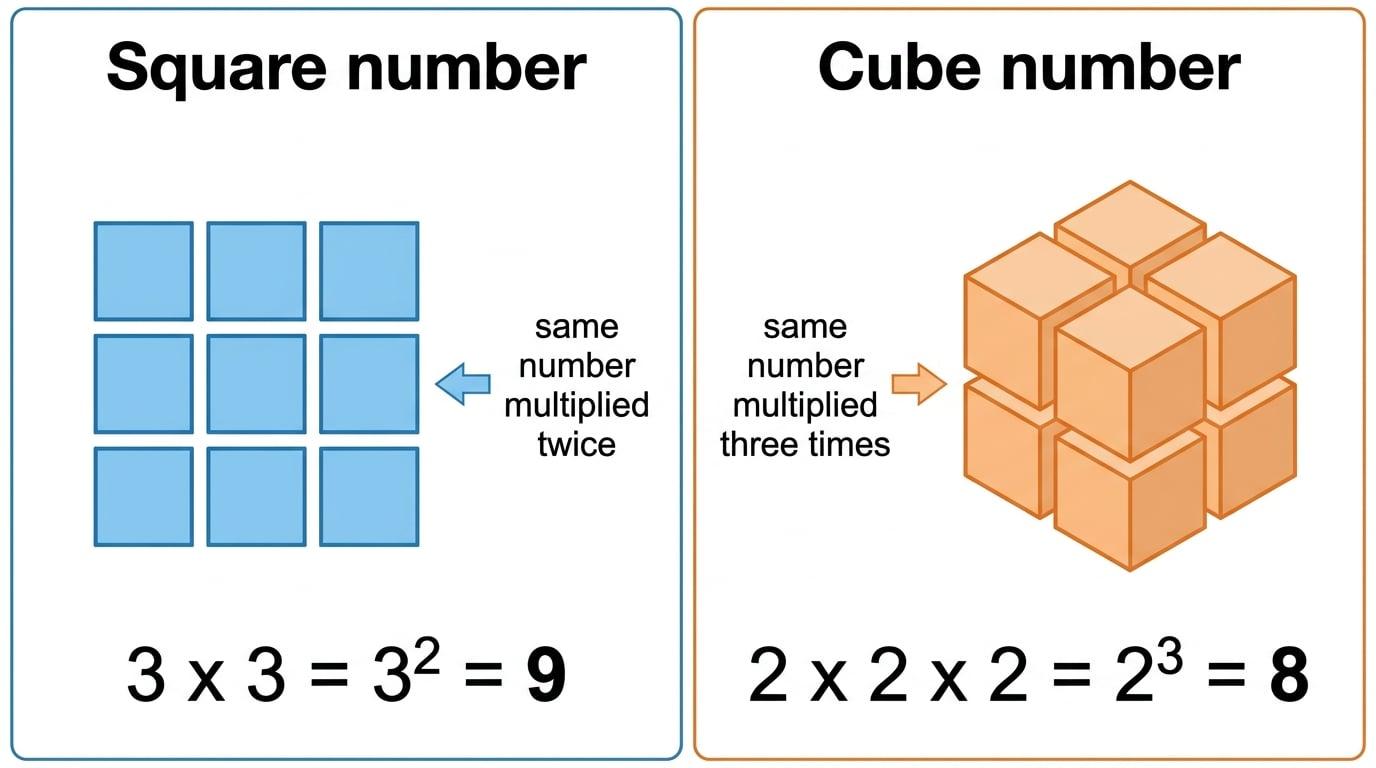
The first few square numbers are:
- 1, because 12=11^2=112=1
- 4, because 22=42^2=422=4
- 9, because 32=93^2=932=9
- 16, because 42=164^2=1642=16
- 25, because 52=255^2=2552=25
- 36, 49, 64, 81, 100
Example
Working out a square
Find the value of 828^282.
-
Squared means “multiply the number by itself”.
-
Write 828^282 as a multiplication.
82=8×88^2 = 8 \times 882=8×8 -
Work out the multiplication.
8×8=648 \times 8 = 648×8=64
Example
Finding a square number with a property
Write down an even square number.
-
Choose a whole number to square. To make the answer even, choose an even number such as 4.
-
Square the number.
42=4×4=164^2 = 4 \times 4 = 1642=4×4=16 -
16 is an even square number.
Tip
Useful squares to learn
Try to know the square numbers from 1 to 100. They come up often: 1, 4, 9, 16, 25, 36, 49, 64, 81 and 100.
Square roots
A root goes backwards from a power. A square root goes backwards from squaring.
Definition
Square root
The square root of a number is the positive number that squares to make it. The symbol n\sqrt{n}n means “the square root of nnn”.
For example, 49=7\sqrt{49}=749=7 because 72=497^2=4972=49.
Example
Finding a square root
Find 81\sqrt{81}81.
-
Ask: “Which number squared gives 81?”
-
Use your square number facts.
92=819^2 = 8192=81 -
Therefore:
81=9\sqrt{81} = 981=9
Key Idea
Squares and square roots undo each other
If 62=366^2=3662=36, then 36=6\sqrt{36}=636=6. Squaring moves one way; square rooting moves back.
Cubes and cube numbers
When the index is 3, we say the number is cubed.
Definition
Cube number
A cube number is the answer you get when a whole number is multiplied by itself three times. For example, 43=644^3=6443=64, so 64 is a cube number.
The first few cube numbers are:
- 1, because 13=11^3=113=1
- 8, because 23=82^3=823=8
- 27, because 33=273^3=2733=27
- 64, because 43=644^3=6443=64
- 125, because 53=1255^3=12553=125
Example
Working out a cube
Work out 535^353.
-
The base is 5 and the index is 3.
-
Write it as repeated multiplication.
53=5×5×55^3 = 5 \times 5 \times 553=5×5×5 -
Multiply carefully: 5×5=255 \times 5 = 255×5=25, then 25×5=12525 \times 5 = 12525×5=125.
-
So:
53=1255^3 = 12553=125
Cube roots
A cube root goes backwards from cubing.
Definition
Cube root
The cube root of a number is the number that cubes to make it. The cube root of 64 is 4 because 43=644^3=6443=64.
You may also see cube root written using the symbol n3\sqrt[3]{n}3n, but questions at this level often write it in words.
Example
Finding a cube root
Find the cube root of 27.
-
Ask: “Which number cubed gives 27?”
-
Check small cube numbers.
33=3×3×3=273^3 = 3 \times 3 \times 3 = 2733=3×3×3=27 -
The cube root of 27 is 3.
Powers of 10
Powers of 10 are very common because our number system is based on tens.
The index tells you how many zeros come after the 1:
101=10102=100103=1000104=10000\begin{aligned} 10^1 &= 10\\ 10^2 &= 100\\ 10^3 &= 1000\\ 10^4 &= 10000 \end{aligned}101102103104=10=100=1000=10000Example
Multiplying by a power of 10
Work out 6×1036 \times 10^36×103.
-
Work out the power of 10 first.
103=100010^3 = 1000103=1000 -
Replace 10310^3103 with 1000.
6×103=6×10006 \times 10^3 = 6 \times 10006×103=6×1000 -
Multiply by 1000.
6×1000=60006 \times 1000 = 60006×1000=6000
Tip
Powers first
In an expression like 6×1036 \times 10^36×103, calculate 10310^3103 first, then multiply by 6.
Spotting powers and roots in a list
Sometimes you are given a list and asked to pick out special numbers.
For Grade 1, the most useful lists to recognise are:
- powers of 2: 2, 4, 8, 16, 32, 64
- square numbers: 1, 4, 9, 16, 25, 36, 49, 64, 81, 100
- cube numbers: 1, 8, 27, 64, 125
Example
Choosing powers of 2 from a list
From the numbers 3, 4, 7, 8, 12, 16, 18 and 25, choose the powers of 2.
-
Recall the powers of 2.
21=2,22=4,23=8,24=16,25=322^1=2,\quad 2^2=4,\quad 2^3=8,\quad 2^4=16,\quad 2^5=3221=2,22=4,23=8,24=16,25=32 -
Compare the given list with these values.
-
The matching numbers are 4, 8 and 16.
Example
Choosing square and cube numbers from a list
From the numbers 6, 9, 15, 16, 25, 27, 32 and 64, choose the square numbers and cube numbers.
-
Compare with the square numbers: 1, 4, 9, 16, 25, 36, 49, 64.
-
The square numbers in the list are 9, 16, 25 and 64.
-
Compare with the cube numbers: 1, 8, 27, 64, 125.
-
The cube numbers in the list are 27 and 64.
Exam technique
In the exam
-
Read the wording carefully: “square”, “square root”, “cube” and “cube root” all mean different things.
-
For powers, expand the expression if you are unsure: 535^353 means 5×5×55 \times 5 \times 55×5×5.
-
For list questions, write down the known square numbers, cube numbers or powers of 2 first, then tick off the matches.
Self review
Check yourself
- Can you explain the difference between 424^242 and 242^424?
- Which square numbers up to 100 can you remember without working out?
- How would you find the cube root of a number like 64?

Recap questions
Test yourself with 5 quick questions on this guide. Answer them all correctly to complete it.
You've reached the end
Test yourself on this topic, or move on to the next guide.
How was this guide?