Revision notes for CIE IGCSE Maths Writing, Simplifying and Ordering Fractions. Open the guide for explanations and worked examples. Written against the CIE IGCSE Maths (0580) specification, so the content matches what's examinable rather than general Maths background.
Writing, Simplifying and Ordering Fractions
What you'll learn
- How to write a fraction from a group of objects or an amount.
- How to simplify fractions into their simplest form.
- How to spot equivalent fractions.
- How to order fractions and decide which fraction is closer to a given value.
What a fraction means
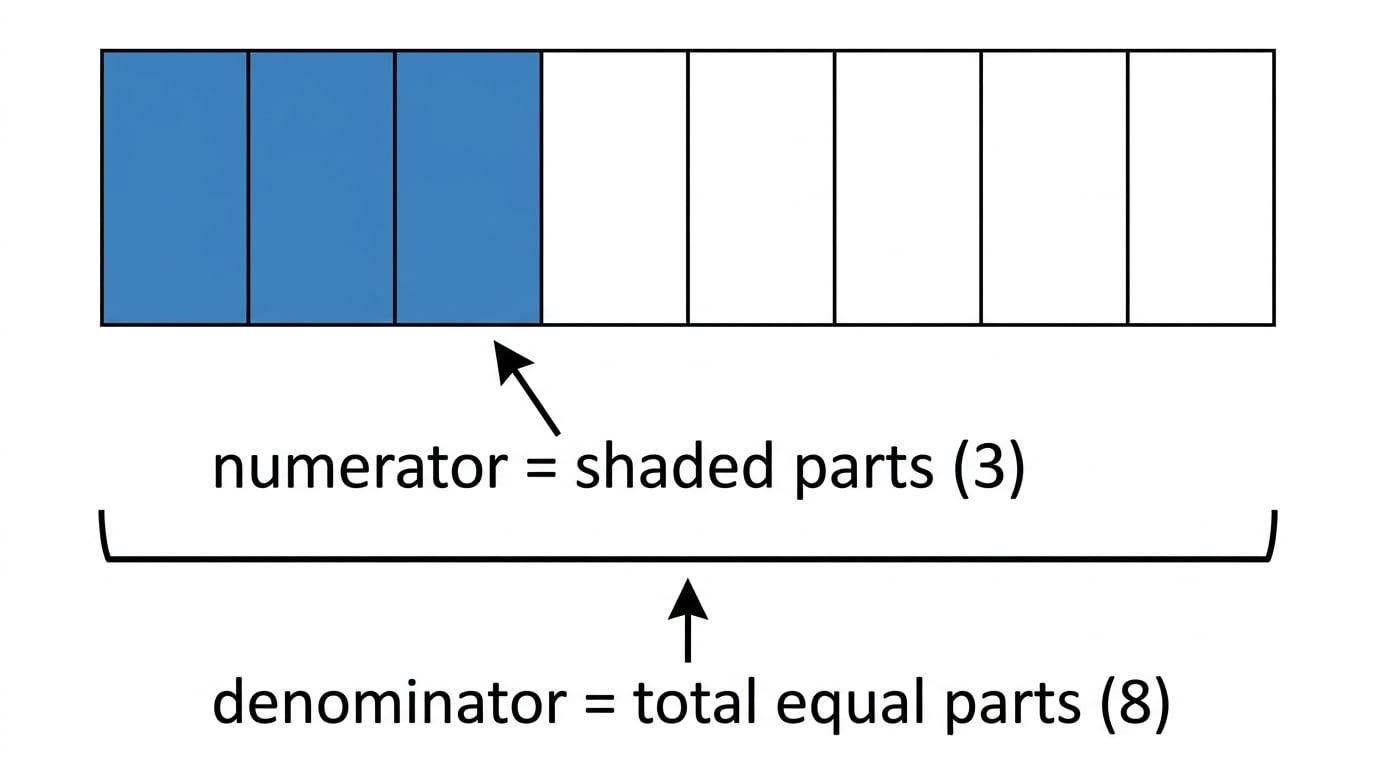
A fraction shows part of a whole or part of a group. For example, if 3 out of 8 equal parts are shaded, the fraction shaded is 38\frac{3}{8}83.
Definition
Numerator and denominator
- The numerator is the top number in a fraction. It tells you how many parts you have.
- The denominator is the bottom number in a fraction. It tells you how many equal parts there are in total.
The diagram shows 38\frac{3}{8}83 because 3 equal parts are shaded out of 8 equal parts altogether.
Writing a fraction from a group
When a question asks, “What fraction are red?” or “What fraction are blue?”, the total number usually goes on the bottom.
Key Idea
Fraction of a group
If you are choosing some objects from a group, use:
- numerator = number of chosen objects
- denominator = total number of objects
Example
Writing a fraction from a group
A bag contains 20 counters. 6 of the counters are yellow. What fraction of the counters are yellow?
-
The total number of counters is 20, so the denominator is 20.
-
The number of yellow counters is 6, so the numerator is 6.
-
The fraction that are yellow is 620\frac{6}{20}206.
Finding “the rest”
Sometimes the question tells you how many objects are one colour, then asks about the remaining objects. The rest means what is left after you subtract.
Example
Writing a fraction for the remaining objects
There are 13 pencils in a pot. 8 pencils are black. The rest are orange. What fraction of the pencils are orange?
-
Start with the total number of pencils: 13.
-
Find how many are orange by subtracting: 13 - 8 = 5.
-
The numerator is 5 because 5 pencils are orange.
-
The denominator is 13 because there are 13 pencils altogether.
-
The fraction that are orange is 513\frac{5}{13}135.
Common Mistake
Forgetting the total
Do not put the number “left over” on the bottom. The denominator is the total number in the group, not the number that are not chosen.
Equivalent fractions
Equivalent fractions have the same value, even though they look different. For example, 12\frac{1}{2}21 and 24\frac{2}{4}42 are equivalent because they both represent the same amount.
You make equivalent fractions by multiplying or dividing the numerator and denominator by the same number.
Example
Spotting the fraction that is not equivalent
One of these fractions is not equivalent to 35\frac{3}{5}53: 610\frac{6}{10}106, 915\frac{9}{15}159, 1220\frac{12}{20}2012, 1530\frac{15}{30}3015, 1830\frac{18}{30}3018. Find it.
-
Simplify 610\frac{6}{10}106 by dividing top and bottom by 2 to get 35\frac{3}{5}53.
-
Simplify 915\frac{9}{15}159 by dividing top and bottom by 3 to get 35\frac{3}{5}53.
-
Simplify 1220\frac{12}{20}2012 by dividing top and bottom by 4 to get 35\frac{3}{5}53.
-
Simplify 1530\frac{15}{30}3015 by dividing top and bottom by 15 to get 12\frac{1}{2}21.
-
Simplify 1830\frac{18}{30}3018 by dividing top and bottom by 6 to get 35\frac{3}{5}53.
-
The fraction that is not equivalent to 35\frac{3}{5}53 is 1530\frac{15}{30}3015.
Simplifying fractions
To simplify a fraction, divide the numerator and denominator by the same number. The value of the fraction stays the same, but the numbers become smaller.
Definition
Simplest form
A fraction is in simplest form when the numerator and denominator have no common factor apart from 1.
A factor is a whole number that divides exactly into another number. For example, 6 is a factor of 24 because 24 can be divided by 6 with no remainder.
Example
Simplifying a fraction
Write 3648\frac{36}{48}4836 in its simplest form.
-
Look for a number that divides exactly into both 36 and 48.
-
12 divides into both numbers, so divide the numerator and denominator by 12.
-
The numerator becomes 3 because 36 divided by 12 is 3.
-
The denominator becomes 4 because 48 divided by 12 is 4.
-
So 3648\frac{36}{48}4836 simplifies to 34\frac{3}{4}43.
Tip
If you cannot spot the biggest factor
You can simplify in stages. For example, divide by 2, then by 2 again, then by 3 if possible. As long as you divide the top and bottom by the same number each time, the fraction stays equivalent.
Common Mistake
Dividing only one part
Never divide just the top or just the bottom. To keep a fraction equivalent, whatever you do to the numerator must also be done to the denominator.
Writing an increase as a fraction
If a question says “write the increase as a fraction of last year’s cost”, the denominator is the original amount.
Example
Increase as a fraction of the original amount
A bus pass cost £30 last year. This year it costs £42. Write the increase as a fraction of last year’s cost.
-
Find the increase: £42 - £30 = £12.
-
The increase is 12, so the numerator is 12.
-
The original cost was £30, so the denominator is 30.
-
The fraction is 1230\frac{12}{30}3012.
-
Simplify by dividing the numerator and denominator by 6.
-
The increase as a fraction of last year’s cost is 25\frac{2}{5}52.
Ordering fractions
To put fractions in order, it is usually easiest to give them a common denominator.
Definition
Common denominator
A common denominator is a denominator that several fractions can all be changed to.
Once the denominators are the same, compare the numerators. The smaller numerator gives the smaller fraction.
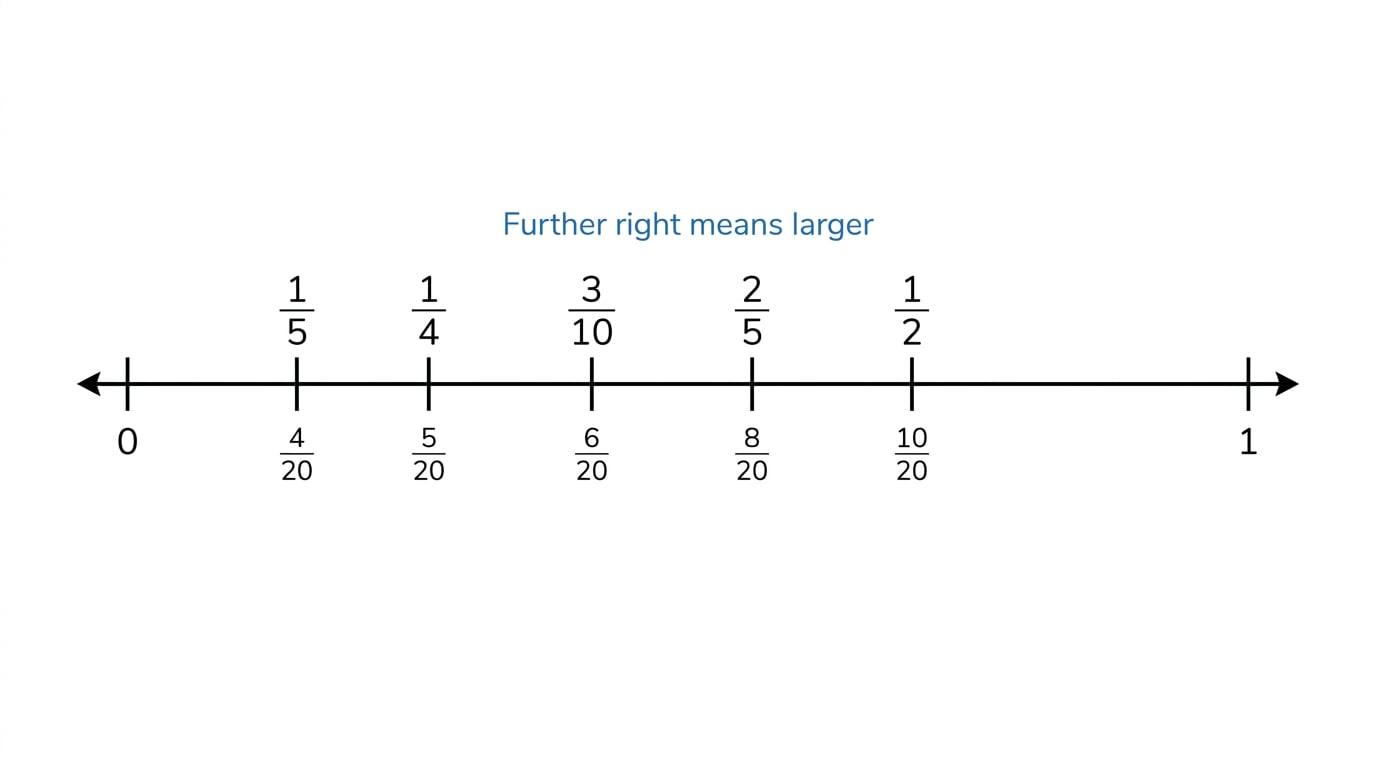
The number line below shows how fractions can be compared once they are written with the same denominator. Fractions further to the right are larger.
Example
Ordering fractions from smallest to largest
Put these fractions in order, starting with the smallest: 14\frac{1}{4}41, 25\frac{2}{5}52, 310\frac{3}{10}103, 12\frac{1}{2}21, 15\frac{1}{5}51.
-
Choose a common denominator. A good choice is 20 because 4, 5, 10 and 2 all divide into 20.
-
Change each fraction into twentieths.
-
The fractions become 14=520\frac{1}{4}=\frac{5}{20}41=205, 25=820\frac{2}{5}=\frac{8}{20}52=208, 310=620\frac{3}{10}=\frac{6}{20}103=206, 12=1020\frac{1}{2}=\frac{10}{20}21=2010 and 15=420\frac{1}{5}=\frac{4}{20}51=204.
-
Order the twentieths from smallest to largest: 420\frac{4}{20}204, 520\frac{5}{20}205, 620\frac{6}{20}206, 820\frac{8}{20}208, 1020\frac{10}{20}2010.
-
Convert back to the original fractions: 15\frac{1}{5}51, 14\frac{1}{4}41, 310\frac{3}{10}103, 25\frac{2}{5}52, 12\frac{1}{2}21.
Tip
Same denominator shortcut
If two fractions have the same denominator, just compare the numerators. For example, 720\frac{7}{20}207 is bigger than 320\frac{3}{20}203 because 7 parts is more than 3 parts.
Which fraction is closer?
To decide which fraction is closer to a number, find the distance or gap between each fraction and the target.
For example, a fraction just below 1 might be closer than a fraction just above 1. You need to compare the gaps, not just guess by looking.
Example
Which fraction is closer to 1?
Which fraction is closer to 1: 89\frac{8}{9}98 or 109\frac{10}{9}910?
-
Find the gap between 89\frac{8}{9}98 and 1. Since 1 is the same as 99\frac{9}{9}99, the gap is 19\frac{1}{9}91.
-
Find the gap between 109\frac{10}{9}910 and 1. Since 1 is the same as 99\frac{9}{9}99, the gap is 19\frac{1}{9}91.
-
The gaps are the same, so both fractions are equally close to 1.
Example
Which fraction is closer to one half?
Which fraction is closer to 12\frac{1}{2}21: 25\frac{2}{5}52 or 58\frac{5}{8}85?
-
Compare 25\frac{2}{5}52 with 12\frac{1}{2}21. Use denominator 10: 25=410\frac{2}{5}=\frac{4}{10}52=104 and 12=510\frac{1}{2}=\frac{5}{10}21=105, so the gap is 110\frac{1}{10}101.
-
Compare 58\frac{5}{8}85 with 12\frac{1}{2}21. Use denominator 8: 12=48\frac{1}{2}=\frac{4}{8}21=84, so the gap is 18\frac{1}{8}81.
-
Compare the gaps 110\frac{1}{10}101 and 18\frac{1}{8}81. Since tenths are smaller parts than eighths, 110\frac{1}{10}101 is the smaller gap.
-
Therefore 25\frac{2}{5}52 is closer to 12\frac{1}{2}21.
Exam technique
In the exam
-
For “fraction of” questions, put the chosen amount on top and the total amount on the bottom.
-
For simplifying, divide the numerator and denominator by the same common factor.
-
For ordering fractions, change them to a common denominator before comparing.
-
For “closer to” questions, show the gap from the target for each fraction.
Self review
Check yourself
- Can you explain what the numerator and denominator mean?
- Can you simplify a fraction by dividing the top and bottom by the same number?
- Can you order fractions by changing them to a common denominator?

Recap questions
Test yourself with 5 quick questions on this guide. Answer them all correctly to complete it.
You've reached the end
Test yourself on this topic, or move on to the next guide.
How was this guide?