Revision notes for CIE IGCSE Maths Place Value. Open the guide for explanations and worked examples. Written against the CIE IGCSE Maths (0580) specification, so the content matches what's examinable rather than general Maths background.
Place Value
What you'll learn
- How to find the value of a digit in a whole number or decimal.
- How to write numbers using words like “million”.
- How to arrange digit cards to make the largest or smallest number.
- How to order whole numbers and decimals from smallest to largest.
Digits, numbers, and place value
A digit is one symbol used to write numbers. The ten digits are 0, 1, 2, 3, 4, 5, 6, 7, 8 and 9.
A number can be made from one digit or many digits. For example, 7 is a number with one digit, while 583 is a number with three digits.
Definition
Place value
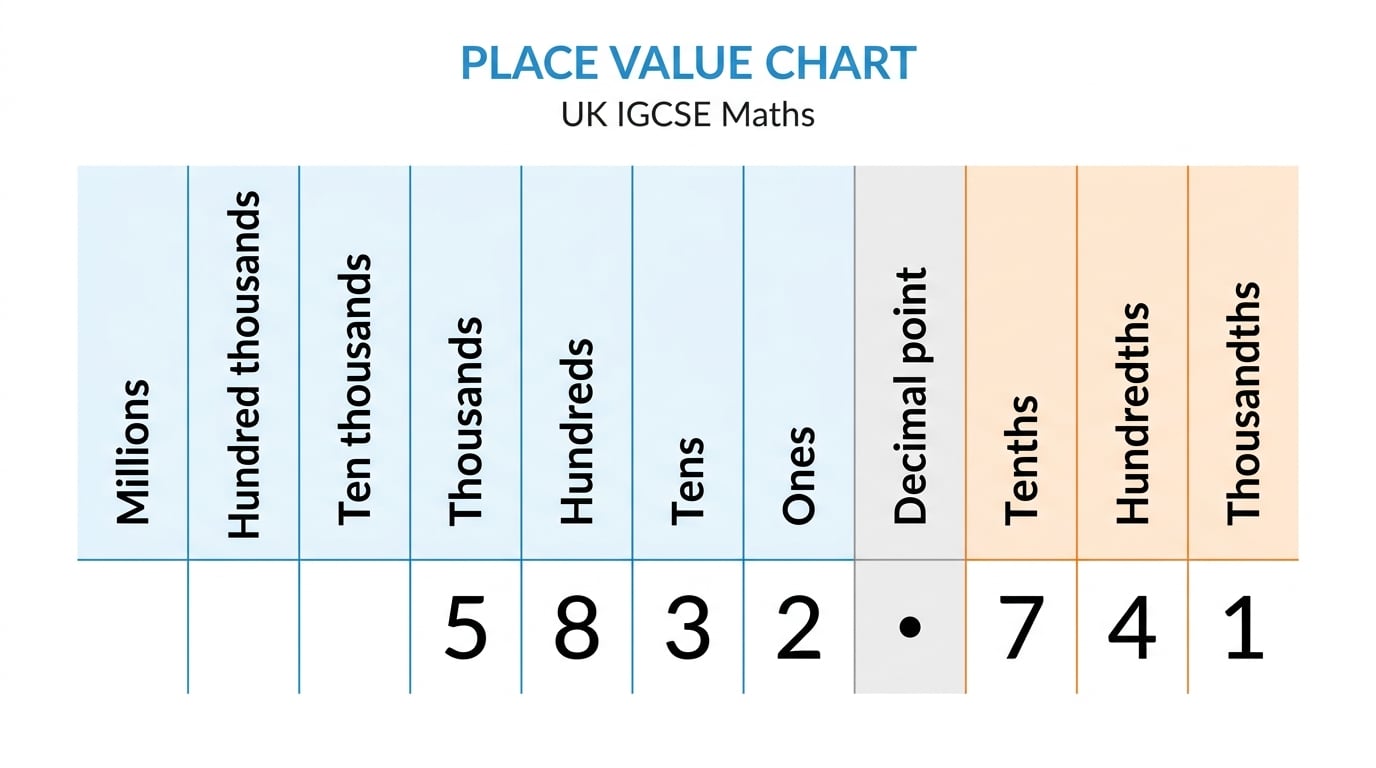
Place value means the value a digit has because of its position in a number. The same digit can be worth different amounts in different places.
For example, in 583, the 5 is worth 500, the 8 is worth 80, and the 3 is worth 3.
A place value chart helps you see what each column is worth.
Key Idea
Main idea
The further left a digit is, the larger its place value. The further right a digit is after the decimal point, the smaller its place value.
Finding the value of a digit in a whole number
For whole numbers, the main columns are:
- thousands
- hundreds
- tens
- ones
In 4,638:
- 4 is in the thousands column, so it is worth 4000
- 6 is in the hundreds column, so it is worth 600
- 3 is in the tens column, so it is worth 30
- 8 is in the ones column, so it is worth 8
Example
Finding the value of a digit
Find the value of the 7 in 2,794.
-
Write the number with its place value columns in mind: thousands, hundreds, tens, ones.
-
In 2,794, the 7 is in the hundreds column.
-
A digit in the hundreds column is worth that digit multiplied by 100.
-
So the value of the 7 is 700.
Zeros as placeholders
A placeholder is a digit, often 0, that keeps the other digits in the correct columns.
For example, in 5,062, the 0 shows there are no hundreds. It also keeps the 5 in the thousands column and the 6 in the tens column.
Example
Using zero correctly
Find the value of the 4 in 8,041.
-
Look carefully at the columns: thousands, hundreds, tens, ones.
-
In 8,041, the 4 is in the tens column.
-
A digit in the tens column is worth ten times the digit.
-
So the value of the 4 is 40.
Common Mistake
Ignoring a zero
Do not “slide” digits across when there is a zero. In 8,041, the 4 is not in the hundreds column. The zero holds the hundreds place, so the 4 is in the tens column.
Decimal place value
A decimal point separates the whole number part from the decimal part.
The first digit after the decimal point is the tenths column. The second digit after the decimal point is the hundredths column. The third digit after the decimal point is the thousandths column.
For example, in 36.482:
- 3 is worth 30
- 6 is worth 6
- 4 is worth 0.4
- 8 is worth 0.08
- 2 is worth 0.002
Definition
Decimal place
A decimal place is a position after the decimal point. Tenths, hundredths and thousandths are decimal places.
Example
Finding the value of a decimal digit
Find the value of the 9 in 125.9.
-
Look at the decimal point.
-
The 9 is the first digit after the decimal point.
-
The first digit after the decimal point is in the tenths column.
-
So the value of the 9 is 0.9.
Example
Another decimal example
Find the value of the 6 in 48.263.
-
The number is 48.263.
-
The digits after the decimal point are 2, 6 and 3.
-
The 6 is the second digit after the decimal point.
-
The second digit after the decimal point is in the hundredths column.
-
So the value of the 6 is 0.06.
Tip
Decimal reading tip
After the decimal point, read the columns carefully from left to right: tenths, hundredths, thousandths. Do not just count how many digits there are and guess.
Writing a number with a digit in a certain place
You may be asked to write down a number with a certain digit in a certain column.
For example, a 5 digit number has five digits. The first digit cannot be 0, because then it would not really be a 5 digit number.
Example
Making a number with a required digit
Write a 5 digit number that has 6 as its thousands digit. Use the digit 6 only once.
-
A 5 digit number has the columns: ten-thousands, thousands, hundreds, tens, ones.
-
The thousands digit must be 6, so put 6 in the second column.
-
Choose other digits that are not 6 for the remaining columns.
-
One possible answer is 76,421.
-
Check: in 76,421, the 6 is in the thousands column and it appears only once.
Example
A 6 digit number example
Write a 6 digit number that has 4 as its hundreds digit. Use the digit 4 only once.
-
A 6 digit number has the columns: hundred-thousands, ten-thousands, thousands, hundreds, tens, ones.
-
The hundreds digit must be 4, so put 4 in the fourth column from the left.
-
Fill the other columns using digits that are not 4.
-
One possible answer is 281,473.
-
Check: in 281,473, the 4 is in the hundreds column and it appears only once.
Writing millions in figures
A million is 1,000,000.
So:
- 2 million means 2,000,000
- 5 million means 5,000,000
- 5.3 million means 5,300,000
Example
Writing a whole number of millions
Write 7 million in figures.
-
Remember that 1 million is 1,000,000.
-
Multiply 7 by 1,000,000:
7×1 000 000=7 000 0007 \times 1\,000\,000 = 7\,000\,0007×1000000=7000000 -
So 7 million in figures is 7,000,000.
Example
Writing a decimal number of millions
Write 4.6 million in figures.
-
Start with 1 million, which is 1,000,000.
-
Multiply 4.6 by 1,000,000:
4.6×1 000 000=4 600 0004.6 \times 1\,000\,000 = 4\,600\,0004.6×1000000=4600000 -
So 4.6 million in figures is 4,600,000.
Tip
Million shortcut
For a whole number of millions, write the number and then add six zeros. For a decimal such as 3.8 million, remember that 0.8 million is 800,000.
Arranging number cards
When you make the largest number from digit cards, put the biggest digits in the biggest place value columns.
When you make the smallest number, put the smallest digits in the biggest place value columns. If 0 is one of the cards, do not put it first in a whole number, because a number cannot start with 0.
Example
Largest number from digit cards
You have the digit cards 6, 1, 8 and 4. Make the largest 3 digit number possible.
-
A 3 digit number has hundreds, tens and ones columns.
-
To make the number as large as possible, put the largest digit in the hundreds column.
-
The three largest digits are 8, 6 and 4.
-
Put them in descending order: 864.
-
So the largest 3 digit number is 864.
Arranging cards in a sum
If you are making two 2 digit numbers and adding them, the tens columns matter more than the ones columns.
For example, putting a digit in the tens column makes it worth ten times as much as putting it in the ones column.
Example
Smallest possible sum
Use the digit cards 1, 5, 7 and 3 to make two 2 digit numbers with the smallest possible sum.
-
To make the sum small, put the smallest digits in the tens columns.
-
The two smallest digits are 1 and 3, so these should be the tens digits.
-
The remaining digits, 5 and 7, go in the ones columns.
-
One possible arrangement is 15 + 37.
-
Add the numbers:
15+37=5215 + 37 = 5215+37=52
Example
Largest possible sum
Use the digit cards 2, 9, 4 and 6 to make two 2 digit numbers with the largest possible sum.
-
To make the sum large, put the largest digits in the tens columns.
-
The two largest digits are 9 and 6, so these should be the tens digits.
-
The remaining digits, 4 and 2, go in the ones columns.
-
One possible arrangement is 94 + 62.
-
Add the numbers:
94+62=15694 + 62 = 15694+62=156
Ordering whole numbers
To put whole numbers in order, compare from left to right.
If the numbers have different numbers of digits, the number with fewer digits is usually smaller. For numbers with the same number of digits, compare the hundreds first, then tens, then ones.
Example
Ordering whole numbers
Put these numbers in order from smallest to largest: 172, 109, 145, 190, 137.
-
All the numbers have three digits, so compare the hundreds digits first.
-
They all have 1 hundred, so compare the tens digits.
-
The tens digits are 7, 0, 4, 9 and 3.
-
Put the tens digits in order: 0, 3, 4, 7, 9.
-
So the numbers in order are 109, 137, 145, 172, 190.
Ordering decimals
Decimals can be tricky because a longer decimal is not always bigger.
For example, 0.305 is smaller than 0.35, even though 305 is bigger than 35. This is because 0.305 means 305 thousandths, while 0.35 means 350 thousandths.
Key Idea
Compare decimals fairly
Line up the decimal points and add zeros at the end if needed. Adding zeros at the end of a decimal does not change its value.
For example:
- 0.5 is the same as 0.50
- 1.6 is the same as 1.600
- 3.2 is the same as 3.200
Example
Ordering decimals less than 1
Put these numbers in order from smallest to largest: 0.42, 0.402, 0.24, 0.024, 0.204.
-
Line up the decimal points.
-
Make each number have three decimal places by adding zeros where needed.
-
The numbers become 0.420, 0.402, 0.240, 0.024 and 0.204.
-
Now compare them from left to right after the decimal point.
-
The order from smallest to largest is 0.024, 0.204, 0.24, 0.402, 0.42.
Example
Ordering decimals greater than 1
Put these numbers in order from smallest to largest: 2.7, 2.07, 2.73, 2.703, 2.37.
-
All the numbers have the same whole number part: 2.
-
Add zeros so they all have three decimal places.
-
The numbers become 2.700, 2.070, 2.730, 2.703 and 2.370.
-
Compare the decimal parts: 070, 370, 700, 703, 730.
-
The order from smallest to largest is 2.07, 2.37, 2.7, 2.703, 2.73.
Common Mistake
Thinking longer means larger
Do not assume that the decimal with more digits is bigger. For example, 1.06 is smaller than 1.6 because 1.06 is the same as 1.060, while 1.6 is the same as 1.600.
Exam technique
In the exam
-
For digit-value questions, say the actual value, such as 80 or 0.08, not just the column name.
-
For ordering decimals, line up the decimal points and add zeros before comparing.
-
For digit cards, put the largest digits in the highest-value columns for the largest answer, and the smallest digits there for the smallest answer.
Self review
Check yourself
-
In 6,305, what is the value of the 3?
-
Write 8.4 million in figures.
-
Put these in order from smallest to largest: 0.7, 0.07, 0.707.

Recap questions
Test yourself with 5 quick questions on this guide. Answer them all correctly to complete it.
You've reached the end
Test yourself on this topic, or move on to the next guide.
How was this guide?