Revision notes for CIE IGCSE Maths Factors and Multiples. Open the guide for explanations and worked examples. Written against the CIE IGCSE Maths (0580) specification, so the content matches what's examinable rather than general Maths background.
Factors and Multiples
What you'll learn
- How to recognise factors and multiples.
- How to list all factors of a number without missing any.
- How to identify prime numbers, even numbers, odd numbers, and square numbers.
- How to answer short “choose from the list” and “thinking of a number” questions confidently.
The basic idea: times tables and division
This topic is mostly about knowing your times tables and using division carefully.
If one whole number divides exactly into another whole number, with no remainder, we say it “goes into” that number.
For example, 4 goes into 28 because 28 can be split into 7 equal groups of 4.
The diagram below shows the difference between going up in a times table to find multiples, and splitting a number into factor pairs.
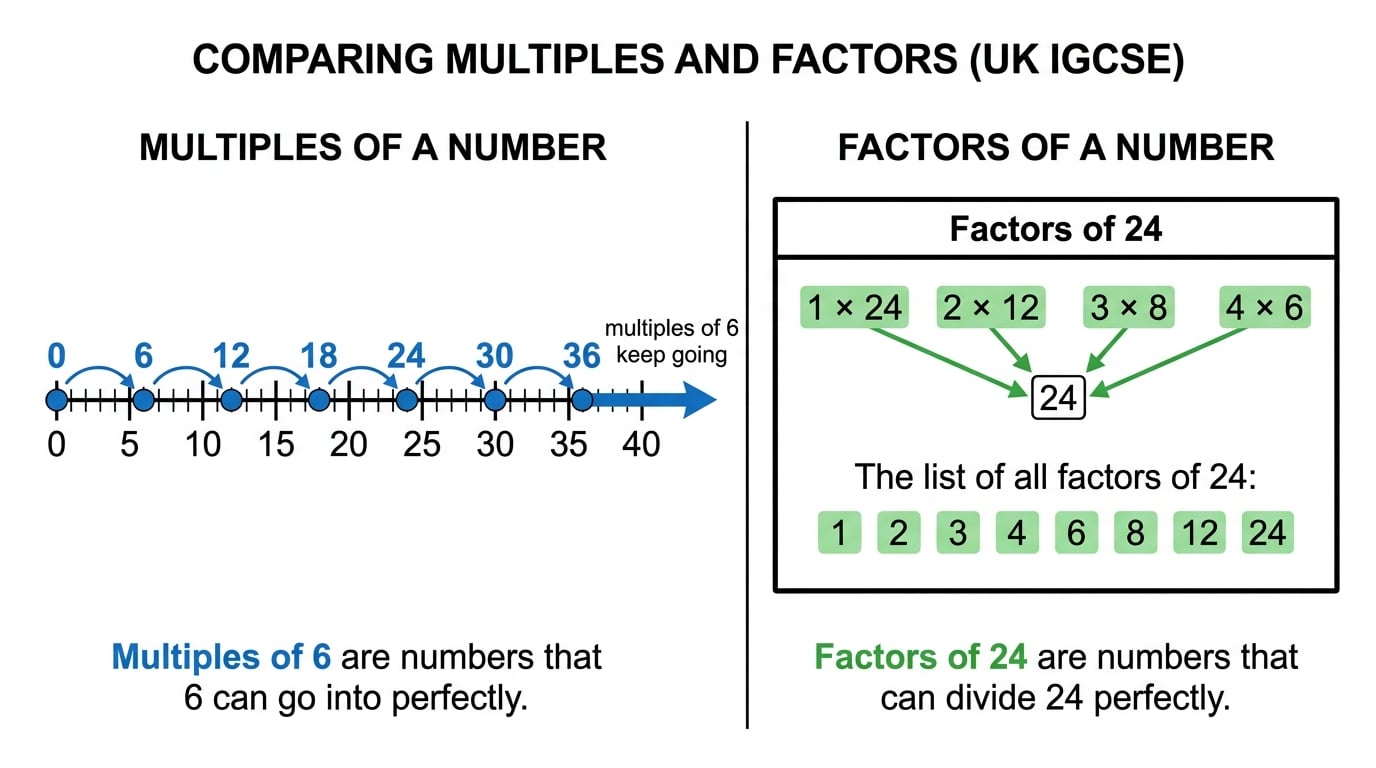
Factors and multiples
Definition
Factors and multiples
- A factor of a number divides into it exactly.
- A multiple of a number is found by multiplying it by a whole number.
For example, 5 is a factor of 20 because 20 ÷ 5 = 4 exactly.
Also, 20 is a multiple of 5 because it is in the 5 times table.
Key Idea
Factor or multiple?
A factor is usually smaller than or equal to the number. A multiple is usually bigger than or equal to the number, and belongs to its times table.
Finding a multiple in a range
To find a multiple, say the times table until you reach the range you need.
Example
Finding a multiple between two numbers
Write down a multiple of 6 that is between 25 and 40.
-
List the 6 times table around that size:
6, 12, 18, 24, 30, 36, 426,\ 12,\ 18,\ 24,\ 30,\ 36,\ 426, 12, 18, 24, 30, 36, 42 -
Choose a number that is bigger than 25 and smaller than 40.
-
Two possible answers are 30 and 36, so you could write 30.
Common Mistake
Meaning of “between”
In exam questions, “between 25 and 40” usually means bigger than 25 and smaller than 40. Do not use the end numbers unless the question clearly allows them.
Finding an even multiple
Definition
Even and odd numbers
- An even number is divisible by 2. It ends in 0, 2, 4, 6, or 8.
- An odd number is not divisible by 2. It ends in 1, 3, 5, 7, or 9.
Sometimes a question asks for the first even multiple of a number. That means you need a number in the times table that is also even.
Example
Finding the first even multiple
Write down the first even multiple of 7.
-
List the first few multiples of 7:
7, 14, 21, 28,…7,\ 14,\ 21,\ 28,\ldots7, 14, 21, 28,… -
Check which one is even. 7 is odd, but 14 is even.
-
The first even multiple of 7 is 14.
Tip
Quick even check
Look only at the last digit. If it is 0, 2, 4, 6, or 8, the number is even.
Listing all factors
When asked for all the factors, you need a method so you do not miss any.
Start at 1 and test numbers in order. A neat shortcut is to find factor pairs.
Definition
Factor pair
A factor pair is two whole numbers that multiply together to make the target number.
For example, 3 and 8 are a factor pair of 24 because 3 × 8 = 24.
A systematic method
Example
Listing all the factors of a number
Write down all the factors of 28.
-
Start with 1. Every whole number has 1 and itself as factors.
1×28=281 \times 28 = 281×28=28 -
Try 2. Since 28 is even, 2 is a factor.
2×14=282 \times 14 = 282×14=28 -
Try 3. 28 does not divide exactly by 3, so 3 is not a factor.
-
Try 4.
4×7=284 \times 7 = 284×7=28 -
You can stop once the factor pairs start repeating. The full list is 1, 2, 4, 7, 14, 28.
Tip
Write factors in order
For “all the factors” questions, write the factors from smallest to largest. It makes it much easier to spot if one is missing.
Prime numbers
Definition
Prime number
A prime number is a whole number greater than 1 with exactly two factors: 1 and itself.
For example, 13 is prime because its only factors are 1 and 13.
The number 12 is not prime because it has more than two factors: 1, 2, 3, 4, 6, and 12.
Common Mistake
1 is not prime
1 is not a prime number because it has only one factor: itself. A prime number must have exactly two factors.
Checking whether a number is prime
To check if a number is prime, test whether it is divisible by small numbers such as 2, 3, 5, and 7.
Example
Prime numbers in a range
Write down all the prime numbers between 30 and 40.
-
List the whole numbers between 30 and 40:
31, 32, 33, 34, 35, 36, 37, 38, 3931,\ 32,\ 33,\ 34,\ 35,\ 36,\ 37,\ 38,\ 3931, 32, 33, 34, 35, 36, 37, 38, 39 -
Cross out even numbers: 32, 34, 36, and 38 are not prime.
-
Check the remaining odd numbers. 33 is divisible by 3, 35 is divisible by 5, and 39 is divisible by 3.
-
The primes left are 31 and 37.
Tip
Small prime checks
For Grade 1 questions, the most useful checks are: even numbers are not prime except 2; numbers ending in 5 or 0 are not prime except 5; numbers in the 3 times table are not prime except 3.
Square numbers
Definition
Square number
A square number is made by multiplying a whole number by itself.
The first few square numbers are:
1, 4, 9, 16, 25, 36, 49, 64, 81, 1001,\ 4,\ 9,\ 16,\ 25,\ 36,\ 49,\ 64,\ 81,\ 1001, 4, 9, 16, 25, 36, 49, 64, 81, 100For example, 36 is a square number because 6 × 6 = 36.
Spotting a square number from a list
Example
Choosing a square number from a list
Here is a list of numbers:
22, 25, 26, 27, 28, 29, 30
Choose the square number.
-
Think of the square numbers near this list:
4×4=16,5×5=25,6×6=364 \times 4 = 16,\quad 5 \times 5 = 25,\quad 6 \times 6 = 364×4=16,5×5=25,6×6=36 -
Look for one of these in the list.
-
The square number is 25.
Questions with a list of numbers
Some questions give you a list and ask for different types of numbers from that list. The important part is: only choose from the numbers given.
Example
Selecting numbers from a list
Here is a list of numbers:
6, 10, 13, 18, 21, 24, 29
From the list, write down:
- a factor of 30
- a multiple of 6
- all the prime numbers
-
For a factor of 30, test which numbers divide exactly into 30. 6 and 10 both work, so you could write 6.
-
For a multiple of 6, look for numbers in the 6 times table. 6, 18, and 24 work, so you could write 18.
-
For prime numbers, check each number in the list. 13 and 29 are prime.
Common Mistake
Use the list only
If the question says “from the list”, do not invent a correct number outside the list. Even if 5 is a factor of 30, you cannot use it unless 5 appears in the list.
Combining clues
Some questions describe a mystery number using several clues, such as:
- it is odd or even;
- it is a factor of a number;
- it is a multiple of another number;
- it is prime.
The best method is to deal with one clue at a time.
Example
Finding numbers that match several clues
A number is even. It is a factor of 40 and a multiple of 5. Find the possible numbers.
-
List the factors of 40:
1, 2, 4, 5, 8, 10, 20, 401,\ 2,\ 4,\ 5,\ 8,\ 10,\ 20,\ 401, 2, 4, 5, 8, 10, 20, 40 -
Keep only the even numbers:
2, 4, 8, 10, 20, 402,\ 4,\ 8,\ 10,\ 20,\ 402, 4, 8, 10, 20, 40 -
Keep only the multiples of 5.
-
The possible numbers are 10, 20, and 40.
Prime clues
If a question says the number is prime and also a factor, first list the factors, then pick out the primes.
Example
Prime factors from a clue
A number is prime and is a factor of 45. Find the possible numbers.
-
List the factors of 45:
1, 3, 5, 9, 15, 451,\ 3,\ 5,\ 9,\ 15,\ 451, 3, 5, 9, 15, 45 -
Pick out the prime numbers from that list.
-
3 and 5 are prime, so the possible numbers are 3 and 5.
Exam technique
In the exam
- Read the key word carefully: factor means divides into; multiple means times table.
- If the question says “all”, use a systematic list in order so you do not miss any.
- If there is a list of numbers, only choose answers from that list.
Self review
Check yourself
- Can you write all the factors of 32 in order?
- Can you name all the prime numbers between 10 and 30?
- If a number is odd, a factor of 24, and a multiple of 3, what could it be?

Recap questions
Test yourself with 5 quick questions on this guide. Answer them all correctly to complete it.
You've reached the end
Test yourself on this topic, or move on to the next guide.
How was this guide?