A range of sustainable strategies is required to address uneven levels of development and human welfare
What you'll learn
- How international aid and intergovernmental agreements try to reduce uneven development.
- Why individuals, organisations and governments may disagree about the best way to close the development gap.
- How top-down and bottom-up projects work in a named developed country and a named emerging or developing country.
- How to evaluate whether a strategy is genuinely sustainable.
The starting point: uneven development
Development means improvements in a country’s economy and in people’s quality of life, such as better health, education, income, housing, water supply and political freedom. Human welfare means people’s wellbeing: whether they can live healthy, secure and fulfilling lives.
Uneven development
Uneven development means that wealth, services and opportunities are distributed unequally between places. The development gap is the difference this creates in living standards and human welfare between richer and poorer countries, and also within countries.
A sustainable strategy does not just create short-term economic growth. It should improve welfare while keeping social, environmental and financial costs manageable for the future.
The whole topic fits into four overlapping groups of strategies: aid, agreements, top-down projects and bottom-up projects.
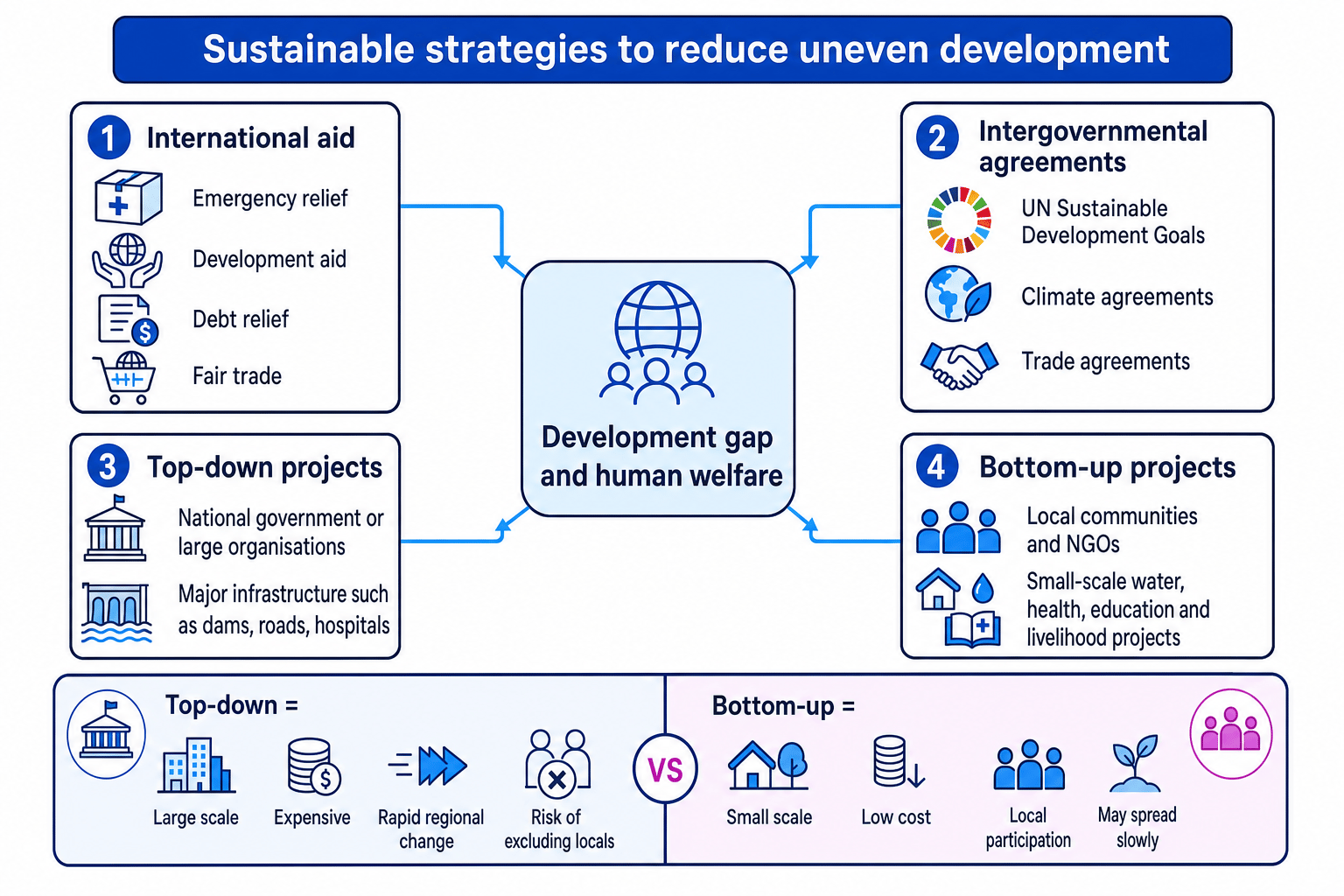
International strategies to reduce uneven development
International aid
International aid
International aid is the transfer of money, goods, skills or services from one country or organisation to another, usually to improve development and human welfare.
Aid can take several forms:
| Type of aid | What it means | How it may reduce uneven development |
|---|---|---|
| Emergency relief | Short-term help after a disaster, such as food, tents, clean water and medical supplies | Saves lives and prevents welfare from falling further |
| Development aid | Long-term support, such as funding schools, clinics, wells or farming training | Builds skills, health and infrastructure |
| Bilateral aid | Aid from one government directly to another | Can target a specific country or region |
| Multilateral aid | Aid given through organisations such as the UN or World Bank | Can coordinate large-scale international responses |
| Debt relief | Reducing, delaying or cancelling debt repayments | Frees government money for services like healthcare and education |
| Voluntary aid | Aid from charities or non-governmental organisations, known as NGOs | Often reaches local communities directly |
Aid can be very effective, but it is not automatically sustainable. Tied aid is aid that must be spent on goods or services from the donor country, which may benefit the donor more than the recipient.
Choosing an aid strategy
A drought has caused food shortages in a rural region, but the deeper problem is that farms rely on unreliable rainfall.
- Separate the short-term and long-term needs. In the short term, people need food, clean water and medical care to prevent deaths and disease.
- Match the first need to emergency relief. Emergency aid is suitable because it can arrive quickly and protect human welfare immediately.
- Match the deeper problem to development aid. Wells, water storage, drought-resistant crops and farmer training would make communities less vulnerable next time.
- Check sustainability. The best strategy would train local people to maintain the water supply, rather than creating permanent dependence on outside aid.
Intergovernmental agreements
Intergovernmental agreements
Intergovernmental agreements are deals or shared targets agreed between national governments, often through global organisations such as the United Nations.
These agreements try to change the wider rules and priorities that shape development. Important examples include:
- The UN Sustainable Development Goals, agreed for 2015–2030, including goals on poverty, health, education, clean water, gender equality and reduced inequalities.
- The Paris Agreement on climate change, which matters because poorer countries often suffer most from droughts, floods and storms despite contributing less to greenhouse gas emissions.
- International debt relief schemes, such as those aimed at heavily indebted poorer countries.
- Trade agreements that may give poorer countries better access to richer markets.
- The UN target encouraging richer countries to give 0.7% of gross national income, meaning the total income earned by a country’s people and businesses, as aid.
Aid and agreements work at different scales
Aid can tackle immediate needs or fund local improvements. Intergovernmental agreements aim to change bigger systems, such as debt, trade, climate finance and global development targets.
Assuming all aid closes the development gap
Aid may fail if it is lost through corruption, spent on unsuitable projects, tied to donor-country businesses, or not maintained after foreign experts leave.
Different views on tackling the development gap
There is no single agreed solution because different groups have different priorities.
Individuals
Some individuals support aid because they see poverty reduction as a moral responsibility. They may donate to charities, buy Fairtrade products or support refugee assistance. Others worry that aid money could be wasted, or argue that governments should spend more on problems at home first.
Organisations
NGOs such as Oxfam often favour bottom-up projects because they involve local people and focus on basic needs. Businesses may prefer trade, investment and infrastructure because these can create markets and profits. International financial organisations may support loans and economic reforms, but critics argue that repayments and conditions can increase pressure on poorer governments.
Governments
Donor governments may use aid for humanitarian reasons, but also for influence, security or trade links. Recipient governments may welcome funding, but they may prefer investment in roads, power and ports rather than small charity projects. Local communities may judge a strategy by whether it improves daily life, such as water, jobs, safety and housing.
Explaining disagreement over a new dam
A government proposes a large dam to increase electricity supply and reduce flooding.
- Consider the national government’s view. It may support the dam because electricity can attract industry, create jobs and support economic growth.
- Consider an NGO’s view. It may question the project if villages are displaced or river ecosystems are damaged.
- Consider local people’s view. Some may support new jobs and roads, while others may lose farmland, homes or cultural sites.
- Make a balanced judgement. The project could reduce the development gap, but only if benefits are shared fairly and social and environmental costs are managed.
Top-down and bottom-up development projects
A development project is a planned action designed to improve economic development or human welfare.
Top-down projects are planned and funded by governments, large companies or international organisations. They are usually large-scale and expensive. Bottom-up projects are planned with local communities, often with support from NGOs. They are usually smaller-scale and focus on local needs.
| Feature | Top-down | Bottom-up |
|---|---|---|
| Decision-making | National government or large organisation | Local people and community groups |
| Scale | Large region or whole country | Village, neighbourhood or small district |
| Cost | Usually high | Usually lower |
| Strength | Can transform infrastructure quickly | Better match with local needs |
| Risk | May ignore local people or create debt | May be too small to solve national problems |
Top-down is not always bad
Do not write “top-down bad, bottom-up good”. Large infrastructure may be essential, but it must be judged against cost, fairness, environmental impact and who benefits.
🌐 Developed-country example: the United Kingdom
The UK is a developed country with high average incomes and strong services, but it still has uneven development. Inner-city areas and some former industrial regions have lower incomes, poorer health and fewer opportunities than wealthier areas.
Top-down: London 2012 Olympic Park regeneration
The regeneration of Stratford in East London was led by national and city authorities. It turned a large area of former industrial and railway land into the Queen Elizabeth Olympic Park, with new sports venues, transport improvements, housing and business space.
Advantages:
- Cleaned up polluted brownfield land.
- Improved transport links and public spaces.
- Attracted investment, tourism and jobs.
Disadvantages:
- Very expensive and planned mainly by powerful authorities.
- Some local people felt priced out as rents and house prices rose.
- The benefits were uneven, with higher-income groups gaining more from some new housing and facilities.
Bottom-up: Coin Street Community Builders, London
Coin Street Community Builders is a community-led regeneration project on London’s South Bank. Local residents helped shape affordable housing, community facilities, co-operative homes and local employment opportunities.
Advantages:
- Local people had more control over decisions.
- It provided community facilities and affordable housing in a very expensive city.
- Profits could be reinvested locally.
Disadvantages:
- It works at a small scale compared with national inequality.
- Community-led projects can take a long time to organise.
- Success may be hard to repeat in areas without valuable land or strong local leadership.
🌐 Emerging/developing-country example: Kenya
Kenya is a lower-middle-income country in East Africa. Nairobi and Mombasa are major economic centres, but many rural areas face poverty, drought risk and limited access to reliable water, healthcare and transport.
Top-down: Standard Gauge Railway, Kenya
Kenya’s Standard Gauge Railway connects Mombasa, the main port, with Nairobi. It opened in 2017 and was funded largely through Chinese loans and construction expertise.
Advantages:
- Improves movement of people and goods between the coast and the capital.
- Can support trade, tourism and urban economic growth.
- Creates jobs during construction and operation.
Disadvantages:
- It involved several billion US dollars of debt.
- Benefits are concentrated along the main corridor, especially in cities.
- Wildlife habitats and national parks raised environmental concerns.
Bottom-up: sand dams in dryland Kenya
In parts of south-eastern Kenya, NGOs and local communities have built sand dams across seasonal rivers. A sand dam traps sand behind a wall; water is stored in the spaces between sand grains, reducing evaporation and providing dry-season water.
Advantages:
- Local people help build and maintain the dam, increasing ownership.
- Reliable water improves health, farming and school attendance because less time is spent collecting water.
- It is relatively low-cost and uses local materials.
Disadvantages:
- It only works where the river, geology and rainfall are suitable.
- It helps villages rather than transforming the whole national economy.
- Severe drought can still reduce water availability.
Comparing top-down and bottom-up in Kenya
- Identify the aim of each project. The railway mainly targets national trade and transport, while sand dams target local water security and welfare.
- Compare scale and cost. The railway is high-cost and national-scale, so it can create major economic links but also debt. Sand dams are low-cost and local-scale, so they are easier to maintain but have limited reach.
- Assess sustainability. Sand dams score strongly on local participation and appropriate technology. The railway may support economic growth, but its sustainability depends on passenger and freight use, debt repayment and environmental management.
- Reach a balanced judgement. Kenya needs both types: large infrastructure for wider economic growth and small local projects for immediate improvements in human welfare.
Why a range of strategies is required
Uneven development has many causes: debt, poor infrastructure, conflict, unfair trade, weak healthcare, limited education, climate risk and lack of political power. One strategy cannot fix all of these.
A strong answer explains that sustainable development usually needs a mix:
- Emergency aid to protect people during crises.
- Development aid to build long-term capacity.
- Intergovernmental agreements to improve global rules on debt, trade and climate.
- Top-down projects for major infrastructure.
- Bottom-up projects for local needs and community participation.
Evaluation phrase
A useful structure is: “This strategy is effective because…, however it may be limited because…, so it is most sustainable when combined with…”
In the exam
- Name and locate examples clearly. For this topic, you could use the UK as a developed country and Kenya as an emerging/developing country.
- Balance every strategy. Give at least one advantage and one disadvantage, then judge whether it is sustainable.
- Link back to human welfare. Do not only discuss money; mention health, education, water, housing, jobs, equality or environmental quality.
Check yourself
- Why might a government prefer a top-down project, while an NGO prefers a bottom-up project?
- How can intergovernmental agreements reduce uneven development at a larger scale than aid?
- In what ways can a project be economically useful but socially or environmentally unsustainable?