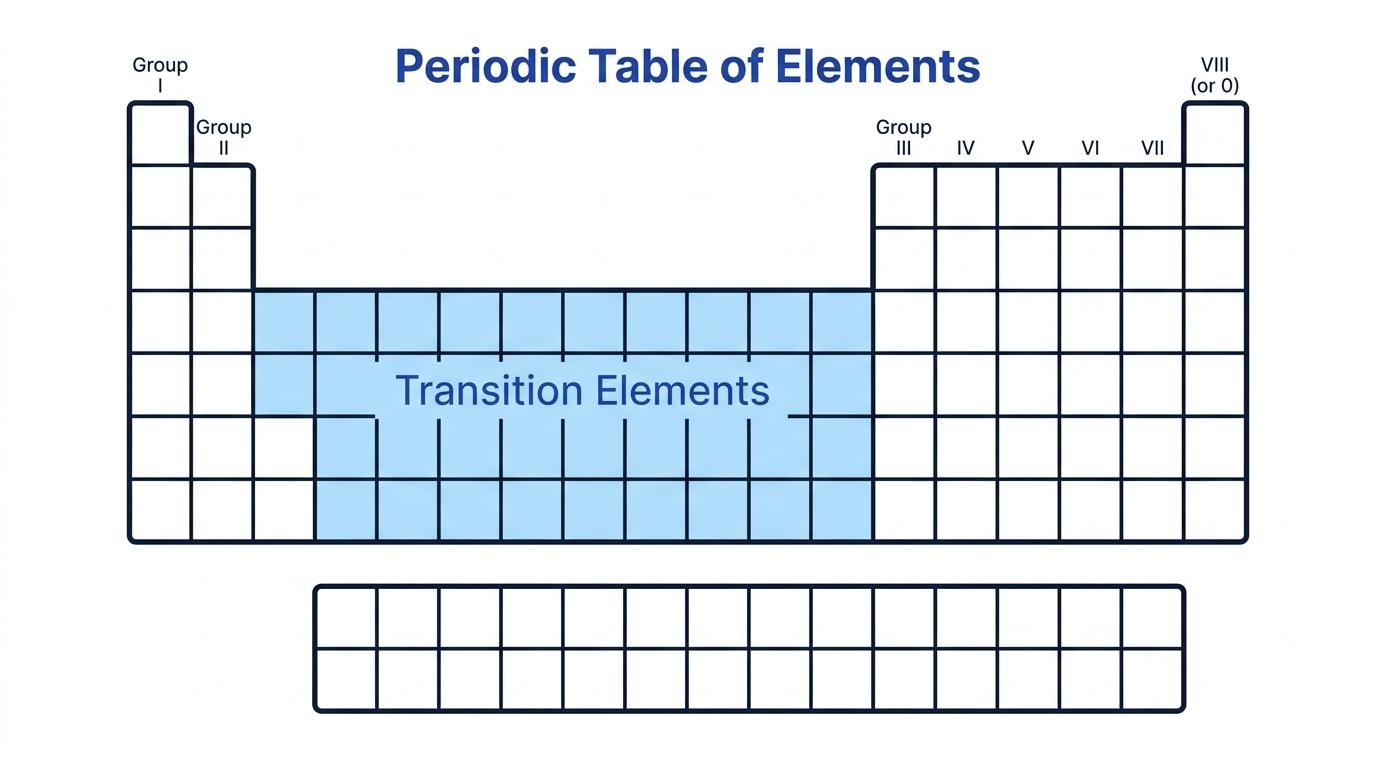
8.4.1 Transition elements
What the transition elements are
Transition element
A metal in the central block of the Periodic Table, between Group II and Group III.
- The transition elements are the block of elements in the middle of the Periodic Table, between Group II and Group III.
- Familiar examples include chromium, manganese, iron, nickel and copper.
- Every transition element is a metal.
- They share four characteristic properties: high densities, high melting points, the formation of coloured compounds, and frequent action as catalysts.
- These properties set them apart from the Group I metals, which are soft, have low densities and low melting points, and form white or colourless compounds.
High density and high melting point
Density
The mass of a substance per unit volume, usually measured in g/cm3\text{g/cm}^3g/cm3.
Melting point
The temperature at which a solid changes into a liquid.
- High density: a piece of a transition element has a large mass for its volume.
- Iron has a density of 7.9 g/cm37.9\ \text{g/cm}^37.9 g/cm3 and copper has a density of 8.9 g/cm38.9\ \text{g/cm}^38.9 g/cm3.
- Sodium, by comparison, has a density of only 0.97 g/cm30.97\ \text{g/cm}^30.97 g/cm3.
- High melting point: a transition element has to be heated to a very high temperature before it melts.
- Iron melts at 1538 ∘C1538\ ^\circ\text{C}1538 ∘C, nickel at 1455 ∘C1455\ ^\circ\text{C}1455 ∘C and copper at 1085 ∘C1085\ ^\circ\text{C}1085 ∘C.
- Sodium melts at only 98 ∘C98\ ^\circ\text{C}98 ∘C and potassium at only 63 ∘C63\ ^\circ\text{C}63 ∘C.
- The atoms of a transition metal are packed tightly together, which gives a large mass in a small volume.
- The metallic bonding between the positive ions and the delocalised electrons is very strong, so a large amount of energy is needed to separate the ions and melt the metal.
- Transition metals are also harder and stronger than the Group I metals, which is why they cannot be cut with a knife.
Comparing the mass of iron and sodium
- Two blocks each have a volume of 10 cm310\ \text{cm}^310 cm3, one made of iron and one made of sodium.
mass=density×volume\text{mass} = \text{density} \times \text{volume}mass=density×volume
- For iron, the mass is 7.9×10=79 g7.9 \times 10 = 79\ \text{g}7.9×10=79 g.
- For sodium, the mass is 0.97×10=9.7 g0.97 \times 10 = 9.7\ \text{g}0.97×10=9.7 g.
- The iron block has about eight times the mass of a sodium block of the same size, which shows how much denser the transition element is.
Coloured compounds
- Compounds of transition elements are usually coloured, both as solids and when dissolved in water.
- Copper(II) sulfate forms blue crystals and a blue solution.
- Nickel(II) sulfate forms a green solution.
- Potassium manganate(VII) forms a deep purple solution.
- Potassium dichromate(VI) forms an orange solution.
- Compounds of Group I and Group II metals, such as sodium chloride and calcium carbonate, are white solids, and any that dissolve give colourless solutions.
- A coloured compound is therefore a strong sign that a transition element is present.
- Do not write that transition elements are coloured, because the metals themselves are mostly grey or silvery and it is their compounds that are coloured.
- Do not describe transition elements as having low densities or low melting points, because those are properties of the Group I metals.
Transition elements as catalysts
Catalyst
A substance that increases the rate of a reaction and is chemically unchanged at the end of the reaction.
- A catalyst increases the rate of a reaction and is chemically unchanged at the end of the reaction, so it can be used again and again.
- Transition elements often act as catalysts, both as the elements themselves and in their compounds.
- As an element: iron is the catalyst in the Haber process, which makes ammonia from nitrogen and hydrogen.
- In a compound: vanadium(V) oxide is the catalyst in the Contact process, which converts sulfur dioxide into sulfur trioxide.
- In a compound: manganese(IV) oxide speeds up the decomposition of hydrogen peroxide into water and oxygen.
- Catalysts allow industrial reactions to run quickly at lower temperatures, which saves energy and money.
- The word often matters, because not every transition element catalyses every reaction.
Manganese(IV) oxide as a catalyst
- Aim: to show that manganese(IV) oxide, a compound of a transition element, speeds up the decomposition of hydrogen peroxide and is unchanged at the end of the reaction.
- Apparatus: two conical flasks, a measuring cylinder, dilute hydrogen peroxide solution, manganese(IV) oxide powder, a spatula, a balance reading to 0.01 g0.01\ \text{g}0.01 g, a filter funnel and filter paper, a wooden splint, a Bunsen burner and eye protection.
- Method:
- Measure 25 cm325\ \text{cm}^325 cm3 of hydrogen peroxide solution into each of the two conical flasks.
- Leave the first flask with no catalyst, so that it acts as a control.
- Weigh 0.50 g0.50\ \text{g}0.50 g of manganese(IV) oxide onto a piece of filter paper and record the exact mass.
- Tip the powder into the second flask and watch both flasks for one minute.
- Light a splint, blow it out so that it glows, and hold it in the neck of each flask in turn.
- When the fizzing in the second flask stops, filter the mixture to collect the black powder.
- Rinse the powder with a little distilled water, leave it to dry completely, and then weigh it again.
- Results:
- The flask without manganese(IV) oxide shows only a few tiny bubbles.
- The flask with manganese(IV) oxide fizzes rapidly and the solution may feel warm.
- The glowing splint relights in the second flask, which shows that the gas is oxygen.
- The dried black powder still has a mass of 0.50 g0.50\ \text{g}0.50 g.
- Conclusion: manganese(IV) oxide increases the rate at which hydrogen peroxide decomposes and is not used up, so it is acting as a catalyst.
- Equation: 2H2O2→2H2O+O22\text{H}_2\text{O}_2 \rightarrow 2\text{H}_2\text{O} + \text{O}_22H2O2→2H2O+O2
- Watch out: the powder must be completely dry before it is weighed again, because any water left on it makes the mass seem to increase.
- Safety: hydrogen peroxide irritates the skin and eyes and manganese(IV) oxide is harmful if swallowed, so wear eye protection and wash off any splashes at once.
Describing transition elements
- When asked to describe the transition elements, give the four properties in full: high density, high melting point, form coloured compounds and act as catalysts.
- For the catalyst property, add that they act as catalysts as elements and in compounds, and name an example of each where you can.
- Write "high density" rather than "heavy", because "heavy" describes a mass, not a property of the material.
- Where are the transition elements found in the Periodic Table?
- Give two physical properties of transition elements and compare them with the Group I metals.
- What is the colour of a solution of copper(II) sulfate?
- Name a transition element that acts as a catalyst as an element, and a transition element compound that acts as a catalyst.
- How can you show that a catalyst is not used up in a reaction?
8.4.2 Variable oxidation numbers
Oxidation numbers of ions
Oxidation number
A number given to each atom in a substance that shows how many electrons it has lost, as a positive value, or gained, as a negative value, compared with the uncombined element.
Variable oxidation number
The ability of an element to form ions with different charges, so that it has more than one oxidation number in its compounds.
- For a simple ion, the oxidation number is equal to the charge on the ion.
- A sodium ion, Na+\text{Na}^{+}Na+, has an oxidation number of +1+1+1, and a chloride ion, Cl−\text{Cl}^{-}Cl−, has an oxidation number of −1-1−1.
- The metals in Groups I and II, and aluminium in Group III, form only one type of ion, so each of these metals has a single oxidation number in its compounds.
- A transition element can lose different numbers of electrons, so one transition element can form ions with different charges.
- Transition elements are therefore described as having ions with variable oxidation numbers.
- The oxidation number shows how many electrons each atom of the metal has lost to form the ion.
Iron(II) and iron(III)
- Iron is the most important example of a transition element with variable oxidation numbers.
- Iron(II): an iron atom loses two electrons to form the Fe2+\text{Fe}^{2+}Fe2+ ion, which has an oxidation number of +2+2+2.
- Iron(III): an iron atom loses three electrons to form the Fe3+\text{Fe}^{3+}Fe3+ ion, which has an oxidation number of +3+3+3.
- Both ions contain the same number of protons, because both come from iron atoms, but Fe3+\text{Fe}^{3+}Fe3+ has one fewer electron than Fe2+\text{Fe}^{2+}Fe2+.
- Because the two ions have different charges, they combine with other ions in different ratios and form compounds with different formulae.
- Iron(II) chloride is FeCl2\text{FeCl}_2FeCl2 and iron(III) chloride is FeCl3\text{FeCl}_3FeCl3.
- Iron(II) oxide is FeO\text{FeO}FeO and iron(III) oxide is Fe2O3\text{Fe}_2\text{O}_3Fe2O3.
- Iron(II) sulfate is FeSO4\text{FeSO}_4FeSO4 and iron(III) sulfate is Fe2(SO4)3\text{Fe}_2(\text{SO}_4)_3Fe2(SO4)3.
- Iron(II) hydroxide is Fe(OH)2\text{Fe(OH)}_2Fe(OH)2 and iron(III) hydroxide is Fe(OH)3\text{Fe(OH)}_3Fe(OH)3.
- Solutions containing iron(II) ions are pale green, while solutions containing iron(III) ions are yellow-brown.
- An iron(II) ion can lose one more electron to become an iron(III) ion, which is an example of oxidation: Fe2+→Fe3++e−\text{Fe}^{2+} \rightarrow \text{Fe}^{3+} + e^{-}Fe2+→Fe3++e−.
- This is why a pale green iron(II) solution left open to the air slowly turns yellow-brown.
- Other transition elements show the same behaviour, so copper forms copper(I) oxide, Cu2O\text{Cu}_2\text{O}Cu2O, and copper(II) oxide, CuO\text{CuO}CuO.
Roman numerals in names
- The oxidation number of a transition element is shown by a Roman numeral in brackets written straight after the name of the element, with no space.
- The name iron(II) chloride tells you that the compound contains Fe2+\text{Fe}^{2+}Fe2+ ions.
- The Roman numeral is needed because the name "iron chloride" on its own could mean either FeCl2\text{FeCl}_2FeCl2 or FeCl3\text{FeCl}_3FeCl3.
- Metals with only one possible ion, such as sodium and magnesium, do not need a numeral, so sodium chloride is never written as sodium(I) chloride.
- The numeral gives the charge on each metal ion, not the number of metal ions in the formula.
- To find the oxidation number from a formula, use the known charges of the other ions and the rule that the total charge in a compound is zero.
Finding the oxidation number of iron
- Iron oxide has the formula Fe2O3\text{Fe}_2\text{O}_3Fe2O3.
- Each oxide ion has a charge of −2-2−2, so three oxide ions give a total of 3×(−2)=−63 \times (-2) = -63×(−2)=−6.
- The two iron ions must give a total of +6+6+6 to balance this.
- Each iron ion is Fe3+\text{Fe}^{3+}Fe3+, so the compound is iron(III) oxide.
Writing a formula from a name
- The compound is iron(III) chloride.
- The numeral (III) shows that each iron ion is Fe3+\text{Fe}^{3+}Fe3+.
- Each chloride ion is Cl−\text{Cl}^{-}Cl−, so three chloride ions are needed to balance one iron ion.
- The formula is FeCl3\text{FeCl}_3FeCl3.
- Do not read iron(III) oxide as a compound with three iron atoms, because the numeral gives the charge on each iron ion and Fe2O3\text{Fe}_2\text{O}_3Fe2O3 contains two.
- Do not write iron(3) or iron III, because the oxidation number is always a Roman numeral inside brackets.
- Do not swap the charges, because iron(II) is Fe2+\text{Fe}^{2+}Fe2+ and iron(III) is Fe3+\text{Fe}^{3+}Fe3+.
Describing variable oxidation numbers
- State that transition elements form ions with different charges, or have variable oxidation numbers.
- Support the statement with iron, giving both Fe2+\text{Fe}^{2+}Fe2+ and Fe3+\text{Fe}^{3+}Fe3+, because one ion alone does not show that the oxidation number varies.
- When naming a compound of iron, always include the numeral, because "iron chloride" does not identify which compound you mean.
- What is meant by a variable oxidation number?
- Give the formulae of the two ions formed by iron.
- Write the formulae of iron(II) oxide and iron(III) oxide.
- Explain how you would work out the oxidation number of iron in FeCl3\text{FeCl}_3FeCl3.
- Why does a sodium compound not need a Roman numeral in its name?