2.5.1 Covalent bonding and the properties of simple molecules
Covalent bonds
Covalent bond
A pair of electrons shared between two atoms, which gives each atom a noble gas electronic configuration.
Molecule
A particle made of two or more atoms joined together by covalent bonds.
- When two non-metal atoms bond, both atoms need to gain electrons, so electrons cannot simply be transferred from one to the other.
- Instead, the atoms share pairs of electrons, and each shared pair of electrons is a covalent bond.
- In a single covalent bond, each atom provides one electron to the shared pair.
- The shared electrons count towards the outer shells of both atoms, so sharing allows each atom to reach a noble gas electronic configuration.
- The shared pair of electrons is attracted to the nuclei of both atoms, and this attraction holds the two atoms together.
- Covalent bonds are strong, so a large amount of energy is needed to break them.
- A group of atoms held together by covalent bonds is called a molecule.
- The number of covalent bonds an atom usually forms equals the number of electrons it needs to fill its outer shell.
- Hydrogen and chlorine each need one more electron, so each forms one bond.
- Oxygen, 2,62,62,6, needs two more electrons, so it forms two bonds.
- Nitrogen, 2,52,52,5, needs three more electrons, so it forms three bonds.
- Carbon, 2,42,42,4, needs four more electrons, so it forms four bonds.
Dot-and-cross diagrams for molecules
- In a dot-and-cross diagram for a molecule, the outer shells of the bonded atoms are drawn as overlapping circles.
- Each shared pair is drawn in the overlap, with one dot from one atom and one cross from the other atom.
- Outer-shell electrons that are not shared are drawn in pairs on their own atom and are called non-bonding pairs.
- When the diagram is complete, every atom should have a full outer shell, which means 2 electrons around hydrogen and 8 around every other atom shown here.
- A covalent bond can also be shown as a single line between the two atoms, as in H−H\text{H}-\text{H}H−H or H−Cl\text{H}-\text{Cl}H−Cl.
Hydrogen, chlorine and hydrogen chloride
- In hydrogen, H2\text{H}_2H2, each hydrogen atom shares its single electron, giving one shared pair of one dot and one cross, so each atom now has 2 electrons like helium.
- In chlorine, Cl2\text{Cl}_2Cl2, each chlorine atom has 7 outer-shell electrons and shares one of them, giving one shared pair and leaving three non-bonding pairs on each atom.
- In hydrogen chloride, HCl\text{HCl}HCl, the hydrogen electron pairs with one chlorine electron, so hydrogen has 2 electrons and chlorine has one shared pair plus three non-bonding pairs, making 8.
Water, ammonia and methane
- In water, H2O\text{H}_2\text{O}H2O, the oxygen atom shares one electron with each of two hydrogen atoms, forming two single bonds and keeping two non-bonding pairs.
- In ammonia, NH3\text{NH}_3NH3, the nitrogen atom shares one electron with each of three hydrogen atoms, forming three single bonds and keeping one non-bonding pair.
- In methane, CH4\text{CH}_4CH4, the carbon atom shares one electron with each of four hydrogen atoms, forming four single bonds and keeping no non-bonding pairs.
- In each molecule the central atom ends up with 8 outer-shell electrons and every hydrogen atom ends up with 2.
Properties of simple molecular substances
Simple molecular substance
A substance made of small, separate molecules that are held near one another only by weak forces of attraction.
- Hydrogen, chlorine, hydrogen chloride, water, ammonia and methane are all simple molecular substances, made of small, separate molecules.
- The covalent bonds inside each molecule are strong, but the forces of attraction between neighbouring molecules are weak.
- Simple molecular substances have low melting points and boiling points, because only a small amount of energy is needed to overcome the weak forces between the molecules.
- Many are gases at room temperature, such as methane, which boils at about −162 ∘C-162\ ^{\circ}\text{C}−162 ∘C, and chlorine, which boils at about −34 ∘C-34\ ^{\circ}\text{C}−34 ∘C.
- Water boils at 100 ∘C100\ ^{\circ}\text{C}100 ∘C, which is still very low compared with an ionic compound such as sodium chloride.
- When a simple molecular substance melts or boils, the molecules move apart but the covalent bonds inside each molecule do not break.
- Simple molecular substances are poor conductors of electricity, because they are made of molecules with no overall charge and contain no ions or free electrons that can move.
Comparing the melting of wax and salt
- Aim: to compare how easily a simple molecular substance and an ionic compound melt when heated.
- Apparatus: paraffin wax shavings, sodium chloride crystals, two dry boiling tubes, a test-tube holder, a test-tube rack, a Bunsen burner, a heat-proof mat, a spatula, a stopwatch and eye protection.
- Method:
- Place one level spatula of wax shavings in the first boiling tube and one level spatula of sodium chloride crystals in the second boiling tube.
- Light the Bunsen burner and adjust it to a gentle blue flame.
- Hold the tube of wax at an angle in the test-tube holder, start the stopwatch and warm the bottom of the tube gently just above the flame.
- Stop the stopwatch and take the tube out of the flame as soon as all the wax has melted to a clear liquid, then place it in the rack to cool.
- Heat the tube of sodium chloride in the same way for up to two minutes, moving it in and out of the flame and watching the crystals closely.
- Record the time taken for each solid to melt, or record that it did not melt.
- Results: the wax melts within a few seconds to a clear, colourless liquid, while the sodium chloride crystals stay solid even after two minutes of heating.
- Conclusion: the wax, a simple molecular substance, has a low melting point because only weak forces between its molecules must be overcome, while sodium chloride has a much higher melting point because of its strong ionic bonds.
- Safety: wear eye protection, heat the wax gently and remove it from the flame as soon as it melts because hot wax vapour is flammable, and let the hot boiling tubes cool in the rack before touching them.
Do not say that covalent bonds break when a simple molecular substance melts or boils, because only the weak forces between the molecules are overcome.
Drawing dot-and-cross diagrams
- Draw only the outer shells unless the question asks for every shell.
- Make sure every shared pair contains exactly one dot and one cross, and that the non-bonding pairs are shown on oxygen, nitrogen and chlorine atoms.
- Count the electrons around each atom before you finish, checking for 2 around hydrogen and 8 around every other atom.
- When explaining a low boiling point, refer to the weak forces between molecules, never to weak covalent bonds.
- What is a covalent bond?
- How many covalent bonds does a nitrogen atom form in ammonia?
- How many non-bonding pairs are on the oxygen atom in a water molecule?
- Why do simple molecular substances have low melting points?
- Why are simple molecular substances poor conductors of electricity?
2.5.2 Covalent bonding in further molecules and their properties
Multiple covalent bonds
Double covalent bond
A covalent bond in which two pairs of electrons are shared between the same two atoms.
Triple covalent bond
A covalent bond in which three pairs of electrons are shared between the same two atoms.
- Some atoms need more than one extra electron to fill their outer shell, but bond to only one other atom.
- These atoms fill their outer shells by sharing more than one pair of electrons with the same atom.
- A double covalent bond contains two shared pairs of electrons, which is four electrons in total, and is shown as a double line, such as O=O\text{O}=\text{O}O=O.
- A triple covalent bond contains three shared pairs of electrons, which is six electrons in total, and is shown as a triple line, such as N≡N\text{N}\equiv\text{N}N≡N.
- In a dot-and-cross diagram, every shared pair is still drawn in the overlap of the two outer shells, with one dot and one cross in each pair.
Oxygen and nitrogen molecules
- An oxygen molecule, O2\text{O}_2O2, is made of two oxygen atoms, each with the configuration 2,62,62,6 and so each needing two more electrons.
- Each oxygen atom shares two of its electrons, so the overlap contains two pairs, each with one dot and one cross, forming a double bond.
- Each oxygen atom keeps two non-bonding pairs, so it ends up with 4+4=84+4=84+4=8 outer-shell electrons.
- A nitrogen molecule, N2\text{N}_2N2, is made of two nitrogen atoms, each with the configuration 2,52,52,5 and so each needing three more electrons.
- Each nitrogen atom shares three of its electrons, so the overlap contains three pairs, forming a triple bond.
- Each nitrogen atom keeps one non-bonding pair, so it ends up with 6+2=86+2=86+2=8 outer-shell electrons.
Methanol and ethene
- A methanol molecule, CH3OH\text{CH}_3\text{OH}CH3OH, contains one carbon atom, one oxygen atom and four hydrogen atoms, all joined by single bonds.
- The carbon atom forms four single bonds, three to hydrogen atoms and one to the oxygen atom, and has no non-bonding pairs.
- The oxygen atom forms two single bonds, one to the carbon atom and one to a hydrogen atom, and keeps two non-bonding pairs, exactly as it does in water.
- Every hydrogen atom shares one pair of electrons, so each has 2 outer-shell electrons.
- An ethene molecule, C2H4\text{C}_2\text{H}_4C2H4, contains two carbon atoms and four hydrogen atoms.
- Each carbon atom forms single bonds with two hydrogen atoms, which uses two of its four outer-shell electrons.
- Each carbon atom shares its remaining two outer-shell electrons with the other carbon atom, forming a carbon-carbon double bond, C=C\text{C}=\text{C}C=C.
- Each carbon atom ends up with four shared pairs, which is 8 outer-shell electrons, and no non-bonding pairs.
Carbon dioxide
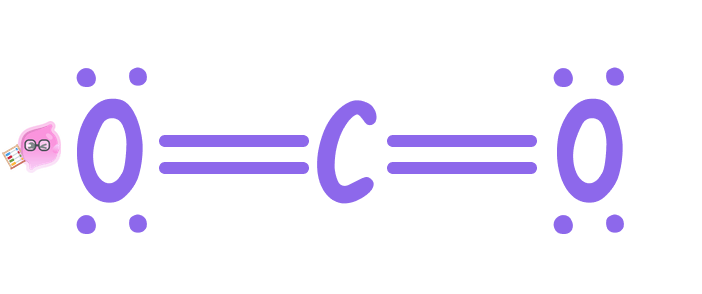
- A carbon dioxide molecule, CO2\text{CO}_2CO2, has a carbon atom in the centre with an oxygen atom on each side.
- The carbon atom, 2,42,42,4, needs four more electrons, while each oxygen atom, 2,62,62,6, needs two more.
- The carbon atom forms a double bond with each oxygen atom, sharing two of its electrons with each one.
- The structure is therefore O=C=O\text{O}=\text{C}=\text{O}O=C=O, with four shared pairs around the carbon atom and two non-bonding pairs on each oxygen atom.
Checking the diagram for carbon dioxide
- The outer-shell electrons available are 4 from carbon and 6 from each oxygen atom.
- Two double bonds use 4 of these pairs, leaving 4 pairs as non-bonding pairs, two on each oxygen atom.
- Carbon is surrounded by 4 shared pairs, which is 8 electrons.
- Each oxygen atom has 2 shared pairs and 2 non-bonding pairs, which is also 8 electrons.
Checking the diagram for methanol
- The outer-shell electrons available are 4 from carbon, 6 from oxygen and 1 from each of the four hydrogen atoms.
- Five single bonds, four from carbon and one between oxygen and hydrogen, use 5 of these pairs.
- The remaining 2 pairs are the two non-bonding pairs on the oxygen atom.
Explaining the properties of simple molecules
Intermolecular forces
The weak forces of attraction that act between neighbouring molecules.
- A simple molecular substance contains two very different kinds of attraction.
- The covalent bonds within each molecule are strong.
- The intermolecular forces between neighbouring molecules are weak.
- When a simple molecular substance melts or boils, only the weak intermolecular forces are overcome, so the molecules separate while staying intact.
- Only a small amount of energy is needed to overcome these weak forces, so simple molecular substances have low melting points and boiling points.
- Oxygen boils at −183 ∘C-183\ ^{\circ}\text{C}−183 ∘C and nitrogen boils at −196 ∘C-196\ ^{\circ}\text{C}−196 ∘C.
- Carbon dioxide turns directly from a solid into a gas at −78 ∘C-78\ ^{\circ}\text{C}−78 ∘C, and ethene boils at −104 ∘C-104\ ^{\circ}\text{C}−104 ∘C.
- Methanol is a liquid at room temperature and boils at 65 ∘C65\ ^{\circ}\text{C}65 ∘C.
- When water boils, the steam is still made of H2O\text{H}_2\text{O}H2O molecules, which shows that the covalent bonds have not been broken.
- Simple molecular substances are poor conductors of electricity in every state, because their molecules have no overall charge and there are no ions or delocalised electrons free to move.
- Do not say that covalent bonds are broken when a simple molecular substance melts or boils, because only the intermolecular forces are overcome.
- Do not describe covalent bonds as weak, because it is the forces between the molecules that are weak.
- Do not draw a double bond with a single dot and cross, because a double bond needs two pairs of shared electrons.
Explaining low boiling points
- A full explanation names the weak intermolecular forces, states that little energy is needed to overcome them, and refers to the substance being made of molecules.
- In dot-and-cross diagrams with double or triple bonds, count the shared pairs carefully and make sure each atom other than hydrogen ends with 8 outer-shell electrons.
- Show every non-bonding pair, because missing pairs on oxygen or nitrogen are a common reason for losing the mark.
- How many pairs of electrons are shared in a triple covalent bond?
- How many non-bonding pairs does each oxygen atom have in a carbon dioxide molecule?
- Which bond in ethene is a double bond?
- What is overcome when methanol boils?
- Why does nitrogen have a very low boiling point?
