6.4.1 Oxidation numbers and redox in terms of oxygen
Oxidation numbers in names
Oxidation number
A number given to each atom in a substance that shows how many electrons it has lost, as a positive value, or gained, as a negative value, compared with the uncombined element.
- Some elements, especially transition elements, can form more than one compound with the same element because their atoms can have different oxidation numbers.
- A Roman numeral in brackets after the element's name shows its oxidation number in that compound.
- Iron(II) oxide, FeO\mathrm{FeO}FeO, contains iron with an oxidation number of +2+2+2, while iron(III) oxide, Fe2O3\mathrm{Fe_{2}O_{3}}Fe2O3, contains iron with an oxidation number of +3+3+3.
- Copper(I) oxide, Cu2O\mathrm{Cu_{2}O}Cu2O, is a red solid, while copper(II) oxide, CuO\mathrm{CuO}CuO, is a black solid, so the numeral tells you which compound is meant.
- Roman numerals also appear in the names of ions containing more than one element, such as the manganate(VII) ion in potassium manganate(VII), KMnO4\mathrm{KMnO_{4}}KMnO4.
- The numeral is written in brackets straight after the name, with no space, as in iron(III).
- For a metal ion, the Roman numeral matches the size of its positive charge, so iron(III) compounds contain Fe3+\mathrm{Fe^{3+}}Fe3+ ions.
Formulae from names
- Copper(II) chloride contains copper ions with a 2+2+2+ charge and chloride ions with a 1−1-1− charge.
- Two chloride ions balance the charge on one copper(II) ion.
- Iron(III) chloride contains iron ions with a 3+3+3+ charge, so three chloride ions are needed.
Oxidation and reduction
Oxidation (in terms of oxygen)
The gain of oxygen by a substance.
Reduction (in terms of oxygen)
The loss of oxygen by a substance.
- Oxidation takes place when a substance gains oxygen.
- When magnesium burns, it gains oxygen to form magnesium oxide, so magnesium is oxidised: 2Mg(s)+O2(g)→2MgO(s)\mathrm{2Mg(s) + O_{2}(g) \rightarrow 2MgO(s)}2Mg(s)+O2(g)→2MgO(s).
- Combustion of fuels and the rusting of iron are everyday examples of oxidation.
- Reduction takes place when a substance loses oxygen.
- When hot copper(II) oxide reacts with hydrogen, it loses oxygen and becomes copper, so copper(II) oxide is reduced.
- Extracting a metal from its oxide involves reduction, because oxygen is removed from the metal oxide.
Redox reactions
Redox reaction
A reaction in which oxidation and reduction take place at the same time.
- Oxidation and reduction always happen together, because oxygen gained by one substance must have been lost by another substance.
- The word redox comes from reduction and oxidation.
- In CuO(s)+H2(g)→Cu(s)+H2O(g)\mathrm{CuO(s) + H_{2}(g) \rightarrow Cu(s) + H_{2}O(g)}CuO(s)+H2(g)→Cu(s)+H2O(g), copper(II) oxide loses oxygen and is reduced, while hydrogen gains oxygen and is oxidised.
- To identify oxidation and reduction, follow the oxygen through the equation.
- The substance that gains oxygen is oxidised.
- The substance that loses oxygen is reduced.
- A reaction is identified as redox when one substance gains oxygen and another substance loses oxygen in the same reaction.
Iron(III) oxide and carbon monoxide
Fe2O3(s)+3CO(g)→2Fe(l)+3CO2(g) \mathrm{Fe_{2}O_{3}(s) + 3CO(g) \rightarrow 2Fe(l) + 3CO_{2}(g)} Fe2O3(s)+3CO(g)→2Fe(l)+3CO2(g)- Iron(III) oxide loses its oxygen and becomes iron, so iron(III) oxide is reduced.
- Carbon monoxide gains oxygen and becomes carbon dioxide, so carbon monoxide is oxidised.
- Both processes happen in the same reaction, so this is a redox reaction.
Magnesium and copper(II) oxide
Mg(s)+CuO(s)→MgO(s)+Cu(s) \mathrm{Mg(s) + CuO(s) \rightarrow MgO(s) + Cu(s)} Mg(s)+CuO(s)→MgO(s)+Cu(s)- Magnesium gains oxygen to form magnesium oxide, so magnesium is oxidised.
- Copper(II) oxide loses oxygen to form copper, so copper(II) oxide is reduced.
Reducing copper(II) oxide with carbon
- Aim: to show a redox reaction by heating black copper(II) oxide with carbon and identifying the products.
- Apparatus: hard-glass boiling tube, bung fitted with a delivery tube, clamp and stand, Bunsen burner, heat-resistant mat, spatula, sheet of paper, test tube of limewater, beaker of cold water, copper(II) oxide powder, powdered charcoal and eye protection.
- Method, preparing the mixture:
- Tip one spatula of copper(II) oxide and one spatula of powdered charcoal onto a sheet of paper and mix them with the spatula until the colour is even.
- Pour the mixture into the hard-glass boiling tube and clamp the tube near its mouth, almost horizontal.
- Fit the bung and dip the end of the delivery tube into the limewater.
- Method, heating:
- Heat the mixture strongly with a roaring blue flame for about five minutes.
- Watch the bubbles of gas passing through the limewater.
- Lift the delivery tube out of the limewater before you stop heating, so that limewater cannot be sucked back into the hot tube.
- Method, finding the copper:
- Leave the tube to cool, then tip its contents into the beaker of cold water and swirl gently.
- Pour off the floating charcoal and look at the solid left at the bottom of the beaker.
- Results: pink-brown specks of copper are left at the bottom of the beaker and the limewater turns milky, which shows that copper(II) oxide has lost oxygen and carbon has gained oxygen to form carbon dioxide.
- Reaction: 2CuO(s)+C(s)→2Cu(s)+CO2(g)\mathrm{2CuO(s) + C(s) \rightarrow 2Cu(s) + CO_{2}(g)}2CuO(s)+C(s)→2Cu(s)+CO2(g)
- Watch out: black solid left in the tube means that the mixture was not heated strongly enough, so use the hottest part of the flame.
- Safety: wear eye protection, let the hot glass cool before you touch it, avoid suck-back, and wash your hands afterwards because copper(II) oxide is harmful if swallowed.
Identifying oxidation and reduction
- Write down which reactant gains oxygen and which reactant loses oxygen.
- Name the substance that is oxidised and the substance that is reduced in full, including any Roman numeral.
- Check that one substance is oxidised and another is reduced, because this confirms the reaction is a redox reaction.
Answering redox questions
- When you are asked which substance is oxidised, name the substance, such as “hydrogen is oxidised”, rather than writing “oxidation”.
- Support the answer with a reason based on oxygen, such as “because it gains oxygen”.
- When you are asked why a reaction is a redox reaction, state that one substance gains oxygen and another substance loses oxygen at the same time.
- Include the Roman numeral whenever a name needs one, such as copper(II) oxide.
- Do not swap the definitions, because reduction is the loss of oxygen, not the gain.
- Do not read the Roman numeral as the number of atoms, because iron(III) oxide contains two iron atoms in each formula unit, Fe2O3\mathrm{Fe_{2}O_{3}}Fe2O3.
- Do not name only the substance that is oxidised when you describe a redox reaction, because the substance that is reduced must be named too.
- What does the Roman numeral in iron(III) oxide show?
- Define oxidation in terms of oxygen.
- Define a redox reaction.
- In the reaction between copper(II) oxide and hydrogen, which substance is reduced?
- Why must oxidation and reduction always happen together?
6.4.2 Oxidation and reduction as electron transfer and change in oxidation number
Electron transfer
Oxidation
The loss of electrons by a substance.
Reduction
The gain of electrons by a substance.
- Many redox reactions involve no oxygen at all, so a more general definition is based on electrons.
- Oxidation is the loss of electrons, and reduction is the gain of electrons.
- The phrase OIL RIG helps you remember this: Oxidation Is Loss, Reduction Is Gain.
- Electrons lost by one substance are gained by another, so oxidation and reduction still happen together.
- A redox reaction can be identified as a reaction in which one substance loses electrons and another substance gains electrons.
- When magnesium is added to copper(II) sulfate solution, magnesium atoms lose electrons and copper(II) ions gain them: Mg(s)+Cu2+(aq)→Mg2+(aq)+Cu(s)\mathrm{Mg(s) + Cu^{2+}(aq) \rightarrow Mg^{2+}(aq) + Cu(s)}Mg(s)+Cu2+(aq)→Mg2+(aq)+Cu(s).
- Magnesium is oxidised because it loses two electrons: Mg→Mg2++2e−\mathrm{Mg \rightarrow Mg^{2+} + 2e^{-}}Mg→Mg2++2e−.
- Copper(II) ions are reduced because they gain two electrons: Cu2++2e−→Cu\mathrm{Cu^{2+} + 2e^{-} \rightarrow Cu}Cu2++2e−→Cu.
- The sulfate ions do not change, so they are spectator ions and are left out of the ionic equation.
Sodium burning in chlorine
2Na(s)+Cl2(g)→2NaCl(s) \mathrm{2Na(s) + Cl_{2}(g) \rightarrow 2NaCl(s)} 2Na(s)+Cl2(g)→2NaCl(s)- No oxygen is involved, but each sodium atom loses one electron to become a sodium ion.
- Sodium loses electrons, so sodium is oxidised.
- Each chlorine molecule gains two electrons to become two chloride ions.
- Chlorine gains electrons, so chlorine is reduced, and the reaction is a redox reaction.
Oxidation numbers
Oxidation number
A number given to each atom in a substance that shows how many electrons it has lost, as a positive value, or gained, as a negative value, compared with the uncombined element.
Oxidation (in terms of oxidation number)
An increase in the oxidation number of an element.
Reduction (in terms of oxidation number)
A decrease in the oxidation number of an element.
- Oxidation numbers let you track electrons in any reaction, including reactions between molecules.
- Uncombined elements
- The oxidation number of an element in its uncombined state is zero, as in Mg\mathrm{Mg}Mg, O2\mathrm{O_{2}}O2 and Cl2\mathrm{Cl_{2}}Cl2.
- Monatomic ions
- The oxidation number of an ion made of a single atom is the same as its charge, so Na+\mathrm{Na^{+}}Na+ is +1+1+1, Cu2+\mathrm{Cu^{2+}}Cu2+ is +2+2+2 and O2−\mathrm{O^{2-}}O2− is −2-2−2.
- Compounds
- The oxidation numbers of all the atoms in a compound add up to zero.
- In H2O\mathrm{H_{2}O}H2O, 2×(+1)+(−2)=02 \times (+1) + (-2) = 02×(+1)+(−2)=0.
- Ions containing more than one atom
- The oxidation numbers of all the atoms in the ion add up to the charge on the ion.
- In OH−\mathrm{OH^{-}}OH−, (−2)+(+1)=−1(-2) + (+1) = -1(−2)+(+1)=−1.
- Useful values in compounds are oxygen at −2-2−2, hydrogen at +1+1+1, Group I metals at +1+1+1 and Group II metals at +2+2+2.
- Oxidation numbers are written with the sign in front, such as +3+3+3, while ionic charges are written with the sign after, such as 3+3+3+.
Finding oxidation numbers
- Sulfur in the sulfate ion, SO42−\mathrm{SO_{4}^{2-}}SO42−, with oxygen at −2-2−2.
- Manganese in the manganate(VII) ion, MnO4−\mathrm{MnO_{4}^{-}}MnO4−, which explains the numeral in its name.
- Iron in iron(III) oxide, Fe2O3\mathrm{Fe_{2}O_{3}}Fe2O3.
- Nitrogen in the ammonium ion, NH4+\mathrm{NH_{4}^{+}}NH4+, with hydrogen at +1+1+1.
Identifying redox from oxidation numbers
- Write the oxidation number of every element on both sides of the equation.
- An element whose oxidation number increases has been oxidised.
- An element whose oxidation number decreases has been reduced.
- If any oxidation numbers change, the reaction is a redox reaction.
- If no oxidation numbers change, the reaction is not a redox reaction.
- Neutralisation, such as NaOH(aq)+HCl(aq)→NaCl(aq)+H2O(l)\mathrm{NaOH(aq) + HCl(aq) \rightarrow NaCl(aq) + H_{2}O(l)}NaOH(aq)+HCl(aq)→NaCl(aq)+H2O(l), is not a redox reaction because every element keeps the same oxidation number.
Iron(III) oxide and carbon monoxide
Fe2O3+3CO→2Fe+3CO2 \mathrm{Fe_{2}O_{3} + 3CO \rightarrow 2Fe + 3CO_{2}} Fe2O3+3CO→2Fe+3CO2- Iron goes from +3+3+3 in Fe2O3\mathrm{Fe_{2}O_{3}}Fe2O3 to 000 in Fe\mathrm{Fe}Fe, a decrease, so iron is reduced.
- Carbon goes from +2+2+2 in CO\mathrm{CO}CO to +4+4+4 in CO2\mathrm{CO_{2}}CO2, an increase, so carbon is oxidised.
- Oxygen stays at −2-2−2 throughout, and the changes for iron and carbon show the reaction is redox.
Chlorine and potassium bromide
Cl2(aq)+2KBr(aq)→2KCl(aq)+Br2(aq) \mathrm{Cl_{2}(aq) + 2KBr(aq) \rightarrow 2KCl(aq) + Br_{2}(aq)} Cl2(aq)+2KBr(aq)→2KCl(aq)+Br2(aq)- Chlorine goes from 000 in Cl2\mathrm{Cl_{2}}Cl2 to −1-1−1 in KCl\mathrm{KCl}KCl, so chlorine is reduced.
- Bromine goes from −1-1−1 in KBr\mathrm{KBr}KBr to 000 in Br2\mathrm{Br_{2}}Br2, so bromine is oxidised.
- Potassium stays at +1+1+1, so the potassium ions are spectator ions.
Colour changes in redox reactions
- Two reagents change colour when they take part in a redox reaction, so they can show that a redox reaction has happened.
- Acidified aqueous potassium manganate(VII) is purple.
- When it reacts with a substance that can be oxidised, the manganate(VII) ions are reduced and the solution changes from purple to colourless.
- Manganese is reduced from +7+7+7 in MnO4−\mathrm{MnO_{4}^{-}}MnO4− to +2+2+2 in Mn2+\mathrm{Mn^{2+}}Mn2+, which is almost colourless in dilute solution.
- Iron(II) ions and sulfur dioxide both decolourise acidified potassium manganate(VII), because they are oxidised by it.
- Aqueous potassium iodide is colourless.
- When it reacts with a substance that can oxidise it, iodide ions are oxidised to iodine and the solution changes from colourless to brown.
- Iodine goes from −1-1−1 in I−\mathrm{I^{-}}I− to 000 in I2\mathrm{I_{2}}I2: 2I−(aq)→I2(aq)+2e−\mathrm{2I^{-}(aq) \rightarrow I_{2}(aq) + 2e^{-}}2I−(aq)→I2(aq)+2e−.
- Chlorine water, hydrogen peroxide and iron(III) ions all turn aqueous potassium iodide brown.
Testing for redox with potassium manganate(VII) and potassium iodide
- Aim: to use colour changes to show whether a substance takes part in a redox reaction with acidified aqueous potassium manganate(VII) or aqueous potassium iodide.
- Apparatus: test tubes, test-tube rack, dropping pipettes, 10 cm310\ \text{cm}^310 cm3 measuring cylinder, white tile, dilute sulfuric acid, very dilute aqueous potassium manganate(VII), aqueous potassium iodide, freshly made aqueous iron(II) sulfate, dilute hydrogen peroxide solution, distilled water and eye protection.
- Method, acidified potassium manganate(VII):
- Pour about 2 cm32\ \text{cm}^32 cm3 of very dilute potassium manganate(VII) into a test tube and add an equal volume of dilute sulfuric acid to acidify it.
- Hold the tube in front of the white tile so that the purple colour is easy to see.
- Add aqueous iron(II) sulfate one drop at a time, shaking gently after each drop, and record any colour change.
- Repeat with distilled water in place of the iron(II) sulfate as a control.
- Method, aqueous potassium iodide:
- Pour about 2 cm32\ \text{cm}^32 cm3 of aqueous potassium iodide into a clean test tube and add three drops of dilute sulfuric acid.
- Add five drops of dilute hydrogen peroxide solution and shake gently.
- Record the colour after one minute, against the white tile.
- Repeat with distilled water in place of the hydrogen peroxide as a control.
- Results: iron(II) sulfate turns the purple manganate(VII) solution colourless, and hydrogen peroxide turns the colourless potassium iodide solution brown, while neither control changes colour.
- Explanation: the loss of purple shows that manganate(VII) ions were reduced as iron(II) ions were oxidised to iron(III) ions, and the brown colour shows that iodide ions were oxidised to iodine.
- Safety: wear eye protection, avoid skin contact with potassium manganate(VII) because it is an oxidiser that stains, and handle dilute sulfuric acid and hydrogen peroxide with care because they irritate the skin and eyes.
Using oxidation numbers and colour changes
- Write every oxidation number with a sign, such as +2+2+2 or −1-1−1, and write 000 for an uncombined element.
- When you identify oxidation or reduction, quote the change for the element, such as “iron decreases from +3+3+3 to 000, so it is reduced”.
- When you use electron transfer, state which species loses electrons and which species gains them.
- For the colour tests, give the starting and finishing colours: purple to colourless for acidified potassium manganate(VII), and colourless to brown for aqueous potassium iodide.
- Write “colourless” rather than “clear”, because a clear solution can still be coloured.
- Do not write “clear” when you mean colourless.
- Do not give oxygen in a compound an oxidation number of +2+2+2, because it is almost always −2-2−2.
- Do not mix up the two tests, because manganate(VII) is decolourised by a substance that is oxidised, while iodide turns brown when something oxidises it.
- Define oxidation in terms of electrons.
- What is the oxidation number of an element in its uncombined state?
- What is the oxidation number of sulfur in SO42−\mathrm{SO_4^{2-}}SO42−?
- How do oxidation numbers show that a reaction is a redox reaction?
- What colour change is seen when acidified aqueous potassium manganate(VII) reacts with a substance that is oxidised?
6.4.3 Oxidising and reducing agents
Oxidising and reducing agents
Oxidising agent
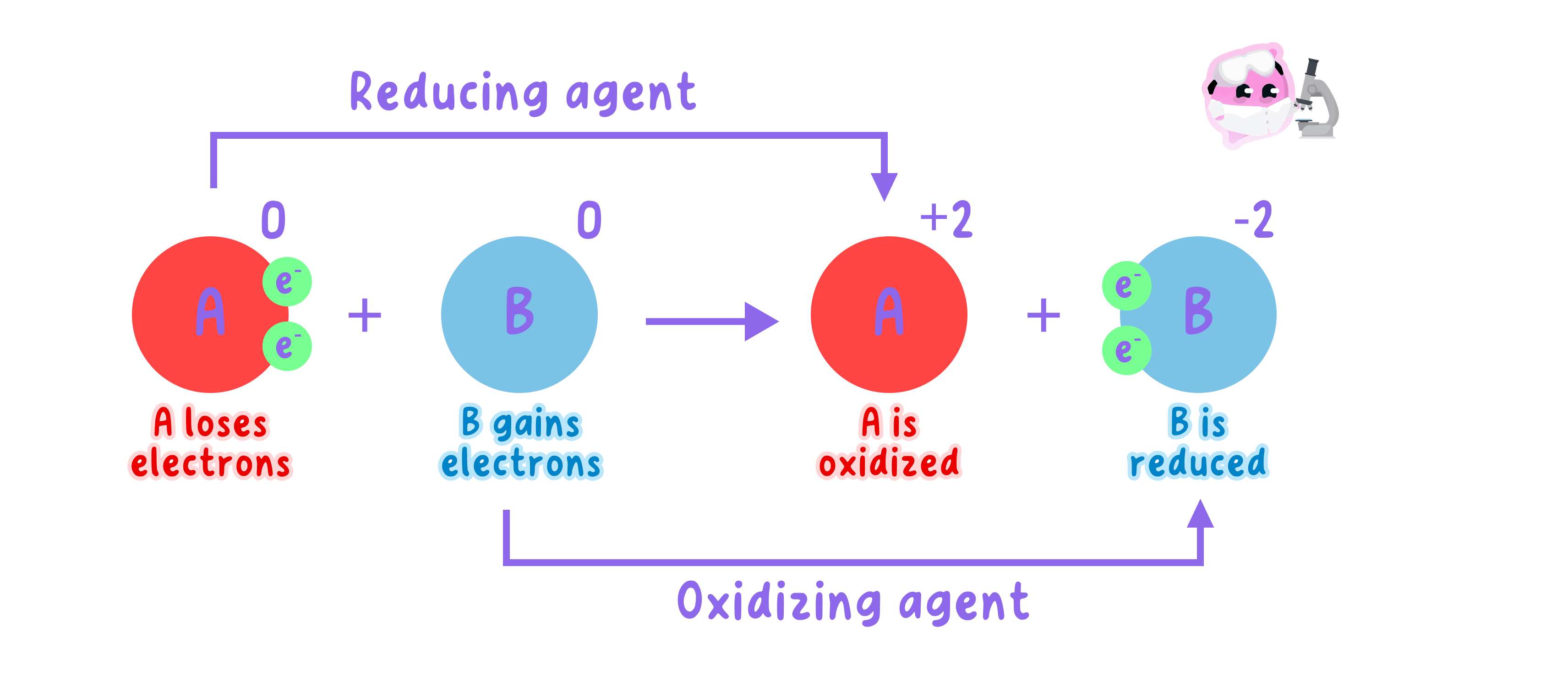
A substance that oxidises another substance and is itself reduced.
Reducing agent
A substance that reduces another substance and is itself oxidised.
- In every redox reaction, one reactant causes the other to be oxidised, and the other reactant causes reduction.
- An oxidising agent takes electrons from another substance, so it oxidises that substance.
- By gaining electrons, the oxidising agent is itself reduced, so the oxidation number of one of its elements decreases.
- A reducing agent gives electrons to another substance, so it reduces that substance.
- By losing electrons, the reducing agent is itself oxidised, so the oxidation number of one of its elements increases.
- The oxidising agent is therefore the substance that is reduced, and the reducing agent is the substance that is oxidised.
Magnesium and copper(II) ions
Mg(s)+Cu2+(aq)→Mg2+(aq)+Cu(s) \mathrm{Mg(s) + Cu^{2+}(aq) \rightarrow Mg^{2+}(aq) + Cu(s)} Mg(s)+Cu2+(aq)→Mg2+(aq)+Cu(s)- Magnesium atoms lose electrons and are oxidised, so magnesium is the reducing agent.
- Copper(II) ions gain electrons and are reduced, so the copper(II) ions are the oxidising agent.
- The electrons lost by magnesium are the same electrons gained by the copper(II) ions.
Identifying the agents
- Write the oxidation number of each element on both sides of the equation.
- Find the element whose oxidation number decreases, because the reactant containing it is the oxidising agent.
- Find the element whose oxidation number increases, because the reactant containing it is the reducing agent.
- Name the whole reactant as the agent, such as iron(III) oxide rather than just iron.
- An agent is always a reactant, never a product.
- Spectator ions take no part in the electron transfer, so they are never the oxidising agent or the reducing agent.
- For a reaction described in terms of oxygen, the substance that gives oxygen away is the oxidising agent and the substance that takes oxygen is the reducing agent.
Iron(III) oxide and carbon monoxide
Fe2O3+3CO→2Fe+3CO2 \mathrm{Fe_{2}O_{3} + 3CO \rightarrow 2Fe + 3CO_{2}} Fe2O3+3CO→2Fe+3CO2- Iron decreases from +3+3+3 to 000, so iron(III) oxide is reduced and is the oxidising agent.
- Carbon increases from +2+2+2 to +4+4+4, so carbon monoxide is oxidised and is the reducing agent.
Chlorine and iodide ions
Cl2(aq)+2I−(aq)→2Cl−(aq)+I2(aq) \mathrm{Cl_{2}(aq) + 2I^{-}(aq) \rightarrow 2Cl^{-}(aq) + I_{2}(aq)} Cl2(aq)+2I−(aq)→2Cl−(aq)+I2(aq)- Chlorine decreases from 000 to −1-1−1, so chlorine is the oxidising agent.
- Iodine increases from −1-1−1 to 000, so the iodide ions are the reducing agent.
- The colourless solution turns brown as iodine forms.
Copper(II) oxide and hydrogen
CuO(s)+H2(g)→Cu(s)+H2O(g) \mathrm{CuO(s) + H_{2}(g) \rightarrow Cu(s) + H_{2}O(g)} CuO(s)+H2(g)→Cu(s)+H2O(g)- Hydrogen takes oxygen from copper(II) oxide and is oxidised, so hydrogen is the reducing agent.
- Copper(II) oxide gives its oxygen away and is reduced, so copper(II) oxide is the oxidising agent.
- In terms of oxidation numbers, copper decreases from +2+2+2 to 000 and hydrogen increases from 000 to +1+1+1.
Common oxidising and reducing agents
- Common oxidising agents include:
- Oxygen, which oxidises metals and fuels.
- Chlorine, which oxidises bromide ions and iodide ions to bromine and iodine.
- Acidified potassium manganate(VII), which turns from purple to colourless as it is reduced.
- Iron(III) ions, which are reduced to iron(II) ions.
- Common reducing agents include:
- Carbon and carbon monoxide, which reduce metal oxides such as iron(III) oxide.
- Hydrogen, which reduces hot copper(II) oxide to copper.
- Reactive metals, such as magnesium and zinc, which reduce the ions of less reactive metals.
- Potassium iodide, whose iodide ions are oxidised to brown iodine.
- The same substance can act as an oxidising agent in one reaction and a reducing agent in another, so always decide from the equation you are given.
- Acidified potassium manganate(VII) turning colourless shows that a reducing agent is present.
- Aqueous potassium iodide turning brown shows that an oxidising agent is present.
Naming oxidising and reducing agents
- Name a reactant from the equation in full, including any Roman numeral, such as “iron(III) oxide”.
- Give a reason linked to the definition, such as “chlorine is the oxidising agent because it gains electrons” or “because its oxidation number decreases from 000 to −1-1−1”.
- When you define an agent, give the whole statement, including the part that says the oxidising agent is itself reduced or the reducing agent is itself oxidised.
- Never give a spectator ion, such as a potassium ion or a sulfate ion, as an agent.
- Do not write that the oxidising agent is oxidised, because it is reduced.
- Do not give a product, such as copper or iodine, as the agent.
- Do not name only the element, such as iron, when the agent is the compound iron(III) oxide.
- Define an oxidising agent.
- Define a reducing agent.
- In the reaction between magnesium and copper(II) ions, which species is the reducing agent?
- How do oxidation numbers show which reactant is the oxidising agent?
- What does a brown colour forming in aqueous potassium iodide show about the substance added?
