9.4.1 The reactivity series and reactions of metals
The reactivity series
Definition
Reactivity series
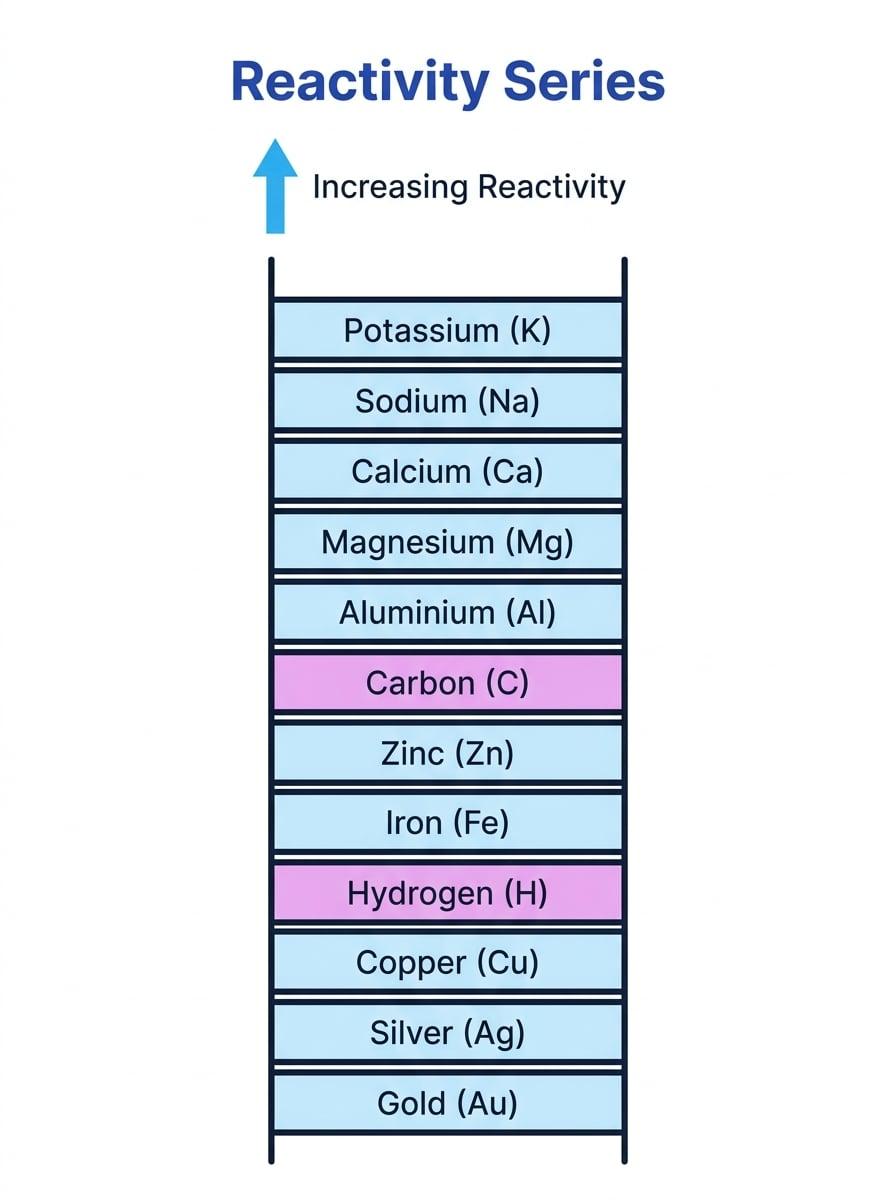
A list of metals, with carbon and hydrogen included for comparison, arranged in order from the most reactive to the least reactive.
- From the most reactive to the least reactive, the order is potassium, sodium, calcium, magnesium, aluminium, carbon, zinc, iron, hydrogen, copper, silver, gold.
- Carbon and hydrogen are non-metals, but they are placed in the series as reference points for comparing metals.
- The higher a metal is in the series, the more vigorously it reacts, so potassium reacts violently with water while gold hardly reacts with anything.
- Metals above hydrogen react with dilute acids to give hydrogen gas, while metals below hydrogen do not.
- The series is built from experimental evidence, by comparing how quickly metals react with cold water, steam and dilute acids.
Reactions with cold water
- Potassium, sodium and calcium react with cold water to form a metal hydroxide and hydrogen.
- Potassium
- Potassium floats, melts into a shiny ball, races across the surface and the hydrogen catches fire with a lilac flame.
- The reaction is so violent that the potassium may crackle and spit.
- The equation is 2K(s)+2H2O(l)→2KOH(aq)+H2(g)\mathrm{2K(s) + 2H_2O(l) \rightarrow 2KOH(aq) + H_2(g)}2K(s)+2H2O(l)→2KOH(aq)+H2(g).
- Sodium
- Sodium floats, melts into a ball and moves quickly around the surface with fizzing until it disappears.
- The reaction is less violent than the reaction of potassium, and the hydrogen does not usually catch fire.
- The equation is 2Na(s)+2H2O(l)→2NaOH(aq)+H2(g)\mathrm{2Na(s) + 2H_2O(l) \rightarrow 2NaOH(aq) + H_2(g)}2Na(s)+2H2O(l)→2NaOH(aq)+H2(g).
- Calcium
- Calcium sinks and fizzes steadily, giving off a stream of hydrogen bubbles.
- The water turns cloudy because calcium hydroxide is only slightly soluble, so some of it appears as a white solid.
- The equation is Ca(s)+2H2O(l)→Ca(OH)2(aq)+H2(g)\mathrm{Ca(s) + 2H_2O(l) \rightarrow Ca(OH)_2(aq) + H_2(g)}Ca(s)+2H2O(l)→Ca(OH)2(aq)+H2(g).
- The solution left in each case is alkaline, because a metal hydroxide has formed.
- The reactions become less vigorous from potassium to sodium to calcium, which matches their order in the series.
- Magnesium reacts only extremely slowly with cold water, producing just a few bubbles over several days.
Magnesium and steam
- Magnesium reacts very slowly with cold water but vigorously with steam.
- Hot magnesium glows with a brilliant white light in steam and leaves a white powder.
- The products are magnesium oxide and hydrogen, not magnesium hydroxide: Mg(s)+H2O(g)→MgO(s)+H2(g)\mathrm{Mg(s) + H_2O(g) \rightarrow MgO(s) + H_2(g)}Mg(s)+H2O(g)→MgO(s)+H2(g).
- Magnesium needs the higher temperature of steam to react quickly, which shows that it is less reactive than calcium.
Practical
Magnesium reacting with steam
- Aim: to show that magnesium reacts with steam to form magnesium oxide and hydrogen.
- Apparatus: a hard-glass boiling tube, mineral wool, a dropping pipette and water, a 5 cm5\ \text{cm}5 cm length of magnesium ribbon, emery paper, a bung fitted with a short glass jet, a clamp and stand, a Bunsen burner, a heat-resistant mat and wooden splints.
- Method, setting up:
- Push a plug of mineral wool to the closed end of the boiling tube and soak it with water from the pipette.
- Rub the magnesium ribbon with emery paper until it is shiny, then coil it loosely.
- Slide the coil into the middle of the tube so that it sits a few centimetres away from the wet mineral wool.
- Clamp the tube horizontally and fit the bung with the glass jet into its open end.
- Method, running the reaction:
- Heat the magnesium strongly with a roaring Bunsen flame.
- Every few seconds, move the flame briefly under the mineral wool so that some of the water boils and steam passes over the hot magnesium.
- When the magnesium begins to glow, hold a lighted splint at the end of the jet.
- Keep heating until the magnesium stops glowing, then lift the burner away and let the tube cool on the heat-resistant mat.
- Results: the magnesium glows with a brilliant white light, a white powder of magnesium oxide is left in the tube, and the gas at the jet burns with a pale flame.
- Reaction: Mg(s)+H2O(g)→MgO(s)+H2(g)\mathrm{Mg(s) + H_2O(g) \rightarrow MgO(s) + H_2(g)}Mg(s)+H2O(g)→MgO(s)+H2(g)
- Watch out: light the gas only after the magnesium is glowing, because the first gas to leave the jet is mostly the air that was in the tube.
- Safety: wear eye protection, avoid staring at the glowing magnesium because the light is very intense, and let the hard-glass tube cool completely before handling it, because it may crack when it is heated strongly.
Reactions with dilute hydrochloric acid
Definition
Effervescence
The rapid release of bubbles of gas from a liquid during a chemical reaction.
- Metals above hydrogen react with dilute hydrochloric acid to form a metal chloride and hydrogen.
- Magnesium reacts vigorously, with rapid effervescence, and the test tube becomes noticeably warm: Mg(s)+2HCl(aq)→MgCl2(aq)+H2(g)\mathrm{Mg(s) + 2HCl(aq) \rightarrow MgCl_2(aq) + H_2(g)}Mg(s)+2HCl(aq)→MgCl2(aq)+H2(g).
- Zinc reacts steadily, giving a moderate stream of bubbles: Zn(s)+2HCl(aq)→ZnCl2(aq)+H2(g)\mathrm{Zn(s) + 2HCl(aq) \rightarrow ZnCl_2(aq) + H_2(g)}Zn(s)+2HCl(aq)→ZnCl2(aq)+H2(g).
- Iron reacts slowly, giving only a few bubbles, and the solution gradually turns pale green as iron(II) chloride forms: Fe(s)+2HCl(aq)→FeCl2(aq)+H2(g)\mathrm{Fe(s) + 2HCl(aq) \rightarrow FeCl_2(aq) + H_2(g)}Fe(s)+2HCl(aq)→FeCl2(aq)+H2(g).
- Copper, silver and gold show no reaction with dilute hydrochloric acid.
- These results are explained by the positions of the metals in the reactivity series.
- Magnesium, zinc and iron are above hydrogen, so they react with the acid and release hydrogen.
- The further above hydrogen a metal is, the more vigorous its reaction, which is why magnesium reacts faster than zinc and zinc reacts faster than iron.
- Copper, silver and gold are below hydrogen, so they cannot release hydrogen from the acid and no reaction happens.
Practical
Comparing metals in dilute hydrochloric acid
- Aim: to put magnesium, zinc, iron and copper in order of reactivity by observing how vigorously each one reacts with dilute hydrochloric acid.
- Apparatus: four test tubes in a rack, a 10 cm310\ \text{cm}^310 cm3 measuring cylinder, 1.0 mol/dm31.0\ \text{mol/dm}^31.0 mol/dm3 hydrochloric acid, pieces of magnesium, zinc, iron and copper of the same size, emery paper, a thermometer, wooden splints and a stopwatch.
- Method, setting up:
- Rub each piece of metal with emery paper so that its surface coating is removed and fresh metal is exposed.
- Measure 5 cm35\ \text{cm}^35 cm3 of the acid into each test tube.
- Record the starting temperature of the acid in each tube.
- Method, observing:
- Add one metal to each tube at the same moment and start the stopwatch.
- Watch the tubes for two minutes and note how fast the bubbles are produced in each one.
- Record the highest temperature reached in each tube.
- Hold a lighted splint at the mouth of the tube with the fastest bubbling to identify the gas.
- Results: magnesium fizzes rapidly and gives the largest temperature rise, zinc bubbles steadily, iron gives a few slow bubbles and copper shows no change, while the gas pops with a lighted splint.
- Conclusion: the order of reactivity, from most to least reactive, is magnesium, zinc, iron, copper.
- Watch out: the pieces of metal must have the same size and surface area, and the acid must have the same volume, concentration and starting temperature in every tube, otherwise the comparison is not fair.
- Safety: wear eye protection, keep the hydrogen away from flames apart from the single splint test, and never test potassium, sodium or calcium in acid, because they react dangerously fast.
Deducing an order of reactivity
- You may be given experimental results for metals you have not met before and asked to place them in order.
- Compare results only when the conditions are the same, such as the same reagent, concentration, temperature and size of metal pieces.
- A metal that reacts is more reactive than a metal that does not react under the same conditions.
- When two metals both react, the one that gives faster bubbling or a larger temperature rise is more reactive.
- A metal that reacts with cold water is more reactive than one that reacts only with steam.
- A metal that does not react with dilute acid must be below hydrogen.
- Write each result as a pair, such as "W is more reactive than X", and then join the pairs into a single list.
Example
Ordering four metals from results
- Metal W reacts with cold water and gives a steady stream of bubbles.
- Metal X does not react with cold water but fizzes quickly in dilute hydrochloric acid.
- Metal Y bubbles only slowly in the same acid.
- Metal Z shows no change in the acid.
- W reacts with cold water, so it is the most reactive of the four.
- X reacts faster with the acid than Y, so X is above Y.
- Z does not react with the acid, so it is below hydrogen and is the least reactive.
- The order from most to least reactive is W, X, Y, Z.
Exam technique
Answering reactivity series questions
- Learn the order with a phrase such as "Please Send Cats, Monkeys And Cute Zebras Into Hot Countries Signed Gordon", where the first letter of each word matches the first letter of each element in order.
- When you explain a reaction, refer to the metal's position relative to hydrogen, for example "copper is below hydrogen in the reactivity series, so it does not react with dilute hydrochloric acid".
- When you describe a reaction with water or acid, give observations such as fizzing, floats or the metal disappears, not just the name of the gas.
- Name the salt correctly, because magnesium and hydrochloric acid give magnesium chloride.
Common Mistake
- Do not give magnesium hydroxide as the product of magnesium and steam, because the product is magnesium oxide.
- Do not say that potassium burns in water, because it is the hydrogen produced that catches fire.
- Do not say that copper reacts slowly with dilute hydrochloric acid, because it does not react at all.
Self review
- What is the order of the reactivity series from potassium to gold?
- What are the products when calcium reacts with cold water?
- What do you see when magnesium is heated in steam?
- Why does iron react with dilute hydrochloric acid when copper does not?
- How can a temperature rise help you compare the reactivity of two metals?
9.4.2 Reactivity, displacement and the oxide layer of aluminium
Reactivity and positive ions
Definition
Reactivity of a metal
The tendency of the atoms of a metal to lose electrons and form positive ions.
- When a metal reacts, its atoms lose electrons from their outer shell and become positive ions.
- Magnesium atoms each lose two electrons: Mg→Mg2++2e−\mathrm{Mg \rightarrow Mg^{2+} + 2e^-}Mg→Mg2++2e−.
- Copper atoms also lose two electrons: Cu→Cu2++2e−\mathrm{Cu \rightarrow Cu^{2+} + 2e^-}Cu→Cu2++2e−.
- A more reactive metal has a greater tendency to lose electrons and form positive ions.
- Magnesium loses its electrons far more readily than copper, so magnesium is much higher in the reactivity series.
- The ions of a less reactive metal have a greater tendency to gain electrons and turn back into metal atoms.
- This difference between two metals is what drives a displacement reaction.
Displacement reactions
Definition
Displacement reaction
A reaction in which a more reactive element takes the place of a less reactive element in a compound.
- In a metal displacement reaction, a more reactive metal is placed in a solution that contains the aqueous ions of a less reactive metal.
- Atoms of the more reactive metal lose electrons and pass into solution as positive ions.
- Ions of the less reactive metal gain these electrons and come out of solution as a coating of solid metal.
- Zinc displaces copper from copper(II) sulfate solution: Zn(s)+CuSO4(aq)→ZnSO4(aq)+Cu(s)\mathrm{Zn(s) + CuSO_4(aq) \rightarrow ZnSO_4(aq) + Cu(s)}Zn(s)+CuSO4(aq)→ZnSO4(aq)+Cu(s).
- The sulfate ions are unchanged, so they are spectator ions and are left out of the ionic equation: Zn(s)+Cu2+(aq)→Zn2+(aq)+Cu(s)\mathrm{Zn(s) + Cu^{2+}(aq) \rightarrow Zn^{2+}(aq) + Cu(s)}Zn(s)+Cu2+(aq)→Zn2+(aq)+Cu(s).
- During this reaction the blue colour of the solution fades, a red-brown coating of copper forms on the zinc, and the temperature rises.
- Zinc atoms lose electrons, so zinc is oxidised, while copper(II) ions gain electrons, so they are reduced.
- A displacement reaction is therefore a redox reaction.
- If the less reactive metal is placed in a solution of the more reactive metal's ions, no reaction happens, so copper in zinc sulfate solution shows no change.
- The further apart two metals are in the reactivity series, the larger the temperature rise in their displacement reaction usually is.
Predicting displacement for five metals
- The order of magnesium, zinc, iron, copper and silver, from most to least reactive, is Mg>Zn>Fe>Cu>Ag\mathrm{Mg > Zn > Fe > Cu > Ag}Mg>Zn>Fe>Cu>Ag.
- Each metal displaces the ions of every metal below it and none of the ions of the metals above it.
- Magnesium displaces zinc, iron(II), copper(II) and silver ions.
- Zinc displaces iron(II), copper(II) and silver ions.
- Iron displaces copper(II) and silver ions.
- Copper displaces silver ions only.
- Silver displaces none of these ions.
- Iron in copper(II) sulfate solution turns the blue solution pale green and becomes coated with brown copper: Fe(s)+Cu2+(aq)→Fe2+(aq)+Cu(s)\mathrm{Fe(s) + Cu^{2+}(aq) \rightarrow Fe^{2+}(aq) + Cu(s)}Fe(s)+Cu2+(aq)→Fe2+(aq)+Cu(s).
- Copper in silver nitrate solution grows shiny grey crystals of silver, while the colourless solution slowly turns blue: Cu(s)+2Ag+(aq)→Cu2+(aq)+2Ag(s)\mathrm{Cu(s) + 2Ag^+(aq) \rightarrow Cu^{2+}(aq) + 2Ag(s)}Cu(s)+2Ag+(aq)→Cu2+(aq)+2Ag(s).
- Magnesium in iron(II) sulfate solution becomes coated with dark grey iron as the pale green colour fades: Mg(s)+Fe2+(aq)→Mg2+(aq)+Fe(s)\mathrm{Mg(s) + Fe^{2+}(aq) \rightarrow Mg^{2+}(aq) + Fe(s)}Mg(s)+Fe2+(aq)→Mg2+(aq)+Fe(s).
Practical
Displacement reactions on a spotting tile
- Aim: to place magnesium, zinc, iron and copper in order of reactivity by testing each metal in solutions of the other metals' ions.
- Apparatus: a white spotting tile, small pieces of magnesium ribbon, zinc foil, iron wire and copper foil, emery paper, forceps, dropping pipettes, a hand lens, and dilute solutions of magnesium sulfate, zinc sulfate, iron(II) sulfate, copper(II) sulfate and silver nitrate.
- Method, setting up:
- Draw a grid on paper with the four metals along the top and the five solutions down the side, and stand the spotting tile on it so that each well matches one combination.
- Rub each piece of metal with emery paper, so that a surface coating does not stop a reaction from starting.
- Use a clean dropping pipette for each solution and half fill the matching wells.
- Method, testing:
- Use forceps to place one piece of metal into each well, leaving out the wells where a metal would meet its own ions.
- Leave the tile undisturbed for about five minutes.
- Look closely at each piece through the hand lens.
- Record a tick where a coating forms on the metal or the solution changes colour, and a cross where there is no change.
- Method, processing the results:
- Count the number of ticks for each metal.
- Rank the metals, because the metal with the most ticks displaces the most metals and so is the most reactive.
- Results: magnesium reacts in all four of the other solutions, zinc reacts in three, iron reacts in two and copper reacts only in silver nitrate.
- Conclusion: the order from most to least reactive is magnesium, zinc, iron, copper, with silver below copper.
- Watch out: a metal that has not been cleaned may give a false cross, and a very thin coating can be missed unless every piece is checked with the hand lens.
- Safety: wear eye protection and gloves, because silver nitrate stains skin black and copper(II) sulfate is harmful, and wash your hands at the end.
Example
Deducing an order from a displacement grid
- Metal P becomes coated with a new metal in solutions of the ions of Q and of R.
- Metal Q becomes coated only in the solution of the ions of R.
- Metal R shows no change in any of the solutions.
- P displaces both Q and R, so P is the most reactive.
- Q displaces R but not P, so Q comes second.
- R displaces neither of the others, so it is the least reactive, and the order is P, Q, R.
The oxide layer on aluminium
- Aluminium is high in the reactivity series, just below magnesium, yet in everyday use it often seems unreactive.
- An aluminium saucepan does not fizz when water is boiled in it, and aluminium foil placed in copper(II) sulfate solution shows little or no change.
- This is because aluminium is always covered by a very thin, tough layer of aluminium oxide, Al2O3\mathrm{Al_2O_3}Al2O3.
- The layer forms as soon as fresh aluminium meets oxygen in the air: 4Al(s)+3O2(g)→2Al2O3(s)\mathrm{4Al(s) + 3O_2(g) \rightarrow 2Al_2O_3(s)}4Al(s)+3O2(g)→2Al2O3(s).
- The oxide layer is unreactive, it sticks firmly to the metal and it has no gaps, so water, acids and aqueous ions cannot reach the aluminium underneath.
- If the surface is scratched, a new layer of oxide forms almost at once, so the protection repairs itself.
- When the oxide layer is removed, the aluminium underneath reacts as vigorously as its position in the series predicts.
- In dilute hydrochloric acid, aluminium reacts slowly at first and then fizzes vigorously once the acid has dissolved the oxide layer.
- The apparent unreactivity of aluminium is caused by its oxide layer, not by a low tendency to form positive ions.
- The same oxide layer explains why aluminium resists corrosion and can be used for food containers.
Exam technique
Explaining displacement and aluminium
- In a displacement explanation, state that the more reactive metal loses electrons more readily, or has a greater tendency to form positive ions.
- Give the observations a question asks for, such as the colour change of the solution and the colour of the metal coating.
- For aluminium, state that it is covered by an oxide layer that stops water or acid reaching the metal underneath.
- Write ionic equations with state symbols and leave out the spectator ions.
Common Mistake
- Do not describe aluminium as an unreactive metal, because its high reactivity is hidden by the oxide layer.
- Do not include the sulfate or nitrate ion in the ionic equation for a displacement reaction, because it is a spectator ion.
- Do not swap the roles, because the more reactive metal is oxidised and the ions of the less reactive metal are reduced.
Self review
- How is the reactivity of a metal linked to its tendency to form positive ions?
- What do you see when zinc is added to copper(II) sulfate solution?
- Write the ionic equation for copper displacing silver from silver nitrate solution.
- Which of magnesium, zinc, iron, copper and silver can displace iron(II) ions from solution?
- Why does aluminium appear unreactive even though it is high in the reactivity series?