6.2.1 Factors affecting the rate of reaction
Rate of reaction
Definition
Rate of reaction
The amount of a reactant used up or the amount of a product formed per unit time.
- The rate of reaction tells you how quickly reactants are turned into products.
- You find a rate by measuring how quickly a reactant is used up or how quickly a product is formed.
- The average rate over a period of time is found using average rate=change in amount of product or reactanttime taken\text{average rate} = \dfrac{\text{change in amount of product or reactant}}{\text{time taken}}average rate=time takenchange in amount of product or reactant.
- The units depend on what you measure, such as cm3/s\text{cm}^3/\text{s}cm3/s for a volume of gas or g/s\text{g}/\text{s}g/s for a mass.
- A reaction is usually fastest at the start, when the most reactant is present.
- The reaction slows down as the reactants are used up.
- The reaction stops when one of the reactants has been completely used up.
- Five factors change the rate of a reaction: concentration, pressure, surface area, temperature and the presence of a catalyst.
Concentration and pressure
- Increasing the concentration of a reacting solution increases the rate of reaction.
- Magnesium ribbon fizzes much more vigorously in 2.0 mol/dm32.0\ \text{mol/dm}^32.0 mol/dm3 hydrochloric acid than in 0.5 mol/dm30.5\ \text{mol/dm}^30.5 mol/dm3 hydrochloric acid.
- Decreasing the concentration, for example by diluting the acid with water, decreases the rate.
- Increasing the pressure of a reacting gas increases the rate of reaction.
- Raising the pressure squeezes the same amount of gas into a smaller volume, which has the same effect as increasing the concentration of the gas.
- Pressure only affects the rate of reactions that involve gases.
Surface area
- Increasing the surface area of a solid reactant increases the rate of reaction.
- Breaking a solid into smaller pieces increases its surface area, so a powder reacts faster than the same mass of lumps.
- Calcium carbonate powder fizzes far more quickly in dilute hydrochloric acid than the same mass of large marble chips.
- Very fine powders can react so fast that they explode, which is why flour dust in mills and coal dust in mines are serious hazards.
Temperature
- Increasing the temperature increases the rate of reaction.
- For many reactions, a rise of about 10 ∘C10\ ^\circ\text{C}10 ∘C roughly doubles the rate.
- Decreasing the temperature decreases the rate, which is why food stays fresh for longer in a fridge.
- To compare temperatures fairly, the reactants are warmed in a water bath before they are mixed, and every other factor is kept the same.
Catalysts and enzymes
Definition
Catalyst
A substance that increases the rate of a reaction and is chemically unchanged at the end of the reaction.
Definition
Enzyme
A protein that acts as a biological catalyst, increasing the rate of reactions in living things.
- Adding a catalyst increases the rate of a reaction, and removing the catalyst lets the rate fall back again.
- A catalyst is unchanged at the end of the reaction, so it has the same mass and the same chemical composition as at the start.
- Only a small amount of catalyst is needed, because it is not used up and can be used again.
- Manganese(IV) oxide is a catalyst for the decomposition of hydrogen peroxide into water and oxygen: 2H2O2(aq)→2H2O(l)+O2(g)\mathrm{2H_{2}O_{2}(aq) \rightarrow 2H_{2}O(l) + O_{2}(g)}2H2O2(aq)→2H2O(l)+O2(g).
- A catalyst does not change the amount of product formed, only how quickly it forms.
- Enzymes are catalysts made by living things, such as the enzymes in yeast that speed up fermentation.
- Enzymes work best within a narrow temperature range, and high temperatures change their structure so that they stop working.
Example
Showing that a catalyst is unchanged
- Hydrogen peroxide solution on its own gives off oxygen very slowly.
- Adding 0.50 g0.50\ \text{g}0.50 g of black manganese(IV) oxide powder makes the solution froth with oxygen within seconds.
- Once the fizzing stops, the mixture is filtered and the black solid is washed and dried.
- The dried solid still has a mass of 0.50 g0.50\ \text{g}0.50 g and it speeds up a fresh sample of hydrogen peroxide just as well.
- This shows that manganese(IV) oxide increased the rate but was not used up, so it acted as a catalyst.
Measuring the rate of reaction
- To follow a reaction, you measure a quantity that changes as the reaction goes on, at regular time intervals.
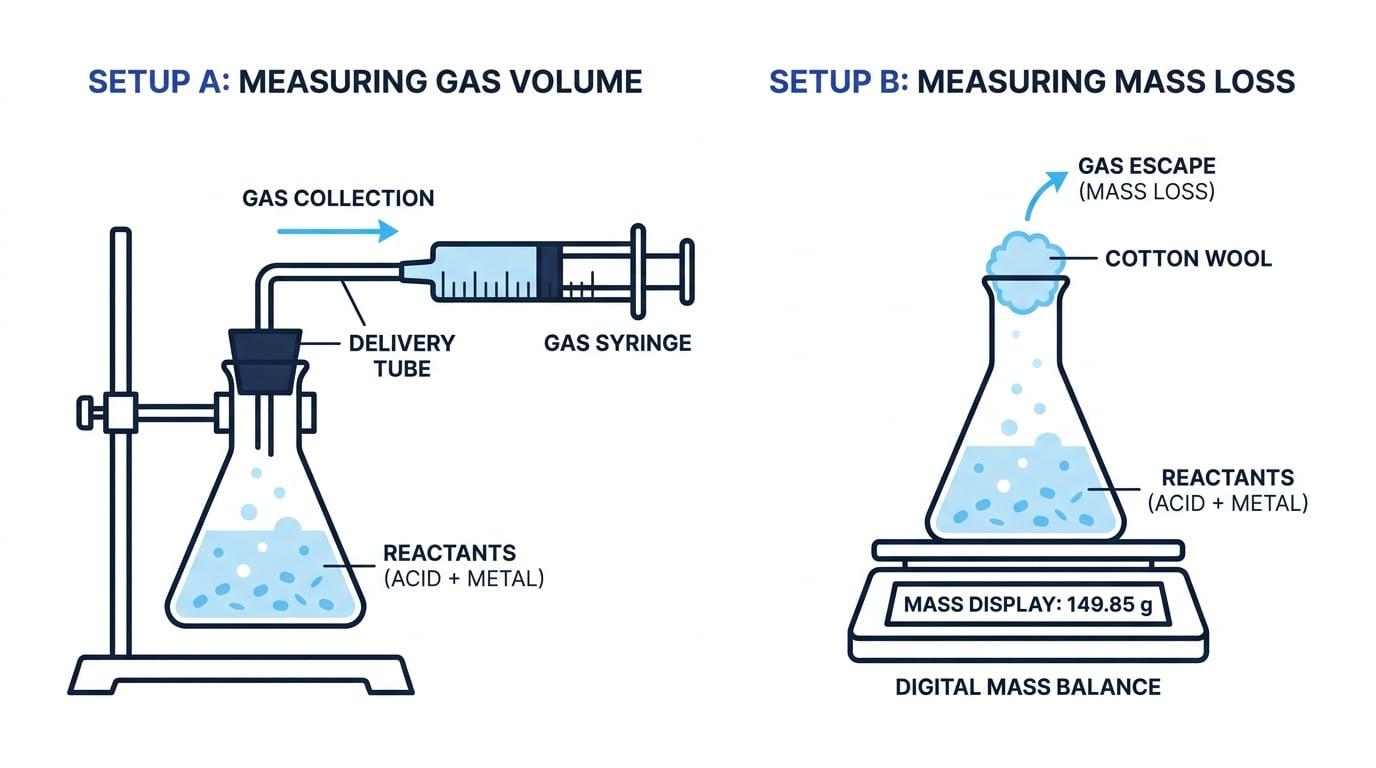
- Volume of gas produced: the gas is collected in a gas syringe or in an upturned measuring cylinder full of water, and its volume is read every few seconds.
- Loss in mass: the reaction is carried out in a flask standing on a balance, and the mass falls as a gas escapes into the air.
- Time for a precipitate to form: the time taken for a cloudy precipitate to hide a cross drawn under the flask is measured, and a shorter time means a faster rate.
- In a fair test you change only one factor, the independent variable, and keep every other factor the same.
- The factor you measure, such as the volume of gas, is the dependent variable.
Practical
Measuring gas volume: magnesium and hydrochloric acid
- Aim: to find how the concentration of hydrochloric acid affects the rate of its reaction with magnesium by measuring the volume of hydrogen produced.
- Apparatus: conical flask, bung fitted with a delivery tube, 100 cm3100\ \text{cm}^3100 cm3 gas syringe held in a clamp and stand, 50 cm350\ \text{cm}^350 cm3 measuring cylinder, stopwatch, scissors, ruler, magnesium ribbon, hydrochloric acid at 0.50.50.5, 1.01.01.0, 1.51.51.5 and 2.0 mol/dm32.0\ \text{mol/dm}^32.0 mol/dm3, and eye protection.
- Method, setting up:
- Clamp the gas syringe horizontally, push the plunger fully in and check that it slides freely and reads zero.
- Cut four 3 cm3\ \text{cm}3 cm lengths of magnesium ribbon with scissors, measuring each one against a ruler.
- Measure 50 cm350\ \text{cm}^350 cm3 of the 0.5 mol/dm30.5\ \text{mol/dm}^30.5 mol/dm3 acid with the measuring cylinder and pour it into the conical flask.
- Connect the delivery tube from the bung to the nozzle of the gas syringe.
- Method, running the reaction:
- Drop one length of magnesium into the acid, push the bung in firmly at once and start the stopwatch.
- Read the volume of gas in the syringe every 10 s10\ \text{s}10 s until two readings in a row are the same.
- Rinse the flask and repeat with each of the other concentrations, keeping the volume of acid, the length of magnesium and the room temperature the same.
- Method, processing the results:
- Plot volume of hydrogen / cm3\text{cm}^3cm3 on the vertical axis against time / s\text{s}s on the horizontal axis, with all four sets of results on the same grid.
- Draw a smooth curve of best fit through each set of points and compare how steep each curve is at the start.
- Results: the higher the concentration of the acid, the steeper the curve is at the start and the sooner it levels off.
- Reaction: magnesium reacts with hydrochloric acid to form magnesium chloride solution and hydrogen, Mg(s)+2HCl(aq)→MgCl2(aq)+H2(g)\mathrm{Mg(s) + 2HCl(aq) \rightarrow MgCl_{2}(aq) + H_{2}(g)}Mg(s)+2HCl(aq)→MgCl2(aq)+H2(g).
- Watch out: the acid is in excess in every run, so each curve levels off at the same final volume because the same length of magnesium is used each time.
- Safety: wear eye protection, keep flames well away because hydrogen is flammable, and wipe up any spilled acid straight away because it irritates the skin and eyes.
Practical
Measuring loss in mass: marble chips and hydrochloric acid
- Aim: to find how the surface area of calcium carbonate affects the rate of its reaction with hydrochloric acid by measuring the loss in mass as carbon dioxide escapes.
- Apparatus: conical flask, cotton wool, top-pan balance reading to 0.01 g0.01\ \text{g}0.01 g, stopwatch, 50 cm350\ \text{cm}^350 cm3 measuring cylinder, weighing boat, large marble chips, small marble chips, calcium carbonate powder, 1.0 mol/dm31.0\ \text{mol/dm}^31.0 mol/dm3 hydrochloric acid and eye protection.
- Method, setting up:
- Weigh out 5.00 g5.00\ \text{g}5.00 g of large marble chips in a weighing boat.
- Measure 50 cm350\ \text{cm}^350 cm3 of hydrochloric acid into the conical flask and stand the flask on the balance, with a loose plug of cotton wool and the weighing boat of chips beside it on the pan.
- Method, running the reaction:
- Note the total mass, tip the chips into the acid, push the cotton wool loosely into the neck of the flask, put the empty weighing boat back on the pan and start the stopwatch.
- The cotton wool lets carbon dioxide escape but stops droplets of acid spraying out, which would add to the loss in mass.
- Record the reading on the balance every 30 s30\ \text{s}30 s for 555 minutes.
- Repeat with 5.00 g5.00\ \text{g}5.00 g of small marble chips and then 5.00 g5.00\ \text{g}5.00 g of powder, using fresh acid each time.
- Method, processing the results:
- Work out the loss in mass at each time by subtracting each reading from the starting mass.
- Plot loss in mass / g\text{g}g against time / s\text{s}s for all three sizes on the same grid.
- Results: the powder gives the steepest curve, the small chips give a less steep curve and the large chips give the shallowest curve.
- Reaction: CaCO3(s)+2HCl(aq)→CaCl2(aq)+H2O(l)+CO2(g)\mathrm{CaCO_{3}(s) + 2HCl(aq) \rightarrow CaCl_{2}(aq) + H_{2}O(l) + CO_{2}(g)}CaCO3(s)+2HCl(aq)→CaCl2(aq)+H2O(l)+CO2(g)
- Watch out: the acid is the reactant that runs out in these amounts, so given enough time all three curves level off at the same total loss in mass of about 1.1 g1.1\ \text{g}1.1 g.
- Safety: wear eye protection and avoid splashing the acid, which irritates the skin and eyes.
Practical
Timing a precipitate: sodium thiosulfate and hydrochloric acid
- Aim: to find how temperature affects the rate of the reaction between sodium thiosulfate solution and hydrochloric acid by timing how long the sulfur formed takes to hide a cross.
- Apparatus: 100 cm3100\ \text{cm}^3100 cm3 conical flask, sheet of white paper with a bold black cross drawn on it, 50 cm350\ \text{cm}^350 cm3 and 10 cm310\ \text{cm}^310 cm3 measuring cylinders, water bath, thermometer, stopwatch, sodium thiosulfate solution, 1.0 mol/dm31.0\ \text{mol/dm}^31.0 mol/dm3 hydrochloric acid and eye protection.
- Method, preparing:
- Measure 50 cm350\ \text{cm}^350 cm3 of sodium thiosulfate solution into the conical flask and warm it in the water bath until the thermometer reads about 20 ∘C20\ ^\circ\text{C}20 ∘C.
- Stand the flask on the cross so that the cross can be seen clearly when you look down through the solution.
- Method, timing the reaction:
- Add 5 cm35\ \text{cm}^35 cm3 of hydrochloric acid, swirl the flask once and start the stopwatch.
- Look down through the mouth of the flask and stop the stopwatch at the moment the pale yellow precipitate of sulfur hides the cross completely.
- Record the temperature of the mixture straight away.
- Repeat at about 303030, 404040, 505050 and 60 ∘C60\ ^\circ\text{C}60 ∘C, using the same volumes, the same flask and the same cross each time.
- Method, processing the results:
- Calculate 1time\dfrac{1}{\text{time}}time1 for each temperature, because a shorter time means a faster rate.
- Plot 1time\dfrac{1}{\text{time}}time1 / s−1\text{s}^{-1}s−1 against temperature / ∘C^\circ\text{C}∘C and draw a smooth curve of best fit.
- Results: as the temperature rises, the cross disappears more quickly, so the time falls and 1time\dfrac{1}{\text{time}}time1 increases.
- Reaction: Na2S2O3(aq)+2HCl(aq)→2NaCl(aq)+S(s)+SO2(g)+H2O(l)\mathrm{Na_{2}S_{2}O_{3}(aq) + 2HCl(aq) \rightarrow 2NaCl(aq) + S(s) + SO_{2}(g) + H_{2}O(l)}Na2S2O3(aq)+2HCl(aq)→2NaCl(aq)+S(s)+SO2(g)+H2O(l)
- Watch out: deciding when the cross has vanished is a judgement, so the same person should watch the cross in every run.
- Safety: wear eye protection, work in a well-ventilated room because the reaction gives off sulfur dioxide, which is toxic and can trigger asthma, and pour the mixtures away promptly once each run is finished.
Interpreting rate graphs
- On a graph of the amount of product against time, the gradient, or steepness, of the line shows the rate of reaction.
- A steeper line means a faster rate.
- The curve is steepest at the start, because this is when the reaction is fastest.
- The curve becomes less steep as the reactants are used up and the reaction slows down.
- The line becomes horizontal, or levels off, when the reaction has stopped because one reactant has been used up.
- The final height of the curve shows the total amount of product, which depends on the amount of the reactant that runs out, not on the rate.
- A faster reaction using the same amounts of reactants gives a steeper curve that levels off sooner, but at the same height.
- Halving the amount of the reactant that runs out makes the curve level off at half the height.
- For a graph of the mass of the flask against time, the curve slopes downwards and then levels off when the reaction stops.
- The rate at one instant is found by drawing a tangent to the curve at that time and calculating its gradient.
Example
Average rate from gas volumes
- In the magnesium experiment, 36 cm336\ \text{cm}^336 cm3 of hydrogen is collected in the first 20 s20\ \text{s}20 s.
- Between 20 s20\ \text{s}20 s and 40 s40\ \text{s}40 s, a further 18 cm318\ \text{cm}^318 cm3 is collected.
- The rate has halved because some of the reactants have already been used up.
Example
Comparing three curves
- Curve A comes from 0.10 g0.10\ \text{g}0.10 g of magnesium in excess acid at 25 ∘C25\ ^\circ\text{C}25 ∘C.
- Curve B uses the same amounts at 35 ∘C35\ ^\circ\text{C}35 ∘C, so it is steeper at the start and levels off sooner, at the same final volume as A.
- Curve C uses 0.05 g0.05\ \text{g}0.05 g of magnesium at 25 ∘C25\ ^\circ\text{C}25 ∘C, so it levels off at half the final volume of A.
- The starting gradients show the order of rates, while the final heights show the amounts of the limiting reactant.
Exam technique
Answering rate questions
- When you describe an effect, give its direction clearly, such as “increasing the temperature increases the rate”.
- When you describe a graph, use the words steeper, gradient and levels off rather than vague phrases such as “goes up quicker”.
- When you are asked when a reaction finished, read off the time at which the line first becomes horizontal.
- When curves end at the same height, explain that the same amount of the reactant that was used up was present in each experiment.
- When you describe a method, name the apparatus and the measurement, such as “measure the volume of gas with a gas syringe every 10 s10\ \text{s}10 s”.
- Always give a unit with any rate you calculate.
Common Mistake
- Do not write that a catalyst is used up or that it makes more product.
- Do not confuse how fast a reaction is with how much product it makes.
- Do not describe a more concentrated acid as a stronger acid.
Self review
- How does increasing the surface area of a solid reactant affect the rate of reaction?
- What is a catalyst?
- Why does a curve of gas volume against time become horizontal?
- Name two ways of measuring the rate of a reaction that produces a gas.
- Why does the cotton wool plug matter in the mass-loss method?
6.2.2 Collision theory and evaluating rate methods
Collision theory
Definition
Collision theory
The theory that reactant particles must collide with energy equal to or greater than the activation energy for a reaction to take place.
Definition
Successful collision
A collision between reactant particles with energy equal to or greater than the activation energy, so that the particles react.
Definition
Activation energy
The minimum energy that colliding particles must have to react, given the symbol EaE_aEa.
- For a reaction to happen, the reactant particles must first collide with each other.
- Most collisions do not lead to a reaction, because the particles do not have enough energy and simply bounce apart.
- A collision only leads to a reaction if the colliding particles have kinetic energy equal to or greater than the activation energy, EaE_aEa.
- The rate of reaction depends on the number of successful collisions per unit time.
- Four ideas are used to explain changes in rate:
- The number of particles per unit volume, which describes how crowded the reacting particles are.
- The frequency of collisions, which is the number of collisions between particles per unit time.
- The kinetic energy of the particles, which increases as they move faster.
- The activation energy, which is the energy barrier that colliding particles must overcome.
Concentration and pressure
- Increasing the concentration of a solution increases the number of particles per unit volume.
- The particles are closer together, so they collide more frequently.
- More frequent collisions mean more successful collisions per unit time, so the rate increases.
- Increasing the pressure of a gas squeezes the same number of particles into a smaller volume, which also increases the number of particles per unit volume.
- The gas particles therefore collide more frequently, so the rate increases in the same way as for concentration.
- Neither change gives the particles more energy, so the proportion of collisions that are successful stays the same.
Surface area
- Only the particles on the surface of a solid can collide with particles of the other reactant.
- Cutting a solid into smaller pieces exposes more of its particles at the surface.
- More particles are available to collide, so there are more frequent collisions and the rate increases.
- The energy of the particles does not change, so it is the frequency of collisions, not the proportion that succeed, that increases.
Temperature
- Increasing the temperature gives the particles more kinetic energy, so they move faster.
- Faster particles collide more frequently.
- A greater proportion of the particles also have energy equal to or greater than the activation energy.
- A greater proportion of collisions are therefore successful, so there are many more successful collisions per unit time.
- The increase in the proportion of successful collisions is the bigger effect, which is why a small rise in temperature can make a large difference to the rate.
Example
Explaining a faster rate at a higher temperature
- Marble chips react with hydrochloric acid more quickly at 40 ∘C40\ ^\circ\text{C}40 ∘C than at 20 ∘C20\ ^\circ\text{C}20 ∘C.
- At 40 ∘C40\ ^\circ\text{C}40 ∘C, the acid particles have more kinetic energy and move faster.
- They collide with the surface of the marble more frequently.
- A greater proportion of these collisions have energy equal to or greater than the activation energy.
- There are more successful collisions per unit time, so carbon dioxide is given off more quickly.
Catalysts and activation energy
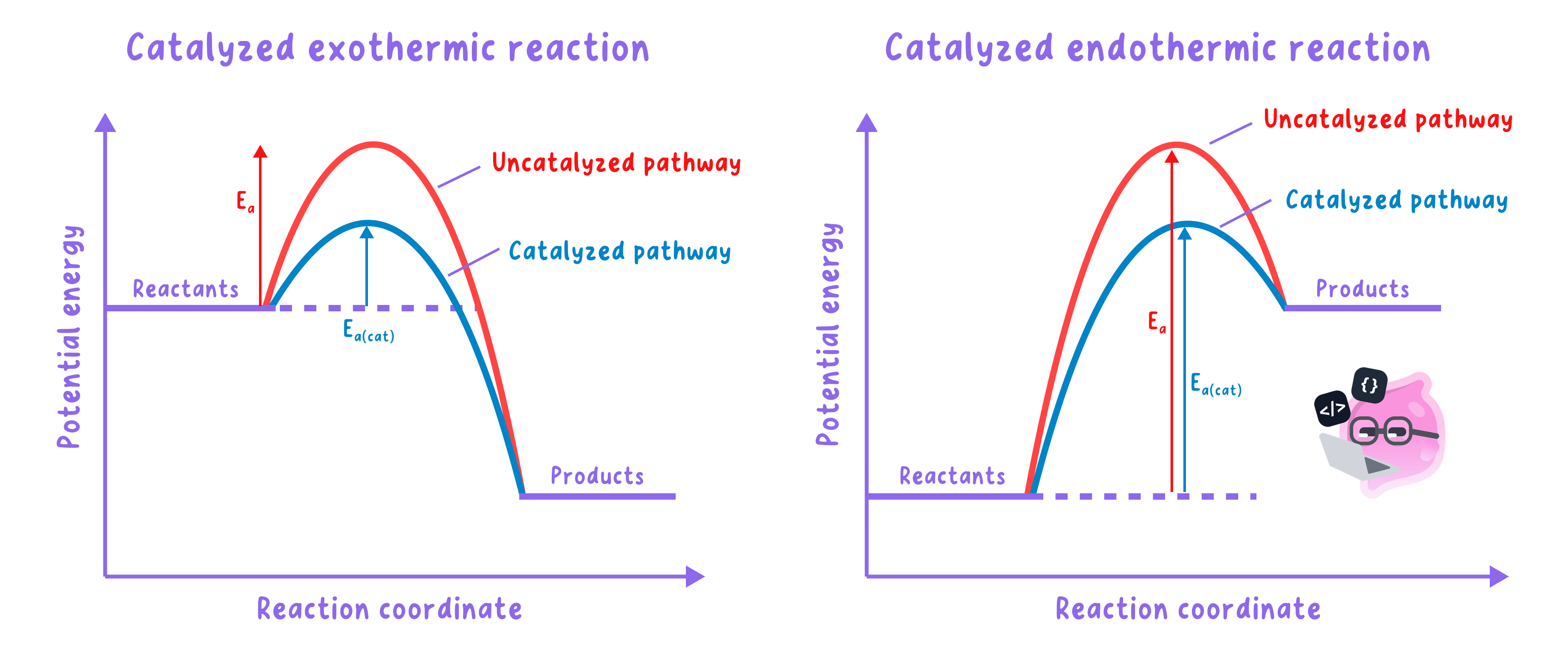
- A catalyst provides an alternative reaction pathway with a lower activation energy.
- The energy of the particles is unchanged, but a greater proportion of collisions now have energy equal to or greater than the lower activation energy.
- There are more successful collisions per unit time, so the rate increases.
- On a reaction pathway diagram, the catalysed pathway has a lower peak, while the energies of the reactants and products stay the same.
- The overall energy change of the reaction, ΔH\Delta HΔH, is therefore the same with or without the catalyst.
- Enzymes work in the same way, lowering the activation energy of reactions in living cells so that they are fast at body temperature.
- At high temperatures an enzyme's structure changes, so it can no longer provide the lower-energy pathway.
- Removing a catalyst means the reaction must again follow the pathway with the higher activation energy, so the rate falls.
Evaluating methods for measuring rate
- Gas syringe: this measures the volume of gas directly, usually to the nearest 1 cm31\ \text{cm}^31 cm3, and works for any gas.
- Some gas escapes in the moment between adding the reactant and fitting the bung, so the first readings are slightly low.
- A syringe can stick, and it cannot hold more than its maximum volume, often 100 cm3100\ \text{cm}^3100 cm3.
- Upturned measuring cylinder or burette over water: this is cheap and simple to set up.
- It is unsuitable for gases that dissolve in water, such as carbon dioxide or ammonia, because some of the gas dissolves instead of being collected.
- Loss in mass on a balance: this is quick to read and can record many readings, especially with a balance linked to a computer.
- It works well for carbon dioxide, which has Mr=44M_r = 44Mr=44, because the mass lost is large enough to measure.
- It works poorly for hydrogen, which has Mr=2M_r = 2Mr=2, because the mass lost is too small to measure accurately.
- A cotton wool plug is needed so that acid spray does not escape and add to the loss in mass.
- Disappearing cross: this needs very little apparatus.
- Deciding when the cross disappears is a judgement, so the timings vary between observers.
- It gives only one time for each experiment, rather than a full curve showing how the rate changes.
- Ways to improve any of these methods include:
- Repeating each experiment and calculating a mean, so that unusual results can be spotted and ignored.
- Using a water bath so that the temperature stays constant.
- Using a light sensor and data logger in place of the eye for the disappearing cross.
- Hanging the solid on a thread or placing it in a small tube inside the flask, so that the bung is already in place when the reaction starts.
Example
Choosing a method for a small amount of hydrogen
- 0.13 g0.13\ \text{g}0.13 g of zinc reacts with excess dilute sulfuric acid.
- The amount of zinc is found from its mass and ArA_rAr.
- One mole of zinc gives one mole of hydrogen, so 0.0020 mol0.0020\ \text{mol}0.0020 mol of hydrogen forms.
- A volume of 48 cm348\ \text{cm}^348 cm3 fits easily in a 100 cm3100\ \text{cm}^3100 cm3 gas syringe, but a mass change of 0.0040 g0.0040\ \text{g}0.0040 g is too small to detect on a balance reading to 0.01 g0.01\ \text{g}0.01 g, so the gas syringe is the better method.
Exam technique
Writing collision theory explanations
- Mark schemes give separate marks for each link in the explanation, so write out every step.
- For concentration or pressure, write that there are more particles per unit volume, so there are more frequent collisions.
- For temperature, write that particles have more kinetic energy, collide more frequently, and that a greater proportion of collisions have energy greater than or equal to the activation energy.
- For a catalyst, write that it lowers the activation energy by providing an alternative pathway, so a greater proportion of collisions are successful.
- Write “more frequent collisions” or “more collisions per unit time”, because “more collisions” on its own is often not enough.
- When you evaluate a method, give a reason linked to the actual reaction, such as “carbon dioxide dissolves in water”.
Common Mistake
- Do not write that a catalyst gives the particles more energy.
- Do not write that raising the temperature lowers the activation energy, because the activation energy does not change.
- Do not write that particles collide harder at a higher concentration, because concentration changes how often particles collide, not their energy.
Self review
- What two conditions must be met for a collision to be successful?
- Why does increasing the pressure of a gas increase the rate of reaction?
- Give the two reasons why increasing temperature increases the rate of reaction.
- How does a catalyst increase the rate of a reaction?
- Why is measuring loss in mass a poor method for a reaction that gives off hydrogen?