Definition
Oxidising agent
A substance that oxidises another substance and is itself reduced.
Definition
Reducing agent
A substance that reduces another substance and is itself oxidised.
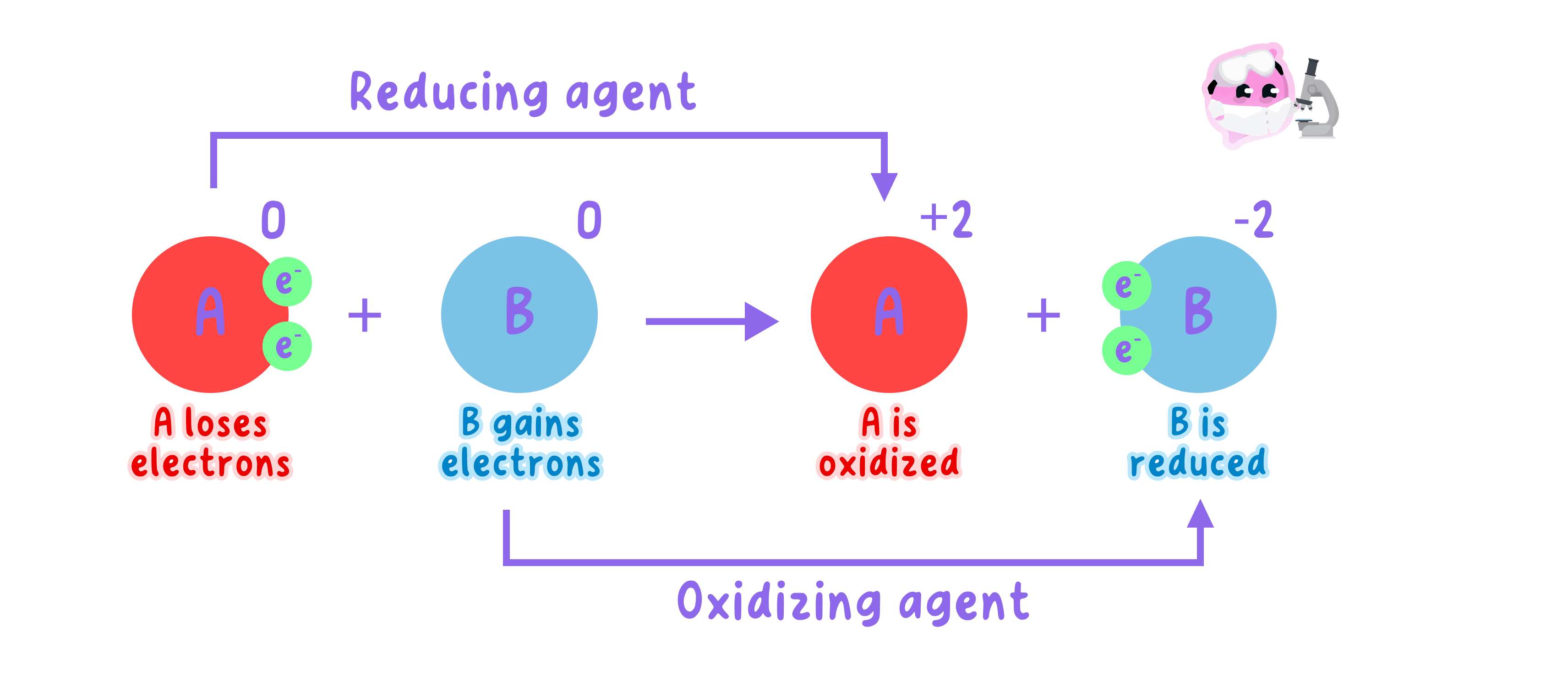
- In every redox reaction, one reactant causes the other to be oxidised, and the other reactant causes reduction.
- An oxidising agent takes electrons from another substance, so it oxidises that substance.
- By gaining electrons, the oxidising agent is itself reduced, so the oxidation number of one of its elements decreases.
- A reducing agent gives electrons to another substance, so it reduces that substance.
- By losing electrons, the reducing agent is itself oxidised, so the oxidation number of one of its elements increases.
- The oxidising agent is therefore the substance that is reduced, and the reducing agent is the substance that is oxidised.
Example
Magnesium and copper(II) ions
Mg(s)+Cu2+(aq)→Mg2+(aq)+Cu(s) \mathrm{Mg(s) + Cu^{2+}(aq) \rightarrow Mg^{2+}(aq) + Cu(s)} Mg(s)+Cu2+(aq)→Mg2+(aq)+Cu(s)- Magnesium atoms lose electrons and are oxidised, so magnesium is the reducing agent.
- Copper(II) ions gain electrons and are reduced, so the copper(II) ions are the oxidising agent.
- The electrons lost by magnesium are the same electrons gained by the copper(II) ions.
Identifying the agents
- Write the oxidation number of each element on both sides of the equation.
- Find the element whose oxidation number decreases, because the reactant containing it is the oxidising agent.
- Find the element whose oxidation number increases, because the reactant containing it is the reducing agent.
- Name the whole reactant as the agent, such as iron(III) oxide rather than just iron.
- An agent is always a reactant, never a product.
- Spectator ions take no part in the electron transfer, so they are never the oxidising agent or the reducing agent.
- For a reaction described in terms of oxygen, the substance that gives oxygen away is the oxidising agent and the substance that takes oxygen is the reducing agent.
Example
Iron(III) oxide and carbon monoxide
Fe2O3+3CO→2Fe+3CO2 \mathrm{Fe_{2}O_{3} + 3CO \rightarrow 2Fe + 3CO_{2}} Fe2O3+3CO→2Fe+3CO2- Iron decreases from +3+3+3 to 000, so iron(III) oxide is reduced and is the oxidising agent.
- Carbon increases from +2+2+2 to +4+4+4, so carbon monoxide is oxidised and is the reducing agent.
Example
Chlorine and iodide ions
Cl2(aq)+2I−(aq)→2Cl−(aq)+I2(aq) \mathrm{Cl_{2}(aq) + 2I^{-}(aq) \rightarrow 2Cl^{-}(aq) + I_{2}(aq)} Cl2(aq)+2I−(aq)→2Cl−(aq)+I2(aq)- Chlorine decreases from 000 to −1-1−1, so chlorine is the oxidising agent.
- Iodine increases from −1-1−1 to 000, so the iodide ions are the reducing agent.
- The colourless solution turns brown as iodine forms.
Example
Copper(II) oxide and hydrogen
CuO(s)+H2(g)→Cu(s)+H2O(g) \mathrm{CuO(s) + H_{2}(g) \rightarrow Cu(s) + H_{2}O(g)} CuO(s)+H2(g)→Cu(s)+H2O(g)- Hydrogen takes oxygen from copper(II) oxide and is oxidised, so hydrogen is the reducing agent.
- Copper(II) oxide gives its oxygen away and is reduced, so copper(II) oxide is the oxidising agent.
- In terms of oxidation numbers, copper decreases from +2+2+2 to 000 and hydrogen increases from 000 to +1+1+1.
Common oxidising and reducing agents
- Common oxidising agents include:
- Oxygen, which oxidises metals and fuels.
- Chlorine, which oxidises bromide ions and iodide ions to bromine and iodine.
- Acidified potassium manganate(VII), which turns from purple to colourless as it is reduced.
- Iron(III) ions, which are reduced to iron(II) ions.
- Common reducing agents include:
- Carbon and carbon monoxide, which reduce metal oxides such as iron(III) oxide.
- Hydrogen, which reduces hot copper(II) oxide to copper.
- Reactive metals, such as magnesium and zinc, which reduce the ions of less reactive metals.
- Potassium iodide, whose iodide ions are oxidised to brown iodine.
- The same substance can act as an oxidising agent in one reaction and a reducing agent in another, so always decide from the equation you are given.
- Acidified potassium manganate(VII) turning colourless shows that a reducing agent is present.
- Aqueous potassium iodide turning brown shows that an oxidising agent is present.
Exam technique
Naming oxidising and reducing agents
- Name a reactant from the equation in full, including any Roman numeral, such as “iron(III) oxide”.
- Give a reason linked to the definition, such as “chlorine is the oxidising agent because it gains electrons” or “because its oxidation number decreases from 000 to −1-1−1”.
- When you define an agent, give the whole statement, including the part that says the oxidising agent is itself reduced or the reducing agent is itself oxidised.
- Never give a spectator ion, such as a potassium ion or a sulfate ion, as an agent.
Common Mistake
- Do not write that the oxidising agent is oxidised, because it is reduced.
- Do not give a product, such as copper or iodine, as the agent.
- Do not name only the element, such as iron, when the agent is the compound iron(III) oxide.
Self review
- Define an oxidising agent.
- Define a reducing agent.
- In the reaction between magnesium and copper(II) ions, which species is the reducing agent?
- How do oxidation numbers show which reactant is the oxidising agent?
- What does a brown colour forming in aqueous potassium iodide show about the substance added?
