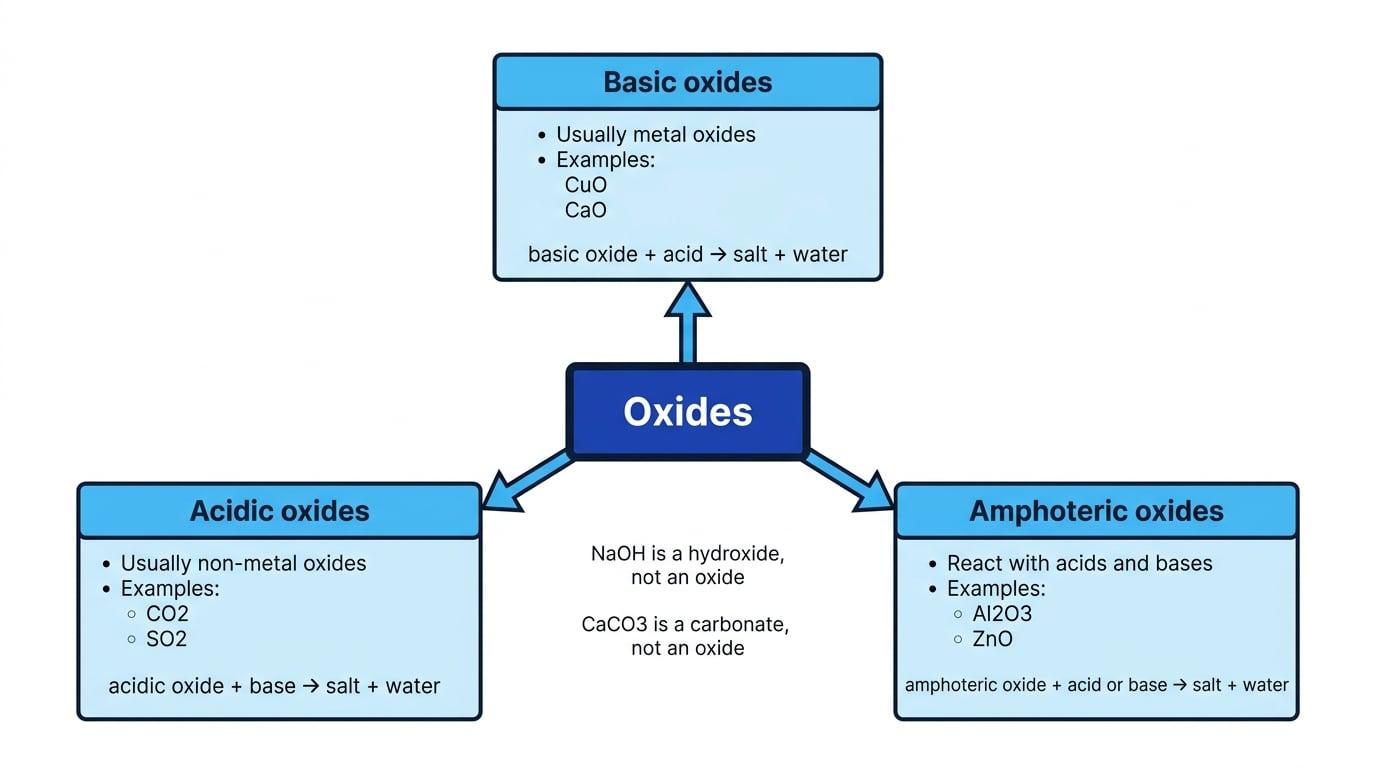
7.2.1 Acidic and basic oxides
Classifying oxides
Acidic oxide
An oxide, usually of a non-metal, that reacts with bases and alkalis to form a salt and water.
Basic oxide
An oxide of a metal that reacts with acids to form a salt and water.
- An oxide is a compound of an element with oxygen, and many oxides form when elements burn in air or oxygen.
- Oxides are classified by whether they react with acids or with bases.
- Basic oxides are oxides of metals, such as copper(II) oxide, CuO\text{CuO}CuO, and calcium oxide, CaO\text{CaO}CaO.
- Acidic oxides are oxides of non-metals, such as sulfur dioxide, SO2\text{SO}_2SO2, and carbon dioxide, CO2\text{CO}_2CO2.
- The type of oxide therefore depends on the metallic or non-metallic character of the element it contains.
- Metals sit on the left of the Periodic Table and non-metals on the right, so oxides of elements on the left are basic and oxides of elements on the right are acidic.
Basic oxides
-
A basic oxide reacts with an acid to form a salt and water, so it behaves as a base.
metal oxide+acid→salt+water \text{metal oxide} + \text{acid} \rightarrow \text{salt} + \text{water} metal oxide+acid→salt+water -
Copper(II) oxide is a black, insoluble solid that disappears when warmed with dilute sulfuric acid, leaving a blue solution of copper(II) sulfate.
-
Most basic oxides are insoluble in water, but calcium oxide reacts with water to form calcium hydroxide, which is an alkali.
CaO(s)+H2O(l)→Ca(OH)2(aq) \text{CaO(s)} + \text{H}_2\text{O(l)} \rightarrow \text{Ca(OH)}_2\text{(aq)} CaO(s)+H2O(l)→Ca(OH)2(aq) -
The calcium hydroxide solution has a pH above 7, so it turns universal indicator blue or purple.
-
Calcium oxide is spread on fields to raise the pH of acidic soil, because as a basic oxide it reacts with the acid in the soil.
-
A basic oxide does not react with an alkali.
Basic oxides with hydrochloric acid
- Copper(II) oxide reacts with hydrochloric acid to form copper(II) chloride and water.
- Calcium oxide reacts with hydrochloric acid to form calcium chloride and water.
- In both cases the metal ion carries a 2+2+2+ charge, so two HCl\text{HCl}HCl are needed for each oxide.
Acidic oxides
-
An acidic oxide reacts with a base or an alkali to form a salt and water.
non-metal oxide+alkali→salt+water \text{non-metal oxide} + \text{alkali} \rightarrow \text{salt} + \text{water} non-metal oxide+alkali→salt+water -
Carbon dioxide reacts with sodium hydroxide solution to form sodium carbonate and water.
-
Sulfur dioxide reacts with sodium hydroxide solution to form sodium sulfite and water.
-
Many acidic oxides dissolve in water to form solutions with a pH below 7.
-
Carbon dioxide gives a slightly acidic solution, while sulfur dioxide gives a more strongly acidic one.
-
An acidic oxide does not react with an acid.
-
The milky colour in the limewater test happens because carbon dioxide, an acidic oxide, reacts with calcium hydroxide, an alkali, to form insoluble calcium carbonate.
Acidic oxides with alkalis
- Carbon dioxide reacts with sodium hydroxide to give sodium carbonate and water.
- Sulfur dioxide reacts with sodium hydroxide to give sodium sulfite and water.
- Carbon dioxide reacts with limewater to give a white precipitate of calcium carbonate and water.
Testing the oxides of a metal and a non-metal
- Aim: to make an oxide of a metal and an oxide of a non-metal by burning, and to compare the pH of the solutions they form with water.
- Apparatus: two gas jars of oxygen with lids, two combustion spoons, magnesium ribbon, powdered sulfur, tongs, Bunsen burner, heat-resistant mat, distilled water, universal indicator solution, fume cupboard and eye protection.
- Method:
- Add about 20 cm320\ \text{cm}^320 cm3 of distilled water and five drops of universal indicator to each gas jar, and note that the water is green.
- Hold a 3 cm3\ \text{cm}3 cm strip of magnesium ribbon in tongs, light it in the Bunsen flame and lower it into the first jar while it burns.
- Replace the lid and shake the jar so the white powder of magnesium oxide mixes with the water.
- In a fume cupboard, heat a small amount of sulfur on a combustion spoon until it melts and burns with a blue flame, then lower it into the second jar and replace the lid.
- Remove the spoon once the flame goes out, replace the lid and shake the jar so the sulfur dioxide dissolves.
- Results: the water in the magnesium oxide jar turns blue at about pH 9 to 10, while the water in the sulfur dioxide jar turns red or orange at about pH 2 to 3.
- Conclusion: the metal forms a basic oxide and the non-metal forms an acidic oxide.
- Safety: wear eye protection, do not look directly at burning magnesium, and burn sulfur only in a fume cupboard because sulfur dioxide is toxic.
- Do not classify an oxide by whether it dissolves in water, because most basic oxides are insoluble.
- Do not say that carbon dioxide reacts with acids, because an acidic oxide reacts with bases and alkalis.
Classifying an oxide
- Decide first whether the element in the oxide is a metal or a non-metal.
- Link a metal to a basic oxide and a non-metal to an acidic oxide.
- Back up the classification with the reaction, stating that a basic oxide reacts with an acid and an acidic oxide reacts with a base, each forming a salt and water.
- Is the oxide of a metal usually acidic or basic?
- Classify sulfur dioxide and calcium oxide.
- What are the products when a basic oxide reacts with an acid?
- Name the salt formed when carbon dioxide reacts with sodium hydroxide solution.
- What colour would universal indicator show in water that has absorbed sulfur dioxide?
7.2.2 Amphoteric oxides
Amphoteric oxides
Amphoteric oxide
An oxide that can react with both an acid and a base, forming a salt and water in each case.
- Some metal oxides behave as a basic oxide and as an acidic oxide.
- An amphoteric oxide reacts with acids, in the same way as a basic oxide, and with bases, in the same way as an acidic oxide.
- Both of these reactions produce a salt and water.
- The two most important amphoteric oxides are aluminium oxide, Al2O3\text{Al}_2\text{O}_3Al2O3, and zinc oxide, ZnO\text{ZnO}ZnO.
- Aluminium and zinc are metals, but they are less strongly metallic than metals such as sodium and calcium, so their oxides show both kinds of behaviour.
- Both oxides are white solids that are insoluble in water, so they do not change the colour of an indicator.
- An amphoteric oxide is identified by showing that it reacts with an acid and also with an alkali.
- Oxides can therefore be sorted into three groups by the reactions they show.
- Basic oxides react with acids only.
- Acidic oxides react with bases and alkalis only.
- Amphoteric oxides react with both acids and bases.
Zinc oxide
-
With an acid, zinc oxide acts as a base and forms a zinc salt and water.
ZnO(s)+2HCl(aq)→ZnCl2(aq)+H2O(l) \text{ZnO(s)} + 2\text{HCl(aq)} \rightarrow \text{ZnCl}_2\text{(aq)} + \text{H}_2\text{O(l)} ZnO(s)+2HCl(aq)→ZnCl2(aq)+H2O(l) -
With an alkali, zinc oxide acts as an acidic oxide and forms a salt called sodium zincate and water.
ZnO(s)+2NaOH(aq)→Na2ZnO2(aq)+H2O(l) \text{ZnO(s)} + 2\text{NaOH(aq)} \rightarrow \text{Na}_2\text{ZnO}_2\text{(aq)} + \text{H}_2\text{O(l)} ZnO(s)+2NaOH(aq)→Na2ZnO2(aq)+H2O(l) -
In sodium zincate the zinc is part of the negative ion, ZnO22−\text{ZnO}_2^{2-}ZnO22−, rather than being a positive metal ion.
-
In both reactions the white solid disappears and a colourless solution forms.
Aluminium oxide
-
With an acid, aluminium oxide acts as a base and forms an aluminium salt and water.
Al2O3(s)+6HCl(aq)→2AlCl3(aq)+3H2O(l) \text{Al}_2\text{O}_3\text{(s)} + 6\text{HCl(aq)} \rightarrow 2\text{AlCl}_3\text{(aq)} + 3\text{H}_2\text{O(l)} Al2O3(s)+6HCl(aq)→2AlCl3(aq)+3H2O(l) -
With a warm alkali, aluminium oxide acts as an acidic oxide and forms a salt called sodium aluminate and water.
Al2O3(s)+2NaOH(aq)→2NaAlO2(aq)+H2O(l) \text{Al}_2\text{O}_3\text{(s)} + 2\text{NaOH(aq)} \rightarrow 2\text{NaAlO}_2\text{(aq)} + \text{H}_2\text{O(l)} Al2O3(s)+2NaOH(aq)→2NaAlO2(aq)+H2O(l) -
In sodium aluminate the aluminium is part of the negative ion, AlO2−\text{AlO}_2^{-}AlO2−.
Balancing aluminium oxide with hydrochloric acid
- Aluminium forms Al3+\text{Al}^{3+}Al3+ ions and chloride ions are Cl−\text{Cl}^{-}Cl−, so the salt is AlCl3\text{AlCl}_3AlCl3.
- One Al2O3\text{Al}_2\text{O}_3Al2O3 contains two aluminium atoms, so it makes 2AlCl32\text{AlCl}_32AlCl3, which needs six chlorine atoms.
- Six chlorine atoms come from 6HCl6\text{HCl}6HCl, which also supplies six hydrogen atoms.
- Six hydrogen atoms combine with the three oxygen atoms from the oxide to make 3H2O3\text{H}_2\text{O}3H2O.
Showing that zinc oxide is amphoteric
- Aim: to show that zinc oxide reacts with both an acid and an alkali, and to compare it with copper(II) oxide, a basic oxide.
- Apparatus: four test tubes in a rack, spatula, zinc oxide, copper(II) oxide, dilute sulfuric acid, dilute sodium hydroxide solution, 10 cm310\ \text{cm}^310 cm3 measuring cylinder, beaker of water at about 60 ∘C60\ ^\circ\text{C}60 ∘C as a water bath, and eye protection.
- Method:
- Put one small spatula measure of zinc oxide into each of two test tubes, and the same amount of copper(II) oxide into each of the other two.
- Add 5 cm35\ \text{cm}^35 cm3 of dilute sulfuric acid to one tube of each oxide.
- Add 5 cm35\ \text{cm}^35 cm3 of dilute sodium hydroxide solution to the other tube of each oxide.
- Stand all four tubes in the warm water bath for five minutes, shaking each one gently every minute.
- Record whether each solid dissolves and any colour change in the liquid.
- Results: zinc oxide disappears in both the acid and the alkali to give colourless solutions, while copper(II) oxide dissolves in the acid to give a blue solution but stays as a black solid in the alkali.
- Conclusion: zinc oxide is amphoteric because it reacts with an acid and an alkali, while copper(II) oxide is basic because it reacts with the acid only.
- Safety: wear eye protection, take extra care with sodium hydroxide because it damages the eyes even when dilute, and avoid breathing in the fine oxide powders.
- Do not call aluminium oxide or zinc oxide basic just because they are metal oxides, because they also react with bases.
- Do not say that amphoteric oxides react with water, because they are insoluble and only react with acids and alkalis.
Showing that an oxide is amphoteric
- Give two reactions, one with an acid and one with a base or alkali.
- State that each reaction forms a salt and water.
- When an equation is asked for, name the zincate or aluminate as the salt formed with sodium hydroxide.
- What is an amphoteric oxide?
- Name two amphoteric oxides.
- What are the products when zinc oxide reacts with hydrochloric acid?
- Name the salt formed when zinc oxide reacts with sodium hydroxide solution.
- How could you show that copper(II) oxide is basic but zinc oxide is amphoteric?