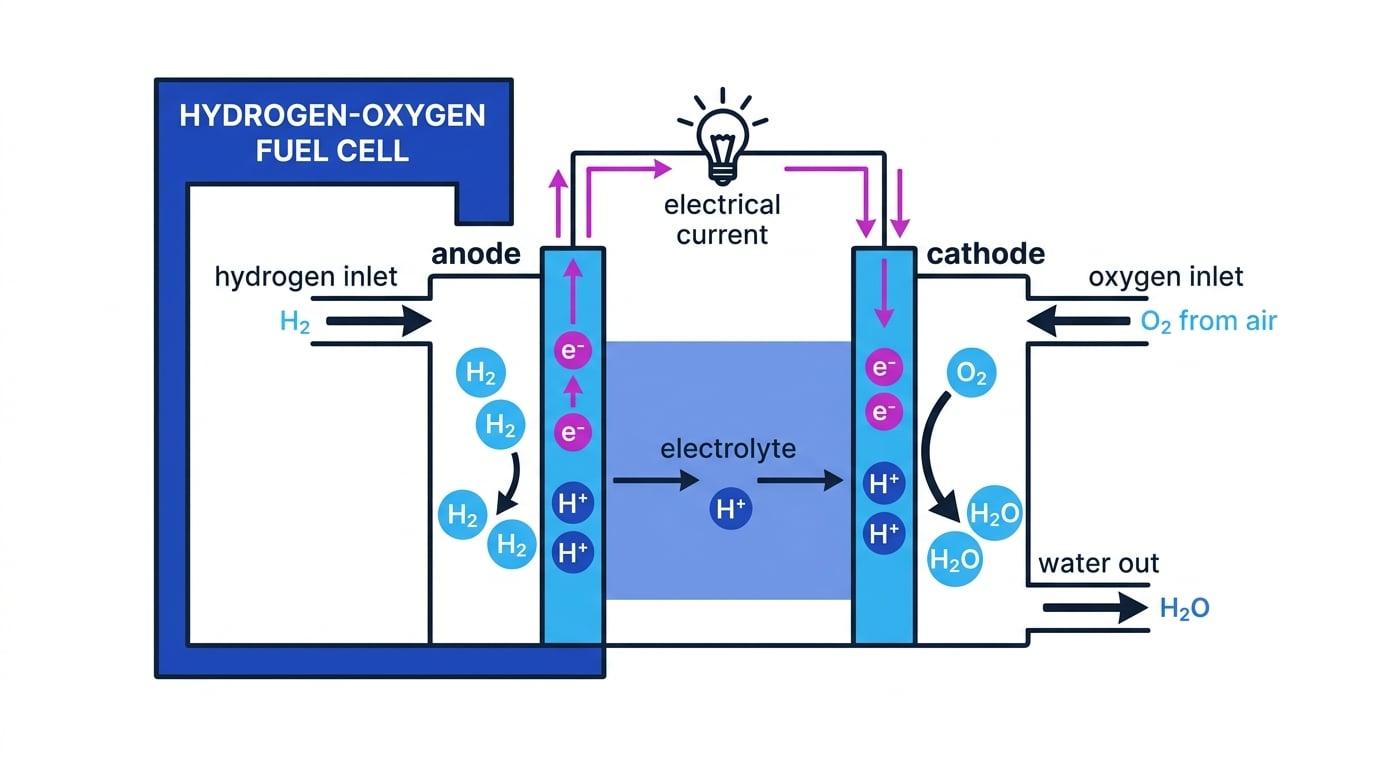
4.2.1 Hydrogen-oxygen fuel cells
What a fuel cell is
Definition
Fuel cell
An electrochemical cell that produces electricity from the reaction of a continuously supplied fuel with oxygen.
- A fuel cell produces electricity directly from a chemical reaction between a fuel and oxygen.
- The fuel and the oxygen are supplied continuously from outside, so a fuel cell keeps working for as long as they are fed in.
- An ordinary battery is different, because it holds a fixed amount of chemicals and stops working once they are used up.
- A fuel cell does not burn its fuel in a flame and has no moving parts.
- Instead, the reaction is split between two electrodes, so much of the energy released is transferred as an electric current rather than as heat and light.
The hydrogen-oxygen fuel cell
Definition
Hydrogen-oxygen fuel cell
A fuel cell in which hydrogen reacts with oxygen to generate electricity, forming water as its only chemical product.
- The most widely used fuel cell is the hydrogen-oxygen fuel cell, which uses hydrogen as its fuel.
- The oxygen is usually taken from the air, so only the hydrogen has to be stored and carried.
- The cell contains two electrodes separated by an electrolyte, with hydrogen gas fed to one electrode and oxygen gas fed to the other.
- The electrodes are porous and coated with a catalyst such as platinum, which speeds up the reactions on their surfaces.
- As hydrogen and oxygen react at the electrodes, electrons flow from one electrode to the other through an external circuit, and this flow is the electric current.
- The only chemical product is water, which leaves the cell as liquid water or water vapour.
- The overall reaction is hydrogen+oxygen→water\text{hydrogen} + \text{oxygen} \rightarrow \text{water}hydrogen+oxygen→water, or as a symbol equation 2H2(g)+O2(g)→2H2O(l)2\text{H}_2(\text{g}) + \text{O}_2(\text{g}) \rightarrow 2\text{H}_2\text{O}(\text{l})2H2(g)+O2(g)→2H2O(l).
- This is the same overall reaction as burning hydrogen, but in a fuel cell much of the energy is released as electrical energy instead of as heat.
- A fuel cell is the reverse of the electrolysis of water, because electrolysis uses electricity to split water into hydrogen and oxygen while a fuel cell joins them to release electricity.
Uses of hydrogen-oxygen fuel cells
- Fuel cells are used wherever a steady, long-lasting supply of electricity is needed without burning a fuel.
- Vehicles: fuel-cell cars, buses and lorries use the electricity to run an electric motor.
- Spacecraft: fuel cells supplied electricity on the Apollo missions and the Space Shuttle.
- Back-up power: fuel cells provide emergency electricity for buildings such as hospitals and for mobile phone masts.
- In every one of these uses, the waste product is only water, so the cell releases nothing harmful where it is working.
Example
Electricity and water in space
- The Apollo spacecraft carried tanks of liquid hydrogen and liquid oxygen.
- Fuel cells combined the two gases to generate electricity for the spacecraft's lights, radios and computers.
- The water produced by the cells was pure enough for the astronauts to drink.
- This was only possible because water is the only chemical product of a hydrogen-oxygen fuel cell.
Common Mistake
- Do not say that a fuel cell burns hydrogen, because the hydrogen reacts at the electrodes without a flame.
- Do not give carbon dioxide as a product, because the fuel contains no carbon and water is the only chemical product.
- Do not confuse a fuel cell with electrolysis, because electrolysis uses electricity to break compounds down while a fuel cell produces electricity.
Exam technique
Stating what a fuel cell does
- A complete statement names both reactants, hydrogen and oxygen, says that electricity is produced, and says that water is the only chemical product.
- Write electricity or electrical energy rather than just energy, because energy alone would also describe the combustion of hydrogen.
Self review
- Which two substances react in a hydrogen-oxygen fuel cell?
- What is the only chemical product of a hydrogen-oxygen fuel cell?
- What is the balanced symbol equation for the overall reaction in the cell?
- How is a fuel cell different from an ordinary battery?
- How does the energy released by a fuel cell differ from the energy released when hydrogen burns?
4.2.2 Fuel cells compared with petrol engines
Two ways to power a vehicle
- A petrol car burns petrol, a mixture of hydrocarbons, inside its engine, and the hot gases produced push the pistons that turn the wheels.
- A fuel-cell car uses a hydrogen-oxygen fuel cell to generate electricity, which drives an electric motor.
- Both vehicles carry their fuel in a tank and both take oxygen from the air.
- Comparing them means looking at what each one releases, how efficiently each uses its fuel, and how easily each fuel can be produced, stored and supplied.
Advantages of fuel cells
Definition
Finite resource
A resource that is being used up much faster than it is formed, so it will eventually run out.
Definition
Energy efficiency
The proportion of the total energy supplied that is transferred as useful energy.
- Water is the only product: a fuel cell releases only water, so no carbon dioxide is produced while the vehicle is running.
- Burning petrol releases carbon dioxide, which is a greenhouse gas linked to climate change.
- No other harmful exhaust gases: a fuel cell does not produce carbon monoxide, unburnt hydrocarbons, soot or oxides of nitrogen.
- A petrol engine produces toxic carbon monoxide and soot through incomplete combustion when the oxygen supply is limited.
- A petrol engine also produces oxides of nitrogen when nitrogen and oxygen from the air react at the high temperature inside the engine.
- These pollutants cause breathing problems, and oxides of nitrogen also contribute to acid rain.
- Higher energy efficiency: a fuel cell transfers a larger proportion of the energy in its fuel to useful energy, because it releases energy directly as electricity rather than as heat in a flame.
- A fuel cell typically transfers about 40%40\%40% to 60%60\%60% of the energy in its fuel usefully, compared with about 20%20\%20% to 30%30\%30% for a petrol engine.
- A fuel that need not run out: hydrogen can be made from water by electrolysis, so it does not depend on crude oil, which is a finite resource.
Disadvantages of fuel cells
- Making hydrogen needs energy: hydrogen is not found as a free gas in nature, so it has to be manufactured.
- Most hydrogen today is made from methane in natural gas, a process that releases carbon dioxide.
- Hydrogen made by electrolysis needs a large amount of electricity, which is often generated by burning fossil fuels in power stations.
- A fuel-cell vehicle is only low in carbon dioxide overall if its hydrogen is made using renewable energy, such as wind or solar power.
- Storage is difficult: hydrogen is a gas with a very low density, so a useful amount takes up far more space than petrol holding the same energy.
- It must be squeezed into strong, heavy tanks at very high pressure or cooled to a liquid at about −253 ∘C-253\ ^{\circ}\text{C}−253 ∘C.
- Flammable and explosive: hydrogen forms explosive mixtures with air, so any leak from a tank, pipe or refuelling pump is a serious hazard.
- Few refuelling stations: there are very few hydrogen filling stations compared with petrol stations, which makes long journeys difficult.
- High cost: fuel cells use expensive catalysts such as platinum, so fuel-cell vehicles cost more to buy than petrol vehicles.
- Advantages of petrol: petrol is a liquid that is easy to store and transport, and a network of filling stations already exists.
Example
A hydrogen bus on a city route
- A city bus that runs on a hydrogen fuel cell releases only water vapour from its exhaust.
- Busy streets along its route are spared the carbon monoxide, soot and oxides of nitrogen that a petrol or diesel bus would release.
- The bus returns to the same depot every night, so a single hydrogen filling station there removes the problem of finding fuel.
- If the depot's hydrogen is made by electrolysis powered by wind turbines, very little carbon dioxide is released at any stage.
- If the hydrogen is made from natural gas instead, carbon dioxide is still released, just at the production plant rather than on the street.
Common Mistake
- Do not say that a fuel-cell vehicle causes no pollution at all, because making the hydrogen can still release carbon dioxide.
- Do not write that fuel cells are better for the environment without explaining why, because the mark is for naming the pollutant that is avoided.
- Do not describe hydrogen as dangerous without a reason, because the point is that it is flammable and forms explosive mixtures with air.
Exam technique
Comparing fuel cells and petrol engines
- Write each point as a direct comparison, for example a fuel cell produces only water whereas a petrol engine produces carbon dioxide.
- Name the substances involved, such as carbon dioxide, carbon monoxide and oxides of nitrogen, instead of writing pollution.
- Give as many separate advantages and disadvantages as the marks suggest, and avoid repeating the same idea in different words.
Self review
- What are two advantages of hydrogen-oxygen fuel cells compared with petrol engines?
- Why is hydrogen difficult to store in a vehicle?
- Why might a fuel-cell car still be linked to carbon dioxide emissions?
- Which two pollutants produced by petrol engines are not produced by fuel cells?
- Why are fuel-cell vehicles more expensive to buy than petrol vehicles?