Dynamic equilibrium
Definition
Dynamic equilibrium
The state of a reversible reaction in a closed system in which the forward and reverse reactions continue at equal rates, so the concentrations of reactants and products no longer change.
Definition
Closed system
A system that no substances can enter or leave, although energy can still be transferred to or from the surroundings.
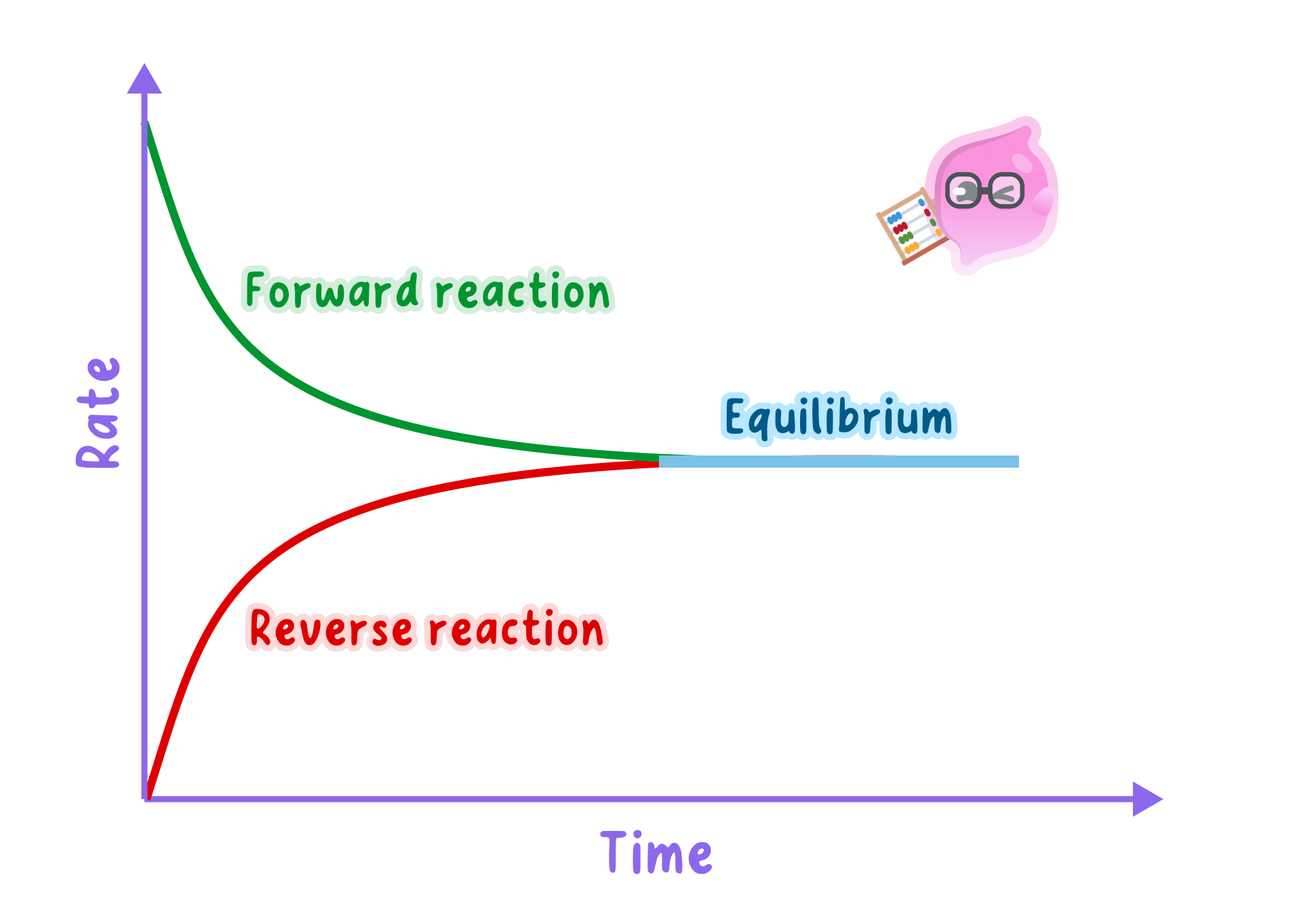
- When a reversible reaction starts with only reactants, the forward reaction is fast and the reverse reaction cannot yet happen.
- As the reactants are used up, their concentrations fall, so the forward reaction slows down.
- As the products build up, their concentrations rise, so the reverse reaction speeds up.
- Eventually the rate of the forward reaction becomes equal to the rate of the reverse reaction.
- From this point, products are made at exactly the same rate as they are turned back into reactants.
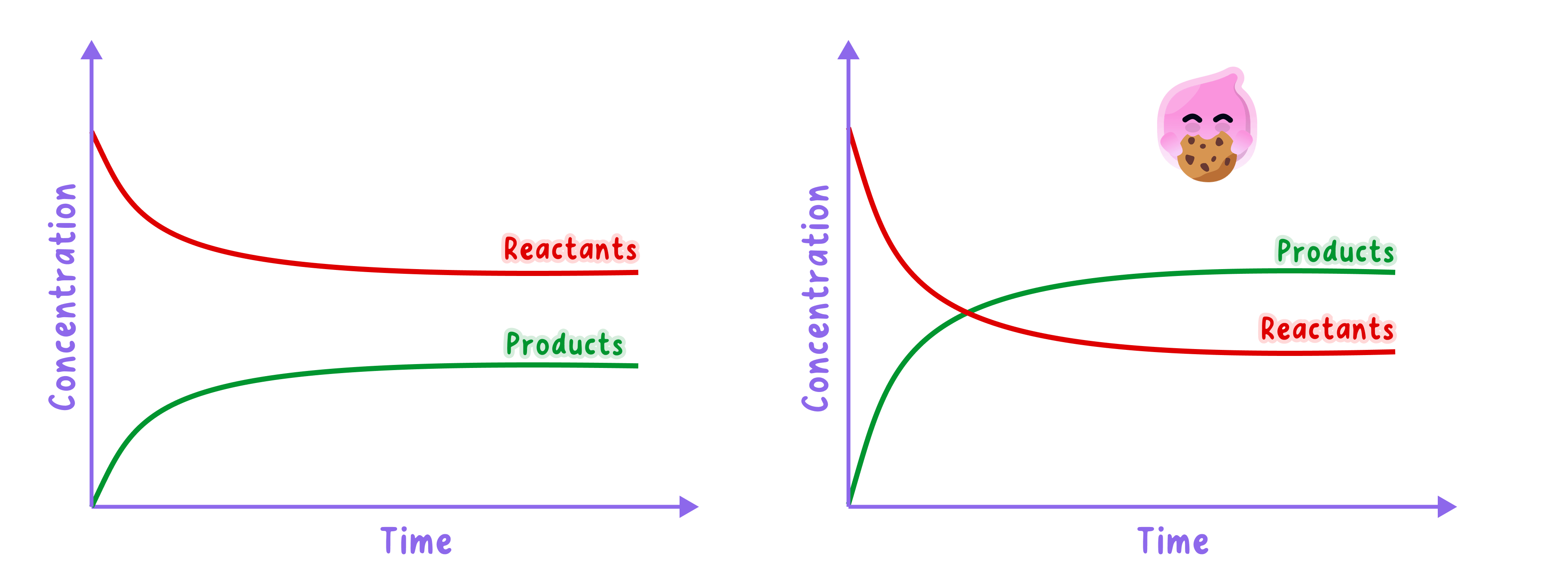
- The concentrations of the reactants and products therefore stop changing, even though both reactions carry on.
- The equilibrium is called dynamic because the reactions have not stopped, they are happening at the same rate.
- Constant concentrations are not the same as equal concentrations, because an equilibrium mixture can contain far more products than reactants, or far more reactants than products.
- Equilibrium can only be reached in a closed system, because in an open system a gaseous product could escape and the reverse reaction could not keep pace.
Example
Nitrogen dioxide in a sealed syringe
- Brown nitrogen dioxide gas, NO2\mathrm{NO_{2}}NO2, is sealed in a gas syringe.
- Pairs of nitrogen dioxide molecules join to form colourless dinitrogen tetroxide, N2O4\mathrm{N_{2}O_{4}}N2O4, and dinitrogen tetroxide molecules also split back into nitrogen dioxide.
- At first the brown colour fades, because the forward reaction is faster than the reverse reaction.
- After a short time the colour stops changing, because the two reactions are now going at the same rate.
- Molecules are still reacting in both directions, so the mixture is in dynamic equilibrium.
Position of equilibrium
Definition
Position of equilibrium
The relative amounts of reactants and products present in a reaction mixture once it has reached equilibrium.
- If an equilibrium mixture contains mainly products, the position of equilibrium lies to the right.
- If an equilibrium mixture contains mainly reactants, the position of equilibrium lies to the left.
- Changing the conditions can make the position of equilibrium shift.
- When a condition is changed, the position of equilibrium shifts in the direction that opposes the change.
- A shift to the right increases the amount of products at equilibrium, and a shift to the left increases the amount of reactants.
- To make a prediction, you use the information given about the reaction, such as the sign of ΔH\Delta HΔH or the number of moles of gas on each side of the equation.
Changing temperature
- Increasing the temperature shifts the position of equilibrium in the direction of the endothermic reaction, which takes in thermal energy and so opposes the rise.
- Decreasing the temperature shifts the position of equilibrium in the direction of the exothermic reaction, which releases thermal energy.
- If ΔH\Delta HΔH for the forward reaction is negative, the forward reaction is exothermic and the reverse reaction is endothermic.
- For an exothermic forward reaction, increasing the temperature shifts the equilibrium to the left and decreases the amount of product.
- For an endothermic forward reaction, increasing the temperature shifts the equilibrium to the right and increases the amount of product.
Example
Heating the nitrogen dioxide mixture
2NO2(g)⇌N2O4(g) \mathrm{2NO_{2}(g) \rightleftharpoons N_{2}O_{4}(g)} 2NO2(g)⇌N2O4(g) ΔH=−58 kJ/mol \Delta H = -58\ \text{kJ/mol} ΔH=−58 kJ/mol- The negative ΔH\Delta HΔH shows that the forward reaction is exothermic, so the reverse reaction is endothermic.
- Placing the syringe in hot water shifts the equilibrium to the left, in the endothermic direction.
- More brown nitrogen dioxide forms, so the mixture turns a darker brown.
- Placing the syringe in iced water shifts the equilibrium to the right, so the mixture becomes paler.
Changing pressure
- Pressure only affects the position of equilibrium for reactions involving gases.
- To predict the effect, count the moles of gas on each side of the balanced equation.
- Increasing the pressure shifts the position of equilibrium towards the side with fewer moles of gas, which lowers the pressure.
- Decreasing the pressure shifts the position of equilibrium towards the side with more moles of gas.
- If both sides have the same number of moles of gas, changing the pressure does not change the position of equilibrium.
Example
Counting moles of gas
2NO2(g)⇌N2O4(g) \mathrm{2NO_{2}(g) \rightleftharpoons N_{2}O_{4}(g)} 2NO2(g)⇌N2O4(g)- There are 222 moles of gas on the left and 111 mole of gas on the right.
- Increasing the pressure shifts the equilibrium to the right, towards fewer moles of gas, so the proportion of colourless dinitrogen tetroxide increases.
- There are 222 moles of gas on each side, so changing the pressure has no effect on the position of this equilibrium.
Changing concentration
- Increasing the concentration of a reactant shifts the equilibrium to the right, using up some of the added reactant and forming more product.
- Decreasing the concentration of a reactant shifts the equilibrium to the left.
- Increasing the concentration of a product shifts the equilibrium to the left.
- Removing a product as it forms shifts the equilibrium to the right, so more product keeps being made.
Example
Chromate and dichromate ions
2CrO42−(aq)+2H+(aq)⇌Cr2O72−(aq)+H2O(l) \mathrm{2CrO_{4}^{2-}(aq) + 2H^{+}(aq) \rightleftharpoons Cr_{2}O_{7}^{2-}(aq) + H_{2}O(l)} 2CrO42−(aq)+2H+(aq)⇌Cr2O72−(aq)+H2O(l)- Chromate ions are yellow and dichromate ions are orange.
- Adding dilute acid increases the concentration of H+\mathrm{H^+}H+ ions, so the equilibrium shifts to the right and the solution turns orange.
- Adding aqueous sodium hydroxide removes H+\mathrm{H^+}H+ ions by neutralising them, so the equilibrium shifts to the left and the solution turns yellow.
Adding a catalyst
- A catalyst increases the rates of the forward and reverse reactions equally.
- The position of equilibrium therefore does not change, so the amount of product at equilibrium stays the same.
- The catalyst makes the system reach equilibrium more quickly.
Exam technique
Predicting and explaining a shift
- Mark schemes usually give one mark for the direction of the shift and one mark for the reason, so always give both.
- State the direction precisely, such as “the position of equilibrium shifts to the right” or “shifts towards the products”.
- For temperature, use the information given to say which direction is exothermic or endothermic before you state the shift.
- For pressure, quote the moles of gas, such as “333 moles of gas on the left and 222 on the right”.
- When a question asks about a colour, link the shift to the substance that causes that colour.
- For a catalyst, write that it has no effect on the position of equilibrium and that equilibrium is reached faster.
Common Mistake
- Do not write that the reactions stop at equilibrium.
- Do not write that the concentrations of reactants and products are equal at equilibrium.
- Do not write that a catalyst increases the amount of product at equilibrium.
Self review
- What two statements describe a reversible reaction at equilibrium?
- Why must a system be closed for equilibrium to be reached?
- Which way does the equilibrium shift when the temperature is increased for a reaction with an exothermic forward reaction?
- What effect does increasing pressure have on an equilibrium with fewer moles of gas on the right?
- Why does a catalyst not change the position of equilibrium?
